
Results
-
 £35.00
Edward Gregson: Fanfare for a New Era (for Brass Band)
DescriptionComposer's NoteThe Fanfare has been designed to be partly antiphonal, with four separate brass 'choirs' initially playing their own music, and so some spatial separation is desirable. Soprano and solo cornets should be placed centrally, standing behind the rest of the band - or in some venues could even be placed off-stage in a side balcony, but still close to the band. If the Fanfare is played by a contesting size band, one of the solo cornets should play the 1st cornet part together with the usual player ie the number of players on the 1st, 2nd, and 3rd cornet parts should be equal. Otherwise the number of players in each of the two cornet 'choirs' is at the discretion of the conductor. The Tubular Bells accompanying the cornets 1-3 group should be placed close to that group. See inside back cover for suggested band formation.The style of playing should replicate that of symphonic brass, with a minimum of vibrato and with long notes being sustained without decaying.Programme NoteCommissioned in 2020 by Youth Brass 2000, Fanfare for a New Era was designed to be partly antiphonal - thus the separation of the band into four brass 'choirs', each with their own percussion accompaniment. First, soprano and solo cornets, rather like heraldic trumpeters, announce the main idea, majestic in character. Then horns, baritones, and euphoniums, with timpani, enter with stately figurations. Next, the heraldic trumpeters usher in trombones and tubas, to the accompaniment of tom-toms and snare drum, presenting a faster and rhythmic dance-like theme. Finally, the remaining cornets amplify the pealing of bells. All four elements then come together, surrounding the audience with a 'joyful noise' of festive brass and percussion.The original symphonic brass version of this fanfare can be purchased as part of a set of Three Fanfares HERE.For more information on Edward Gregson's music please visit the composer's website: www.edwardgregson.com
Estimated dispatch 7-14 working days
-
 £45.00
The Thunderer (Brass Band - Score and Parts)
This march, one of Sousa's most popular compositions, was written in 1889 and was dedicated to the Knights Templar of Washington, D.C. Sousa had been knighted by that organization three years earlier. The origins of the name of the march are unclear and the march is noteworthy not only for Sousa's usual creative skills but also for the use, in two sections of the march, of military-style percussion and, in the last section, of featured fanfares.This arrangement was prepared for the 2009 Summer concerts of Brass Band of the Western Reserve, musical director Dr Keith M Wilkinson. The arrangement highlights the particular features mentioned above and performances will be enhanced by following the indicated staging directions.
Estimated dispatch 7-14 working days
-
 £95.00
Variations on a Theme of Michael Tippett (Brass Band - Score and Parts)
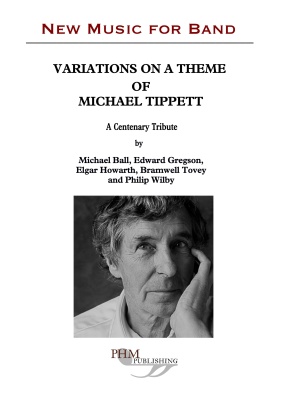
A Centenary Tribute by Michael Ball, Edward Gregson, Elgar Howarth, Bramwell Tovey and Philip WilbyThis unique 'pice d'occasion' arose out of a telephone conversation in 2004 with Alan Wycherley, who was the soprano cornet player of the Foden's Richardson Band at the time. He indicated that the band would like to include an original birthday tribute for Edward Gregson (60) and Elgar Howarth (70) in its concert at the 2005 RNCM Festival of Brass in Manchester. I have been Artistic Director of Manchester's Festival of Brass since it was established in 1990 as a BBC Radio 3 series, As the centenary of the birth of Sir Michael Tippett fell on 5 January 2005, I devised this collective work as a way of embracing all three anniversaries in a novel way.The idea of joint compositions is not a new one in the classical music world. In the 1860s, Verdi was joined by a number of his contemporaries in a Requiem Mass for Rossini. In this country there have been a number of orchestral examples over the past fifty years, but never before for the brass band. Although Tippett composed only one work for brass band, Festal Brass with Blues, his orchestral works and operas are full of idiomatic brass writing. The theme I chose for this celebration is one of Tippet's most memorable miniatures featuring wind and brass. In the opera Midsummer Marriage it marks the entry of the Ancients. It is also included in the orchestral Suite in D (1948), for the Birthday of Prince Charles.I invited five of the leading contemporary voices in brass band music to add their own creative perspectives to the little Tippett theme, with it's characteristic rhythms, embellishments and modality - the Lydian mode. Each contribution was designed to fit into a tonal and formal template to give the whole work a flow and continuity. In Danse des Amis, Bramwell Tovey has composed a jazzy, humorous variation. Inspiration came from Tippett's love of jazz and, more personally, from the characteristically syncopated gait of the distinguished music critic John Amis, who Tovey once observed leaving a performance of Tippett's opera King Priam before the end. Incidentally, that performance was conducted by Elgar Howarth.We hear Edward Gregson in lyrical mode. His Midsummer Song is redolent of the sound world of Tippett's opera A Midsummer Marriage and it ends with a brief reference to a favourite of Gregson's, Tippett's Concerto for Orchestra. Michael Ball provides a brief moment of light, airy activity bringing to mind perhaps Tippett's love of Shakespearian fantasy, especially The Tempest. Elgar Howarth juxtaposes a slowed down version of the processional theme with distant recollections of fanfares from King Priam. Philip Wilby has rounded the tribute off with a spectacular fugue. During its inexorable progress Wilby ingeniously introduces the two other birthday references - the three-note musical signature that Elgar Howarth includes in much of his music and the characteristic theme which begins Edward Gregson's substantial work for brass an organ The Trumpets of the Angels. An elaborated reprise of Tippett's little theme is followed by a dynamic coda.- Paul HindmarshDuration: 13.00
Estimated dispatch 7-14 working days
-
£40.00
Variations on a Theme of Michael Tippett (Brass Band - Score only)
A Centenary Tribute by Michael Ball, Edward Gregson, Elgar Howarth, Bramwell Tovey and Philip WilbyThis unique 'pice d'occasion' arose out of a telephone conversation in 2004 with Alan Wycherley, who was the soprano cornet player of the Foden's Richardson Band at the time. He indicated that the band would like to include an original birthday tribute for Edward Gregson (60) and Elgar Howarth (70) in its concert at the 2005 RNCM Festival of Brass in Manchester. I have been Artistic Director of Manchester's Festival of Brass since it was established in 1990 as a BBC Radio 3 series, As the centenary of the birth of Sir Michael Tippett fell on 5 January 2005, I devised this collective work as a way of embracing all three anniversaries in a novel way.The idea of joint compositions is not a new one in the classical music world. In the 1860s, Verdi was joined by a number of his contemporaries in a Requiem Mass for Rossini. In this country there have been a number of orchestral examples over the past fifty years, but never before for the brass band. Although Tippett composed only one work for brass band, Festal Brass with Blues, his orchestral works and operas are full of idiomatic brass writing. The theme I chose for this celebration is one of Tippet's most memorable miniatures featuring wind and brass. In the opera Midsummer Marriage it marks the entry of the Ancients. It is also included in the orchestral Suite in D (1948), for the Birthday of Prince Charles.I invited five of the leading contemporary voices in brass band music to add their own creative perspectives to the little Tippett theme, with it's characteristic rhythms, embellishments and modality - the Lydian mode. Each contribution was designed to fit into a tonal and formal template to give the whole work a flow and continuity. In Danse des Amis, Bramwell Tovey has composed a jazzy, humorous variation. Inspiration came from Tippett's love of jazz and, more personally, from the characteristically syncopated gait of the distinguished music critic John Amis, who Tovey once observed leaving a performance of Tippett's opera King Priam before the end. Incidentally, that performance was conducted by Elgar Howarth.We hear Edward Gregson in lyrical mode. His Midsummer Song is redolent of the sound world of Tippett's opera A Midsummer Marriage and it ends with a brief reference to a favourite of Gregson's, Tippett's Concerto for Orchestra. Michael Ball provides a brief moment of light, airy activity bringing to mind perhaps Tippett's love of Shakespearian fantasy, especially The Tempest. Elgar Howarth juxtaposes a slowed down version of the processional theme with distant recollections of fanfares from King Priam. Philip Wilby has rounded the tribute off with a spectacular fugue. During its inexorable progress Wilby ingeniously introduces the two other birthday references - the three-note musical signature that Elgar Howarth includes in much of his music and the characteristic theme which begins Edward Gregson's substantial work for brass an organ The Trumpets of the Angels. An elaborated reprise of Tippett's little theme is followed by a dynamic coda.- Paul HindmarshDuration: 13.00
Estimated dispatch 7-14 working days
-
 £89.95
Revelation (Score and Parts)
Symphony for Double Brass on a theme of Purcell 1995 marked the tercentenary of Purcell's death, and my new score Revelation has been written as a tribute to his music and the ornate and confident spirit of his age. There are five major sections: 1 Prologue 2 Variations on a ground bass I 3 Fugue 4 Variations on a ground bass II 5 Epilogue and Resurrection The score uses many features of the Baroque Concerto Grosso, and arranges players in two equal groups from which soloists emerge to play in a variety ofvirtuoso ensembles. It quotes freely from Purcell's own piece Three Parts on a Ground in which he has composed a brilliant sequence of variations over a repeating six-note bass figure. This original motif can be heard most clearly beneath the duet for Cornet 5 and Soprano at the beginning of the 2nd section. There is, of course, a religious dimension to Revelation as the title suggests, and the score is prefaced by lines by the 17th century poet John Donne. His Holy Sonnet paraphrases the Book of Revelation in which the dead are raised at the sounds of the last trumpet. Donne's trumpets are themselves placed stereophonically ". . . At the round Earth's imagined corners" and it is this feature that today's players represent as they move around the performing area. Their final apocalyptic fanfares can be heard at the close of the score, as Purcell's music re-enters in a lasting tribute to England's first composer of genius. Philip Wilby September 1995 At the round Earth imagined corners, blow your trumpets, angels, and arise, arise from death, you numberless infinities Of souls, and to your scattered bodies go. All whom the flood did, and fire shall o 'erthrow All whom war, dearth, age, agues, tyrannies, Despair, law, chance hath slain, and you whose eyes Shall Behold God, and never taste death woe. John Donne after Revelation Ch. 11 v.15
Estimated dispatch 7-14 working days
-
 £44.95
Revelation (Score Only)
Symphony for Double Brass on a theme of Purcell 1995 marked the tercentenary of Purcell's death, and my new score Revelation has been written as a tribute to his music and the ornate and confident spirit of his age. There are five major sections: 1 Prologue 2 Variations on a ground bass I 3 Fugue 4 Variations on a ground bass II 5 Epilogue and Resurrection The score uses many features of the Baroque Concerto Grosso, and arranges players in two equal groups from which soloists emerge to play in a variety ofvirtuoso ensembles. It quotes freely from Purcell's own piece Three Parts on a Ground in which he has composed a brilliant sequence of variations over a repeating six-note bass figure. This original motif can be heard most clearly beneath the duet for Cornet 5 and Soprano at the beginning of the 2nd section. There is, of course, a religious dimension to Revelation as the title suggests, and the score is prefaced by lines by the 17th century poet John Donne. His Holy Sonnet paraphrases the Book of Revelation in which the dead are raised at the sounds of the last trumpet. Donne's trumpets are themselves placed stereophonically ". . . At the round Earth's imagined corners" and it is this feature that today's players represent as they move around the performing area. Their final apocalyptic fanfares can be heard at the close of the score, as Purcell's music re-enters in a lasting tribute to England's first composer of genius. Philip Wilby September 1995 At the round Earth imagined corners, blow your trumpets, angels, and arise, arise from death, you numberless infinities Of souls, and to your scattered bodies go. All whom the flood did, and fire shall o 'erthrow All whom war, dearth, age, agues, tyrannies, Despair, law, chance hath slain, and you whose eyes Shall Behold God, and never taste death woe. John Donne after Revelation Ch. 11 v.15
Estimated dispatch 7-14 working days
-
 £94.95
An Age of Kings (Mezzo-Soprano Solo with Brass Band and optional choir - Score and Parts) - Gregson, Edward
The origins of this work date back to 1988, when I was commissioned by the Royal Shakespeare Company to write the music for The Plantagenets trilogy, directed by Adrian Noble in Stratford-upon-Avon. These plays take us from the death of Henry V to the death of Richard III. Later, in 1991, I wrote the music for Henry IV parts 1 and 2, again in Stratford. All of these plays are concerned with the struggle for the throne, and they portray one of the most turbulent periods in the history of the British monarchy.Much of the music used in these productions was adapted into two large symphonic suites for wind band - The Sword and the Crown (1991) and The Kings Go Forth (1996). An Age of Kings is a new version for brass band incorporating music from both the symphonic suites for wind band. It was specially composed for a recording made by the Black Dyke Band, conducted by Nicholas Childs, in 2004.An Age of Kings is music on a large-scale canvas, scored for augmented brass band, with the addition of harp, piano, mezzo-soprano solo, male chorus, as well as two off-stage trumpets. The music is also organized on a large-scale structure, in three movements, which play without a break - "Church and State", "At the Welsh Court", and "Battle Music and Hymn of Thanksgiving".The first movement, "Church and State", opens with a brief fanfare for two antiphonal trumpets (off-stage), but this only acts as a preface to a Requiem aeternam (the death of Henry V) before changing mood to the English army on the march to France; this subsides into a French victory march, but with the English army music returning in counterpoint. A brief reminder of the Requiem music leads to the triumphal music for Richard Plantagenet, Duke of York, father of Edward IV and Richard III (the opening fanfare transformed). However, the mood changes dramatically once again, with the horrors of war being portrayed in the darkly-drawn Dies Irae and Dance of Death, leading to the final section of the first movement, a funeral march for Henry VI.The second movement, "At the Welsh Court", takes music from the Welsh Court in Henry IV part 1 with a simple Welsh folk tune sung by mezzo-soprano to the inevitable accompaniment of a harp. This love song is interrupted by distant fanfares, forewarning of battles to come. However, the folk song returns with variation in the musical fabric. The movement ends as it began with off-stage horn and gentle percussion.The final movement, "Battle Music and Hymn of Thanksgiving", starts with two sets of antiphonally placed timpani, drums and tam-tam, portraying the 'war machine' and savagery of battle. Trumpet fanfares and horn calls herald an heroic battle theme which, by the end of the movement, transforms itself into a triumphant hymn for Henry IV's defeat of the rebellious forces.- Edward GregsonDuration - 22'00"Optional TTBB available separately.
Estimated dispatch 7-14 working days
-
 £79.95
The Plantagenets (Brass Band - Score and Parts) - Gregson, Edward
A Symphonic Study for Brass BandThe Plantagenets was Gregson's first major test piece, written specially for the 1973 National Brass Band Championships.In this ambitious symphonic study he turned his attention to music which sets out to create a mood or atmosphere, in contrast to his earlier brass band works such as Essay and Partita where the underlying concerns are technical rather than expressive. However, Gregson is at pains to emphasise that The Plantagenets is not programme music. 'Symphonic' is the optimum word here. In its textural and harmonic complexity, its rhythmic and melodic variety, this was his most ambitious brass band piece so far. His language, with its roots in Hindemith and Bartok is further enriched here with the expressive language of Holst and Rachmaninov.As he says in his notes on the work: The Plantagenets attempts to portray the mood and feelings of an age - that of the House of Plantagenet which lasted from the middle of the twelfth century to the end of the fourteenth. To many it conjures up an age of chivalry and this is represented by fanfare motifs which occur throughout the work in varied form.Characteristically, the composer then goes on to describe not the atmosphere or mood he is trying to convey, but the means by which the music has been composed: the opening fanfares, based on the interval of the third, generating the musical material for the whole work; an exposition of two themes - one fanfare-like, one lyrical (on horns); a slow episode introducing a new melody on solo horn (answered by cornet and euphonium in canon); a little scherzo, fugal in character; and a recapitulation leading to a maestoso statement of the slow movement theme with a final reference to the fanfares as a triumphant conclusion.Duration: 11.30
Estimated dispatch 7-14 working days
-
£39.95
The Plantagenets (Brass Band - Score only) - Gregson, Edward
A Symphonic Study for Brass BandThe Plantagenets was Gregson's first major test piece, written specially for the 1973 National Brass Band Championships.In this ambitious symphonic study he turned his attention to music which sets out to create a mood or atmosphere, in contrast to his earlier brass band works such as Essay and Partita where the underlying concerns are technical rather than expressive. However, Gregson is at pains to emphasise that The Plantagenets is not programme music. 'Symphonic' is the optimum word here. In its textural and harmonic complexity, its rhythmic and melodic variety, this was his most ambitious brass band piece so far. His language, with its roots in Hindemith and Bartok is further enriched here with the expressive language of Holst and Rachmaninov.As he says in his notes on the work: The Plantagenets attempts to portray the mood and feelings of an age - that of the House of Plantagenet which lasted from the middle of the twelfth century to the end of the fourteenth. To many it conjures up an age of chivalry and this is represented by fanfare motifs which occur throughout the work in varied form.Characteristically, the composer then goes on to describe not the atmosphere or mood he is trying to convey, but the means by which the music has been composed: the opening fanfares, based on the interval of the third, generating the musical material for the whole work; an exposition of two themes - one fanfare-like, one lyrical (on horns); a slow episode introducing a new melody on solo horn (answered by cornet and euphonium in canon); a little scherzo, fugal in character; and a recapitulation leading to a maestoso statement of the slow movement theme with a final reference to the fanfares as a triumphant conclusion.Duration: 11.30
Estimated dispatch 7-14 working days
-
 £79.99
A Midwest Fanfare (Brass Band - Score and Parts) - Sparke, Philip
A Midwest Fanfare was commissioned by the Brass Band of Battle Creek and premiered by them during their appearance at the Midwest Clinic in Chicago on 20th December 2017 where this fanfare was the opening piece of the entire event. This piece is designed to be played with the cornets split into two teams either side of the band. It opens with the two groups answering each other antiphonally over a repeated figure in the lower band. A calmer central section introduces a euphonium solo which is then taken up by the whole ensemble. This leads back to a repeat of the opening fanfares over a rhythmic accompaniment and a short coda which brings the work to a close.Duration: 4.00
Estimated dispatch 7-14 working days
 View Music