Results
-
£59.70The Faithful Hussar (Trombone Trio with Brass Band - Score and Parts) - Frantzen, Heinrich - Fernie, Alan
Duration: 3.30
Estimated dispatch 7-14 working days
-
£59.70Variations in Blue (Trombone Trio with Brass Band - Score and Parts) - Broadbent, Derek M.
Duration: 4.00
Estimated dispatch 7-14 working days
-
£56.00Wandrin' Star (Bass Trombone Solo with Brass Band - Score and Parts) - Lerner & Loewe - Fernie, Alan
Duration: 4:15
Estimated dispatch 7-14 working days
-
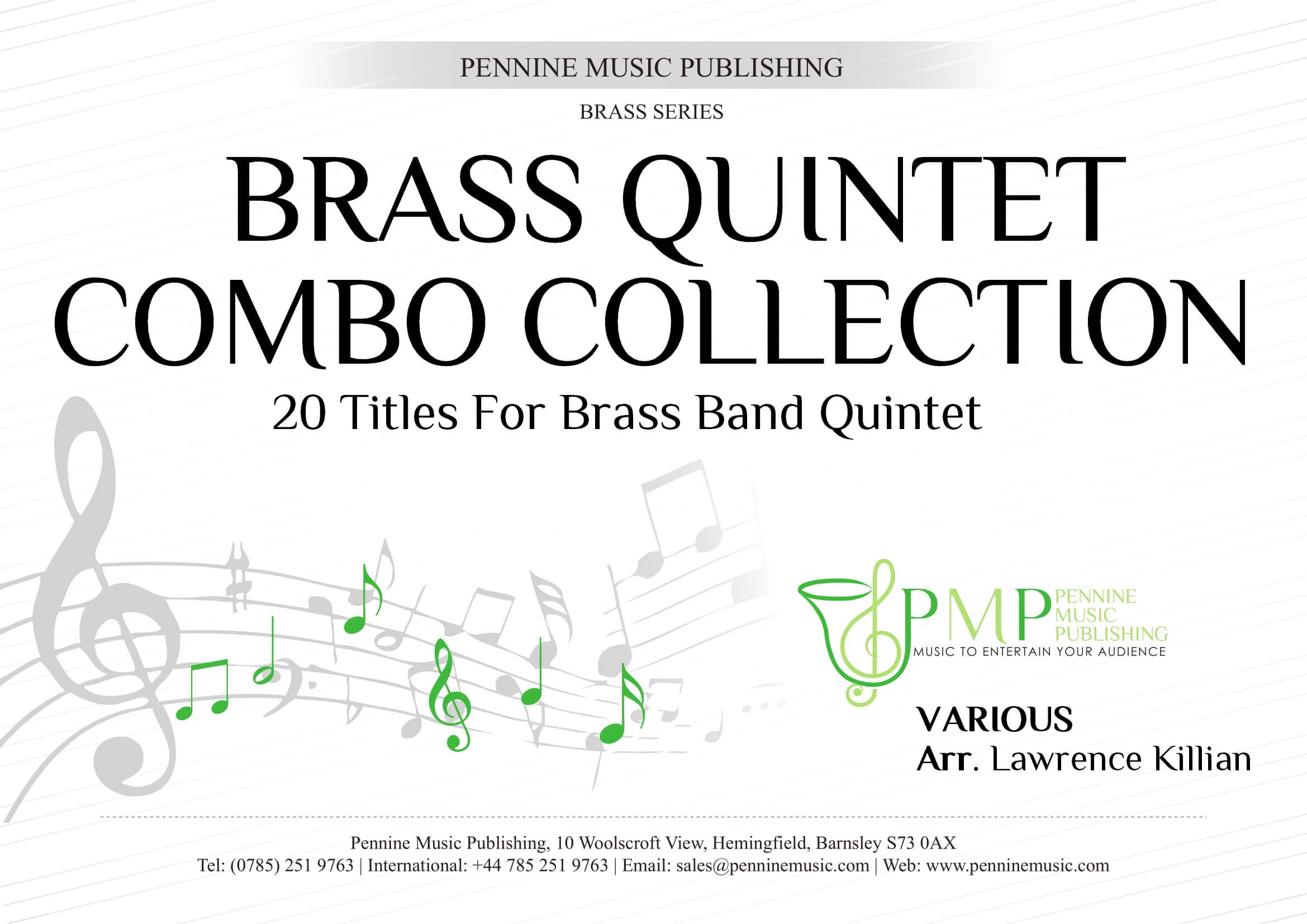
£150.00Brass Quintet Collection - Various - Lawrence Killian
20 Titles for Brass Quintet with Optional AugmentationFeaturing stylish arrangements using a flexible format for a minimum of five brass players, this set of music for small ensemble covers a wide range of composers and styles. The collection includes music by Purcell, Bach, Verdi, Gounod, Sousa, Joplin, Botsford, Elgar, Gershwin, and others.Using a unique approach to the scoring, the basic setup is for five players: two cornets/ trumpets, one horn, one trombone, and one bass tuba. Two optional "augment" players can be added using the "flugelhorn", and/ or the "Euphonium" parts. Further expansion of the ensemble is possible by adding multiple players to each part.Twelve parts are provided in total: 1st Bb Cornet, 2nd Bb Cornet, Eb Tenor Horn, French Horn in F, Bb Trombone or Baritone in treble clef, C Trombone in bass clef, EEb Bass, BBb Bass, C Tuba in bass clef, Bb Flugelhorn or Cornet (augment part 1), Bb Euphonium or Baritone (augment part 2), C Euphonium or Trombone in bass clef (augment part 2).A Full score is available seperately at a cost of �35.00. Please contact [email protected] to order. NOTE: Individual books are priced at �20.00 each. Please email [email protected] to order individual books. Videos of these works being performed are available below:- Asturias (Leyenda) from Suite Espanola No.1, Isaac AlbenizBerceuse from "Jocelyn", Benjamin Godard TITLES INCLUDED:- 1. Asturias (Leyenda) from Suite Espanola No.1, Isaac Albeniz 2. Bist du bei mir (Be Thou with Me), J. S. Bach3. Chatterbox Rag, George Botsford4. Grizzly Bear Rag, George Botsford5. Jubilee Fantasy on God Save the King, Bernhard Brahmig 6. Chanson de Matin, Sir Edward Elgar 7. Pomp and Circumstance March No. 4, Sir Edward Elgar 8. But Not For Me, George Gershwin 9. By Strauss, George Gershwin10. They All Laughed, George Gershwin11. Berceuse from "Jocelyn", Benjamin Godard12. JUDEX - from "Mors et Vita", Charles Gounod 13. The Entertainer (Rag), Scott Joplin14. Intermezzo No.2, Vasily Sergeyevich Kalinnikov 15. Berliner Luft, Paul Lincke 16. Sound the Trumpet, from "Come Ye Sons of Art", Henry Purcell 17. Gymnopedie No.1, Erik Satie 18. The Liberty Bell March, John Philip Sousa 19. Tritsch-Tratsch Polka, Johann Strauss II 20. Grand March from the opera Aida, Giuseppe Verdi
In Stock: Estimated dispatch 1-3 working days
-
£45.00Overture for Brass - Franzetti
Carlos Franzetti was born in 1948, in Buenos Aires, Argentina. He worked along with Paquito D'Rivera, Joe Farrell, and among other talented artists, composing the soundtracks for Beat Street, Misunderstood, and theMambo Kings and arranging for the Boston Pops Orchestra, Carnegie Hall Jazz Band, and the American Symphony Orchestra. This sheet music, arranged by Mark Freeh, includes a full instrumentation: Full score Soprano Cornet in Eb Solo Cornets in Bb Repiano Cornet in Bb 2nd and 3rd Cornets in Bb Flugelhorn Solo Horn 1st and 2nd Horn inEb1st and 2nd Baritone in Bb 1st and 2nd Trombone in Bb Bass Trombone Euphoniums in Bb Bass in Eb and Bb Timpani Percussion World Parts Includes : Horn in F 1st and 2nd Baritone 1st and 2nd Trombone Bass Trombone Euphoniums Bass in Eb and Bb
Estimated dispatch 5-14 working days
-
£80.00St. Magnus - Kenneth Downie
Dedicated to Alastair Massey, an inspirational music teacher. Commissioned by the Scottish Brass Band Association for the 2004 European Brass Band Championships in Glasgow. This music is a set of variations on the tune known as St Magnus, which is attributed to Jeremiah Clarke. Most people will associate it with Thomas Kelly's hymn which begins: "The Head that once was crowned with thorns is crowned with glory now". The tune is very simple, consisting of just two, four-bar phrases. Neither is there much in the way of rhythmic variety, every note being a crotchet with the exception of two quavers, and the last note in each phrase. Within such a simple structure, however, lies considerable strength. THEME The listener is given the opportunity of hearing it twice, in full, at the beginning, starting with one player but soon taken up by the full ensemble. It returns in the middle of the music and is stated again near the end. This has been done quite deliberately in the hope that there will be an appreciation of what material is being developed, by the listener as well as by those with access to the score, who are able to see the visual connections. VARIATION 1 This takes the rhythm of the last part of the theme and also uses the shape of the opening as a recurring figure. The mood is whimsical and skittish, with short, teasing rhythmic figures tossed around the band, and quick interplay with percussion, at a fast tempo. An energetic flourish finishes this variation before the Andante espress. VARIATION 2 This commences with chords related to the opening of Variation 1. The cantabile on solo comets establishes a new, lyrical mood and there is scope for expressive playing in a series of short solo passages. The theme works its way unobtrusively into the texture before a reprise of the solo cornet melody and some more lyrical interchanges between Eb bass, euphonium, flugel horn and comets. The variation ends serenely with clear references to the last phrase of the theme. VARIATION 3 The first idea to dominate is clearly linked to the shape of the theme's first phrase. There is a frenetic feel to much of this variation, with considerable energy and instability created by extensive use of cross-rhythms. A thinning-out of the score marks a clear change to development of the start of the second phrase of the theme. This proves to be short-lived however, and the opening material returns leading to a restatement of the theme, "Maestoso," after which a euphonium cadenza links to Variation 4. VARIATION 4 Here we have some solos for euphonium, cornet, trombone and Eb bass set against a background of horns and baritones presenting a pensive statement of the theme's opening. VARIATION 5 This commences Allegro, with lively work for cornet and euphonium spreading to the whole band before attention focuses on the beginning of the second phrase of the theme which is initially presented in diminution, then in regular rhythm, then in inversion. An increase in tempo coupled with a decrease in volume, requires dexterity and control, with several metrical challenges thrown in for good measure. The same fragment of phrase becomes an ostinato which generates a frenzied climax, punctuated by short, dramatic silence, before the opening figure returns and the music gradually winds down. The tubular bells herald the final return of the theme, in augmentation, marking the start of the Finale. FINALE This features the running semiquavers of the previous variation sounding in counterpoint. A fast, furious coda speeds the work to a conclusion while references to the opening of the theme are still trying to break into the texture of the music. Kenneth Downie
Estimated dispatch 5-14 working days
-
£60.99
Feeling Good - Leslie Bricusse - Stefan Schwalgin
Score and parts for Leslie Bricusse's Feeling Good arranged by Stefan Schwalgin for Brass band with solo Trombone.
Estimated dispatch 5-14 working days
-
£74.99Willow Pattern - Philip Harper
Composed in 2009 for Nicholas Childs and the Black Dyke BandThis piece tells the Willow Pattern legend through music. Several leitmotifs are used both for the different characters and also for some of the important emotions in the tale. Additionally, Knoon-se's part is mainly played by the flugel horn, Changby the euphonium, the Mandarin by the Eb Bass and the Duke Ta-jin by the trombone. The Willow Pattern LegendOnce, in ancient China, there lived a wealthy and powerful Mandarin who had a beautiful daughter, Knoon-se. She had fallen in love with Chang, a humble accountant, which angered her father who imprisoned her in the Pavilion by the river with only theexotic birds for company. She learnt that the Mandarin planned to marry her to the pompous Duke Ta-jin and that the wedding would take place on the day the blossom fell from the willow tree, so she sent Chang a message: "Gather thy blossom, ere it bestolen". The Duke arrived by sea amid great fanfare when the tree was heavy with bud, and nights of magnificent banquets followed. After one such occasion when the Mandarin slept, Chang crept over the crooked fence and tiptoed into the Pavilion to rescueKnoon-se, but as they escaped the alarm was raised. They fled over the bridge with the Mandarin close on their heels brandishing his whip.They managed to escape by boat to a secluded island where they lived happily for a time. Meanwhile, the Mandarin learned of their refuge and, intent on revenge, he ordered his soldiers to kill them. As Knoon-se and Chang slept at night, the men setfire to the pagoda in which they lived and the lovers perished in the flames. However, the Gods, moved by the lovers' plight, transformed their souls into two turtle-doves which rose from the charred remains, soaring above the Earth, symbolising eternal happiness. Willow Pattern is dedicated to the memory of Jean Harper who passed away as I was completing the piece and who was a great collector of porcelain and china-ware. NOTES ON PERFORMANCEMute Requirements:Metal mutes soprano cornet, repiano cornet, 2nd cornets, 3rd cornets (6 in total) Cup mutes all cornets and trombones (10 + 3) Harmon mutes soprano cornet, solo cornets, repiano cornet (6) Percussion Requirements:There are two parts for percussion on the score. The minimum requirements are as follows: 2 players - Timpani, 2 Large tom toms, 2 Wood Blocks, Triangle, Sleigh Bells, Whip, Clash Cymbals, Suspended Cymbal, Hi-hat, Glockenspiel, Xylophone, Tam tam (or susp. cym.) For performances with extra resources, and to achieve closer authenticity, the full requirements are as follows: 3 players - Timpani, 3 Taiko Drums played with thick wooden sticks (or Large tom toms), 2 Wood Blocks, Triangle, Chinese Bells (or Sleigh Bells), Whip, Clash Cymbals, Chinese Cymbals (small clash cymbals approx 12"), Suspended Cymbal, Glockenspiel,Xylophone, Tam tam
Estimated dispatch 5-14 working days
-
£47.82Finale from Symphony No.3 (Organ Symphony) (Brass Band) Saint-Saens arr. Norbury
Saint-Saens' magnificent Finale from Symphony No.3 (widely known as the 'Organ Symphony') has here been arranged for brass band with optional organ by Kevin Norbury. It was recorded by The International Staff Band on its CD Manuscripts, although this version has been revised in places. Saint-Saens decided to add the organ and piano to his 3rd symphony as a pragmatic orchestration innovation. The composition of this symphony was probably started in 1885 and a first draft was completed in Prague in 1886. Saint-Saens later recalled its eventful genesis: 'The Symphony in C was three-quarters sketched out when I found it impossible to write the finale. I did not know how to resolve this situation, until one night I suddenly woke up and, in a sort of hallucination, I heard the whole finale, which I hastily wrote down in outline, knowing that if I went back to sleep without having put anything on paper, I would have forgotten it all the next day.' The symphony was first performed under the composer's direction at Saint James's Hall in London on May 19, 1886. This arrangement by Kevin Norbury can both function as a stand-alone brass band piece, and be performed with an organ by omitting the notes found in square brackets in the parts and score. To view a rolling score video please visit www.youtube.com/watch?v=OlUd_FppBY8 PDF download includes score and parts. Additional parts (Horn in F and Baritone, Trombone, Euphonium & Tuba in Bass Clef) available here. Sheet music available from: UK - www.brassband.co.uk USA - www.cimarronmusic.com Difficulty Level: 1st Section + Length: 8.30 minutes Instrumentation: Soprano Cornet Eb Solo Cornet Bb Repiano Cornet Bb 2nd Cornet Bb 3rd Cornet Bb Flugel Horn Bb Solo Horn Eb 1st Horn Eb 2nd Horn Eb 1st Baritone Bb 2nd Baritone Bb 1st Trombone Bb 2nd Trombone Bb Bass Trombone Euphonium Bb Bass Eb Bass Bb Timpani Glockenspiel Percussion Organ (optional)
In Stock: Estimated dispatch 1-3 working days
-
£33.10The Lord Bless You and Keep You (Brass Band) John Rutter arr. Andrew Wainwright
John Rutter's popular choral benediction is based on Numbers 6:24-26, and has here been arranged for brass band by Andrew Wainwright. It is a setting of a biblical benediction, followed by an extended 'Amen'. Rutter originally scored the piece for four vocal parts (SATB) and organ. He composed it in 1981 for the memorial service of Edward T. Chapman, the director of music at Highgate School, London, with whom he had studied when he attended the school. The arrangement sounds a semi-tone down from the original choral setting although otherwise maintains the same format, so can be performed with choir if they sing down a semi-tone. To view a rolling score video with Wellington Brass performing the work please visit www.youtube.com/watch?v=ijJ2Nir3wRQ PDF download includes score and parts. Additional parts (Horn in F and Baritone, Trombone, Euphonium & Tuba in Bass Clef) available here. Sheet music available from: UK - www.brassband.co.uk USA - www.cimarronmusic.com Difficulty Level: 4th Section + Length: 2.50 minutes Instrumentation: Soprano Cornet Eb Solo Cornet Bb 1st Cornet Bb 2nd Cornet Bb Flugel Horn Bb Solo Horn Eb 1st Horn Eb 2nd Horn Eb 1st Baritone Bb 2nd Baritone Bb 1st Trombone Bb 2nd Trombone Bb Bass Trombone Euphonium Bb Bass Eb Bass Bb Timpani Percussion
In Stock: Estimated dispatch 1-3 working days