
Results
-
£29.95
BEFORE THE CROSS (Cornet Solo with Brass Band Set) - Edward Gregson
Written at the request of David Daws for his solo album The Sound of David Daws, this meditation for cornet and brass band uses the composer's own song Before the cross (originally published in The Musical Salvationist, April 1965), the first lines of which are Before the cross I stand in fear and wonder, and see that all my sirs on Thee are laid. The song was written at an early stage of the composer's career, just before commencing study at The Royal Academy of Music, London. After a brief introduction the melody is heard twice, first played by the soloist, then on Euphonium and Flugel Horn with the soloist adding ornate counterpoint before taking up the melody once again, this time leading to a quiet and reflective conclusion.
Estimated dispatch 7-14 working days
-
 £35.00
strange geometry
Descriptionstrange geometrywas commissioned by Morgan Griffiths and the Hammonds Saltaire Band for their performance at the Brass in Concert Championships of 2015.As a bit of a space/sci-fi geek, as well as a musician, two events during the summer of 2015 had a particular effect on me. The first was the tragic early death in a plane crash of the famous film composer James Horner. Horner's music, particularly in films like 'Star Trek II: The Wrath of Khan', 'Avatar', 'Apollo 13' and even his debut in Roger Corman's 1980 budget film 'Battle Beyond the Stars', defined for a generation the sound of sci-fi at the cinema. Along with John Williams he created the vocabulary for those who wish to express other-worldly wonder in music and his inventive talent will be much missed in an industry where originality has become something of a dirty word in recent years.The second event was the epic flyby of Pluto by the NASA New Horizons spacecraft. There are many reasons to find this mission inspiring - for example, the scientists and engineers behind it created a craft that has travelled at 37,000 mph for nine years and three billion miles to arrive within seventy-two seconds of the predicted time for the flyby. That they achieved this with such accuracy is an outstanding tribute to humanity's ingenuity and insatiable curiosity. However, the most exciting aspect of the mission was the clear, high resolution pictures of this unthinkably remote and inhospitable world beamed back to mission control. The best previous image of Pluto was an indistinct fuzzy blob - suddenly we could see mountains made of ice, glaciers of methane and carbon monoxide and nitrogen fog - features previously unimagined on a world thought to be a slightly dull ball of cold rock. The BBC's venerable astronomy programme 'The Sky at Night' waxed lyrical about these newly discovered features, referring to "the surprising discoveries of mountains and strange geometry on the surface of this cold distant world".I like to think that Horner would have been as inspired as I have been by this real-life science story, and this piece uses some of the vocabulary of the sci-fi movie soundtrack in a tribute to the memory of a great musician and to the inspirational geeks at NASA who have boldly taken us where no-one has gone before.Note: This work comes with a B4 portrait score. Listen to a preview and follow the music below!
Estimated dispatch 7-14 working days
-
£39.00
Lime Tree Islet - Jan Utbult
Lime Tree Islet is a jazz-tune composed by Jan Utbult for Noteservice' Flex 4 series. The song has a simple form and logical melody. The middle section features a drum solo as well as a tutti-passage where the intention is to make it sound like a big band playing this kind of music.The title is a pun with one of the Islands, Lindholmen in the northern part of the Gothenburg archipelago. The archipelago is visited by many people and their yachts every summer.
Estimated dispatch 7-14 working days
-
£225.00
Prillar&Halling - for Solo Clarinet and Wind Band - Stig Nordhagen
"Prillar" has it's origin from Norwegian folklorist music. It's a way of calling and singing the cattle home from the fields. Halling is a wellknown folk dance from the valleys in the eastern part of Norway.In this work, the clarinet use the prillar to get the other musicians to join in.The melodic material in Prillar and Halling hasn't got all the sound of Norwegian folklore exclusively. You can also hear folkloric music from other nations. The idea is to show the similarities between these and also the small differences there are between folkloristic elements from a large area. The piece also contains the folk tune "Adam in paradise", from south of Norway. At the end, the tunes are stacked on top of each other, and the similarities of origin turns out.- Stig Nordhagen -
Estimated dispatch 7-14 working days
-
 £30.00
La Musica Notturna Delle Strade di Madrid
DescriptionLuigi Boccherini was born in Lucca, Italy, into a musical family. His father, a cellist and double-bass player, sent him to study in Rome at a young age. In 1757 they both went to Vienna, where the court employed them as musicians in the Burgtheater. In 1761 Boccherini went to Madrid, entering the employ of Prince Luis Antonio of Spain, younger brother of King Charles III. There he flourished under royal patronage, until one day when the King expressed his disapproval at a passage in a new trio, and ordered Boccherini to change it. The composer, no doubt irritated with this intrusion into his art, doubled the passage instead, which led to his immediate dismissal. Then he accompanied Don Luis to Arenas de San Pedro, a little town in the Gredos mountains, where Boccherini wrote many of his most famous works. Although neglected after his death and throughout the 19th and early 20th century (he was known mockingly as 'Haydn's Wife' for a time), Boccherini's music has been rediscovered in recent decades.La Musica Notturna delle Strade di Madrid('Night Music of the Streets of Madrid') is a string quintet of seven short movements composed during Boccherini's exile in Arenas, no doubt to remind him and his prince of happier times. The music is reminiscent of "the gaiety and bustle of Spain's capital, recalling the sound of the city's church bells ringing for evening prayer, the popular dances that were the delight of its young people, and the blind beggars singing their typical songs". This arrangement excludes the first and last two movements, comprising the middle four:Il Tamburo di Soldati(The Soldier's Drum)Minuetto dei Ciechi(The Minuet of the Blind Beggars)Il Rosario(The Rosary)Passe Calle(The Passacaglia of the Street Singers)The music was featured in the Russell Crowe filmMaster and Commander: The Far Side of the World(2003) set during the Napoleonic Wars and featuring the adventures of the Royal Navy ship HMS Surprise and her captain Jack Aubrey as they pursue the French ship Acheron into the Pacific Ocean.You can listen to an audio preview while following the score in the video below!Duration approximately 5'00".
Estimated dispatch 7-14 working days
-
£67.00
Elegi - Haakon Esplo
This beautiful little piece of music will be perfect to play at any concert. Elegy means lamentation and the melodic themes reflect this. You may use the piece to work with sound, dynamics and phrasing in your band.
Estimated dispatch 7-14 working days
-
 £89.99
Torsion (Brass Band - Score and Parts)
Torsion was commissioned by the Leyland Band and first performed on 23 January 2010 at the Royal Northern College of Music Festival of Brass, Manchester, by Leyland Band conducted by Jason Katsikaris. This colourful and dynamic work is the most personal and ambitious that Simon Dobson composed during his residency with the Lancashire brass band. The dictionary defines torsion as the state of being twisted and the composer interprets this as the imagined dis-torsions and con-torsions of Time, Light and Sound in three contrasting movements. Simon Dobson fuses the traditional brass band sound with drive and energy of pop and funk jazz with optional digitally distorted 'echoes' providing added aural confusion at the points of climax. Although composed as a substantial concert work, Torsion would also make a challenging test-piece for contesting brass bands in the elite divisions. Suitable for Championship Section Bands. Duration: 15.00
Estimated dispatch 7-14 working days
-
 £74.95
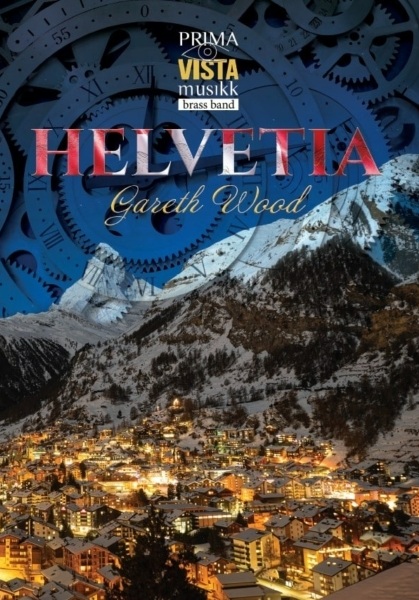
Helvetia (Brass Band - Score and Parts) - Wood, Gareth
I first went to Switzerland in the early 1970's and regularly played at the Lucerne Festival with the Royal Philharmonic Orchestra. It is a beautiful city, one of my favourite European cities.In writing Helvetia (the Roman name for Switzerland) I wanted to encapsulate the moods that remind me of this wonderful place. The work is in four distinct sections and is on the whole, self-explanatory.It opens with An Alpine Dawn and sunrise, the tubas and euphoniums substituting for the Swiss Alphorns. Next The Clock Shop at Mid-day, a loud ticking, chiming and the sad sound of a cuckoo, builds into the cacophony of the mid-day chimes. The third section is A Walk to Wagner's House. Just along the lake from the centre of town is Tribschen. This walk I have done many times, and it is here that Wagner wrote 'Tristan'. I have quoted the Dresden Amen (written by J.G. Naumann) which is much used in Parsifal. The final section is The Cesta Run, the most famous bob-sleigh run in the world. As we take each corner, the feeling of speed is demonstrated as only a brass band can do!The work is dedicated to the Cory Band and also to the memory of James Watson, a great cornet player, trumpeter and conductor. It was he who got me into writing for brass band and I hope this piece is worthy.- Gareth Wood (Feb. 2011)Duration: 11.00
Estimated dispatch 7-14 working days
-
 £31.95
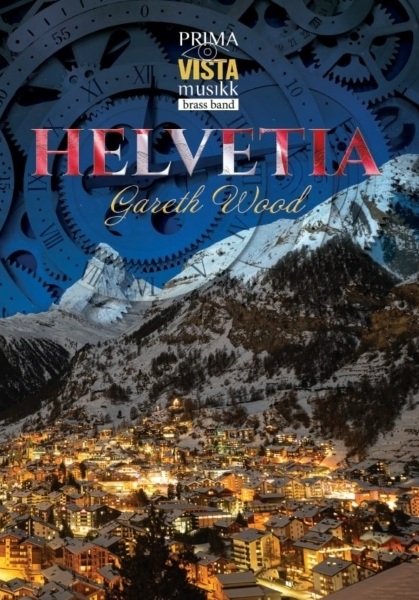
Helvetia (Brass Band - Score only) - Wood, Gareth
I first went to Switzerland in the early 1970's and regularly played at the Lucerne Festival with the Royal Philharmonic Orchestra. It is a beautiful city, one of my favourite European cities.In writing Helvetia (the Roman name for Switzerland) I wanted to encapsulate the moods that remind me of this wonderful place. The work is in four distinct sections and is on the whole, self-explanatory.It opens with An Alpine Dawn and sunrise, the tubas and euphoniums substituting for the Swiss Alphorns. Next The Clock Shop at Mid-day, a loud ticking, chiming and the sad sound of a cuckoo, builds into the cacophony of the mid-day chimes. The third section is A Walk to Wagner's House. Just along the lake from the centre of town is Tribschen. This walk I have done many times, and it is here that Wagner wrote 'Tristan'. I have quoted the Dresden Amen (written by J.G. Naumann) which is much used in Parsifal. The final section is The Cesta Run, the most famous bob-sleigh run in the world. As we take each corner, the feeling of speed is demonstrated as only a brass band can do!The work is dedicated to the Cory Band and also to the memory of James Watson, a great cornet player, trumpeter and conductor. It was he who got me into writing for brass band and I hope this piece is worthy.- Gareth Wood (Feb. 2011)Duration: 11.00
Estimated dispatch 7-14 working days
-
 £21.95
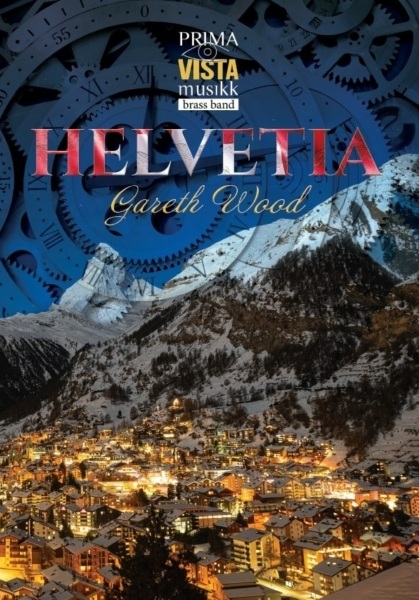
Helvetia (Brass Band - Study Score) - Wood, Gareth
I first went to Switzerland in the early 1970's and regularly played at the Lucerne Festival with the Royal Philharmonic Orchestra. It is a beautiful city, one of my favourite European cities.In writing Helvetia (the Roman name for Switzerland) I wanted to encapsulate the moods that remind me of this wonderful place. The work is in four distinct sections and is on the whole, self-explanatory.It opens with An Alpine Dawn and sunrise, the tubas and euphoniums substituting for the Swiss Alphorns. Next The Clock Shop at Mid-day, a loud ticking, chiming and the sad sound of a cuckoo, builds into the cacophony of the mid-day chimes. The third section is A Walk to Wagner's House. Just along the lake from the centre of town is Tribschen. This walk I have done many times, and it is here that Wagner wrote 'Tristan'. I have quoted the Dresden Amen (written by J.G. Naumann) which is much used in Parsifal. The final section is The Cesta Run, the most famous bob-sleigh run in the world. As we take each corner, the feeling of speed is demonstrated as only a brass band can do!The work is dedicated to the Cory Band and also to the memory of James Watson, a great cornet player, trumpeter and conductor. It was he who got me into writing for brass band and I hope this piece is worthy.- Gareth Wood (Feb. 2011)Duration: 11.00
Estimated dispatch 7-14 working days