
Results
-
 £150.00
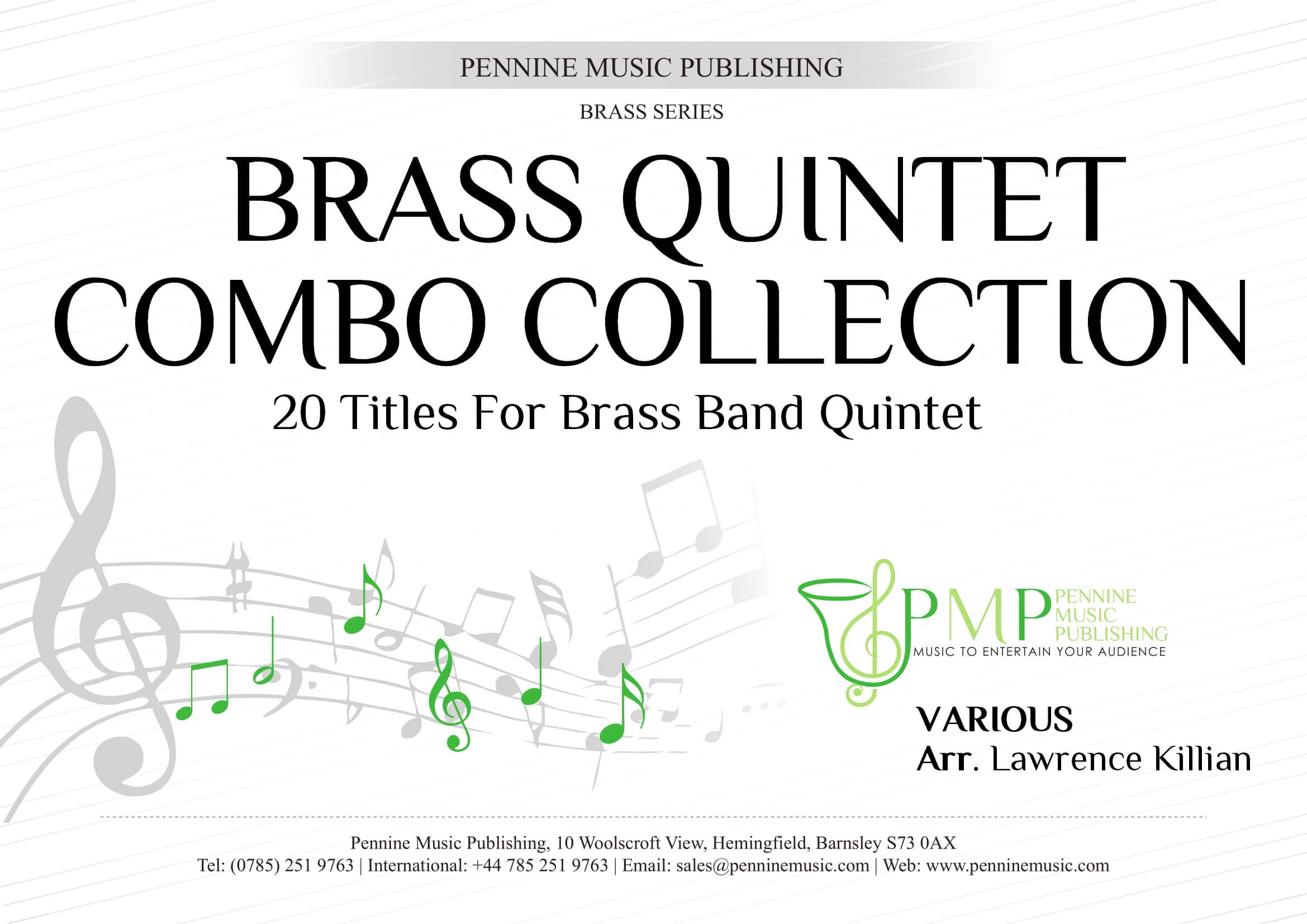
Brass Quintet Collection - Various - Lawrence Killian
20 Titles for Brass Quintet with Optional AugmentationFeaturing stylish arrangements using a flexible format for a minimum of five brass players, this set of music for small ensemble covers a wide range of composers and styles. The collection includes music by Purcell, Bach, Verdi, Gounod, Sousa, Joplin, Botsford, Elgar, Gershwin, and others.Using a unique approach to the scoring, the basic setup is for five players: two cornets/ trumpets, one horn, one trombone, and one bass tuba. Two optional "augment" players can be added using the "flugelhorn", and/ or the "Euphonium" parts. Further expansion of the ensemble is possible by adding multiple players to each part.Twelve parts are provided in total: 1st Bb Cornet, 2nd Bb Cornet, Eb Tenor Horn, French Horn in F, Bb Trombone or Baritone in treble clef, C Trombone in bass clef, EEb Bass, BBb Bass, C Tuba in bass clef, Bb Flugelhorn or Cornet (augment part 1), Bb Euphonium or Baritone (augment part 2), C Euphonium or Trombone in bass clef (augment part 2).A Full score is available seperately at a cost of �35.00. Please contact [email protected] to order. NOTE: Individual books are priced at �20.00 each. Please email [email protected] to order individual books. Videos of these works being performed are available below:- Asturias (Leyenda) from Suite Espanola No.1, Isaac AlbenizBerceuse from "Jocelyn", Benjamin Godard TITLES INCLUDED:- 1. Asturias (Leyenda) from Suite Espanola No.1, Isaac Albeniz 2. Bist du bei mir (Be Thou with Me), J. S. Bach3. Chatterbox Rag, George Botsford4. Grizzly Bear Rag, George Botsford5. Jubilee Fantasy on God Save the King, Bernhard Brahmig 6. Chanson de Matin, Sir Edward Elgar 7. Pomp and Circumstance March No. 4, Sir Edward Elgar 8. But Not For Me, George Gershwin 9. By Strauss, George Gershwin10. They All Laughed, George Gershwin11. Berceuse from "Jocelyn", Benjamin Godard12. JUDEX - from "Mors et Vita", Charles Gounod 13. The Entertainer (Rag), Scott Joplin14. Intermezzo No.2, Vasily Sergeyevich Kalinnikov 15. Berliner Luft, Paul Lincke 16. Sound the Trumpet, from "Come Ye Sons of Art", Henry Purcell 17. Gymnopedie No.1, Erik Satie 18. The Liberty Bell March, John Philip Sousa 19. Tritsch-Tratsch Polka, Johann Strauss II 20. Grand March from the opera Aida, Giuseppe Verdi
In Stock: Estimated dispatch 1-3 working days
-
 £53.99
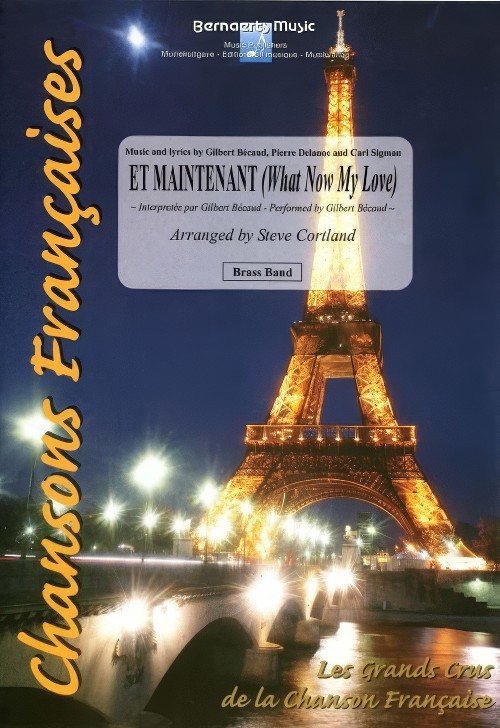
Et Maintenant (What now My Love) (Brass Band - Score and Parts) - Cortland, Steve
Performed by Gilbert Becaud. Duration: 03:15
Estimated dispatch 7-14 working days
-
 £57.50
Supernova - Thierry Deleruyelle
Supernova is an energetic piece in a pop style that inspires joy and good humour, its rhythm giving it an exceptionally lively and festive character. Its theme is renewal, rebirth and solidarity in the wake of the COVID-19 pandemic. The Confederation Musicale de France commissioned this work as part of the initiative "Concerts solidaires au profit de l'enfance en France et dans le monde" (Concerts in aid of children in France and worldwide).
Estimated dispatch 5-14 working days
-
 £127.30
What Now My Love - Gilbert Becaud - Ray Farr
What Now, My Love was written in 1961 by composer Gilbert Becaud and lyricist Pierre Delanoe with the original title Et Maintenant.Very many top, internationally renowned artists have recorded this song including Elvis Presley, Frank Sinatraand Shirley Bassey.Ray Farr has set the emotional song to the ostinato of Ravel's Bolero, and features several soloists from within the band.
Estimated dispatch 5-14 working days
-
£69.99
Suite Symetrique - Jacob de Haan - Menno Haantjes
This playful three-part suite is largely based on symmetry. This of course is largely due to the relations of the arrangement of the themes; however, on the other hand, to the larger structures in form. The first part, (Prelude et Scherzo) has a solemn opening. Followed by it a related scherzo with many changes in time, this too is composed in a symmetrical form. In the second movement, Choral Dorian, the theme of the prelude is reversed and used in chorale in Dorian tonality. The suite comes to a close with Rondo d'Avignon. An annual theatre festival in a French city on the Rhone inspired this suite. It is a lively movement, symmetrically bought to a finish with a repeat of theprelude from the first movement.
Estimated dispatch 5-14 working days
-
 £76.99
Bread and Games - William Vean
'Panem et Circenses', Bread and Games were essential for keeping the citizens of ancient Rome in check. While the bread was meant for the poorest among the Romans, the Games were Popular Pastime Number One for everybody.There were different kinds of games, such as chariot races (especially popular with female spectators), or wild-beast fights, where lions, tigers, bulls or bears were set on one another or even on human beings. Most popular, however, were the Gladiator fights. In 'Bread and Games' William Vean depicts one of the many fights in the antique Colosseum. 1. Entrance of the Gladiators: By powerful bugle-calls the attention of the peoplewas asked for, after which the Gladiators entered the Arena at the sound of heroic marching-music.2.Swordfight: We can hear that the fights were not mere child's play in this part.On the contrary, they were a matter of life and death and were fought accordingly.3.Mercy of the Emperor: Sometimes a wounded gladiator could be fortunate, depending on the mercy of the audience. Waving one's handkerchief meant mercy, a turned-down thumb meant no pardon. The Emperor had the right to take the final decision, but he usually complied with the wish of the majority of the public. 4.Lap of Honour: Gladiators were mainly selected among slaves, convicted criminals, or prisoners of war. Consequently, winning was very important, as it would mean fame, honour and sometimes even wealth. A lap of honour, therefore, was the winner's due reward.
Estimated dispatch 5-14 working days
-
 £127.30
Guess What I Wanna Do - Bernard Trulsrud Seland - Andreas Heier Røe
Pa den tiden da Guess what I wanna do ble til, tidlig i nittiarene, var jeg sa utrolig heldig a vaere medlem av Oslo Groove Company, et kruttsterkt storband fra miljoet rundt musikkhogskolen. Bandet vant en spellemanspris med sin forste utgivelse Anno 1990. Alt stoffet vi spilte skulle vaere egenprodusert, noe som gjorde at mange i bandet provde seg, meg selv inkludert. Jeg hadde fatt med lata Frontal Separese,(blanding av frontal lobotomi og cerebral parese), pa Anno 1992, noe som selvfolgelig ga meg blod pa tann! Jeg husker jeg var opptatt av a fa til en stilig bassgang, og sa hadde jeg hort om kvarter. Resultatet ble Guess what I wanna do. At jeg fikk spille baritonesax solo pa lata var ogsa stor stas!Bernhard Trulsrud SelandEn storbandinteressert kompis introduserte meg for CD-en Anno 1996 da jeg var tenaring pa slutten av nittitallet. Jeg ble umiddelbart veldig glad i Guess what I wanna do - en utrolig toff og fengende lat med en bassgang man ikke glemmer! I mitt seinere liv som arrangor har jeg alltid hatt denne laten i bakhodet, med en tanke om a gjore den for korps, slik at den saledes blir tilgjengelig for enda flere musikanter. Og da jeg lanserte tanken for Bertnes Brass i 2019 var de umiddelbart klare for utfordringen! Arrangementet er blitt til med stotte fra NOPA.Andreas Heier Roe
Estimated dispatch 5-14 working days
-
£132.00
Abstractions - Torstein Aagaard-Nilsen
Verket ble bestilt av Norges Musikkorpsforbund som pliktnummer til NM for Brass Band 2. divisjon (na 1. divisjon) 1990.Satstitlene er abstraksjoner der synsopplevelser er tenkt gjenskapt som musikk, altsa en abstrakt fremstilling av et motiv, likt et abstrakt bilde der man ikke umiddelbart kan se likheten.1. Aurora Borealis (Lento espressivo) Inspirert av Nordlyset som kan vaere svaert intenst vinterstid.Det er aldri i ro og antar nye fasonger og farger hele tiden mens det farer over nattehimmelen.The first movement is inspired by the northern lights. It constantly changes in colour and shape.2. Rocks (Moderato ben ritmico)I denne satsen er tittelen et ordspill. Ordet "rock" er velkjent i musikken, men er ogsa en enorm stein eller del av et fjell.The title of the second movement is a play with the word "rock" is a well-known word describing a musical genre. But it is also a giant stone or a part of a mountain.3. Seascape (Allegro)I denne satsen forsoker jeg a fange ulike aspekter ved havet, samtidig som satsen samler opp musikalske ideer fra de to foregaende satsene. Denne satsen videreforer, oppsummerer og avslutter verket.The third movement is inspired by different aspects of the sea. It also sums up different ideas that occurs in the two previous movements to round off the whole piece.Tredje utgave - 2015Third Edition - 2015
Publisher Closed for Holidays. Est Delivery 13-14th Aug
-
 £37.40
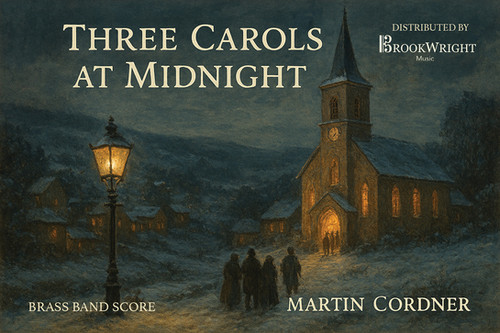
Three Carols at Midnight (Brass Band) Martin Cordner
Rooted in the sacred stillness of a French village on Christmas Eve, this suite by Martin Cordner draws upon traditional carols that have echoed through centuries of candlelit chapels and midnight vigils. Each movement offers a window into the Nativity story: I. Mystery: Noel Nouvelet (Christmas Comes Anew) opens with modal wonder, evoking the anticipation of Christ's coming and the quiet awe of Advent. II. Cradle: Entre le boeuf et l'ane gris (Between the Ox and the Grey Donkey) rests in pastoral tenderness, where the newborn Savior lies between humble beasts, watched over by angels and the Virgin. III. Joy: Il est ne, le divin enfant (He is born, the Divine Infant) bursts forth in celebration, proclaiming the divine birth with rustic dance and jubilant praise. Together, these carols form a musical triptych - moving from mystery to intimacy to exultation. Three Carols at Midnight invites listeners to step into the hush of a French Noel, where the sacred story is told not only in word, but in melody, memory, and light. All proceeds support the mission and ministry of The Salvation Army Delaware Command, USA. To view a rolling score video of the work please visit www.youtube.com/watch?v=fUcCluBS18Q Difficulty level: 4th Section + Duration: approx. 5.00 minutes This PDF download includes parts and score. Sheet music available at www.brassband.co.uk or www.durhammusicshop.co.uk (UK) or www.cimarronmusic.com (USA) Instrumentation: Soprano Cornet Eb 1st Cornet Bb 2nd Cornet Bb 1st Horn Eb 2nd Horn Eb 1st Baritone Bb 2nd Baritone Bb 1st Trombone Bb 2nd Trombone Bb Bass Trombone Euphonium Bb Bass Eb Bass Bb Percussion 1-2 Glockenspiel
In Stock: Estimated dispatch 1-3 working days
-
£85.00
Life (Bra) - Stijn Aertgeerts
'Life' was written in 2019 for euphonium virtuoso Glenn Van Looy, for a performance at the 'Academie de cuivres et percussion de Larmor-Plage' with an occasional brass ensemble conducted by Florent Didier. Afterwards, the work had disappeared below the radar, until Lorenz Havermans and Bert Van Thienen asked composer Stijn Aertgeerts to make a new version for fanfare band, especially for Koninklijke De Berthoutzonen Hallaar to perform at the World Music Contest 2022 in Kerkrade (NL).
Estimated dispatch 7-14 working days
 View Music