
Results
-
 £30.00
All Shall Be Well - Brass Band Sheet Music Full Score & Parts - LM931
COMPOSER: Tamsin TateCOMPOSERS NOTE"All shall be well" was composed during the first lockdown of the Covid crisis, from May 2020.This was a worrying time for many and a time of great anxiety and sadness for some.I have always tried to be practically optimistic in trying times, but still I needed hope.I am lucky to have a faith in God which gives me hope and assurance that things will be better,and I also know that music, particularly playing it, can help express some of these emotions.Certainly, music through the crisis was a wonderful, enjoyable escape for meand one I shared with my family and my band family through our online recordings.Julian of Norwich was an anchoress in the 14th Century.She set herself apart for God and spent a lot of time in prayer.Interestingly, she was the first published woman in the English language.Julian of Norwich is quoted as saying "all shall be well, all shall be well,and all manner of thing shall be well." The paraphrase of this spurred me on to develop this piece for brass band.Hopefully you will also find that the music portrays the worries and trials of this uniquetime through the natural minor key, with the rhythm hinting towards the phrase"All shall be well" and then the dawning transition to the major keyfollowed by a triumphant ending with the whole band joining together.Thanks to Adam Cable and the Martlesham Brass family for support and encouragement always.Thanks also to Alan Fernie and his supportive critique of my initial efforts.LM931 - ISMN : 9790570009312
In Stock: Estimated dispatch 3-5 working days
-
 £35.00
Passing - Brass Band - LM982
COMPOSER: Chris AllenPassing was written over the course of a series of weekly virtual workshops,with fellow young brass band writers, led by composer Mike Sheppard duringthe 2020 COVID-19 lockdown. The piece has a ternary (ABA) form, beginningwith a haunting melody accompanied by untethered, bleak harmonies.From letter B, the clouds begin to dissipate, leading to a central section witha very traditional, romantic climax. However, this relief is short-lived and themusic quickly returns to the atmosphere of the opening, but with smallrecollections of the bliss of the central section.
In Stock: Estimated dispatch 3-5 working days
-
 £30.00
Psalm 150 - Brass Band - LM469 - Charles Stanford - Neil Lock
COMPOSER: Charles StanfordARRANGER: Neil LockTo celebrate the planned re-opening of St. Mary's Church, Liss, 2020In 1909, Charles Villiers Stanford composed the chant to which the last psalm in the book, Psalm 150, is now usually sung. This is a free arrangement of that tune for brass band, which can be used either as a stand-alone piece or as an encore, particularly at the end of a concert in a church. I use some of Stanford's original harmonies, but most of the chords are my own.At the beginning and end, imagine the band playing at one end of a cathedral. After the first, very loud phrase, we hear the sound reflected back from the far end. The fast main section is divided into six "verses" as follows:Praise him in the cornets and trumpets;Praise him in the horns and baritones;Praise him in the deepest basses,And praise him in the trombones;Praise him in the loud percussion,And in the euphoniums.This piece was first played in public as part of the Liss Band's first formal post-COVID concert, in St. Mary's Church, Liss on July 16th, 2022.Suitable for most bandsLM469ISMN : 9790570004690
In Stock: Estimated dispatch 3-5 working days
-
 £35.00
Edward Gregson: Fanfare for a New Era (for Brass Band)
DescriptionComposer's NoteThe Fanfare has been designed to be partly antiphonal, with four separate brass 'choirs' initially playing their own music, and so some spatial separation is desirable. Soprano and solo cornets should be placed centrally, standing behind the rest of the band - or in some venues could even be placed off-stage in a side balcony, but still close to the band. If the Fanfare is played by a contesting size band, one of the solo cornets should play the 1st cornet part together with the usual player ie the number of players on the 1st, 2nd, and 3rd cornet parts should be equal. Otherwise the number of players in each of the two cornet 'choirs' is at the discretion of the conductor. The Tubular Bells accompanying the cornets 1-3 group should be placed close to that group. See inside back cover for suggested band formation.The style of playing should replicate that of symphonic brass, with a minimum of vibrato and with long notes being sustained without decaying.Programme NoteCommissioned in 2020 by Youth Brass 2000, Fanfare for a New Era was designed to be partly antiphonal - thus the separation of the band into four brass 'choirs', each with their own percussion accompaniment. First, soprano and solo cornets, rather like heraldic trumpeters, announce the main idea, majestic in character. Then horns, baritones, and euphoniums, with timpani, enter with stately figurations. Next, the heraldic trumpeters usher in trombones and tubas, to the accompaniment of tom-toms and snare drum, presenting a faster and rhythmic dance-like theme. Finally, the remaining cornets amplify the pealing of bells. All four elements then come together, surrounding the audience with a 'joyful noise' of festive brass and percussion.The original symphonic brass version of this fanfare can be purchased as part of a set of Three Fanfares HERE.For more information on Edward Gregson's music please visit the composer's website: www.edwardgregson.com
Estimated dispatch 7-14 working days
-
 £77.00
General Series Brass Band Journal, Numbers 2261 - 2264, December 2025
2261: March - Win the world (Paul Sharman)This march was written at the request of Staff Bandmaster Ken Waterworth for the Melbourne Staff Band's visit to South Africa in 2018. It features the tunes We shall win (T.B. 455) and Storm the forts of darkness (T.B. 844) - the latter chosen for its similarity to the Australian national anthem in its opening two bars.2262: Festival March - Alleluia! (Kevin Larsson)Both hymns used in this march, This is my Father's world (S.A.S.B. 66) and All creatures of our God and King (S.A.S.B. 2), bought the composer comfort as he began to grapple with the ramifications of the global pandemic in 2020. Both songs talk about God's sovereignty over nature, revealing himself to us through the beauty and majesty of our world.2263: Prayer gently lifts me (Ty Watson)This is a simple arrangement of the chorus Prayer gently lifts me (S.A.S.B. 783). The piece was written to precede the opening prayer in a band programme.2264: What a Saviour! (Steven Ponsford)This devotional music explores the events of Good Friday, dramatically reminding us of words associated with familiar Easter hymns tunes.
Estimated dispatch 7-14 working days
-
 £44.95
Powerhouse (Brass Band - Score and Parts)
Spirit divine, come as of old. So begins the song by Brindley Boon (S.A.S.B. 311), and that phrase becomes the message of this piece, and an important motif in the music. It appears at the very beginning of the work and recurs at important points during the piece. The theme of the need for spiritual power is further underlined by the use of the hymns Show your power (S.A.S.B. 365), Wonder-working power (S.A.S.B. 451) and the very old chorus Send a new touch of power on my soul, Lord (S.A.S.B. 785).The composer first heard Boon's song Spirit Divine when it was sung by Parkhead Songsters in the Sunday morning meeting at his home Corps of Greenock Citadel. They were visiting for the weekend from Glasgow, and were conducted by Songster Leader Walter Chalmers, himself a beautiful lyric tenor soloist. They sang it in a moving fashion, unaccompanied, and such was the impact that, at the conclusion, many people went to the mercy seat. It made a huge impression on the young composer. It was the first time that Downie discovered the enormous power of music in worship. It also serves as a reminder to us all that young people of a tender age are very capable of grasping deeply significant events happening around them. This music was written for the 2020 UK Territorial Youth Band course.
Estimated dispatch 7-14 working days
-
£60.00
Anno 1920 - Harper, P
Anno 1920 is a fabulous concert opener composed by Philip Harper.Commissioned by the Swiss Brass Band Feldmusik Knutwil for its Centenary in 2020, the piece features an uplifting melody which moves around the sections of the band before returning as a triumphant final section.2nd Section +Live Recording
In Stock: Estimated dispatch 1-3 working days
-
£36.00
Anno 1920 (Score) - Harper, P
Anno 1920 is a fabulous concert opener composed by Philip Harper.Commissioned by the Swiss Brass Band Feldmusik Knutwil for its Centenary in 2020, the piece features an uplifting melody which moves around the sections of the band before returning as a triumphant final section.2nd Section +Live Recording
In Stock: Estimated dispatch 1-3 working days
-
£45.00
IMG Anthem Unity - Harper, P
Composed for a lockdown project in 2020, this brief, optimistic fanfare-style piece is the perfect opener for your concert3rd Section +Duration 2.5 mins
In Stock: Estimated dispatch 1-3 working days
-
 £69.95
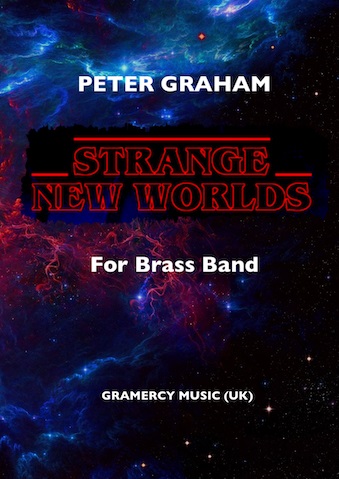
Strange New Worlds (Brass Band - Score and Parts) - Graham, Peter
Strange New Worlds was commissioned by Nicholas Childs for the National Children's Brass Band of Great Britain with funds provided by Arts Council England.The COVID-19 pandemic made it necessary for the 2020 course to transition from residential to virtual and the work was designed to accommodate this change. The participants individually filmed themselves to a click track and the videos were collated to create a "virtual" performance. The premiere was streamed live on YouTube on August 7, 2020.The work is in 5 movements with a narrative dictated by the individual movement titles. Although to me this narrative is clearly defined, multiple scenarios present themselves. Some may interpret the story as being one from the ancients while others might identify with the science-fiction of H.G. Wells. Others still will relate to the recent surge of interest in 1980s culture and the Netflix series Stranger Things (to which the title of my work pays homage). Nor would it be unreasonable to consider the piece an analogy reflecting events in 2020. Listeners will decide the story (or message) for themselves.The five movements are: I. Things to Come; II. Descent to Darkness (featuring Cornets, Trombones and Percussion); III. Resistance (featuring Horns, Baritones, Euphoniums, Basses and Percussion); IV/V. Aftermath/A New HopeDuration: 8.00
Estimated dispatch 7-14 working days
 View Music