Results
-
 £50.00
Triumph Series Band Journal March 2017 Numbers 1283-1286
March - Proud to serve (Ray Steadman-Allen)One of the last works written by Lt. Colonel Ray Steadman-Allen and dedicated to the Chatham Corps, this march was featured by the International Staff Band at the composers tribute evening at the Adrian Boult Hall in Birmingham in 2015. The tunes featured are 'By the pathway of duty' and 'Marching Along'.Song Setting - His Grace! (Noel Jones)Noel Jones has for many years provided music of an attractive and accessible nature. This beautiful setting of the Herbert Booth song 'The Penitent's plea', along with touches of Major Howard Davies' song 'The wonders of his grace' will be a powerful addition to any bands repertoire.Song Arrangement - Blood of the Lamb (Ian Feltwell)Here is a bright setting of the old tune 'Are you washed?' which will provide many with a popular item for festival use.March - Makeover (Andreas Holmund)A bright and attractive work by Swedish Salvationist composer Andreas Holmund brings a traditional march with excellent harmonic and melodic interest.
Estimated dispatch 7-14 working days
-
 £60.00
General Series Band Journal December 2014 Numbers 2138 - 2141
No. 2138 Song Arrangement - Praise his holy name! (Dean Jones)Dr Keith Hampton's song has been popular with choral groups for the best part of two decades. In this arrangement for band, Dean Jones has kept close to the original vocal version.No. 2139(1) Prelude on 'Hereford' (Norman Bearcroft)The beautiful tune of Hereford was written in 1872 by Samuel Sebastian Wesley and is often associated with the words of his grandfather, Charles Wesley; 'O thou who camest from above'.No. 2139(2) The Lord bless you and keep you (arr. Paul Sharman)Nik and Emma Pears have written this lovely setting of familiar words, which has been arranged as a benediction for band by Paul Sharman.No. 2140 Now I belong to Jesus (Steven Ponsford)This beautiful, descriptive arrangement of the well-loved song has an imaginatively extended ending, with long notes and rich harmonies, to give the impression of time stretching out into eternity.No. 2141 My name is written there! (Kenneth Downie)This setting of General Albert Orsborn's lovely song was inspired by a Corps retreat based on the theme 'The Calvary track'. The music provides a fitting commentary on the lyrics of the song.
Estimated dispatch 7-14 working days
-
 £95.00
A Wartime Sketchbook (Brass Band - Score and Parts)
Early in 1941 William Walton, 39, received his call-up papers. He was by then one of the most eminent of British composers and was exempted from military service on condition that he provided music for films deemed to be of 'national importance'. Scoring Lawrence Olivier's Shakespeare epic Henry V in 1943 was the most substantial of these wartime projects. His role in patriotic films from 1941 and 42 like The Foreman went to France, Next of Kin, Went the day Well and The First of the Few was to provide appropriate title music and some underscoring at key moments. Walton extracted the most substantial portions of the latter as the popular Spitfire Prelude and Fugue for orchestra. The remaining music remained unpublished until 1990, when Christopher Palmer assembled the highlights into A Wartime Sketchbook. I was intrigued to hear these examples of Walton's wartime music and having discovered that they would fit naturally and idiomatically onto the brass band, I arranged six of the numbers into a suite for Besses o' th' Barn Band, which I was conducting at the time.In 1995 the brass band suite was recorded by the famous Black Dyke Mills Band as part of an all Walton album which I produced for the ASV label (ASV CD WHL 2093). This award- winning CD also included Walton's First Shoot, in the edition by Elgar Howarth, my transcription of movements from Music for Children and two substantial brass versions by Edward Watson of the suite from Henry V (with narrator) and the March and Siegfried Music from The Battle of Britain music.Prologue: This is the stirring title music from Went the day Well, a screen play by Graham Greene about a German airborne invasion of an English village. The main theme leads toBicycle Chase: Characteristic musical high-jinks for J.B.Priestley's The Foreman went to France.Refugees: From the same film, this is a poignant accompaniment to the long march of refugees. As Ernest Irving, the film's musical director, put it, "this really makes your feet sore and your knees sag."Young Siegfrieds: This lively movement comes from the music that Walton composed for The Battle of Britain in 1968, with the assistance of Malcolm Arnold, but which the film's producer rejected. It portrays first the Berliners, cheerfully ignoring the black-out and then, in the trio, the Young Siegfrieds of the Luftwaffe, courtesy of a parody of Siegfried's horn call from Wagner's opera.Romance: A soldier and a Dutch refugee snatch a few tender moments together in Next of Kin.Epilogue: At the end of The Foreman went to France, the French look forward with hope and optimism to eventual liberation.- Paul HindmarshDuration: 14.00
Estimated dispatch 7-14 working days
-
£40.00
A Wartime Sketchbook (Brass Band - Score only)
Early in 1941 William Walton, 39, received his call-up papers. He was by then one of the most eminent of British composers and was exempted from military service on condition that he provided music for films deemed to be of 'national importance'. Scoring Lawrence Olivier's Shakespeare epic Henry V in 1943 was the most substantial of these wartime projects. His role in patriotic films from 1941 and 42 like The Foreman went to France, Next of Kin, Went the day Well and The First of the Few was to provide appropriate title music and some underscoring at key moments. Walton extracted the most substantial portions of the latter as the popular Spitfire Prelude and Fugue for orchestra. The remaining music remained unpublished until 1990, when Christopher Palmer assembled the highlights into A Wartime Sketchbook. I was intrigued to hear these examples of Walton's wartime music and having discovered that they would fit naturally and idiomatically onto the brass band, I arranged six of the numbers into a suite for Besses o' th' Barn Band, which I was conducting at the time.In 1995 the brass band suite was recorded by the famous Black Dyke Mills Band as part of an all Walton album which I produced for the ASV label (ASV CD WHL 2093). This award- winning CD also included Walton's First Shoot, in the edition by Elgar Howarth, my transcription of movements from Music for Children and two substantial brass versions by Edward Watson of the suite from Henry V (with narrator) and the March and Siegfried Music from The Battle of Britain music.Prologue: This is the stirring title music from Went the day Well, a screen play by Graham Greene about a German airborne invasion of an English village. The main theme leads toBicycle Chase: Characteristic musical high-jinks for J.B.Priestley's The Foreman went to France.Refugees: From the same film, this is a poignant accompaniment to the long march of refugees. As Ernest Irving, the film's musical director, put it, "this really makes your feet sore and your knees sag."Young Siegfrieds: This lively movement comes from the music that Walton composed for The Battle of Britain in 1968, with the assistance of Malcolm Arnold, but which the film's producer rejected. It portrays first the Berliners, cheerfully ignoring the black-out and then, in the trio, the Young Siegfrieds of the Luftwaffe, courtesy of a parody of Siegfried's horn call from Wagner's opera.Romance: A soldier and a Dutch refugee snatch a few tender moments together in Next of Kin.Epilogue: At the end of The Foreman went to France, the French look forward with hope and optimism to eventual liberation.- Paul HindmarshDuration: 14.00
Estimated dispatch 7-14 working days
-
 £34.95
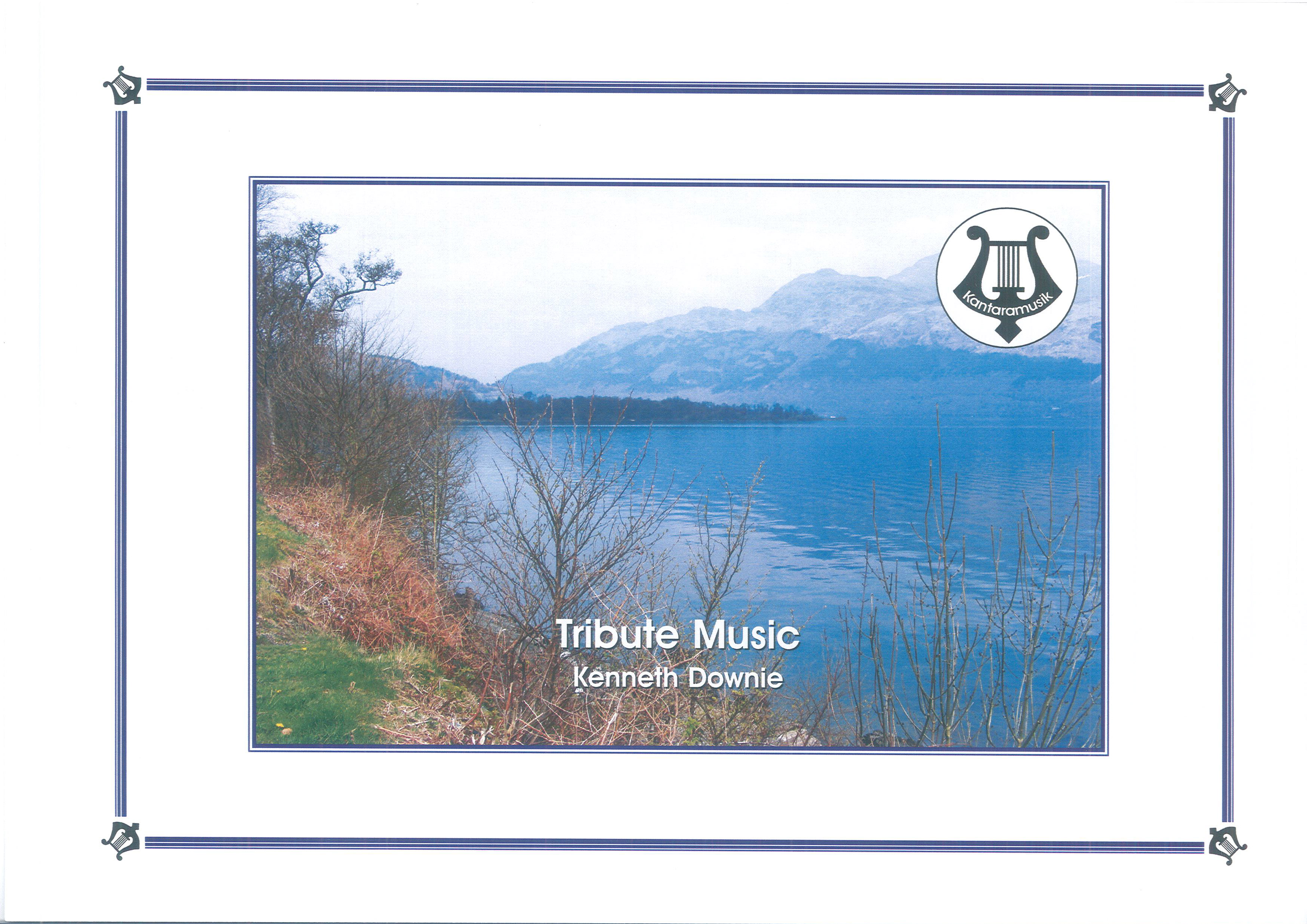
Tribute Music (Brass Band - Score and Parts)
The composer writes: Having received delightful reports about Neil Ferguson from his colleagues in Granite City Brass, I thought it might be a good idea to incorporate the musical initials from his name, EFEG, in the opening idea of the music. I used this short idea as a motif during the piece. A recurring comment in the tributes referred to his dry sense of humour, and particularly his ability to deliver a one-liner when least expected. The music does therefore contain a few surprises and sudden changes of direction. I also thought that it might be in character for me to include a little "joke" of my own, which is there to be heard by the very careful listener! Such listeners would do well to remember that the Granite City Brass, the commissioning band, is based in Aberdeen. The idea of commemorating such a faithful member of the band with a piece of music led me to try and write a noble, upright theme, which might be remembered as a melody in the future. I hope that it is a fitting tribute.
Estimated dispatch 7-14 working days
-
 £32.00
Blaenwern (Brass Band - Score and Parts)
This arrangement is dedicated to the memory of a much-loved friend and wonderful cornet player, Stephen Howard. Stephen played with the Clacton-on-Sea Band, conducted by his father Robert, and was a frequent guest with the G.U.S. Band directed by Dr. Keith M Wilkinson. Indeed, only a few weeks before his untimely death in 1984, Stephen had played principal cornet with the G.U.S. Band on a tour of Switzerland, performing outstandingly at each concert.The arrangement was first performed at Stephen's Memorial Service in October, 1984."Changed from glory into glory,Till in Heaven we take our place,Till we cast our crowns before Thee,Lost in wonder, love and praise." Charles Wesley
Estimated dispatch 7-14 working days
-
£65.00
Infernal Ride - Phillip Littlemore
Infernal Ride is mercurial and virtuosic, reflecting the mad-cap chase of Ichabod Crane's final ride on his horse, Gunpowder, in the story by Washington Irving, namely The Legend of Sleepy Hollow. Often an atmosphere of driven fear pushes the music forward, only briefly stopping for breath. The work closes with flourishes in rapid succession, perhaps with the hapless Ichabod meeting his unfortunate end!Brass Band Grade 5: 1st SectionDuration: 7 minutes.Infernal Ride has been recorded by the Leyland Band, conducted by Jason Katsikaris, and is available on the CD Penlee.
In Stock: Estimated dispatch 1-3 working days
-
.png) £29.95
£29.95Ghost of Christmas Past, The - Jonathan Bates
DURATION: 2'30". DIFFICULTY: 2nd+. Composed for Strata Brass in 2020 as part of their COVID-19 induced, virtually recorded 'A Christmas Carol' (a new suite for brass bandlasting around 30 minutes in total), 'The Ghost of Christmas Past' is a lively and virtuosic cornet solo portraying the visions Scrooge is shown of his childhood. Beginning in a jovial mood, the ghost then shows Scrooge his early love life, before showing how Scrooge's unsympathetic and callous ways lead to his loss of love and friendship throughout the years as the music gets gradually darker and darker with each passing section. .
In Stock: Estimated dispatch 1-3 working days
-
 £29.95
Ghost of Christmas Yet To Come, The - Jonathan Bates
DURATION: 3'00". DIFFICULTY: 2nd+. Composed for Strata Brass in 2020 as part of their COVID-19 induced, virtually recorded 'A Christmas Carol' (a new suite for brass bandlasting around 30 minutes in total), 'The Ghost of Christmas Yet To Come' is a jagged and virtuosic solo for Euphonium portraying what Ebenezer Scrooge sees when he is shown how his Christmases in the future will occur by the Ghost of Christmas Yet To Come. Having already been shown how is mean and uncaring ways have impacted his life this far by the previous two visions, this 3rd and final vision is enough to force Scrooge to become a changed man and embrace the Christmas spirit with all his heart. Throughout this solo, you may hear small references to Camille Saint-Saens' 'Danse Macabre'. .
In Stock: Estimated dispatch 1-3 working days
-
 £19.95
As A Cloud... - Jonathan Bates
'As A Cloud..' is a work for Solo Baritone and Piano composed for Nick Wilson in 2021. The inspiration for the work comes from the words of the poet William Wordsworth and his much loved text "I wandered lonely as a cloud". In the process of writing this work, the dedicatee's desire was to have a work to reflect his passion for the Lake District - a part of Northern England which Wordworth (and several other renowned poets of the time) became synonymous with; the group of writers becoming known as 'The Lake Poets'. Musically, this programmtic work reflects the words from Wordsworth's text, painting each line of the first stanza in a variety of settings and moods before the work floats away with an audio extract from the poem itself.
In Stock: Estimated dispatch 1-3 working days