
Results
-
 £137.70
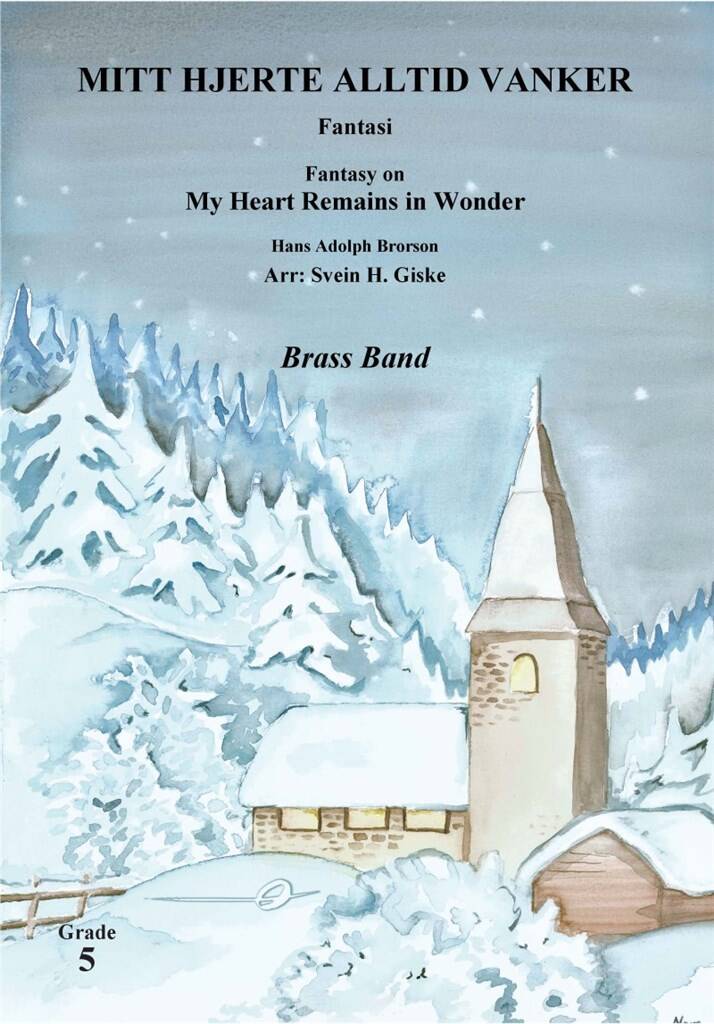
Mitt hjerte alltid vanker - Fantasi - Hans Adolph Brorson - Svein H. Giske
This arrangement was commissioned by B3 (The Bergen Woodwind Ensemble). B3 is a large woodwind ensemble located in Bergen with a mix of professional and amateur players. My Heart Remains in Wonder is a well-known Christmas hymn in Scandinavia. I wanted my version to be different to the traditional hymn tune style in which it is normally performed. One day I was outside walking and this idea came to me: an ostinato-like, mechanical skeleton of arpeggio semiquavers on which I could 'hang' the melody. However, I also wanted to do the melody line a bit different. The inspiration for this comes from folk music and the way fiddlers hardly ever lift their bow off the strings when they play. Because of this, it is important that the melody is played in a very sostenuto style in this arrangement. The harmonies lie somewhere between jazz and folk music with a little nod towards Grieg (himself heavily influenced by folk music) in the slow middle section.
Estimated dispatch 5-14 working days
-
 £54.99
Flashback - John DeBee
Which of us does not have them, memories? Everyone sometimes remembers things from the past, be they happy memories or not. Sometimes, a scent may remind us of a particular place, or a tune may bring back memories of a certain situation. John DeBee experienced something similar when he heard a song on the radio: he immediately picked up his pen and composed 'Flashback'. It has become a piece that appeals to the ear, which will provide both the musicians performing it and their audience with pleasant memories.
Estimated dispatch 5-14 working days
-
£69.99
Homage - Jan Van der Roost
In the most literal sense: a piece for an occasion. The actual occasion was Jan de Haan's twentieth anniversary as a conductor of the top Dutch brass band, "Soli Deo Gloria" (Leeuwarden). To mark the occasion, the band commissioned the Belgian comopser Jan Van der Roost to create a surprise piece: without knowledge of the person being celebrated, a suitable source of inspiration was sought for. After some thought the chorale-theme from Camille Saint-Saens organ symphony was chosen, a piece with which Jan de Haan has a special bond.Apart from this chorale, Homage is also based on the names of notes taken from 'Jan de Haan' and 'Soli Deo Gloria', resulting in the tonerow: DEGAH. Both elements are combined together and form a grand climax towards the end of the piece when the whole band unites in the Saint Saens' theme.
Estimated dispatch 5-14 working days
-
 £109.99
Fantasy for Brassband and Organ - Jan Bosveld
When I was approached to compose a work for brassband and church organ I already envisioned the concept I would use. It would indeed literally become a work for brassband and organ. Without the traditional solos, the organ would form an addition to the brassband orchestration as would the brassband provide an extra register for the organ. In short a homogeneous entity. The most important reason for doing this is quite simple. Since this work can only be performed in a church and because of the specific acoustics of the church, the brassband would sound in al its tone colour like an organ. By using certain registers of the organ and combining these with the brassband a wonderfulsound palette can be created. The use of complementary or contrasting tone quality is also possible. The primary theme of this composition is based on these three methods of "colouring". As far as structure is concerned this work consists of two parts. slow fast. It is built on a number of motifs in which some behave like a consecutive canon. In the fast movement the primary motif develops into a fugue-like section. The canon and fugato are techniques frequently used in classical and contemporary organ literature. The liberal use of structure and motif has lead to the title. "Fantasy for Brassband and Organ".
Estimated dispatch 5-14 working days
-
 £115.60
Norge i rodt, hvitt og blatt - Lars-Erik Larsson - Petter S. Kragstad
Norge i rodt, hvitt og blatt ("Norway in Red, White and Blue") was commissioned by the Oslo Fagott Choir (yes, that is indeed a gay men's choir) for a concert with The Staff Band of the Armed Forces in 2015. I was given artistic licence to write a more modern and somewhat 'eclectic' arrangement for this originally Swedish melody written by Lars-Erik Larsson, which became something of a national liberation anthem when Nazi occupation ended in May 1945 - then with new lyrics by Finn Bo, Bias Bernhoft and Arild Feldborg.After the premiere in Oslo, and a music video with Oslo Fagott Choir and The Staff Band, broadcasted by Norwegian Broadcasting Corporation (NRK) on Constitution Day during coronavirus lockdown in 2020, I was approached by many to write an instrumental version of the arrangement for concert band. This version is now available through Norsk Noteservice. Reid Gilje has made this instrumentation for Brass Band.
Estimated dispatch 5-14 working days
-
£94.99
The Devil's Bridge - Bertrand Moren
The "Teufelsbrucke" (devil's bridge) is a very old bridge connecting the Goschenen and Andermatt valleys in the canton of Uri, central Switzerland. Legend has it that in the 13th century the people of Uri made a pact with the devil to build a bridge across the canyon. When the people only delivered a goat in payment of the soul demanded by the devil he was angry and decided to knock down the bridge. An old woman painted the sign of a cross on the rock the devil was intending to destroy the bridge with and the devil, unable to lift it, disappeared forever. The rock remains to this day at the northern entry of the Gotthard tunnel.
Estimated dispatch 5-14 working days
-
 £76.99
Variations on Shalom Chaverim - Andreas Ludwig Schulte
Shalom Chaverim is an ancient Hebrew (farewell)song, which was originally sung at the end of a celebration or meeting. It was and is mostly sung as a round. Freely translated the words mean "Goodbye, friends, goodbye and see you again!". The varying moods at a parting have been captured very well by Andreas Schulte in his arrangement 'Variations on Shalom Chaverim'. The composer himself says about the song, 'Although the melody is in a minor key, the overall atmosphere in the song is positive. one wishes each other all the best. Saying goodbye, however, also hurts. When you slow down the pace of the melody and add 'blue notes' in the harmonies, this can be sensed immediately.'Schulte refers here to the first variation. The second variation is very intense with possibly even deeper-felt emotions. 'Variations on Shalom Chaverim' ends on a cheerful and positive note, in fast tempo, and with oriental elements in the melody: 'L'hitra'ot, Shalom' (See you again, and farewell!).
Estimated dispatch 5-14 working days
-
 £59.95
Music from Kantara - Kenneth Downie
Despite the exotic sounding title, the origins of Kenneth Downies fine composition are somewhat more prosaic. When the composer and his wife moved into a new home they were intrigued to find it called Kantara. Not wanting to upset the outgoing owners, and wishing to find out more, they decided to keep the name.Some judicious research found that Kantara was a ruined castle in Northern Cyprus which the previous owners had once visited. A picture of it was left hanging on the wall of the house for the new owners to enjoy.Written in 1993 for the National School Band Association Composer Competition, it has subsequently been used at youth and senior level - from the National Youth Band Championships of Great Britain to the Pontins Championship.The three-movement work is in no way descriptive, but each has individual character - from a light hearted spiritoso followed by a short lyrical middle section to an animated presto finale.
Estimated dispatch 5-14 working days
-
 £54.99
Slavonic Rock March - David Well
According to his teachers, Pyotr Ilyich Tchaikovsky (1840-1893), was not particularly gifted. His special talents were acknowledged only in 1865 when he had been working for the Ministry of Finances for some years. In 1866 he was appointed teacher at the Conservatory and applied himself to composing. His oeuvre is fairly extensive and many of his compositions receive a high ranking on the international list of classical music, including his six symphonies, solo concertos (violin concerto and piano concertos), ballets (The Nut Cracker, Swan Lake), and his overtures (1812 and Romeo and Juliette). In 1893 Tchaikovsky died of Cholera after drinking a glass of infectedwater. His Slavonic March is a popular concert piece for symphonic orchestra that is still frequently performed in concert halls. David Well arranged the theme and created a contemporary march in rock style. Tchaikovsky once said to an unsatisfied teacher: 'I will be a great composer within 10 years time.'
Estimated dispatch 5-14 working days
-
 £183.20
Folklore - Kjetil Djønne
"Folklore" is a work for brass band and percussion loosely based on the story of the Norwegian woman accused of witchcraft, Anne Pedersdotter. She was sentenced to be burned at the stake in Bergen in the spring of 1590 and has since been frequently highlighted as Norway's most famous and talked-about witch.The work begins with the movement "Lyderhorn," depicting the mountain outside Bergen where witches gathered to plan magical actions against the city. Here, we hear the quietness of nature and the wind blowing through the trees before a new theme appears, which will come to life in the next movement. In the distance, the witches have started their ceremony.In the next movement, "Walpurgis Night," the witches perform their rituals to afflict the city with fire, disease, and natural disasters. The ceremony becomes more and more chaotic, violent, and compelling until the darkness of the night envelops us, concluding the section.The third movement describes the women's inner struggle against the harassment they faced when the people of Bergen suspected them of being witches. Rumors often turned into formal accusations from the legal system, and many were sentenced to death after undergoing trial. "From life to death through the fire."The fourth and final movement, "The Pyre," depicts the actual death sentence. You can hear the pyre being ignited and the flames growing and intensifying. It all culminates in a chorale as a memorial to the lives that were taken.
Estimated dispatch 5-14 working days
 View Music