
Results
-
 £44.95
Lionel Monckton Memories
Includes: Moonstruck (Our Miss Gibbs); Arcady is Ever Young (The Arcadians); Pipes of Pans (The Arcadians); When I Marry Amelia (The Toreador); Come to the Ball (The Quaker Girl).
Estimated dispatch 7-14 working days
-
 £44.50
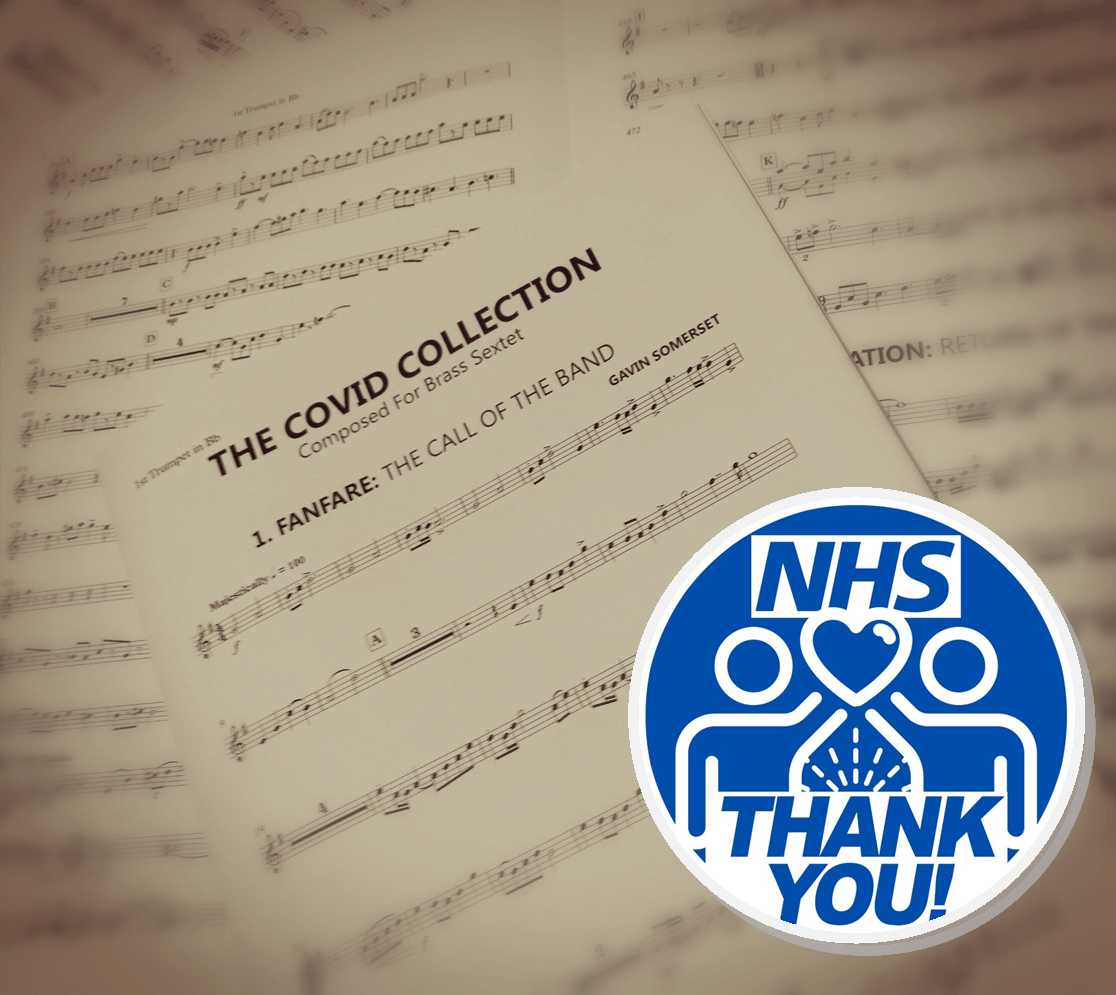
The Covid Collection - Gavin Somerset
This exciting new 22-minute concert suite for Brass Sextet has been composed during the months of lockdown charting the feelings of a nation, with seven movements playable by 6 (or more) players. The music was composed with the intention for players to perform either together live in a small group, in isolation by way of a virtual performance (downloadable backing tracks are available to play along to) and ultimately, to give players something to enjoy as we all miss our brass band families. This concert suite is the perfect addition to all bands' libraries at a time when rehearsals are limited. Several of the movements are already in preparation for a full band edition to be released at a later date: (also available as a digital download worldwide - purchase now & print to play). Bands purchasing this sextet edition will be eligible for a discount on the upcoming full brass band edition of the concert suite. ------------------------------------------------------------------------------------- Movement 1: FANFARE: The Call of the Band - CLICK HERE TO DOWNLOAD PLAYBACK TRACK This opening fanfare gives way to a full of life and energy. With catchy melodies and harmonies, it is an effective opening to any concert programme and the perfect way to begin the Suite. Movement 2: March of the Antibodies - CLICK HERE TO DOWNLOAD PLAYBACK TRACK A cheeky little number that keeps on fighting though. Whilst not a March in the traditional brass band sense, players should aim to give a 'happy' performance of this movement ensuring smiles all around for both performers and the audience.Movement 3: Solidarity - CLICK HERE TO DOWNLOAD PLAYBACK TRACK The first slow movement of the concert suite aims to reflect on the isolation many of us felt during the time of lockdown. However, during these times, walks out with loved ones allowed many to connect and enjoy downtime, not often afforded to many. Movement 4: Lazy Days - CLICK HERE TO DOWNLOAD PLAYBACK TRACK A movement whose title really does say it all. A laid back swing number that should be played in an as relaxed manner, as possible!Movement 5: Hymn for Carers (Dedicated to the NHS & Care Workers) - CLICK HERE TO DOWNLOAD PLAYBACK TRACK Dedicated to the NHS & Care Workers, this hymn tune is filled with emotional highs and lows, felt by many of the hospital and care staff who worked tirelessly to keep our people safe, with a timely nod at the end to Vera Lynn & our missed VE day commemorations. Movement 6: Army of the Keyworkers - CLICK HERE TO DOWNLOAD PLAYBACK TRACK A stirring work in 12/8 which rightfully, depicts our heroes who kept the country moving through the most difficult of times. An heroic number for players to enjoy.Movement 7: CELEBRATION: Return of the Band - CLICK HERE TO DOWNLOAD PLAYBACK TRACK Little needs to be said about this movement, as at this time of release, we cannot yet celebrate the return of all players to the band rooms across the country. However, when that time comes, this movement is to be played with the joy of normality we shall all feel. CLICK HERE TO DOWNLOAD THE FULL SUITE BACKING TRACK ------------------------------------------------------------------------------------- Each movement can be performed as a standalone item, or form part of the full 22-minute concert suite. Sextet scored for: x1 Cornet I in Bbx1 Cornet 2 in Bb1x Flugelhorn1x Tenor Horn in Eb1x Euphonium/Baritone in Bb1x Eb Bass*extra parts included are, Cornet parts in Eb & C, Horn in F, Euphonium/Baritone in BC, Trombone (TC and BC), BBb Bass in TC & Tuba in BC.
In Stock: Estimated dispatch 1-3 working days
-
 £98.00
KirkFeld (Trombone Solo with Brass Band - Score and Parts) - Kirkhope, Grant - McKenzie, Jock
Written for Ian Bousfield and the International Trombone Festival 2017. Grant Kirkhope is a BAFTA nominated British composer who has created the soundtrack for video games that have sold in excess of 30 million copies. From "GoldenEye" to "Banjo-Kazooie", "Viva Pi?ata" to "Donkey Kong", "Kingdoms of Amalur: Reckoning" to "Civilization: Beyond Earth" and "Perfect Dark" to "Castle of Illusion starring Mickey Mouse". He has also recently scored the feature film "The King's Daughter" starring Pierce Brosnan and William Hurt and is currently working on "Yooka Laylee" and "Dropzone". Grant's score for "Viva Pi?ata" was nominated by BAFTA in the Original Score category in its 2007 awards. Grant is represented by the prestigious Gorfaine/Schwartz Agency by Cheryl Tiano and Kevin Korn. Grant has a degree in music from the Royal Northern College of Music, Manchester, where he majored in classical trumpet, is a green card holder and now lives in Agoura Hills, LA with his wife and two children. "Ian and I first met when we were around 15 years old. We both played in our county orchestra, the North Yorkshire Schools Symphony Orchestra (I was a trumpet player). I think we hit it off straight away, as we were definitely a couple of cheeky kids, if you know what I mean! We both ended up playing in Rowntree Mackintosh Brass Band for a while too which Ian's Dad, Trevor conducted. We bumped into each other again when we both went for the Shell/LSO Scholarship. I got to the area finals in Manchester so I was pretty pleased with myself but then I saw Ian and I knew it was all over! Of course Ian went on to win and the rest is history. I saw him again when I was attending the Royal Northern College of Music around 1983 by which time Ian had just got the principal chair at the Halle Orchestra. Then I guess 30 something years went by as we both went about our lives and lost touch. We re-kindled our friendship due to his wife really. She emailed me to say it was Ian's 50th birthday and she was collecting stories from all his friends over the years. After that we got back in touch and then one day on Facebook I got a message from him in typical dry Yorkshire fashion "now then Grant, I had a listen to your music and I think it's good, how about writing a piece for me ?" I was a little bit unsure at first but of course I loved Ian's playing and of course I said yes. Over a Skype call in 2016, he asked me what I thought I'd write. I said since I live in LA I'd like to write a "Hollywood" trombone piece. Imagine if John Williams had written a piece for solo trombone, that's what I'd like to write - well I'd certainly like to try" - Grant Kirkhope
Estimated dispatch 7-14 working days
-
 £34.95
SLOW RIDE IN A STATIC MACHINE, A (Brass Band) - Lawrence, Phil
A Slow Ride in a Static Machine was inspired some time ago when my (late) Father came to visit me "down in London" as he put it. It was based not on one of his circular mishaps, but on several! He was always directed carefully, but refused to carry a map in the car! At one time when I lived in North London I would meet him outside the capital, and he would then follow be back to my place, but after I moved to East London I made him bite the navigational bullet and transverse the 'M25 Orbital'. His main problem seemed to be getting off this mesmerising circular cark park. He would often phone (in a weary tone) from the Dartford Tunnel (which is 5 junctions past the one he needed to get off at), asking me to, "bring him in" so to speak. I would always refuse. And then, he would do the opposite (especially when travelling at night), he would phone me up from near Cambridge (he'd gone the wrong way up the M11 away from London by 45 miles), and would ask where he was!The title is obviously a play on John Adams' composition, A Short Ride In A Fast Machine. This quirky tone poem starts as a wind-up by using those unwanted intervals of augmented 4th's and minor 9th's & 7th's in the main tune, before hearing the road works, the juggernauts multi horns, fender-benders, ambulance and police sirens! This then all works to a back beat on kit. The wind-up start gets to an almost Go-Go 1960's Disco middle section (the nostalgic hay-days of the open road), where our wind-up tune falls into place and we all relax as we can now drive at 42.1 mph! We DC, and then get into a right car mess in the Coda!Phil Lawrence.Duration:4:00
Estimated dispatch 7-14 working days
-
 £39.99
Evolution (Five States of Change) (Brass Band - Score only) - Sparke, Philip
Evolution was commissioned by Kunstfactor for the 4th section of the Dutch National Brass Band Championships (NBK) 2011. It is dedicated to Jappie Dijkstra and the Music Information Centre (MUI), Arnhem, Holland, in acknowledgement of their outstanding work in developing brass band repertoire.The composer writes:The idea for the piece came when I was reading an article about a branch of Chinese philosophy which is abbreviated as Wu Xing, which has no exact translation but can mean, for example, five elements, five phases or five states of change. It is central to all elements of Chinese thought, including science, philosophy, medicine and astrology, and in simple terms tries to create various cyclic relationships between five elements in all walks of life. An example is: Earth - Metal - Water - Wood - Fire - (Earth) etc. where (in one cycle) earth bears metal, metal changes to liquid (water) when heated, water helps trees grow, wood burns to create fire, fire produces ash (earth) and the cycle continues. I was particularly interested in the cycle of emotions: Meditation - Sorrow - Fear - Anger - Joy - (Meditation) etc. and thought this cyclic principle would provide an effective emotional journey for a piece of music. So Evolution has five equal sections which loosely characterise this emotional cycle. I have tried to make the music grow organically, with minimal repetition, and each movement evolves from the musical elements at the end of the previous one, with the opening material appearing, transformed, at the end of the piece to complete the cycle.- Philip SparkeDuration: 11:15
Estimated dispatch 7-14 working days
-
£106.99
Evolution (Five States of Change) (Brass Band - Score and Parts) - Sparke, Philip
Evolution was commissioned by Kunstfactor for the 4th section of the Dutch National Brass Band Championships (NBK) 2011. It is dedicated to Jappie Dijkstra and the Music Information Centre (MUI), Arnhem, Holland, in acknowledgement of their outstanding work in developing brass band repertoire.The composer writes:The idea for the piece came when I was reading an article about a branch of Chinese philosophy which is abbreviated as Wu Xing, which has no exact translation but can mean, for example, five elements, five phases or five states of change. It is central to all elements of Chinese thought, including science, philosophy, medicine and astrology, and in simple terms tries to create various cyclic relationships between five elements in all walks of life. An example is: Earth - Metal - Water - Wood - Fire - (Earth) etc. where (in one cycle) earth bears metal, metal changes to liquid (water) when heated, water helps trees grow, wood burns to create fire, fire produces ash (earth) and the cycle continues. I was particularly interested in the cycle of emotions: Meditation - Sorrow - Fear - Anger - Joy - (Meditation) etc. and thought this cyclic principle would provide an effective emotional journey for a piece of music. So Evolution has five equal sections which loosely characterise this emotional cycle. I have tried to make the music grow organically, with minimal repetition, and each movement evolves from the musical elements at the end of the previous one, with the opening material appearing, transformed, at the end of the piece to complete the cycle.- Philip SparkeDuration: 11:15
Estimated dispatch 7-14 working days
-
 £15.00
Symphony in Two Movements (Brass Band - Study Score) - Gregson, Edward
Selected as the Championship Section test piece for the National Brass Band Championships of Great Britain 2025This work was jointly commissioned by the National Youth Brass Band of Great Britain (NYBBGB) and the National Youth Brass Band of Wales (NYBBW), the latter with funding from T Cerdd (Music Centre Wales), to celebrate their 60th and 30th anniversaries respectively. The first performances were given at Cadogan Hall, London, in April 2012, by the NYBBGB, conducted by Bramwell Tovey; and at the Great Hall, Aberystwyth University, in July 2012, by the NYBBW, conducted by Nicholas Childs.When I was approached about a joint commission to write a new work to celebrate the anniversaries of these two outstanding youth bands I was delighted to accept, and decided to respond by writing a work apposite for the magnitude of these special occasions, namely a 'symphony for brass'.Through a long journey of writing music for brass band, which commenced with Connotations (1977), and continued with Dances and Arias (1984), Of Men and Mountains (1991), The Trumpets of the Angels (2000) and Rococo Variations (2008), I arrived at what I regard as the most important work of the cycle to date, combining as it does serious musical intent with considerable technical demands. It is perhaps my most abstract work for brass band, avoiding any programmatic content.The symphony lasts for some 19 minutes and is structured in two linked movements. The form is based on that used by Beethoven in his final piano sonata (Op.111), which is in two movements only: a compact sonata-form allegro, followed by a more expansive theme and four variations. Prokofiev also adopted this model in his 2nd Symphony of 1925.The opening Toccata of this Symphony is highly dramatic but compact, whilst still retaining the 'traditional' structural elements of exposition, development and recapitulation; indeed, it also has the 'traditional' element of a contrasting second subject - a gentle, lyrical modal melody first heard on solo cornets.In contrast, the longer and more substantial second movement Variations is built around a theme and four variations. The slowly unfolding chorale-like theme accumulates both added note harmony and increasing instrumentation, whilst the four variations which follow are by turn mercurial (fast, starting with all the instruments muted), march-like (menacing, with short rhythmic articulations underpinning an extended atonal melody), serene (a series of 'romances' for solo instruments alongside echoes of the chorale) with an emerging theme eventually bursting into a climax of passionate intent; whilst the final variation is a dynamic scherzo (concertante-like in its series of rapid-fire solos, duets, trios and quartets) with the music gradually incorporating elements of the main ideas from the first movement, thus acting as a recapitulation for the whole work. It reaches its peroration with a return to the very opening of the symphony, now in the 'home' tonality of F, and thus creating a truly symphonic dimension to the music.Most of the melodic material of the symphony is derived from the opening eleven-note 'row', which contains various intervallic sets, and although the work is not serially conceived it does use some typical quasi-serial procedures, such as canons, inversions, and retrogrades. The symphony uses somewhat limited percussion, in line with a 'classical' approach to the sound world of the brass band, alongside a use of multi-divisi instrumentation, whereby each player has an individual part rather than the traditional doubling within certain sections of the band.- Edward GregsonDuration: 19.00
Estimated dispatch 7-14 working days
-
 £107.95
Symphony in Two Movements (Brass Band - Score and Parts) - Gregson, Edward
Selected as the Championship Section test piece for the National Brass Band Championships of Great Britain 2025This work was jointly commissioned by the National Youth Brass Band of Great Britain (NYBBGB) and the National Youth Brass Band of Wales (NYBBW), the latter with funding from T Cerdd (Music Centre Wales), to celebrate their 60th and 30th anniversaries respectively. The first performances were given at Cadogan Hall, London, in April 2012, by the NYBBGB, conducted by Bramwell Tovey; and at the Great Hall, Aberystwyth University, in July 2012, by the NYBBW, conducted by Nicholas Childs.When I was approached about a joint commission to write a new work to celebrate the anniversaries of these two outstanding youth bands I was delighted to accept, and decided to respond by writing a work apposite for the magnitude of these special occasions, namely a 'symphony for brass'.Through a long journey of writing music for brass band, which commenced with Connotations (1977), and continued with Dances and Arias (1984), Of Men and Mountains (1991), The Trumpets of the Angels (2000) and Rococo Variations (2008), I arrived at what I regard as the most important work of the cycle to date, combining as it does serious musical intent with considerable technical demands. It is perhaps my most abstract work for brass band, avoiding any programmatic content.The symphony lasts for some 19 minutes and is structured in two linked movements. The form is based on that used by Beethoven in his final piano sonata (Op.111), which is in two movements only: a compact sonata-form allegro, followed by a more expansive theme and four variations. Prokofiev also adopted this model in his 2nd Symphony of 1925.The opening Toccata of this Symphony is highly dramatic but compact, whilst still retaining the 'traditional' structural elements of exposition, development and recapitulation; indeed, it also has the 'traditional' element of a contrasting second subject - a gentle, lyrical modal melody first heard on solo cornets.In contrast, the longer and more substantial second movement Variations is built around a theme and four variations. The slowly unfolding chorale-like theme accumulates both added note harmony and increasing instrumentation, whilst the four variations which follow are by turn mercurial (fast, starting with all the instruments muted), march-like (menacing, with short rhythmic articulations underpinning an extended atonal melody), serene (a series of 'romances' for solo instruments alongside echoes of the chorale) with an emerging theme eventually bursting into a climax of passionate intent; whilst the final variation is a dynamic scherzo (concertante-like in its series of rapid-fire solos, duets, trios and quartets) with the music gradually incorporating elements of the main ideas from the first movement, thus acting as a recapitulation for the whole work. It reaches its peroration with a return to the very opening of the symphony, now in the 'home' tonality of F, and thus creating a truly symphonic dimension to the music.Most of the melodic material of the symphony is derived from the opening eleven-note 'row', which contains various intervallic sets, and although the work is not serially conceived it does use some typical quasi-serial procedures, such as canons, inversions, and retrogrades. The symphony uses somewhat limited percussion, in line with a 'classical' approach to the sound world of the brass band, alongside a use of multi-divisi instrumentation, whereby each player has an individual part rather than the traditional doubling within certain sections of the band.- Edward GregsonDuration: 19.00
Estimated dispatch 7-14 working days
-
 £57.95
Symphony in Two Movements (Brass Band - Score only) - Gregson, Edward
Selected as the Championship Section test piece for the National Brass Band Championships of Great Britain 2025This work was jointly commissioned by the National Youth Brass Band of Great Britain (NYBBGB) and the National Youth Brass Band of Wales (NYBBW), the latter with funding from T Cerdd (Music Centre Wales), to celebrate their 60th and 30th anniversaries respectively. The first performances were given at Cadogan Hall, London, in April 2012, by the NYBBGB, conducted by Bramwell Tovey; and at the Great Hall, Aberystwyth University, in July 2012, by the NYBBW, conducted by Nicholas Childs.When I was approached about a joint commission to write a new work to celebrate the anniversaries of these two outstanding youth bands I was delighted to accept, and decided to respond by writing a work apposite for the magnitude of these special occasions, namely a 'symphony for brass'.Through a long journey of writing music for brass band, which commenced with Connotations (1977), and continued with Dances and Arias (1984), Of Men and Mountains (1991), The Trumpets of the Angels (2000) and Rococo Variations (2008), I arrived at what I regard as the most important work of the cycle to date, combining as it does serious musical intent with considerable technical demands. It is perhaps my most abstract work for brass band, avoiding any programmatic content.The symphony lasts for some 19 minutes and is structured in two linked movements. The form is based on that used by Beethoven in his final piano sonata (Op.111), which is in two movements only: a compact sonata-form allegro, followed by a more expansive theme and four variations. Prokofiev also adopted this model in his 2nd Symphony of 1925.The opening Toccata of this Symphony is highly dramatic but compact, whilst still retaining the 'traditional' structural elements of exposition, development and recapitulation; indeed, it also has the 'traditional' element of a contrasting second subject - a gentle, lyrical modal melody first heard on solo cornets.In contrast, the longer and more substantial second movement Variations is built around a theme and four variations. The slowly unfolding chorale-like theme accumulates both added note harmony and increasing instrumentation, whilst the four variations which follow are by turn mercurial (fast, starting with all the instruments muted), march-like (menacing, with short rhythmic articulations underpinning an extended atonal melody), serene (a series of 'romances' for solo instruments alongside echoes of the chorale) with an emerging theme eventually bursting into a climax of passionate intent; whilst the final variation is a dynamic scherzo (concertante-like in its series of rapid-fire solos, duets, trios and quartets) with the music gradually incorporating elements of the main ideas from the first movement, thus acting as a recapitulation for the whole work. It reaches its peroration with a return to the very opening of the symphony, now in the 'home' tonality of F, and thus creating a truly symphonic dimension to the music.Most of the melodic material of the symphony is derived from the opening eleven-note 'row', which contains various intervallic sets, and although the work is not serially conceived it does use some typical quasi-serial procedures, such as canons, inversions, and retrogrades. The symphony uses somewhat limited percussion, in line with a 'classical' approach to the sound world of the brass band, alongside a use of multi-divisi instrumentation, whereby each player has an individual part rather than the traditional doubling within certain sections of the band.- Edward GregsonDuration: 19.00
Estimated dispatch 7-14 working days
-
 £59.95
Sinfonietta - Saints and Devils (Brass Band - Score and Parts) - Wiffin, Rob
Saints and Devils is a challenging three movement work:Dance with the Devil (4.30)A Glimpse of Paradise (4.45)Reyes Magos (3.45)I wrote it when I was living in Spain where the Catholic culture is still much more prevalent than in the UK. The first two movements are a transition from dark to light; Dance with the Devil is aggressive and occasionally macabre whereas A Glimpse of Paradise is serene.The first and final parts of the second movement were originally written for a sequence in the Royal Military Tattoo 2000, played under the John Magee poem High Flight - 'Oh I have slipped the surly bonds of Earth ............ Put out my hand, and touched the face of God'- with videos of eagle owls in flight dramatically projected onto the buildings of Horse Guards in Whitehall, London.The last movement, Reyes Magos, is the joyous fiesta of the Three Kings. In Spain, January 6th, rather than Christmas Day, is the main day of present-giving, marking the Epiphany, the arrival of the Kings from the Orient at the Nativity. Saints and Devils is technically and expressively demanding but is written within the realms of tonal language.- Rob WiffinDuration: 13.00
Estimated dispatch 7-14 working days
 View Music