
Results
-
 £44.95
VIVAT! (Brass Band - Score only) - Davoren, Tom
2012 National Championships Finals - First Section.Commissioned for the 2012 Section 1 Finals as a celebration of the Queen's Diamond Jubilee, the work is in three contrasting continuous sections that run continuously and the music is derived from Parry's coronation anthem, I Was Glad. The sections are:In Memorium, evoking the noble but gentle personality of the Queen's father, George VI. Opening with an atmospheric baritone solo (and later featuring solo horn, flugel horn, euphonium and solo cornet), the music explores themes of grief, sentimentality and hope.Coronation, a fanfare and subsequent theme which is grandiose in style, capturing the spirit and excitement of British pomp and ceremony.The closing, Jubilate is a celebration of life and family values, Vivat being Latin for life, or long life. The music passes through moments of tension, virtuosity, humour and jubilance before a finale constructed from connected musical fragments, drawn from throughout the work, form (for the first time) Parry's majestic I Was Glad theme.Duration: 10.45
Estimated dispatch 7-14 working days
-
 £69.95
Starmaker (Brass Band - Score and Parts) - Steadman-Allen, Ray
Described by the composer as one of his more ambitious works for brass band, this work is in three movements. Although each movement is capable of standing alone, the composer's own concept is totality with the three movements forming a composite whole. Starmaker presents in music the concept of God's creation of the universe. The frantic and sometimes harsh music of the first movement portrays the chaos from which the immortal and invisible wisdom of God created the order and structure of the heavens, with the stars and planets in their ordered places. An exquisite second movement, based on the benediction 'Now the day is over', brings a calm and ordered peace to the universe, also reminding listeners of the night sky, when God's amazing work is best viewed in all its awesome wonder. The final movement is celebratory in nature, with fragments of melodies like 'Praise to the Lord, the Almighty, the King of creation' appearing in various guises.
Estimated dispatch 7-14 working days
-
£34.95
Starmaker (Brass Band - Score only) - Steadman-Allen, Ray
Described by the composer as one of his more ambitious works for brass band, this work is in three movements. Although each movement is capable of standing alone, the composer's own concept is totality with the three movements forming a composite whole. Starmaker presents in music the concept of God's creation of the universe. The frantic and sometimes harsh music of the first movement portrays the chaos from which the immortal and invisible wisdom of God created the order and structure of the heavens, with the stars and planets in their ordered places. An exquisite second movement, based on the benediction 'Now the day is over', brings a calm and ordered peace to the universe, also reminding listeners of the night sky, when God's amazing work is best viewed in all its awesome wonder. The final movement is celebratory in nature, with fragments of melodies like 'Praise to the Lord, the Almighty, the King of creation' appearing in various guises.
Estimated dispatch 7-14 working days
-
 £74.95
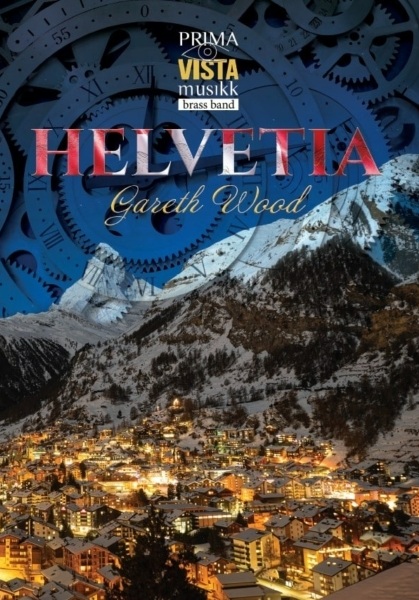
Helvetia (Brass Band - Score and Parts) - Wood, Gareth
I first went to Switzerland in the early 1970's and regularly played at the Lucerne Festival with the Royal Philharmonic Orchestra. It is a beautiful city, one of my favourite European cities.In writing Helvetia (the Roman name for Switzerland) I wanted to encapsulate the moods that remind me of this wonderful place. The work is in four distinct sections and is on the whole, self-explanatory.It opens with An Alpine Dawn and sunrise, the tubas and euphoniums substituting for the Swiss Alphorns. Next The Clock Shop at Mid-day, a loud ticking, chiming and the sad sound of a cuckoo, builds into the cacophony of the mid-day chimes. The third section is A Walk to Wagner's House. Just along the lake from the centre of town is Tribschen. This walk I have done many times, and it is here that Wagner wrote 'Tristan'. I have quoted the Dresden Amen (written by J.G. Naumann) which is much used in Parsifal. The final section is The Cesta Run, the most famous bob-sleigh run in the world. As we take each corner, the feeling of speed is demonstrated as only a brass band can do!The work is dedicated to the Cory Band and also to the memory of James Watson, a great cornet player, trumpeter and conductor. It was he who got me into writing for brass band and I hope this piece is worthy.- Gareth Wood (Feb. 2011)Duration: 11.00
Estimated dispatch 7-14 working days
-
 £31.95
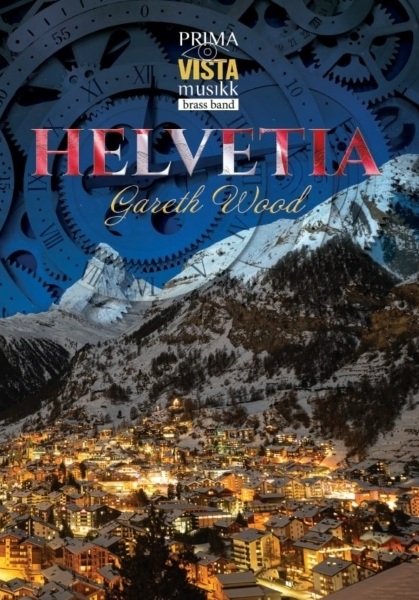
Helvetia (Brass Band - Score only) - Wood, Gareth
I first went to Switzerland in the early 1970's and regularly played at the Lucerne Festival with the Royal Philharmonic Orchestra. It is a beautiful city, one of my favourite European cities.In writing Helvetia (the Roman name for Switzerland) I wanted to encapsulate the moods that remind me of this wonderful place. The work is in four distinct sections and is on the whole, self-explanatory.It opens with An Alpine Dawn and sunrise, the tubas and euphoniums substituting for the Swiss Alphorns. Next The Clock Shop at Mid-day, a loud ticking, chiming and the sad sound of a cuckoo, builds into the cacophony of the mid-day chimes. The third section is A Walk to Wagner's House. Just along the lake from the centre of town is Tribschen. This walk I have done many times, and it is here that Wagner wrote 'Tristan'. I have quoted the Dresden Amen (written by J.G. Naumann) which is much used in Parsifal. The final section is The Cesta Run, the most famous bob-sleigh run in the world. As we take each corner, the feeling of speed is demonstrated as only a brass band can do!The work is dedicated to the Cory Band and also to the memory of James Watson, a great cornet player, trumpeter and conductor. It was he who got me into writing for brass band and I hope this piece is worthy.- Gareth Wood (Feb. 2011)Duration: 11.00
Estimated dispatch 7-14 working days
-
 £21.95
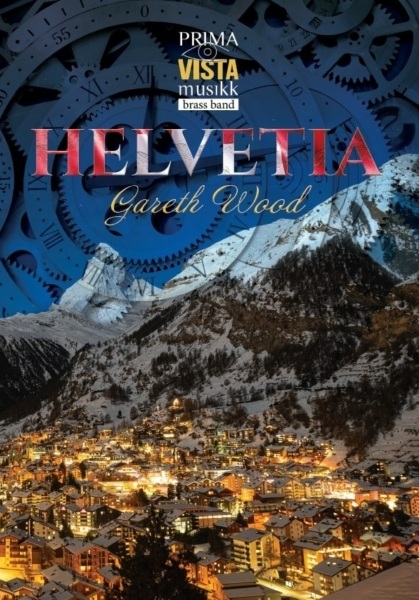
Helvetia (Brass Band - Study Score) - Wood, Gareth
I first went to Switzerland in the early 1970's and regularly played at the Lucerne Festival with the Royal Philharmonic Orchestra. It is a beautiful city, one of my favourite European cities.In writing Helvetia (the Roman name for Switzerland) I wanted to encapsulate the moods that remind me of this wonderful place. The work is in four distinct sections and is on the whole, self-explanatory.It opens with An Alpine Dawn and sunrise, the tubas and euphoniums substituting for the Swiss Alphorns. Next The Clock Shop at Mid-day, a loud ticking, chiming and the sad sound of a cuckoo, builds into the cacophony of the mid-day chimes. The third section is A Walk to Wagner's House. Just along the lake from the centre of town is Tribschen. This walk I have done many times, and it is here that Wagner wrote 'Tristan'. I have quoted the Dresden Amen (written by J.G. Naumann) which is much used in Parsifal. The final section is The Cesta Run, the most famous bob-sleigh run in the world. As we take each corner, the feeling of speed is demonstrated as only a brass band can do!The work is dedicated to the Cory Band and also to the memory of James Watson, a great cornet player, trumpeter and conductor. It was he who got me into writing for brass band and I hope this piece is worthy.- Gareth Wood (Feb. 2011)Duration: 11.00
Estimated dispatch 7-14 working days
-
 £54.95
WORLD WITHIN, A (Brass Band Parts) - Scott, Andy
Brass Band parts only. 'A World Within' is a one-movement work that starts with a simple theme stated by the Soprano Cornet before an ostinato figure in 6/8 time emerges (Vibraphone, Horns and muted 2nd and 3rd Cornets) over which firstly Solo Cornet, and then both Solo Cornets (1 & 2), play a sustained melody. A shift between major and minor harmonies characterises the 'B' section, before making way for a virtuosic Flugel solo. When the Flugel leaves centre stage the front line Cornets take over, leading to a full bodied reprise of the 'B' section. The low brass bridge the gap between what is in effect the end of the first main section of the piece and the second section. The constant time shift between 3/4 and 6/8 that has been prevalent through-out 'A World Within', re-emerges towards the end of the 'slow, heavy blues' section, leading into an intricate almost fugue-like passage (Horn and Baritone leading the way). Out of this comes a short transitional bridge section that leads us back to the (transposed) original 6/8 time theme and feel, this time scored with a bold directness that leads to a powerful 2/4 time passage. The climax of 'A World Within' is heralded by one dark and dissonant chord that is repeated three times. A flashback moment occurs where the 'hymn' is stated (muted Cornets) in a bitonal harmonic world. A final statement emerges from the denseness of sound, a re-working of the initial theme (Solo Cornet), with the last work being left to Solo Eb Bass. Dur: 13:00
Estimated dispatch 7-14 working days
-
£20.00
WORLD WITHIN, A (Brass Band Score) - Scott, Andy
Brass Band score only. 'A World Within' is a one-movement work that starts with a simple theme stated by the Soprano Cornet before an ostinato figure in 6/8 time emerges (Vibraphone, Horns and muted 2nd and 3rd Cornets) over which firstly Solo Cornet, and then both Solo Cornets (1 & 2), play a sustained melody. A shift between major and minor harmonies characterises the 'B' section, before making way for a virtuosic Flugel solo. When the Flugel leaves centre stage the front line Cornets take over, leading to a full bodied reprise of the 'B' section. The low brass bridge the gap between what is in effect the end of the first main section of the piece and the second section. The constant time shift between 3/4 and 6/8 that has been prevalent through-out 'A World Within', re-emerges towards the end of the 'slow, heavy blues' section, leading into an intricate almost fugue-like passage (Horn and Baritone leading the way). Out of this comes a short transitional bridge section that leads us back to the (transposed) original 6/8 time theme and feel, this time scored with a bold directness that leads to a powerful 2/4 time passage. The climax of 'A World Within' is heralded by one dark and dissonant chord that is repeated three times. A flashback moment occurs where the 'hymn' is stated (muted Cornets) in a bitonal harmonic world. A final statement emerges from the denseness of sound, a re-working of the initial theme (Solo Cornet), with the last work being left to Solo Eb Bass. Dur: 13:00
Estimated dispatch 7-14 working days
-
 £79.95
The Plantagenets (Brass Band - Score and Parts) - Gregson, Edward
A Symphonic Study for Brass BandThe Plantagenets was Gregson's first major test piece, written specially for the 1973 National Brass Band Championships.In this ambitious symphonic study he turned his attention to music which sets out to create a mood or atmosphere, in contrast to his earlier brass band works such as Essay and Partita where the underlying concerns are technical rather than expressive. However, Gregson is at pains to emphasise that The Plantagenets is not programme music. 'Symphonic' is the optimum word here. In its textural and harmonic complexity, its rhythmic and melodic variety, this was his most ambitious brass band piece so far. His language, with its roots in Hindemith and Bartok is further enriched here with the expressive language of Holst and Rachmaninov.As he says in his notes on the work: The Plantagenets attempts to portray the mood and feelings of an age - that of the House of Plantagenet which lasted from the middle of the twelfth century to the end of the fourteenth. To many it conjures up an age of chivalry and this is represented by fanfare motifs which occur throughout the work in varied form.Characteristically, the composer then goes on to describe not the atmosphere or mood he is trying to convey, but the means by which the music has been composed: the opening fanfares, based on the interval of the third, generating the musical material for the whole work; an exposition of two themes - one fanfare-like, one lyrical (on horns); a slow episode introducing a new melody on solo horn (answered by cornet and euphonium in canon); a little scherzo, fugal in character; and a recapitulation leading to a maestoso statement of the slow movement theme with a final reference to the fanfares as a triumphant conclusion.Duration: 11.30
Estimated dispatch 7-14 working days
-
£39.95
The Plantagenets (Brass Band - Score only) - Gregson, Edward
A Symphonic Study for Brass BandThe Plantagenets was Gregson's first major test piece, written specially for the 1973 National Brass Band Championships.In this ambitious symphonic study he turned his attention to music which sets out to create a mood or atmosphere, in contrast to his earlier brass band works such as Essay and Partita where the underlying concerns are technical rather than expressive. However, Gregson is at pains to emphasise that The Plantagenets is not programme music. 'Symphonic' is the optimum word here. In its textural and harmonic complexity, its rhythmic and melodic variety, this was his most ambitious brass band piece so far. His language, with its roots in Hindemith and Bartok is further enriched here with the expressive language of Holst and Rachmaninov.As he says in his notes on the work: The Plantagenets attempts to portray the mood and feelings of an age - that of the House of Plantagenet which lasted from the middle of the twelfth century to the end of the fourteenth. To many it conjures up an age of chivalry and this is represented by fanfare motifs which occur throughout the work in varied form.Characteristically, the composer then goes on to describe not the atmosphere or mood he is trying to convey, but the means by which the music has been composed: the opening fanfares, based on the interval of the third, generating the musical material for the whole work; an exposition of two themes - one fanfare-like, one lyrical (on horns); a slow episode introducing a new melody on solo horn (answered by cornet and euphonium in canon); a little scherzo, fugal in character; and a recapitulation leading to a maestoso statement of the slow movement theme with a final reference to the fanfares as a triumphant conclusion.Duration: 11.30
Estimated dispatch 7-14 working days
 View Music