
Results
-
 £54.99
Heb je even voor mij - Klaas van der Woude
Since his first successes in the 1990s the amiable popular singer Frans Bauer has grown into a megastar in the Netherlands. In Germany, too, he has a great number of fans. Although he is derided by many because of his schmalzy style, Frans Bauer sells CDs galore, attracts full houses everywhere and can be viewed in his own reality soap on television. In 2004 he was even awarded a Gouden Harp (Gold Harp), which is the most important prize within Dutch music. It is presented to artists and composers who have promoted Dutch light music in their own unique way during their career. The cheery singalong Heb je even voor mij (Got a Minute for Me) is a great top hit: a winner in everypub and at parties. This arrangement by Klaas van der Woude willput the musicians as well as the audience in a happy mood.
Estimated dispatch 5-14 working days
-
 £60.99
Bist Du bei mir - Johann Sebastian Bach - Jacob de Haan
The song Bist du bei mir, geh' ich mit Freuden zum Sterben und zu meiner Ruh' (BWV 508) was composed by Johann Sebastian Bach for his second wife Anna Magdalena (1701-1760), who he married in 1721. The unparalleled popularity of this song is probably due to the magnificent, sensitive melody that wonderfully fits the anonymous text, in which a loved one is told that even death is beautiful "as long as you are there with me." Jacob de Haan has produced this beautiful arrangement for brass band, which is suitable for many occasions.
Estimated dispatch 5-14 working days
-
 £74.99
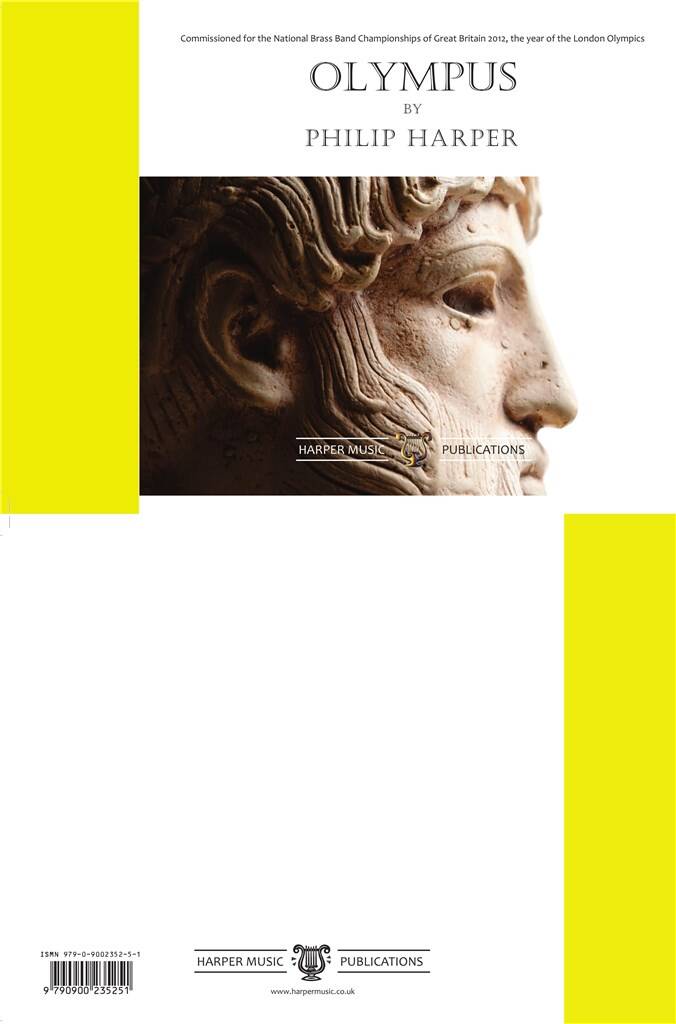
Olympus - Philip Harper
Selected as the test-piece for the 3rd Section Regional contests of the National Brass Band Championships 2012The music begins with a depiction of the exciting Opening Ceremony where noisy fanfares and sudden swells add to the cosmopolitan flag-waving clamour. Without a break the music leads to The Chariot Race, a fast compound-time gallop withthundering hooves in the basses and percussion, and a heroic melody introduced by the tenor horns. Chariot racing was the main equestrian event in the Ancient Greek Games, which were founded in memory of King Oenomaus. In the Greek legend he suffereddefeat in a chariot race to his son-in-law and Zeus' grandson, Pelops, but much of the music is bitter-sweet to symbolise the fact that Pelops had to cheat to win drawing parallels with some of the issues still facing modern-day athletics. A slow, mystical passage follows, describing The Temple of Zeus at Olympia. The statue of Zeus, who was honoured throughout the Ancient Games' history, was housed inside the temple and was one of the Seven Wonders of the Ancient World. Themusic depicts this period of the dawn of one of mankind's most ancient civilisations and there is a series of solo passages above a drone. The next section is called The Olympic Flame and a broad and lyrical anthem-like melody develops slowly in the euphoniums, which gradually ascends until the horns can take it over before passing upwards again to the cornets (Higher). The musicbursts into bright life at the lighting of the flame and the regular rhythmic pattern which has been established goes through an accelerando (Faster). The final section is called The Olympic Truce and aims to capture the cooperative spirit of the ancient practice of ending wars for the duration of the games. The anthem-like melody makes an affirmatory return (Stronger) and the work ends asit began with a blaze of colour and a real sense of optimism and global celebration. "Citius, Altius, Fortius" (Faster, Higher, Stonger)NOTES ON PERFORMANCEPercussion requirements: 1 to 3 players (3 Timpani, Snare Drum, Tenor Drum, Cymbals, Glockenspiel, Triangle)
Estimated dispatch 5-14 working days
-
 £154.99
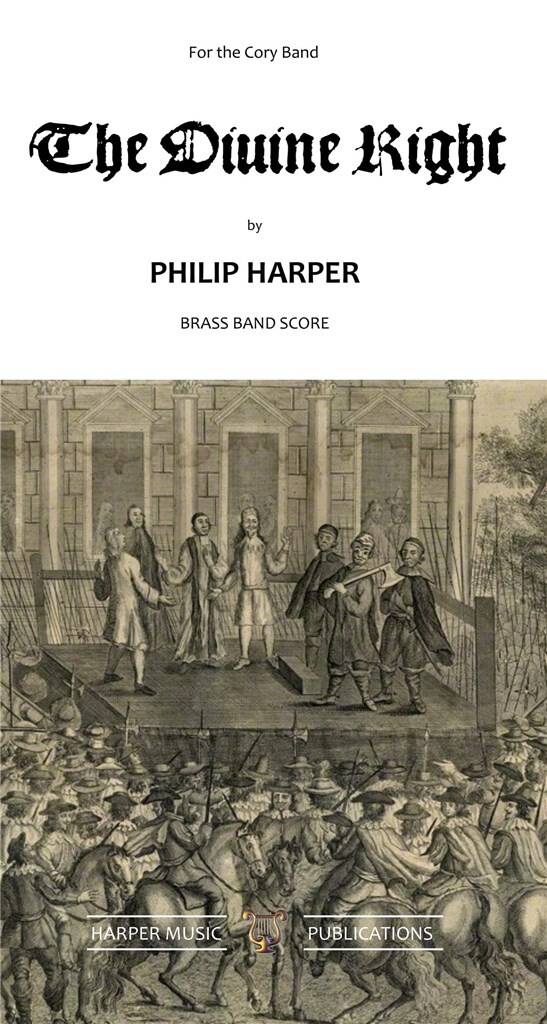
The Divine Right - Philip Harper
At the time of composing this piece, the Arab Spring was sweeping through the Middle East. It seemed that almost every week a new countrys people had risen up against the regimes and dictatorships which had prevailed for generations, leaving manynations at a defining crossroads in their history. There were so many possible ways ahead: so many hopes, yet so many uncertainties.My music is a depiction of these revolutionary times, and several musical themes are in turn presented, discussed, considered, fought over, altered, rejected or accepted. Most nations have had, or probably will have, their own Arab Spring, including my own, the United Kingdom. Events of 17th Century Britain provide the context for this piece, particularly those following the execution of the tyrant King Charles I on30 January 1649. The regicide was in part due to Charless steadfast belief in the Divine Right of Kings, and led to a tumultuous interregnum, where England stood at its own defining crossroads.The music begins turbulently, before King Charles appears and is led to the gallows outside Banqueting House in central London where he is brutally decapitated. From the assembled crowd rose, according to one observer, a moan as I never heard before and desire I may never hear again.The music descends to emptiness. The musical argument which follows is not strictly programmatic, but a number of musical themes are all thrown into the melting pot, representing ideas such as: religion; military force; reasoned Parliamentary debate; and the chattering,irrepressible voice of the people. Additionally, there are some quotations from the music of royalist composer Thomas Tomkins (1572-1656), who was often in tune with the feeling of the times. This defining episode in Englands history was brought to a close with the Restoration of the monarchy in 1660, and as the exiled King Charles II rode back into London the diarist John Evelyn wrote: Never was so joyful a day seen in this nation. I stood in the Strand and beheld it, and blessed God.At the end of the piece the bells ring out, and the musical appearance of the King has transformed from turbulent to triumphant. Philip Harper, 2013
Estimated dispatch 5-14 working days
-
 £87.99
Lady Claus - Thierry Deleruyelle
The Christmas festive season is a time for sharing the most wonderful stories. There are few female characters in these tales. And yet, they do exist in many countries. In Italy, Mother Christmas is associated with the Befana; in Russia with Babushka; and with Lucia in Scandinavia, Frau Holle in Germany, Mari Lwyd in Wales, and Tante Arie in France. What these women have in common is that they too hand out presents to children.The music begins with a majestic introduction that draws us into the heart of the Christmas legends. The timpani and sleigh bells then launch into a fast, joyful, and dynamic section. Finally, the music softens, with a Christmas chorale heard across multiple sections. The piece ends in a hushed atmosphere, as if all that remained was a Christmas tree twinkling in the darkness.Lady Claus was commissioned by the Montbeliard Municipal Wind Band, conducted by Laurent Zemp, to mark its 150th anniversary. This work pays tribute to those legendary women who contribute to the beauty and magic of Christmas, not only by delivering presents but also by passing on the human values they embody.
Estimated dispatch 5-14 working days
-
 £134.99
West Wind - Oliver Waespi
West Wind is structured in three parts, each bearing a subtitle drawn from poems of Emily Bronte (1818-1848). Poetry of the Romantic period, Bronte's in particular, often presents a gentle, almost innocent surface, beneath which lies the most elemental and volatile emotional forces capable of erupting at any moment.Accordingly, the opening movement, West-wind, in the glory and pride!, begins with a mellow, warm soundscape, underpinned by lightly pulsating patterns, almost like an aquarelle. Gradually however, the music transitions into far rougher, forward-driven gestures - turbulent, restless, and at times unpredictable, much like the west wind itself.The ensuing Adagio reflects on the poem Stars, in which a fundamental tension between exaltation and regret, another recurring feature of Bronte's poetry, is palpable throughout. Introspective solo and chamber music statements give way to a broad ecstatic sound field involving the full ensemble, before finally receding into a solitary euphonium soliloquy.The final movement, Wild words of an ancient song, takes the form of an extended rondo-scherzo, driven by virtuosic, perpetual motion. The sense of relentless pursuit bears a nod to The Boy on the Moor by the German poet Annette von Droste-Hulshoff, a contemporary of Bronte who explored similar narratives, albeit from a different perspective.Although certain core musical elements recur - pulsating patterns, a chorale, a tone row - the work is guided less by systematic symphonic development than by an intuitive stream of variants. These generate a sequence of metamorphoses that illuminate the material from shifting vantage points, projecting the emotional landscapes of Romantic poetry into the present day.West Wind was commissioned by the Flowers Band and was first performed under Musical Director Paul Holland, at the 2026 European Brass Band Championships in Linz (AT), where they also became European Champions.
Estimated dispatch 5-14 working days
-
 £69.99
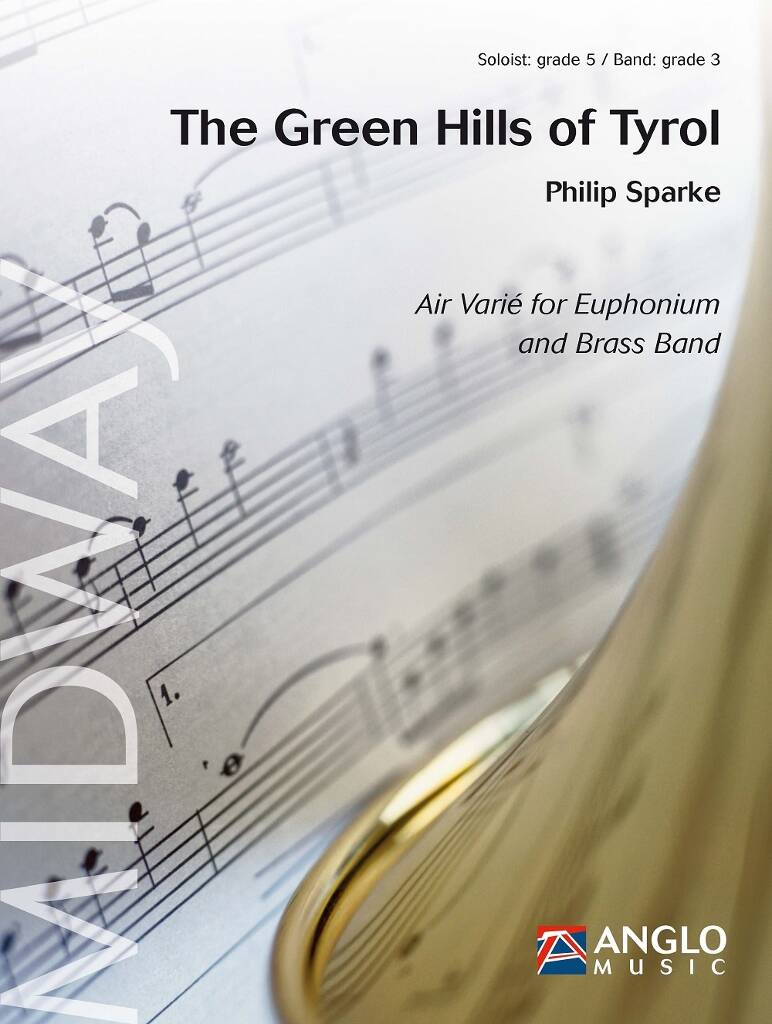
The Green Hills of Tyrol - Philip Sparke
The Green Hills of Tyrol was commissioned by Jrena and Beat Knusel for their son, Swiss euphonium player Joel Knusel, to celebrate his 20th birthday in 2019. The request was for a piece suitable for use in a solo competition, possibly using a Scottish or Irish melody, and composer Philip Sparke suggested an 'old-fashioned' air varie might be a suitable idea. The piece follows the well-established formula of a theme followed by four variations. The history of the original melody is fascinating and, although it is now well-known as a bagpipe tune, its background is Austrian or Italian, rather than Scottish. The tune appears as a chorus of Swiss soldiers in Rossini's 1829 opera William Tell but was possibly an existing Tyrolean folk tune. In 1854, during the Crimean War, Pipe Major John MacLeod of the 93rd Highlanders heard a band of the Sardinian contingent playing selections from the opera in camp before the Siege of Sebastopol. He was struck by the melody and arranged it for his pipers, calling it The Green Hills of Tyrol, referring to Tell's visit to that corner of Austria in the opera. It has since become universally popular among pipe bands who usually refer to it as A Scottish Soldier, following the addition of new lyrics in a 1961 hit by Andy Stewart.
Estimated dispatch 5-14 working days
-
 £119.99
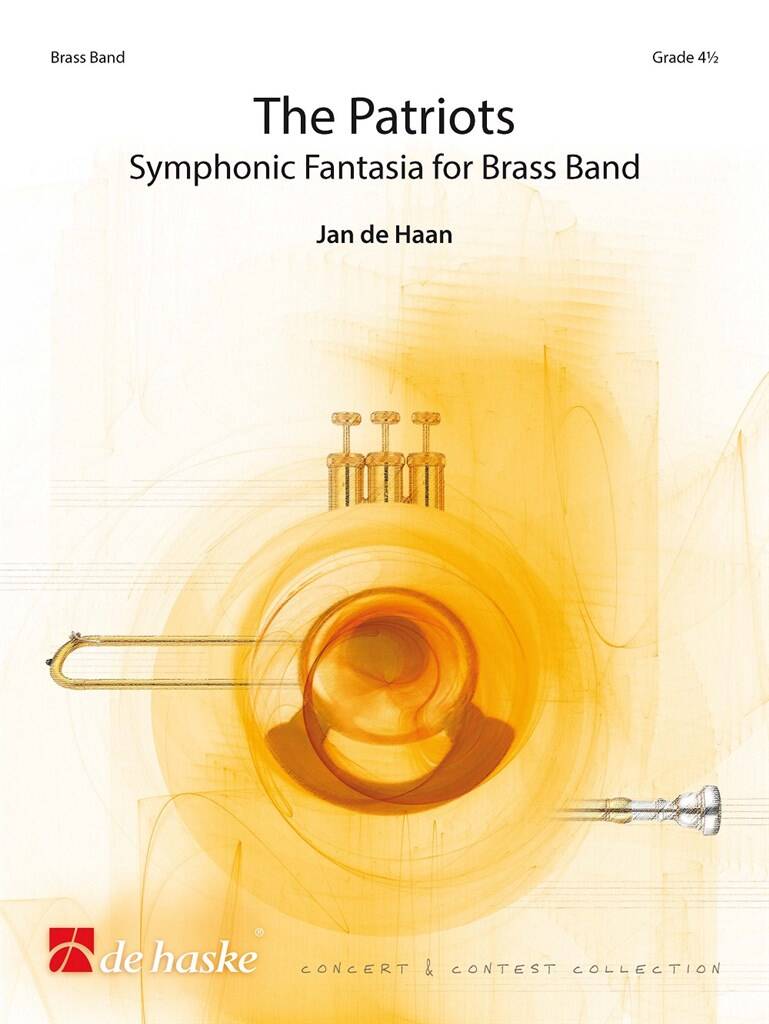
The Patriots - Jan de Haan
The Dutch patriottentijd (literally 'Time of the Patriots') was a period of political instability in the 1780s. The country was led by regents who were occupied with their own personal interests rather than dedicating themselves to the needs of the people. In this revolutionary period, the devoted republican Patriots were in conflict with the Orangists. A civil war followed, in which the Patriots were beaten and driven away by a Prussian army. This composition is an abstract piece inspired by the Patriots. The thematic material is based on the Dutch war song 'Merck toch hoe sterck'. Its powerful minor melody, which has its origins in the Eighty Years' War, is recognizablethroughout the work, presented in variations of constantly shifting character.
Estimated dispatch 5-14 working days
-
£84.99
Alpine Variations - Bertrand Moren
Grandiose is probably the word that best defines the character of the alpine regions. The magnificence of the mountains is fascinating. It makes anyone who has visited this region feel nostalgic and cherishing the hope of returning to see them again one day.Alpine Variations is a four-movement work written in the theme and variations form which reflects the majestic grandure of this breathtaking region in music.
Estimated dispatch 5-14 working days
-
£60.99
Aurora Borealis - Morten J. Wallin
Aurora Borealis, more popularly known as the Northern Lights, was a source of superstition in the Middle Ages. This dazzling spectacle, which is accompanied by whispering sounds, put the fear of God into those who didn't know that this was simply one of nature's grand shows. Many heathen attributed the phenomenon to the incomprehensible ways of the gods. Today we know better. Every 11 years, the amount of particles emitted by the sun is at its highest level, as is the case this year. These particles are hurled away from the sun, beyond its magnetic field. A small percentage of these particles are able to penetrate the earth's atmosphere. Once they are here, they begin tocollide and form the beautiful patterns in the night sky which we call the Aurora Borealis.
Estimated dispatch 5-14 working days
 View Music