
Results
-
 £54.99
Soweto Swing - Peter Martin
The sparkling music from Soweto (South Africa) has a long history. The rhythmic dances of Kwela, the 'syncopated guitars' of Mbaqanga, the saxophones and trumpets with their supple African jazz sounds as well as the infectious and sometimes gripping choir singing. All these elements can be recognized when listening to the 'Soweto String Quartet', which in its turn inspired Peter Martin to write 'Soweto Swing'.
Estimated dispatch 5-14 working days
-
 £84.99
Convergents - Franco Cesarini
With Convergents Franco Cesarini has succeeded in composing a piece suitable for both concerts or contests which whilst not being too difficult still has the feel of a major work. This extremely rhythmical piece is built upon three themes which, after being introduced in turn, finally converge into the triumphal finale of the work. This scintillating workwill be a definite enrichment to the repertoire of your concert band.
Estimated dispatch 5-14 working days
-
 £76.99
Last Call - Otto M. Schwarz
Last Call was commissioned by and written for Brass Band Oberosterreich (Austria) as a special concert finale. Austrian composer Otto M. Schwarz was asked to write an encore piece with which the band could really show off. Featuring all the sections of the band in turn, your audience will surely be dazzled by their skills!
Estimated dispatch 5-14 working days
-
 £59.99
Merry-Go-Round - Philip Sparke
Merry-Go-Round is a mini concerto for band in which each section takes a turn as soloist. On a merry-go-round the viewpoint is constantly changing, this being portrayed by different instrumental groups playing variations on the main theme, continually coming to the fore. This attractive work will bring all the excitement of the fairground to your concert.
Estimated dispatch 5-14 working days
-
 £87.99
Moon Song, Sun Dance - Philip Sparke
Moon Song, Sun Dance was commissioned by Flugel Horn virtuoso, Claude Romailler, and premiered by him at the Swiss National Solo and Quartet Championships in April 2012. As the title implies, the work is in two contrasting movements, which can be performed separately or together.Moon Song opens with a flowing modal theme, which the soloist embellishes before the band takes centre stage. A central section brightens the mood with a new melody over the lightest of accompaniments; this is once again developed by the soloist until the original theme reappears, played by the band. This introduces a cadenza for the soloist which either closes the movement, or canbe extended to link directly to the second movement.Sun Dance is a vivace 6/8 scherzo which opens with a flourish from the band. The soloist then introduces the main theme, which in turn is taken up by the band. A short bridge passage heralds a change of key and a new melody from the soloist. A brief central interlude then introduces a change of meter and recalls the main melody of Moon Song, before a recapitulation leads to a florid coda, which brings the work to a close.
Estimated dispatch 5-14 working days
-
£54.99
Dear Frog - Victor Trojan - Georges Moreau
Dear Frog describes the story of a prince who changes into a frog and then waits for a princess to kiss him so that he can turn back into a prince again. A musical satire for the trombone and orchestra. What is remarkable about this work is the use of the "wah-wah sourdine" throughout the entire piece, which gives it an extra amusing flavour.
Estimated dispatch 5-14 working days
-
 £60.99
Spring Song - Jan de Haan
Spring has finally arrived. The days grow longer, birds prepare to nest, trees turn green and plants begin to bloom as nature wakes up from her winter sleep. This, and the fact that the composer's third grandson was born in the spring, were the inspiration for Spring Song.
Estimated dispatch 5-14 working days
-
 £54.99
Discovery March - Patrick Millstone
Patrick Millstone composed his 'Discovery March' for Gobelin Music Publications' 'Discovery Series' : The music in this series is meant to be a journey of discovery for incipient musicians who have started playing in an ensemble. 'Discovery March' is a cheerful march in which the melody part is not only played by the lead instrument, but rather by all instruments in turn.
Estimated dispatch 5-14 working days
-
 £109.99
Fincastle Overture - Jan Bosveld
Fort Fincastle was built in 1793 by royal governor 'Lord Dunmore at an unusual location: Nassau, the capital of the Bahamas. The name of the fort: Fort Fincastle' comes from Dunmore's second title of Viscount Fincastle '( Earl of Fincastle). He gave the fort a particular shape, a circular building with a sharp expansion in the form of a bow or bow of ship. In order to deceive enemy ships. The sounds of the first bars show the contours of a looming majestic stronghold, after a heroic theme follows. Soon we hear the threat of hostile elements. Work on the fort means much waiting and lonely, but you should always alert and vigilant for the ever lurking attack. After the turn of yet another attack there is a feeling of satisfaction and pride, we see the fort are on the hill towering above Nassau.
Estimated dispatch 5-14 working days
-
 £154.99
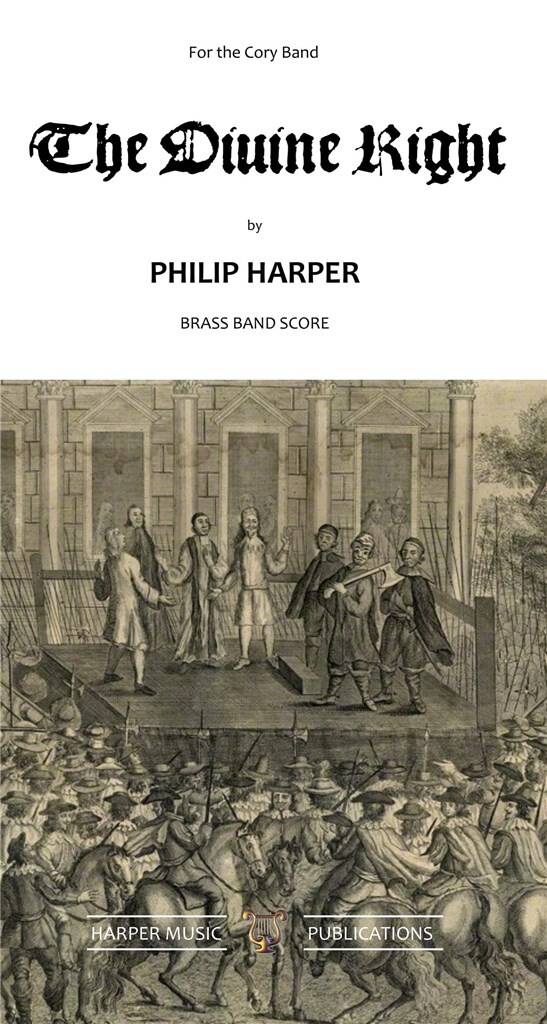
The Divine Right - Philip Harper
At the time of composing this piece, the Arab Spring was sweeping through the Middle East. It seemed that almost every week a new countrys people had risen up against the regimes and dictatorships which had prevailed for generations, leaving manynations at a defining crossroads in their history. There were so many possible ways ahead: so many hopes, yet so many uncertainties.My music is a depiction of these revolutionary times, and several musical themes are in turn presented, discussed, considered, fought over, altered, rejected or accepted. Most nations have had, or probably will have, their own Arab Spring, including my own, the United Kingdom. Events of 17th Century Britain provide the context for this piece, particularly those following the execution of the tyrant King Charles I on30 January 1649. The regicide was in part due to Charless steadfast belief in the Divine Right of Kings, and led to a tumultuous interregnum, where England stood at its own defining crossroads.The music begins turbulently, before King Charles appears and is led to the gallows outside Banqueting House in central London where he is brutally decapitated. From the assembled crowd rose, according to one observer, a moan as I never heard before and desire I may never hear again.The music descends to emptiness. The musical argument which follows is not strictly programmatic, but a number of musical themes are all thrown into the melting pot, representing ideas such as: religion; military force; reasoned Parliamentary debate; and the chattering,irrepressible voice of the people. Additionally, there are some quotations from the music of royalist composer Thomas Tomkins (1572-1656), who was often in tune with the feeling of the times. This defining episode in Englands history was brought to a close with the Restoration of the monarchy in 1660, and as the exiled King Charles II rode back into London the diarist John Evelyn wrote: Never was so joyful a day seen in this nation. I stood in the Strand and beheld it, and blessed God.At the end of the piece the bells ring out, and the musical appearance of the King has transformed from turbulent to triumphant. Philip Harper, 2013
Estimated dispatch 5-14 working days
 View Music