
Results
-
 £44.99
Cartoon Classics (Brass Band - Score and Parts)
In Cartoon Classics, Andrew Duncan has brought together four classic cartoon themes in one medley that will be a sure-fire hit with audiences everywhere. It features the Looney Tunes Theme (Merrily We Roll Along), The Pink Panther, The Flintstones and The Simpsons.Suitable for Advance Youth/3rd Section Bands and aboveDuration: 4.00
Estimated dispatch 7-14 working days
-
 £57.99
Irish Dances (Brass Band - Score and Parts)
The rich musical heritage of Ireland represents some of the greatest traditional melodies. These melodies somehow retain the flavour of the culture and its traditions, which at times can be as lively as they are enchanting. This setting for brass band features a familiar selection of contrasting dance-like tunes that are drawn from the modern era of traditional Irish songs.Duration: 4.00
Estimated dispatch 7-14 working days
-
 £34.95
The Ambassadors (Brass Band - Score and Parts)
This march was composed for the 1982 world tour by the New York Staff Band. The two featured tunes are 'Stand up for Jesus' and 'Marching through Georgia'.
Estimated dispatch 7-14 working days
-
 £29.95
Trevithick (Brass Band - Score and Parts)
Trevithick (2013) is a march for brass band, written on the occasion of Camborne's 30th Trevithick Day celebration which saw six Cornish brass bands parade through the streets one after the other, performing the work. Structured as any traditional march is with the bass solo forming the central section, the work is formed from both existing Cornish tunes such as Trelawny and Camborne Hill, as well as original material.
Estimated dispatch 7-14 working days
-
 £39.95
A Southern Sketch (Score and Parts) - William Rimmer Realised by Elgar Howarth
Taken from William Rimmer's The Artistic Soloist - a volume of character melodies for solo cornet - Elgar Howarth has furnished four of the tunes with full accompaniment for brass band. A Southern Sketch is a quaint melody suggestive, perhaps of the cotton fiels of the southern USA. Clean tonguing is required in the second strain, while the meno mosso requires a soft undertone.
Estimated dispatch 7-9 working days
-
£54.20
A German Fantasy (Brass Band - Score and Parts)
A medley of German tunes, very much in the style of the famous Gordon Langford fantasies. Commissioned by Kirkbymoorside Town band for their German visit in 2015.
Estimated dispatch 7-14 working days
-
£16.00
Selected Hymn Tunes - Various
Dedicated to the South West Brass Bands AssociationDavinia Lorraine (Drake Rimmer)Belmont (arr. Drake Rimmer)Aberystwyth (Joseph Parry arr. Beckingham)
In Stock: Estimated dispatch 1-3 working days
-
 £47.50
The Bells of Christmas (Brass Band - Score and Parts) - Bulla, Stephen
This arrangement is an energetic march that provides a spirited setting for the familiar bell melodies of the season. The main tunes featured are Carol of the Bells, I Heard the Bells and Jingle Bells, but you will also hear several other tunes woven into the music.Duration: 3.45
Estimated dispatch 7-14 working days
-
 £54.95
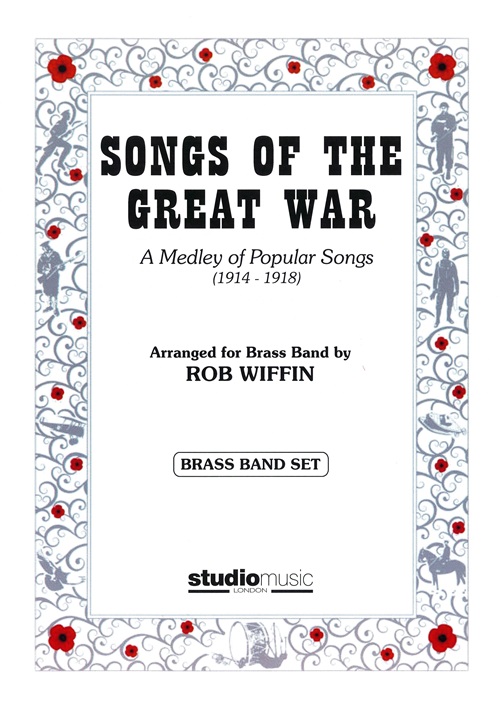
Songs of the Great War (Brass Band - Score and Parts) - Wiffin, Rob
A Medley of Popular Songs, 1914 - 1918Music of the Great War is a five year project to use music of the period to educate and engage schools, colleges, town bands, and the wider public across the UK and the world to learn in a positive way about the events, the experience of the troops involved from all sides, and how music played its part.This year, to commemorate the centenary of the Great War a specially arranged medley Songs of the Great War has been created. The medley has been arranged for bands to rehearse and eventually perform on the 11 November 2015. It brings together some of the most popular tunes played, sung and performed by the men and women of the time - in the trenches and on the various home fronts.With the support of many countries and organisations, on the 11 November the medley will be first played in New Zealand and Australia. It will ripple east across the world being performed in countries like India and Pakistan before hitting Europe and onwards to include performances in Canada and the Caribbean. This could become one of the most played pieces of music in a 24-hour period.In Britain, there will be performances across the country, including some at key events and sites involving a wide range of military and non-military personnel.The medley includes:It's a Long Way to TipperaryYour King and Country Want YouGood Bye-eeOh! It's a Lovely WarHello! Hello! Who's Your Lady FriendTake Me Back to Dear Old BlightyMademoiselle from ArmentieresThere's a Long, Long Trail A-windingIf You Were the Only Girl in the WorldPack Up Your Troubles (In Your Old Kit Bag)Old Soldiers Never Die/Last Post
Estimated dispatch 7-14 working days
-
 £44.95
Deus Solus (Brass Band - Score and Parts) - Wainwright, Andrew
Deus Solus (meaning God Alone) was composed for the Melbourne Staff Band's 130th anniversary at the request of Bandmaster Ken Waterworth. It is based on three Christian tunes - the 18th century hymn O God, our help in ages past, and the more contemporary songs God and God alone (Phill McHugh) and Chris Bowater's Faithful God. The work begins quietly and with a sense of the unknown, with references to O God, our help in ages past, alluding to the formation and early days of the band.
Estimated dispatch 7-14 working days
 View Music