
Results
-
 £154.99
A Road Less Travelled By (Brass Band - Score and Parts) - Sparke, Philip
A Road Less Travelled By was commissioned by Palangos Orkestras for the Championship Section of the 2020 European Brass Band Championships held in Palanga, Lithuania.The following was written by the composer, Philip Sparke:The title alludes to a poem by American author, Robert Frost, which appeared in his 1916 collection, Mountain Intervals: The Road Not Taken.In common with most of my larger works, this piece in not programmatic, but purely abstract; there is no extrinsic musical story. The choice of title shares my view of how composers can often develop. There can be no 'destination' in a composer's career, but rather a continuing journey to an unknown place. From piece to piece a composer needs to decide his or her next steps, never really knowing where they might lead. As Frost so eloquently describes, these sorts of instinctive decisions guide all our lives.Set in three movements, which play without a break, A Road Less Travelled By opens with a Moto Perpetuo firmly rooted in classical language, form and syntax. A continuous river of semiquavers, veering from melody to accompaniment and back again, adds drive, every and motion. The second movement, Nocturne, is in the form of a free fantasia; solos for vibraphone, flugel horn and euphonium set the stage for a central cornet solo, quietly echoed by the full band. A triumphal climax is reached before the movement dissolves into a Scherzo Finale. Mercurial and quixotic in nature, this third movement starts jovially until trios for trombones and horns darken the atmosphere. A change of mood and meter leads to a reprise of the opening and a return of the cornet melody, this time accompanied by figures derived from the scherzo theme. A brief coda based on earlier material drives the piece to a close.Duration: 15.30
Estimated dispatch 7-14 working days
-
£36.50
A Road Less Travelled By (Brass Band - Score only) - Sparke, Philip
A Road Less Travelled By was commissioned by Palangos Orkestras for the Championship Section of the 2020 European Brass Band Championships held in Palanga, Lithuania.The following was written by the composer, Philip Sparke:The title alludes to a poem by American author, Robert Frost, which appeared in his 1916 collection, Mountain Intervals: The Road Not Taken.In common with most of my larger works, this piece in not programmatic, but purely abstract; there is no extrinsic musical story. The choice of title shares my view of how composers can often develop. There can be no 'destination' in a composer's career, but rather a continuing journey to an unknown place. From piece to piece a composer needs to decide his or her next steps, never really knowing where they might lead. As Frost so eloquently describes, these sorts of instinctive decisions guide all our lives.Set in three movements, which play without a break, A Road Less Travelled By opens with a Moto Perpetuo firmly rooted in classical language, form and syntax. A continuous river of semiquavers, veering from melody to accompaniment and back again, adds drive, every and motion. The second movement, Nocturne, is in the form of a free fantasia; solos for vibraphone, flugel horn and euphonium set the stage for a central cornet solo, quietly echoed by the full band. A triumphal climax is reached before the movement dissolves into a Scherzo Finale. Mercurial and quixotic in nature, this third movement starts jovially until trios for trombones and horns darken the atmosphere. A change of mood and meter leads to a reprise of the opening and a return of the cornet melody, this time accompanied by figures derived from the scherzo theme. A brief coda based on earlier material drives the piece to a close.Duration: 15.30
Estimated dispatch 7-14 working days
-
 £120.00
Dark Arteries Suite (Brass Band - Score and Parts) - Higgins, Gavin
Dark Arteries was commissioned by Rambert Dance Company and first performed in May 2015 with the Tredegar Town Band sharing the stage with Rambert dancers. Dark Arteries is a personal and at times highly wrought response to the Miners Strike and its aftermath. It is in three movements, the first and last are expansive, with widely contrasting sound worlds, from dark, brooding melodies and the haunting sounds of solo flugel horn to wild syncopations on cornets, suggestive of an imposing, but often bleak mining landscape. Suitable for 1st Section Bands and above. Duration: 16.00
Estimated dispatch 7-14 working days
-
 £79.99
Fanfare and Celebration (Brass Band - Score and Parts) - Sparke, Philip
Fanfare and Celebration was commissioned by the Brass Band of the Western Reserve (Dr Keith M. Wilkinson, director) to celebrate their 15th anniversary. Based in north-west Ohio, the band was formed in 1997 and was competing in the Championship Section of the North American Brass Band Championships in less than three years. The first performance of Fanfare and Celebration took place in Akron, Ohio, on November 10th 2012.The opening Fanfare features the cornet section, in two groups standing either side of the band. A central horn theme brings a change of mood before the cornets take the lead once more. Celebration follows seamlessly and continues the declamatory style until a cantando theme in uneven meter is introduced. A transformed recapitulation ushers in a return of the Fanfare to close the work.Duration: 6:15
Estimated dispatch 7-14 working days
-
 £115.00
Sinfonietta No.1 (Brass Band - Score and Parts) - De Meij, Johan
Sinfonietta No.1, written for brass band, was commissioned by the Dutch National Championships 2011 in Groningen. It also served as the test piece for the Swiss National Championships 2011 in Montreux, Switzerland. Unlike most of Johan de Meij's compositions, Sinfonietta No.1 is an abstract, non-programmatic work. It consists of three movements, in which the thematic material of the opening measures, an upward fifth jump, returns in various shapes and forms throughout the piece. The slow middle section features solo passages by cello, English horn and bassoon, all starting with the same fifth jump. The final movement presents an Elgar-like march theme, interspersed with quotes from the second movement, and ending with the opening theme of movement I.Duration: 15.00
Estimated dispatch 7-14 working days
-
 £79.95
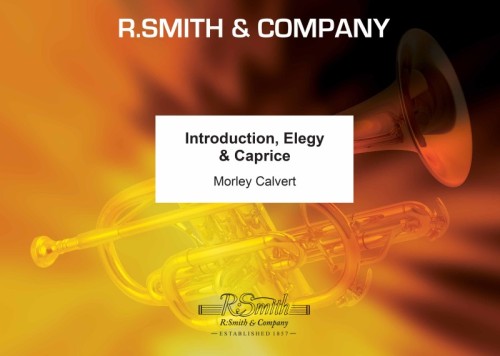
Introduction, Elegy and Caprice (Brass Band - Score and Parts) - Calvert, Morley
This work was written by Morley Calvert, the Canadian composer, especially for the first European Brass Band Championships held in 1978.The piece consists of three contrasting movements. The Introduction opens with a slow, mysterious figure after the first fanfare-like unison notes. This leads to the main section, a quick 'one-in-a-bar' movement centred around a persistent figure.The Elegy opens with an unaccompanied Euphonium solo, which is then passed through to horn, cornet, and basses in the manner of a passacaglia. This is broken and then the movement fragments.After the tension of the Elegy, the Caprice provides much needed relief: a spritely dance, very rhythmical in character, the theme of which is thrown around the band with great abandon.
Estimated dispatch 7-14 working days
-
£39.95
Introduction, Elegy and Caprice (Brass Band - Score only) - Calvert, Morley
This work was written by Morley Calvert, the Canadian composer, especially for the first European Brass Band Championships held in 1978.The piece consists of three contrasting movements. The Introduction opens with a slow, mysterious figure after the first fanfare-like unison notes. This leads to the main section, a quick 'one-in-a-bar' movement centred around a persistent figure.The Elegy opens with an unaccompanied Euphonium solo, which is then passed through to horn, cornet, and basses in the manner of a passacaglia. This is broken and then the movement fragments.After the tension of the Elegy, the Caprice provides much needed relief: a spritely dance, very rhythmical in character, the theme of which is thrown around the band with great abandon.
Estimated dispatch 7-14 working days
-
 £54.20
WARM AND BEAUTIFUL (Double Brass Quartet with Brass Band) - McCartney, Paul - Smith, Sandy
Quartet 1: Solo Horn, 1st Baritone, Solo Euphonium, and Solo Eb Bass; Quartet 2: Flugelhorn and Three Trombones. The solo euphonium takes the lead in this arrangement, almost as a soloist. Grade: Easy
Estimated dispatch 7-14 working days
-
 £54.95
WORLD WITHIN, A (Brass Band Parts) - Scott, Andy
Brass Band parts only. 'A World Within' is a one-movement work that starts with a simple theme stated by the Soprano Cornet before an ostinato figure in 6/8 time emerges (Vibraphone, Horns and muted 2nd and 3rd Cornets) over which firstly Solo Cornet, and then both Solo Cornets (1 & 2), play a sustained melody. A shift between major and minor harmonies characterises the 'B' section, before making way for a virtuosic Flugel solo. When the Flugel leaves centre stage the front line Cornets take over, leading to a full bodied reprise of the 'B' section. The low brass bridge the gap between what is in effect the end of the first main section of the piece and the second section. The constant time shift between 3/4 and 6/8 that has been prevalent through-out 'A World Within', re-emerges towards the end of the 'slow, heavy blues' section, leading into an intricate almost fugue-like passage (Horn and Baritone leading the way). Out of this comes a short transitional bridge section that leads us back to the (transposed) original 6/8 time theme and feel, this time scored with a bold directness that leads to a powerful 2/4 time passage. The climax of 'A World Within' is heralded by one dark and dissonant chord that is repeated three times. A flashback moment occurs where the 'hymn' is stated (muted Cornets) in a bitonal harmonic world. A final statement emerges from the denseness of sound, a re-working of the initial theme (Solo Cornet), with the last work being left to Solo Eb Bass. Dur: 13:00
Estimated dispatch 7-14 working days
-
£20.00
WORLD WITHIN, A (Brass Band Score) - Scott, Andy
Brass Band score only. 'A World Within' is a one-movement work that starts with a simple theme stated by the Soprano Cornet before an ostinato figure in 6/8 time emerges (Vibraphone, Horns and muted 2nd and 3rd Cornets) over which firstly Solo Cornet, and then both Solo Cornets (1 & 2), play a sustained melody. A shift between major and minor harmonies characterises the 'B' section, before making way for a virtuosic Flugel solo. When the Flugel leaves centre stage the front line Cornets take over, leading to a full bodied reprise of the 'B' section. The low brass bridge the gap between what is in effect the end of the first main section of the piece and the second section. The constant time shift between 3/4 and 6/8 that has been prevalent through-out 'A World Within', re-emerges towards the end of the 'slow, heavy blues' section, leading into an intricate almost fugue-like passage (Horn and Baritone leading the way). Out of this comes a short transitional bridge section that leads us back to the (transposed) original 6/8 time theme and feel, this time scored with a bold directness that leads to a powerful 2/4 time passage. The climax of 'A World Within' is heralded by one dark and dissonant chord that is repeated three times. A flashback moment occurs where the 'hymn' is stated (muted Cornets) in a bitonal harmonic world. A final statement emerges from the denseness of sound, a re-working of the initial theme (Solo Cornet), with the last work being left to Solo Eb Bass. Dur: 13:00
Estimated dispatch 7-14 working days
 View Music