
Results
-
 £109.99
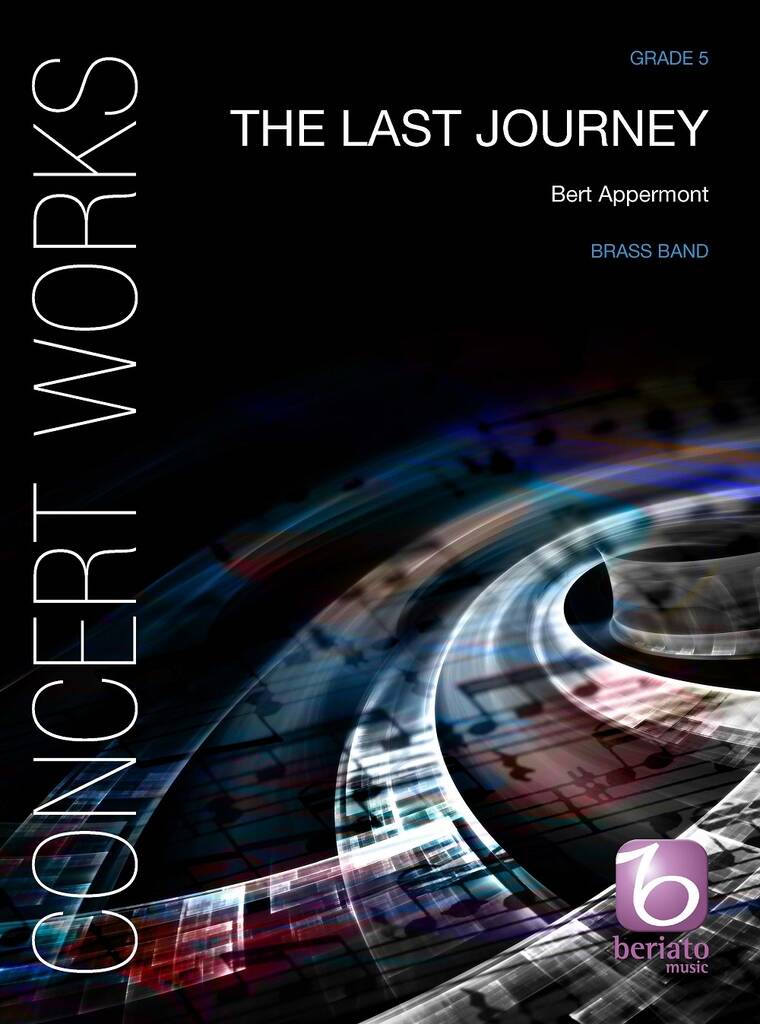
The Last Journey - Bert Appermont
This emotive work is based on the story of a young trombone player who died of cancer. It is an emotional rollercoaster expressing, by turn, the joy of life, fate, farewell, sadness, and yet again, joy. Every one of us will recognize something in this intensely human music. The Last Journey mirrors the grieving process, but above all it expresses the beauty of life.
Estimated dispatch 5-14 working days
-
 £89.99
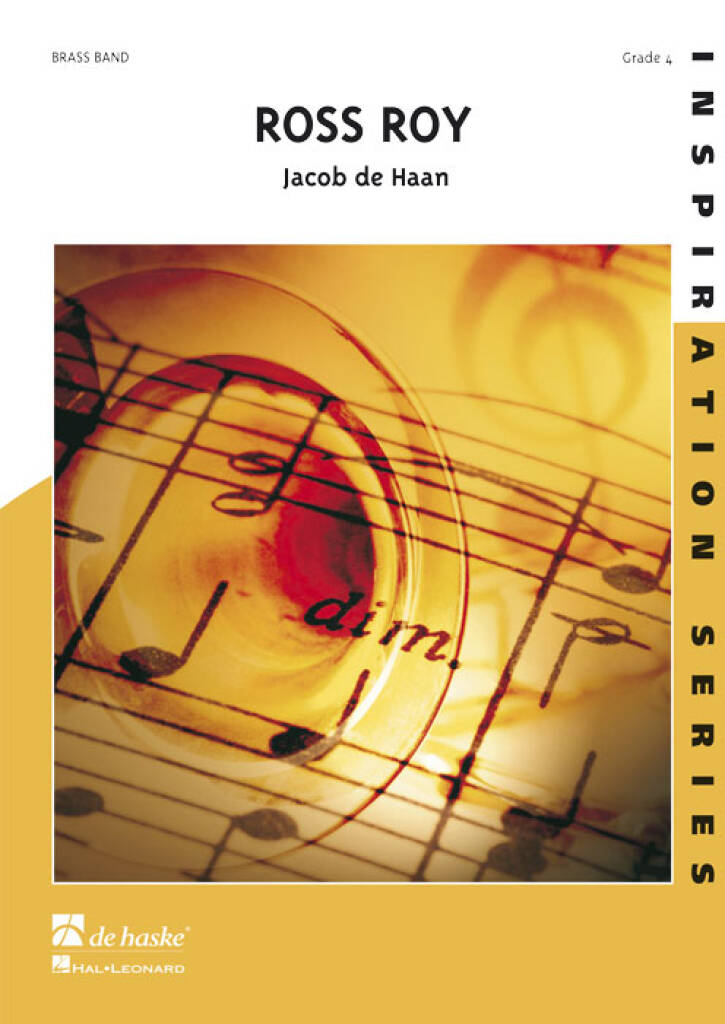
Ross Roy - Jacob de Haan
In this composition, Jacob de Haan sees the "Ross Roy" as a metaphor for the years spent at school (a monument in time), where one's personality is formed. So, the opening theme the artist calls the Ross Roy theme initially has monumental characteristics.The rhythmic motion, which strides along in the lower register and percussion at the beginning of the next section is typical of "Tempo di Marcia". This movement, accompanied by repetitions of sound, is a metaphor for the structure and discipline in school. This is the introduction to a march theme, symbolic of "passing through" the classes up to the final examinations.Then, the Ross Roy theme is dealt with again, now in aplayful, humorous variation. As if the composer is saying there should also be time for a smile in school. The same theme can be heard in major key and a slower tempo in the following section, expressing pride and self-confidence. This is also the introduction to the expressive middle section that represents love, friendship and understanding.We then return to the march theme in a slightly altered construction. The oriental sounds, constituting the modulation to the final theme, are symbols of the diversity of cultures in the school. The characteristic final theme first sounds solemn, but turns into a festive apotheosis. It is no coincidence that the final cadence is reminiscent of the close to a traditional overture, for the school years can be considered the "overture" to the rest of one's life.
Estimated dispatch 5-14 working days
-
 £64.30
Zourfaroka - Marc Jeanbourquin
One morning everything went wrong in Zourfaroka. In this forest where thousands of magical beings live, everything sparkles and shines and is full of life. But not this morning, because the terrible troll Potugor has returned. This is the opening text for the musical fairy tale written by Lise Jeanbourquin and set to music by her husband Marc Jeanbourquin. The first part is a warlike setting, showing the preparations of Kirielo and the inhabitants of Zourfaroka for the battle with Potugor. On the way they meet the fairy Xeriole, and this meeting is put to music in the second part. The soloist's role in the first few bars is left to the choice of the conductor. And as in many fairy tales, with fairies, gnomes, and amazing magical creatures, the piece ends in the third part with everyone coming together in song and dance.
Estimated dispatch 5-14 working days
-
 £104.99
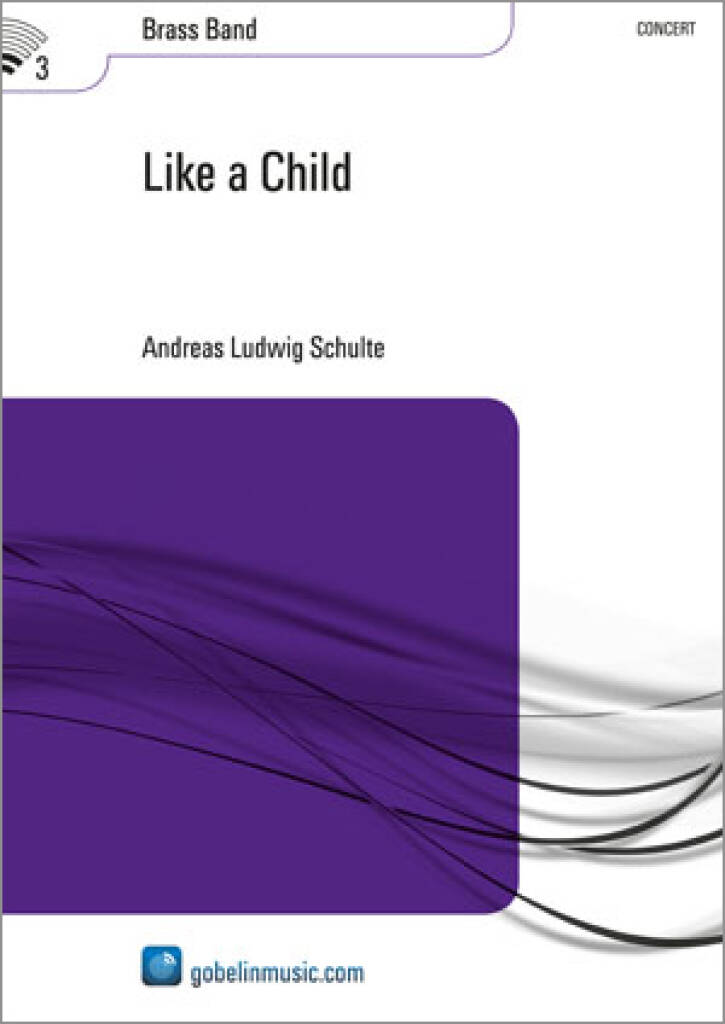
Like a Child - Andreas Ludwig Schulte
The young have the future. This is the statement made at the beginning of 'Like a Child' by Andreas Ludwig Schulte. The opening radiates strength and ambition, but one is also made to wonder which direction will be chosen, which choices will have to be made.After the introduction the first steps on the path of life are taken, still somewhat unsteadily (the 3/4th time used illustrates this uncertainty). However, the child has now set off and will meet the future with an open mind, unafraid, even though experience will teach it how easily it can be hurt.Fortunately, it is sometimes allowed to be vulnerable and it discovers there will always be someone to offer shelter,support and love. (Adagio) The last part breathes a far greater independence. Youth is able to face the future, it can even take on the whole world!
Estimated dispatch 5-14 working days
-
£60.99
Circle of Life - Elton John - Klaas van der Woude
The Lion King, the hugely successful Disney animated film, tells the story of Simba, a young lion trying to escape his past. The film opens with the impressive song Circle of Life which immediately evokes the Disney magic. The music was written by Elton John and the text is by Tim Rice, a successful lyricist in the world of musicals. This arrangement for brass band by Klaas van der Woude has definitely done the song justice.
Estimated dispatch 5-14 working days
-
 £174.99
The Turing Test - Simon Dobson
Alan Turing is considered the father of modern computational science and much, if not all, of our modern computer technology and the connectivity that we now take for granted is born of the work of this one great, but troubled man. His famous test was designed to prove whether artificial intelligence (AI) could successfully imitate human thought. The single movement of The Turing Test is essentially non-programmatic, but it does seek to show something of the emotion and colour of Turing's life in its different sections. The composer employs bi-tonality and complex rhythms to show opposing worlds colliding. At the end of each test, we must decide: has true AI beenborn?
Estimated dispatch 5-14 working days
-
 £104.99
The Baltic Way (Brass Band - Score and Parts) - De Haan, Jan
In 1989, the demonstration named the Baltic Way also known as the Baltic Chain-- was held in the Baltic states of Estonia, Latvia and Lithuania by its citizens in a call for independence from the Soviet Union. On 23rd August 1989, some two million participants formed a human chain, hand-in-hand all the way from the Estonian capital of Tallinn its Latvian counterpart, Riga, through to the Lithuanian capital of Vilnius - six hundred kilometres long. It became the longest human chain ever created and turned out to be the final push needed for much sought-after independence. This historic event became the source of inspiration for this composition. The introduction of thefirst movement, 'Struggle for Independence', is based on a nocturne for piano by the renowned Lithuanian composer and painter Mikalojus Konstantinas iurlionis (1875-1911), thematic material from which has been incorporated throughout the whole composition. The melancholic beginning is followed by a powerful theme which reflects the resolve of the Baltic people. The sudden aggressive, dissonant chords and a dominant and--in rhythmic terms--contrary bass drum announce that the resistance is not going smoothly. Just for a moment, we hear the anthem of the Soviet Union in the lower brass, but this is relentlessly pushed to the background by the rest of the band playing the Lithuanian national anthem, 'Tautika giesm ' (Lithuania, our homeland). The second movement, 'Decades of Suffering', echoes life under the Soviet Union's thumb. In the pursuit of independence, a peaceful protest is planned in which a human chain is formed across the Baltic states of Estonia, Latvia and Lithuania. This 'Chain of Freedom' is depicted in the final movement of the work. Duration: 10.30
Estimated dispatch 7-14 working days
-
 £59.99
Whence is that Goodly Fragrance Flowing? (Brass Band - Score and Parts) - Sparke, Philip
Whence is that Goodly Fragrance Flowing? is the first line of an old French Christmas song that originated in the 17th century. In 1728 John Gay used this joyous and markedly festive melody that honours Jesus Christ and His miraculous birth in his Beggar's Opera. Philip Sparke has given this melody a new lease of life with his charming and imaginative arrangement for the Christmas season.Duration: 3:45
Estimated dispatch 7-14 working days
-
 £168.50
Music of the Spheres (Brass Band - Score and Parts) - Sparke, Philip
Music of the Spheres was commissioned by the Yorkshire Building Society Band and first performed by them at the European Brass Band Championships in Glasgow, May 2004. The piece reflects the composers fascination with the origins of the universe and deep space in general. The title comes from a theory, formulated by Pythagoras, that the cosmos was ruled by the same laws he had discovered that govern the ratios of note frequencies of the musical scale. ('Harmonia' in Ancient Greek, which means scale or tuning rather than harmony - Greek music was monophonic). He also believed that these ratios corresponded to the distances of the six known planets from the sun and thatthe planets each produced a musical note which combined to weave a continuous heavenly melody (which, unfortunately, we humans cannot hear). In this work, these six notes form the basis of the sections Music of the Spheres and Harmonia. The pieces opens with a horn solo called t = 0, a name given by some scientists to the moment of the Big Bang when time and space were created, and this is followed by a depiction of the Big Bang itself, as the entire universe bursts out from a single point. A slower section follows called The Lonely Planet which is a meditation on the incredible and unlikely set of circumstances which led to the creation of the Earth as a planet that can support life, and the constant search for other civilisations elsewhere in the universe. Asteroids and Shooting Stars depicts both the benign and dangerous objects that are flying through space and which constantly threaten our planet, and the piece ends with The Unknown, leaving in question whether our continually expanding exploration of the universe will eventually lead to enlightenment or destruction.Duration: 18:00
Estimated dispatch 7-14 working days
-
£42.50
Music of the Spheres (Brass Band - Score only) - Sparke, Philip
Music of the Spheres was commissioned by the Yorkshire Building Society Band and first performed by them at the European Brass Band Championships in Glasgow, May 2004. The piece reflects the composers fascination with the origins of the universe and deep space in general. The title comes from a theory, formulated by Pythagoras, that the cosmos was ruled by the same laws he had discovered that govern the ratios of note frequencies of the musical scale. ('Harmonia' in Ancient Greek, which means scale or tuning rather than harmony - Greek music was monophonic). He also believed that these ratios corresponded to the distances of the six known planets from the sun and thatthe planets each produced a musical note which combined to weave a continuous heavenly melody (which, unfortunately, we humans cannot hear). In this work, these six notes form the basis of the sections Music of the Spheres and Harmonia. The pieces opens with a horn solo called t = 0, a name given by some scientists to the moment of the Big Bang when time and space were created, and this is followed by a depiction of the Big Bang itself, as the entire universe bursts out from a single point. A slower section follows called The Lonely Planet which is a meditation on the incredible and unlikely set of circumstances which led to the creation of the Earth as a planet that can support life, and the constant search for other civilisations elsewhere in the universe. Asteroids and Shooting Stars depicts both the benign and dangerous objects that are flying through space and which constantly threaten our planet, and the piece ends with The Unknown, leaving in question whether our continually expanding exploration of the universe will eventually lead to enlightenment or destruction.Duration: 18:00
Estimated dispatch 7-14 working days
 View Music