
Results
-
 £36.00
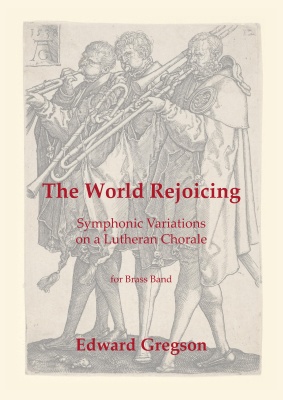
Edward Gregson: The World Rejoicing
DescriptionComposer's NoteIn searching for a common link between the brass band traditions of the various European countries that commissioned this work, I considered the fact that hymns have always played an important role in the relationship that brass bands have with their particular communities; and thus I turned to a well-known Lutheran chorale, Nun danket alle Gott (Now thank we all our God), written around 1636 by Martin Rinkart, with the melody attributed to Johann Cruger. A number of composers have incorporated this chorale into their music, most famously J.S.Bach in his Cantatas no. 79 and 192, and Mendelssohn in the Lobsegang movement of his 2nd Symphony (the harmonization of which is usually used when this hymn is sung).It seemed fitting therefore for me to return to a compositional form I have used many times before (Variations) and to write a work based on this hymn. I have used it in a similar way to that which I employed in my Variations on Laudate Dominum of 1976 - that is, rather than writing a set of variations using elaborations of the complete tune, I have taken various phrases from the chorale and used them within the context of other musical material, applying an overall symphonic process of continuous variation and development. The structure, or sub-divisions of the work, which is through composed and plays without a break, is as follows: Prelude, Capriccio, La Danza 1, Processional, La Danza 2, Arias and Duets, Fuga Burlesca, Chorale, and Postlude.The work is also partly autobiographical - in the manner say of Strauss's Ein Heldenleben - in that I have incorporated into the score brief quotations from many of my other major works for brass band. In that respect, The World Rejoicing sums up a particular facet of my life as a composer, and reflects the admiration I have always had for what is surely one of the great amateur music-making traditions in the world.The World Rejoicing is dedicated 'in loving memory of my brother', Bramwell Logan Gregson, who sadly passed away in the Autumn of 2018.Edward Gregson
Estimated dispatch 7-14 working days
-
 £125.00
The World Rejoicing (Brass Band - Score and Parts)
The World Rejoicing was commissioned by the National Brass Band Associations of Belgium, Netherlands, Norway, Switzerland, and the British Open, as the test piece for their competitions in 2020/21. Although the work was completed in 2019, the pandemic of 2020 meant that these competitions were postponed until 2021/22. The premiere took place in September 2021 at Symphony Hall, Birmingham, UK.In searching for a common link between the brass band traditions of the various European countries that commissioned this work, I considered the fact that hymns have always played an important role in the relationship that brass bands have with their particular communities; and thus I turned to a well- known Lutheran chorale, Nun danket alle Gott (Now thank we all our God), written around 1636 by Martin Rinkart, with the melody attributed to Johann Cruger. A number of composers have incorporated this chorale into their music, most famously J.S. Bach in his Cantatas no. 79 and 192, and Mendelssohn in the Lobsegang movement of his 2nd Symphony (the harmonisation of which is usually used when this hymn is sung).It seemed fitting therefore for me to return to a compositional form I have used many times before (Variations) and to write a work based on this hymn. I have used it in a similar way to that which I employed in my Variations on Laudate Dominum of 1976 - that is, rather than writing a set of variations using elaborations of the complete tune, I have taken various phrases from the chorale and used them within the context of other musical material, applying an overall symphonic process of continuous variation and development. The structure, or sub-divisions of the work, which is through composed and plays without a break, is as follows:Prelude, Capriccio, La Danza 1, Processional, La Danza 2, Arias and Duets, Fuga Burlesca, Chorale, and Postlude.The work, which is around 16 minutes in length, is also partly autobiographical - in the manner say of Strauss's Ein Heldenleben - in that I have incorporated into the score brief quotations from many of my other major works for brass band. In that respect, The World Rejoicing sums up a particular facet of my life as a composer, and reflects the admiration I have always had for what is surely one of the great amateur music-making traditions in the world.Duration: 16.00
Estimated dispatch 7-14 working days
-
£40.00
The World Rejoicing (Brass Band - Score only)
The World Rejoicing was commissioned by the National Brass Band Associations of Belgium, Netherlands, Norway, Switzerland, and the British Open, as the test piece for their competitions in 2020/21. Although the work was completed in 2019, the pandemic of 2020 meant that these competitions were postponed until 2021/22. The premiere took place in September 2021 at Symphony Hall, Birmingham, UK.In searching for a common link between the brass band traditions of the various European countries that commissioned this work, I considered the fact that hymns have always played an important role in the relationship that brass bands have with their particular communities; and thus I turned to a well- known Lutheran chorale, Nun danket alle Gott (Now thank we all our God), written around 1636 by Martin Rinkart, with the melody attributed to Johann Cruger. A number of composers have incorporated this chorale into their music, most famously J.S. Bach in his Cantatas no. 79 and 192, and Mendelssohn in the Lobsegang movement of his 2nd Symphony (the harmonisation of which is usually used when this hymn is sung).It seemed fitting therefore for me to return to a compositional form I have used many times before (Variations) and to write a work based on this hymn. I have used it in a similar way to that which I employed in my Variations on Laudate Dominum of 1976 - that is, rather than writing a set of variations using elaborations of the complete tune, I have taken various phrases from the chorale and used them within the context of other musical material, applying an overall symphonic process of continuous variation and development. The structure, or sub-divisions of the work, which is through composed and plays without a break, is as follows:Prelude, Capriccio, La Danza 1, Processional, La Danza 2, Arias and Duets, Fuga Burlesca, Chorale, and Postlude.The work, which is around 16 minutes in length, is also partly autobiographical - in the manner say of Strauss's Ein Heldenleben - in that I have incorporated into the score brief quotations from many of my other major works for brass band. In that respect, The World Rejoicing sums up a particular facet of my life as a composer, and reflects the admiration I have always had for what is surely one of the great amateur music-making traditions in the world.Duration: 16.00
Estimated dispatch 7-14 working days
-
 £15.00
The World Rejoicing (Brass Band - Study Score)
In searching for a common link between the brass band traditions of the various European countries that commissioned this work, I considered the fact that hymns have always played an important role in the relationship that brass bands have with their particular communities; and thus I turned to a well-known Lutheran chorale, Nun danket alle Gott (Now thank we all our God), written around 1636 by Martin Rinkart, with the melody attributed to Johann Crger. A number of composers have incorporated this chorale into their music, most famously J.S.Bach in his Cantatas no. 79 and 192, and Mendelssohn in the Lobsegang movement of his 2nd Symphony (the harmonization of which is usually used when this hymn is sung).It seemed fitting therefore for me to return to a compositional form I have used many times before (Variations) and to write a work based on this hymn. I have used it in a similar way to that which I employed in my Variations on Laudate Dominum of 1976 - that is, rather than writing a set of variations using elaborations of the complete tune, I have taken various phrases from the chorale and used them within the context of other musical material, applying an overall symphonic process of continuous variation and development. The structure, or sub-divisions of the work, which is through composed and plays without a break, is as follows: Prelude, Capriccio, La Danza 1, Processional, La Danza 2, Arias and Duets, Fuga Burlesca, Chorale, and Postlude.The work is also partly autobiographical - in the manner say of Strauss's Ein Heldenleben - in that I have incorporated into the score brief quotations from many of my other major works for brass band. In that respect, The World Rejoicing sums up a particular facet of my life as a composer, and reflects the admiration I have always had for what is surely one of the great amateur music-making traditions in the world.The World Rejoicing is dedicated 'in loving memory of my brother', Bramwell Logan Gregson, who sadly passed away in the Autumn of 2018.Edward Gregson
Estimated dispatch 7-14 working days
-
 £29.95
Ghost of Christmas Yet To Come, The - Jonathan Bates
DURATION: 3'00". DIFFICULTY: 2nd+. Composed for Strata Brass in 2020 as part of their COVID-19 induced, virtually recorded 'A Christmas Carol' (a new suite for brass bandlasting around 30 minutes in total), 'The Ghost of Christmas Yet To Come' is a jagged and virtuosic solo for Euphonium portraying what Ebenezer Scrooge sees when he is shown how his Christmases in the future will occur by the Ghost of Christmas Yet To Come. Having already been shown how is mean and uncaring ways have impacted his life this far by the previous two visions, this 3rd and final vision is enough to force Scrooge to become a changed man and embrace the Christmas spirit with all his heart. Throughout this solo, you may hear small references to Camille Saint-Saens' 'Danse Macabre'. .
In Stock: Estimated dispatch 1-3 working days
-
 £39.95
A Little Prayer (Score and Parts) - Evelyn Glennie
Composer Evelyn Glennie writes... "When I wrote the chorale for marimba, A Little Prayer, it expressed my spiritual feelings and displayed a pleasantly relaxed dimension of the instrument. Over the years my exposure to brass bands has filled me with wonder; their musical diversity is considerable. From performing a simple melody to the most complex of test-pieces, they bring brilliance to the music. I had no hesitation in giving A Little Prayer to Robert Childs to bring this little melody to life through brass." A perfect reflective interlude for concert or devotional use by bands of all abilities. This is the only version of this arrangement available for sale to the public.
Estimated dispatch 7-9 working days
-
 £32.00
Cityscapes (Score only) - Stephen Bulla
The music of Cityscapes intends to parallel the impressions, sights, and sounds of a modern city to what a painter might convey with a landscape portrait. 'Morning Scene - Awakening': the quiet solitude of a sunrise, birdsong, and empty streets can betray the crowded jungle of city life. These are the last moments of sleep before the alarm goes off and the coffee goes on. 'Faces in Motion': The pavements come alive, streets fill with cars, office buildings open, the rush hour is on - and everyone is late! 'Museum Visit': To step into a museum is to visit another world. Looking at what we've been and where we've been, there's always a sense of awe at how much has gone before; and the realisation of how much there is yet to come... 'Nightlife': After hours is not the time to slow down, for the city never really sleeps. Nightclubs open, and the jazz circuit is alive with swinging sounds. This is the soul of the city. Duration: 12:00
Estimated dispatch 7-9 working days
-
 £42.00
Cityscapes (Parts only) - Stephen Bulla
The music of Cityscapes intends to parallel the impressions, sights, and sounds of a modern city to what a painter might convey with a landscape portrait. 'Morning Scene - Awakening': the quiet solitude of a sunrise, birdsong, and empty streets can betray the crowded jungle of city life. These are the last moments of sleep before the alarm goes off and the coffee goes on. 'Faces in Motion': The pavements come alive, streets fill with cars, office buildings open, the rush hour is on - and everyone is late! 'Museum Visit': To step into a museum is to visit another world. Looking at what we've been and where we've been, there's always a sense of awe at how much has gone before; and the realisation of how much there is yet to come... 'Nightlife': After hours is not the time to slow down, for the city never really sleeps. Nightclubs open, and the jazz circuit is alive with swinging sounds. This is the soul of the city. Duration: 12:00
Estimated dispatch 7-9 working days
-
 £45.00
Believe (From 'The Polar Express')
ABOUT THIS PIECE: Capture the magic and wonder of Christmas with this beautiful arrangement of Believe, from the beloved film The Polar Express. Composed by the award-winning songwriter Glen Ballard and legendary film composer Alan Silvestri, Believe is a heartwarming ballad that celebrates the themes of faith, hope, and the spirit of Christmas. Originally performed by Josh Groban, the song earned an Academy Award nomination and has become a seasonal favourite around the world. This arrangement brings the enchanting melody and emotional depth of the original to life, making it a perfect choice for Christmas concerts. Believe offers a wonderful opportunity for your band to connect with audiences and celebrate the magic of the holiday season. ENSEMBLE: Standard British Brass Band WHEN YOU BUY THIS PRODUCT, YOU GET: High-quality printed score and parts LEVEL: 1 LISTEN: DURATION: 4-minutes 40-seconds EXAMPLE SCORE: Click here LEVEL GUIDE: Level 1- Accessible to all Level 2 - c. UK third section and higher Level 3 - c. UK second section and higher Level 4 - c. UK first section and higher Level 5 - c. UK championship section level
Estimated dispatch 5-7 working days
-
£33.00
You are the Sunshine of My Life - Wonder, S - Harper, P
Released by Stevie Wonder in 1973 this worldwide hit is regularly voted as being amongst the greatest songs of all time. There can be few who won't recognise this one!
In Stock: Estimated dispatch 1-3 working days
 View Music