
Results
-
 £29.88
Alegria (Cornet Feature with Brass Band) Barrie Gott
This foot-tapping Latin-style cornet feature showcasing the front row was written by Barrie Gott for the Brisbane Excelsior Band. The composer writes: 'I had wanted to write something in this genre after the success of the third movement of the Jazz Suite. Entertainment numbers are always needed for park and popular concerts. It is important that the rhythm section maintains a consistent tempo. They can be featured also. The samba rhythm and feel should be maintained throughout. The occasional sombrero would not be out of place. Enjoy!' To view a follow-the-score video of the work please visit www.youtube.com/watch?v=TpFZPX3glxo PDF download includes score and parts. Sheet music available from: UK - www.brassband.co.uk USA - https://satradecentral.org Difficulty Level: 3rd Section + Length: 2.40 minutes Instrumentation: Soprano Cornet Eb Solo Cornet Bb Repiano Cornet Bb 2nd Cornet Bb 3rd Cornet Bb Flugel Horn Bb Solo Horn Eb 1st Horn Eb 2nd Horn Eb 1st Baritone Bb 2nd Baritone Bb 1st Trombone Bb 2nd Trombone Bb Bass Trombone Euphonium Bb Bass Eb Bass Bb Drum Kit Claves Maracas Cowbell Xylophone
In Stock: Estimated dispatch 1-3 working days
-
 £33.62
Excursion (Brass Band) Christopher Cook
Excursion was the winner of the 2022 BrookWright International Brass Band Composition Competition. The composer Christopher Cook writes: 'In this short and effervescent study for brass band, I wanted to take the listener and players on a journey which moves from a soundworld of bristling, bubbling energy to a triumphant fanfare and finally a moment of repose. The initial fast flurry of notes, highlighted and emphasised by precise elements of percussion, informs the motivic development of the rest of the piece and eventually forms the basis for the textural backdrop to the filmic sounding melody heard around halfway through the piece. The unexpected final passage is intended to be a nod to works for brass band by Paul Patterson and Harrison Birtwistle.' To view a rolling score video of the piece performed by the Royal Northern College of Music (RNCM) Brass Band please visit www.youtube.com/watch?v=rSCrQIv_W2k PDF download includes score and parts. Sheet music available from www.brassband.co.uk Difficulty Level: 1st Section + Instrumentation: Soprano Cornet Eb Solo Cornet Bb Repiano Cornet Bb 2nd Cornet Bb 3rd Cornet Bb Flugel Horn Bb Solo Horn Eb 1st Horn Eb 2nd Horn Eb 1st Baritone Bb 2nd Baritone Bb 1st Trombone Bb 2nd Trombone Bb Bass Trombone Euphonium Bb Bass Eb Bass Bb Timpani Percussion 1-3
In Stock: Estimated dispatch 1-3 working days
-
 £33.62
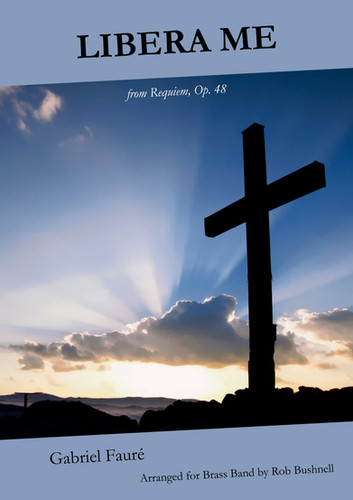
Libera Me from 'Requiem' (Brass Band) Faure arr. Rob Bushnell
Composed between 1887 and 1890, Gabriel Faure's Requiem is not only one of his best-known works but one of the most popular piece of choral music in the Classical repertoire, coming 23rd in the Classic FM's Hall of Fame 2024. Believed to be a tribute to his father (who died in 1885), Faure himself said "My Requiem wasn't written for anything - for pleasure, if I may call it that!" It started life as a five-movement work but was later expanded to be the final seven-movement work we know today. The first version (which Faure called "un petit Requiem") was first performed on 16 January 1888, with Faure conducting, a second version premiered on 21 January 1893 before the final version (reworked for full orchestra) was played on 12 July 1900; the Requiem was performed at the composer's own funeral in 1924.The Libera Me, or Deliver Me, was actually written in 1877 and is the sixth part of the Requiem.Faure once said of the work, "Everything I managed to entertain by way of religious illusion I put into my Requiem, which moreover is dominated from beginning to end by a very human feeling of faith in eternal rest." Upon interview, he also said, "It has been said that my Requiem does not express the fear of death and someone has called it a lullaby of death. But it is thus that I see death: as a happy deliverance, an aspiration towards happiness above, rather than as a painful experience. The music of Gounod has been criticised for its inclination towards human tenderness. But his nature predisposed him to feel this way: religious emotion took this form inside him. Is it not necessary to accept the artist's nature? As to my Requiem, perhaps I have also instinctively sought to escape from what is thought right and proper, after all the years of accompanying burial services on the organ! I know it all by heart. I wanted to write something different."This arrangement is for the British-style brass band, with alternative parts for horns in F and bass-clef lower brass. The tenor solo is featured on the euphonium. A recording of the original composition can be found here: www.youtube.com/watch?v=fXwFNoBHCf0 Duration: 4.20 minutes approx. Difficulty Level: 4th Section + PDF download includes parts and score. Sheet music available from www.brassband.co.uk Instrumentation: Soprano Cornet Eb Solo Cornet Bb Repiano Cornet Bb 2nd Cornet Bb 3rd Cornet Bb Flugel Horn Bb Solo Horn Eb 1st Horn Eb 2nd Horn Eb 1st Baritone Bb 2nd Baritone Bb 1st Trombone Bb 2nd Trombone Bb Bass Trombone Euphonium Bb Bass Eb Bass BbTimpani
In Stock: Estimated dispatch 1-3 working days
-
 £74.72
Mind Dances (Brass Band) Fendall Hill
This highly descriptive and personal work for brass band is autobiographical, and based on a seven-year period of the composer Fendall Hill's life. He comments: "...external events had severe personal consequences, and my previously self assured self woke in the early mornings, way before my body wanted. My mind would fret, regret, and attempt to fix things beyond my control or powers, carving out an anxiety-shaped hole in my soul. This piece is an exploration of the sheer range of thought processes I went through, the mind dances I would perform to either calm myself back to sleep, or somehow come to terms with my situation. So often I would get to the point of mental exhaustion after phases of semi-calm, imagined alternate realities, and sheer panic. Your mind knows there is no benefit to worrying, but that doesn't stop the flow of emotions, the fear, and the anxiety." To view a performance video of the work please visit www.youtube.com/watch?v=pUhy33KKCKY&t=3s PDF download includes score and parts. Sheet music available from: UK - www.brassband.co.uk USA - https://satradecentral.org Difficulty Level: First Section + Length: 15.00 minutes Instrumentation: Soprano Cornet Eb Solo Cornet Bb Repiano Cornet Bb 2nd Cornet Bb 3rd Cornet Bb Flugel Horn Bb Solo Horn Eb 1st Horn Eb 2nd Horn Eb 1st Baritone Bb 2nd Baritone Bb 1st Trombone Bb 2nd Trombone Bb Bass Trombone Euphonium Bb Bass Eb Bass Bb Timpani Percussion Vibraphone Marimba
In Stock: Estimated dispatch 1-3 working days
-
 £37.35
Whodunnit? Murder Mystery for Brass & Percussion (Brass Band) Karl Whelan
The composer writes: 'One of my all time favourite films is Clue (1985) based on the board game of the same name (Cluedo, if you're from the UK). Clue follows the night of six guests who are invited to a mansion for dinner. The host, Mr. Boddy is murdered, and the guests must work together to find the killer before any more lives are lost. I implore you to give it a watch if you haven't already, even if it's just for Tim Curry's magical performance as The Butler. Running at 82 minutes, the film is over before you know it. I wanted to create a similar story here with Whodunnit?, which like it's inspiration, Clue, moves at an incredible pace as it follows a dinner party, to which our guests have been invited. This work is rather dark throughout and full of intentional cliches, for which, I make no apology!' To view a rolling score video please visit www.youtube.com/watch?v=hdviJUrCvOE Sheet music available from: UK - www.brassband.co.uk USA - https://satradecentral.org Difficulty Level: 2nd Section + Length: 6.00 minutes Instrumentation: Soprano Cornet Eb Solo Cornet Bb Repiano Cornet Bb 2nd Cornet Bb 3rd Cornet Bb Flugel Horn Bb Solo Horn Eb 1st Horn Eb 2nd Horn Eb 1st Baritone Bb 2nd Baritone Bb 1st Trombone Bb 2nd Trombone Bb Bass Trombone Euphonium Bb Bass Eb Bass Bb Timpani Percussion 1 (Suspended Cymbal**, Shaker, Drum Kit, Vibraslap) Percussion 2 (Bass Drum, Suspended Cymbal**, Wood Blocks, Tam-tam) Percussion 3 (Glockenspiel, Xylophone, Tubular Bells, Vibraphone) * Doubling on Trumpet (if possible) ** Shared
In Stock: Estimated dispatch 1-3 working days
-
Left Bank Two - Wayne Hill - Len Jenkins
In the 1960's, a group of session musicians had some studio time left over and asked if anyone had something they wanted to try. The young vibes player, Wayne Hill came up with this tune, which they recorded on the spot, almost as a 'throwaway' piece. To viewers in the UK, it is best known as the music used in "The Gallery" sequence of 'Vision On', which was a British children's television programme, shown on BBC1 from 1964 to 1976. Tony Hart, artist and co-presenter of the programme, made pictures in a variety of sizes and media, and encouraged children to submit their own paintings to "The Gallery" for display on TV. They did so in their thousands. The piece has been used in a number of adverts including those for Volkswagen, Castrol Oil and Waitrose, and TV programmes such as NBC's America's Got Talent, The X Factor (U.S) and the BBC panel show QI. Left Bank Two features a Vibraphone solo with Brass Band accompaniment. For those bands that do not have a Vibraphone, an alternative solo for a B flat instrument is included.
-
 £33.62
La Chica sin nombre (Trombone Solo with Brass Band) Rob Wiffin
A vibrant, rhythmic solo for trombone and band. La Chica sin Nombre was written in March 2020 at the request of Brett Baker, who wanted something in Latin style, resulting in a Mambo-type dance piece. For the right percussion sound, Conga drums and Mambo Bell/Timbales are recommended rather than a drum kit, and the piece should be played with an appropriate feel for Latin music. It should sound light and easy to play but has a few tricky moments - especially the cadenza-like sections from F to H. The virtuosic section at letter G can be cut if required. Audio demo: https://soundcloud.com/user-565396545/la-chica-sin-nombre-trombone Duration: Approx. 4.20 minutes Difficulty Level (Band): Medium Soloist: Advanced This PDF download includes the full score and parts. Sheet music available at www.brassband.co.uk (UK) or https://satradecentral.org (USA)
In Stock: Estimated dispatch 1-3 working days
-
 £33.62
Menuet (Brass Band) Ravel arr. Rob Bushnell
Le Tombeau de Couperin (The Grave of Couperin) was written by Maurice Ravel between 1914 and 1917, originally a suite of piece for solo piano. Based on what was considered a traditional Baroque suite, Ravel wanted to pay homage to Baroque French keyboard music, whilst retaining his 20th-century chromaticism, making the work neoclassicist. Each movement is dedicated to the memory of a friend of the composer who died fighting in World War I. Ravel produced an orchestral version in 1919, omitting two of the original six movements. The Menuet was written in memory of Jean Dreyfus; Ravel had recuperated at his home. This arrangement is for the British-style brass band, with alternative parts for horns in F and bass-clef lower brass. A recording of the original composition can be found here: www.youtube.com/watch?v=jnNwEcBTSmk. Duration: Approx. 4 minutes Difficulty Level: 2nd Section + Duration: 4 minutes (depending on tempo and without any cuts) PDF download includes parts and score. Sheet music available at www.brassband.co.uk (UK) or https://satradecentral.org (USA) Instrumentation: Soprano Cornet Eb Solo Cornet Bb Repiano Cornet Bb 2nd Cornet Bb 3rd Cornet Bb Flugel Horn Bb Solo Horn Eb 1st Horn Eb 2nd Horn Eb 1st Baritone Bb 2nd Baritone Bb 1st Trombone Bb 2nd Trombone Bb Bass Trombone Euphonium Bb Bass Eb Bass Bb Timpani Percussion - Vibraphone & Glockenspiel
In Stock: Estimated dispatch 1-3 working days
-
 £24.95
Judd: Just Like Him
This solo was written at the request of David Daws and recorded by him with The International Staff Band on the CD Glory, Glory. David liked the solo 'Kim' by Allan Street and wanted a solo in similar style. It requires musicianship beyond mere technique and calls for keen interpretive skills. Built around 'He giveth more grace' and an arrangement of 'There is a name I love to hear', there is plenty of scope, in a variety of styles, for the soloist's artistry to show through.
Estimated dispatch 7-14 working days
-
 £39.95
Quicksilver (Solo for Eb flat Tuba - soloist grade 8, band 3+) - Paul Lovatt-Cooper
Quicksilver is a concert showcase for the E flat Tuba specially commissioned by Tuba Virtuoso Perry Hoogendijk. Perry is Principal Tuba with the Royal Concertgebouw Orchestra based in the Netherlands and wanted new repertoire for the instrument.
Estimated dispatch 10-14 days