
Results
-
 £42.95
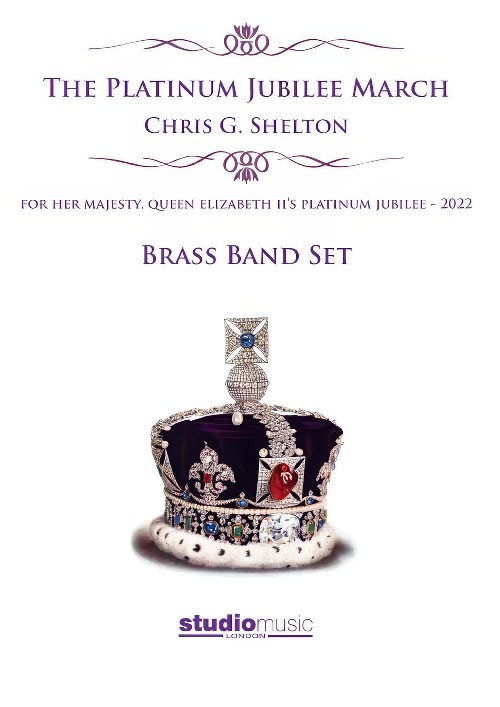
The Platinum Jubilee March (Brass Band - Score and Parts) - Shelton, Chris G.
The Platinum Jubilee March was written to celebrate Her Majesty, Queen Elizabeth II's seventy-year reign as monarch of the United Kingdom. Its premiere was televised live around the world as part of the Queen's Birthday Parade which marked the start of the national Platinum Jubilee celebrations.The Queen's Birthday Parade 2022 saw the First Battalion of the Irish Guards trooping their colour. To reflect this, the march begins in a celebratory style and features a melody based around the opening motif of Let Erin Remember - the regimental slow march of the Irish Guards. In traditional style, the march develops excitement both harmonically and melodically, creating a strong sense of drive before reaching a stately trio. This section has a very regal and noble feel, lending subtle harmonic nods to two of the most quintessentially British composers, Gustav Holst, and Sir William Walton. The march culminates in a bold grandioso, featuring semi-quaver lines that are underpinned by a driving trombone countermelody. A forthright restatement of the introductory fanfare brings the march to a very definite and resolved ending.
Estimated dispatch 7-14 working days
-
 £82.95
The Flowers of the Forest (Brass Band - Score and Parts) - Bennett, Richard Rodney - Hindmarsh, Paul
In a preface to the score, the composer explains that 'the folk song The Flowers of the Forest is believed to date from 1513, the time if the battle of Flodden, in the course of which the archers of the Forest (a part of Scotland) were killed almost to a man'. Bennett had already used the same tune in his Six Scottish Folksongs (1972) for soprano, tenor and piano, and it is the arrangement he made then that forms the starting-point for the brass-band piece. A slow introduction (Poco Adagio) presents the folk song theme three times in succession - on solo cornet, on solo cornets and tenor horns, and on muted ripieno cornets in close harmony - after which the work unfolds through five sections and a coda. Although played without a break, each of these five sections has its own identity, developing elements of the tune somewhat in the manner of variations, but with each arising from and evolving into the next. The first of these sections (Con moto, tranquillo) is marked by an abrupt shift of tonality, and makes much of the slow rises and falls characteristic of the tune itself. The tempo gradually increases, to arrive at a scherzando section (Vivo) which includes the first appearance of the theme in its inverted form. A waltz-like trio is followed by a brief return of the scherzando, leading directly to a second, more extended, scherzo (con brio) based on a lilting figure no longer directly related to the theme. As this fades, a single side drum introduces an element of more overtly martial tension (Alla Marcia) and Bennett says that, from this point on, he was thinking of Debussy's tribute to the memory of an unknown soldier (in the second movement of En Blanc et noir, for two pianos). Bennett's march gradually gathers momentum, eventually culminating in a short-lived elegiac climax (Maestoso) before the music returns full-circle to the subdued melancholy of the opening. The work ends with a haunting pianissimo statement of the original tune.
Estimated dispatch 7-14 working days
-
£44.95
The Flowers of the Forest (Brass Band - Score only) - Bennett, Richard Rodney - Hindmarsh, Paul
In a preface to the score, the composer explains that 'the folk song The Flowers of the Forest is believed to date from 1513, the time if the battle of Flodden, in the course of which the archers of the Forest (a part of Scotland) were killed almost to a man'. Bennett had already used the same tune in his Six Scottish Folksongs (1972) for soprano, tenor and piano, and it is the arrangement he made then that forms the starting-point for the brass-band piece. A slow introduction (Poco Adagio) presents the folk song theme three times in succession - on solo cornet, on solo cornets and tenor horns, and on muted ripieno cornets in close harmony - after which the work unfolds through five sections and a coda. Although played without a break, each of these five sections has its own identity, developing elements of the tune somewhat in the manner of variations, but with each arising from and evolving into the next. The first of these sections (Con moto, tranquillo) is marked by an abrupt shift of tonality, and makes much of the slow rises and falls characteristic of the tune itself. The tempo gradually increases, to arrive at a scherzando section (Vivo) which includes the first appearance of the theme in its inverted form. A waltz-like trio is followed by a brief return of the scherzando, leading directly to a second, more extended, scherzo (con brio) based on a lilting figure no longer directly related to the theme. As this fades, a single side drum introduces an element of more overtly martial tension (Alla Marcia) and Bennett says that, from this point on, he was thinking of Debussy's tribute to the memory of an unknown soldier (in the second movement of En Blanc et noir, for two pianos). Bennett's march gradually gathers momentum, eventually culminating in a short-lived elegiac climax (Maestoso) before the music returns full-circle to the subdued melancholy of the opening. The work ends with a haunting pianissimo statement of the original tune.
Estimated dispatch 7-14 working days
-
 £64.00
Milonga del Angel (Soprano Cornet, Cornet and Trombone Trio with Brass Band - Score and Parts) - Piazzolla, Astor - Olsrud, Sverre Stakston
This arrangement was made after hearing Astor Piazzolla s 1986 recording of his own work written in 1965. The original instrumentation of bandoneon, violin and string bass is here arranged for three wind soloists with Concert Band. The Soprano Sax is the main soloist (filling the bandoneon role), while the trombone and clarinet shares the violin part as a kind of flirting undertone to the soprano saxophone. It s not possible to make a 100% correct notation of the solo parts, so it s recommended to listen to the record album Zero Hour from 1986 to get the best impression of the work. Enjoy Milonga Del Angel and imagine a small, dark cafe in Buenos Aires!
Estimated dispatch 7-14 working days
-
£44.95
The Victor (Brass Band - Score and Parts) - Downie, Kenneth
Written for the Melbourne Staff Band, this march features the hymn tune, 'Millennium'. While the origins of the tune are unclear, it has a distinct character; from the opening rising fourth interval through to its conclusion, it embodies strength and vigour. The composer has hinted at the style brilliantly employed by the great Australian march writer, Arthur Gullidge, by opting for a minor key in the first section offset by a melodious trio section in a major key.
Estimated dispatch 7-14 working days
-
£22.50
The Victor (Brass Band - Score only) - Downie, Kenneth
Written for the Melbourne Staff Band, this march features the hymn tune, 'Millennium'. While the origins of the tune are unclear, it has a distinct character; from the opening rising fourth interval through to its conclusion, it embodies strength and vigour. The composer has hinted at the style brilliantly employed by the great Australian march writer, Arthur Gullidge, by opting for a minor key in the first section offset by a melodious trio section in a major key.
Estimated dispatch 7-14 working days
-
£29.95
Wade In The Water (Brass Band - Score and Parts) - Ballantine, Leonard
Wade in the Water is a Negro Spiritual made popular in 1962 by the Ramsey Lewis Trio. Further versions followed in 1968 by Big Mama Thornton and in 1997 by Eva Cassidy. The song is thought to be a coded message for slaves escaping to freedom and tells the fugitive to walk in the water, instead of on the land, where tracking dogs cannot follow human scent. This version for brass band is in swing style.
Estimated dispatch 7-14 working days
-
£14.95
Wade In The Water (Brass Band - Score only) - Ballantine, Leonard
Wade in the Water is a Negro Spiritual made popular in 1962 by the Ramsey Lewis Trio. Further versions followed in 1968 by Big Mama Thornton and in 1997 by Eva Cassidy. The song is thought to be a coded message for slaves escaping to freedom and tells the fugitive to walk in the water, instead of on the land, where tracking dogs cannot follow human scent. This version for brass band is in swing style.
Estimated dispatch 7-14 working days
-
 £152.99
Hymn of the Highlands, Suite from (Brass Band - Score and Parts) - Sparke, Philip
Suite from Hymn of the Highlands draws three expressive musical pictures of the Scottish highlands.The first movement, Ardross Castle, contains solo passages for horn and baritone and features a fascinating bagpipe melody.The second movement, Alladale, is a trio for tenor horn, flugel horn and baritone with an accompaniment featuring the percussion section.The final movement, Dundonnell,features two highly contrasting melodies, a wild presto and the bagpipe melody first heard in the first movement.Duration: 17:00
Estimated dispatch 7-14 working days
-
 £42.50
The Lights of Europe (Brass Band - Score and Parts) - Evers, Harm
The inspiration for The Lights of Europe was the continuous growth in unity throughout Europe. The march begins in the minor key (all beginnings are difficult) but unity is found and is clearly audible in the melodious trio of the march.Duration: 3:00
Estimated dispatch 7-14 working days
 View Music