
Results
-
£125.00
Titan's Progress (Score & Parts) - Hermann Pallhuber
Commissioned by Austria's leading brass band, Brass Band Oberoesterreich, Titan's Progress is a series of descriptive, virtuoso episodes based on the principal character of the novel by Jean Paul. This was also the original subject of Mahler's Symphony No. 1, from which Hermann Pallhuber derives much of his material. The work has proved an exceptionally popular test piece all over the world. Titan's Progress was the selected test piece for the British Open Brass Band Championship, held at Symphony Hall, Birmingham on Saturday 12th September 2009. Brass Band Grade 6: Championship Duration: 17 minutes The score provided with this set is a larger format, B4 size.
In Stock: Estimated dispatch 1-3 working days
-
 £69.95
Decade - Jonathan Bates
DIFFICULTY: 3rd+. DURATION: 10'00". 'Decade' was composed to mark the 10th anniversary of the Foden's Youth Band in 2022 and was premiered by the band, Foden's Band and Foden's Junior Band at Manchester's Stoller Hall. The work is in 3 clear movements - yet is through-composed, each movement based around the figure 10. Right from the initial 10 bell strikes at the opening of the piece, the musical material is also derived from the number 10 with the main 'motif' in the piece spanning an interval of a 10th - and the piece lasts 10 minutes!. .
In Stock: Estimated dispatch 1-3 working days
-
 £74.95
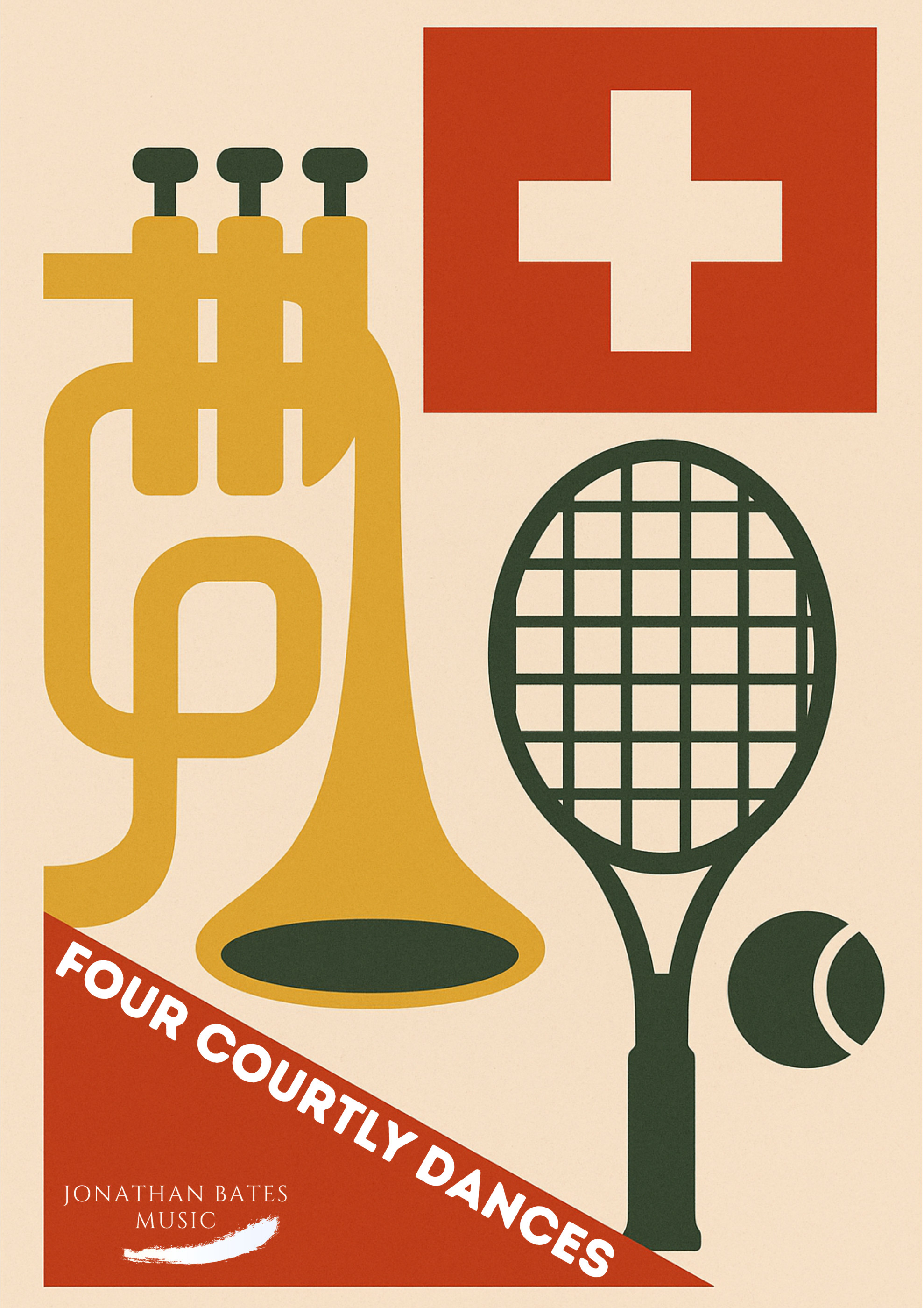
Four Courtly Dances - Jonathan Bates
DURATION: 12'00". DIFFICULTY: 1st+. 'Four Courtly Dances' was composed for Brass Band Burgermusik Luzern in 2025 for their Brass & Sport Gala Concert in the KKL Luzern. The work is a tribute to career of Swiss Tennis great Roger Federer with each movement giving a musical 'nod' to the story of his life and career. Each movement is inspired by a traditional 'courtly' (not in a tennis sense, but that was the idea!) dance:. 1. Inspiration (Almain) . The opening movement is subtitled 'Elegance on Court', backed by a deep-rooted sense of Swiss nationlism, featuring a prelude based upon the traditional Swiss song 'Guggisberglied'. . 2. Success & Failure (Galliard) . A movement centred around the trials and tribulations of an elite sportsperson, with antiphonal cornet & tambourine groups playing avirtuosic musical tennis match across the band. . 3. Rivalry (Sarabande & Canario) . An upbeat movement fused with Spanish and Balkan influences, inspired by Federer's long-running rivalries with Rafael Nadal and Novak Djokovic. . 4. Legacy (Pavane) . A final reflective and uplifting homage to the legacy leftby one of the greatest sportspeople of all time, culminating in a coda whichbrings together all the previous 'ingredients' which made Federer the icon he is. . .
In Stock: Estimated dispatch 1-3 working days
-
 £34.95
How To Catch A Killer... - Jonathan Bates
DURATION: 5 minutes. DIFFICULTY: Championship. 'How To Catch A Killer.' was composed as the energetic finale to Carlton Main Frickley Colliery Band's 2nd placed 'Murder in the Night' set at the 2018 Brass In Concert Championships. The piece is built upon a quite complex motif in the tuned percussion, exploring an almost sci-fi-esque soundworld as the identity of the killer is figured out. After the identity of the killer is revealed, there is a brief chase scene before the work draws to a dramatic and fiery conclusion. .
In Stock: Estimated dispatch 1-3 working days
-
£110.00
Red Lines (Bra) - Stijn Aertgeerts
Red Lines was commissioned by the Swiss Army Brass Band and their conductor Philipp Werlen. The title is a reference to their very distinctive black uniforms with Red vertical lines. Switzerland is a country with a tremendously rich brass band culture and have some of the best bands in the world. The individual level of musicians is also of incredibly high quality. The work begins very bombastically with continuous 8th notes. This immediately sets the drive for the entire first movement where the low brass can also show off huge sounds several times. It culminates in a grand tutti before the music calms down in the second movement where the euphonium can show its solistic qualities and the band can show a big difference in dynamics and sound. The final movement is driven by the drums and timpani that provide a solid boost to keep moving the thematic material forward in the band and through the percussion solo a big build-up to a glorious finale.
Estimated dispatch 7-14 working days
-
£87.00
Sparkle (Bra) - Lennert Van Thienen
In 'Sparkle', Lennert Van Laenen describes the glittering of a shooting star that wanders down during a dark night. The work starts with an aural representation of the glittering, which is used as a guide throughout the piece. The quiet middle section symbolises the beauty of the starry sky, after which a new tempo announces the finale.
Estimated dispatch 7-14 working days
-
£104.00
Rise (Bra) - Stijn Aertgeerts
The work 'Rise' was specially written for Lode Violet and Kevin Van Giel, principal cornet and euphonium of Brass Band Willebroek, for their CD 'Rise'. The idea behind the piece is that friends always pull you through a difficult period, they make you rise again. It is a duet for cornet and euphonium, starting with a wonderful melancholic melody presented by the euphonium. The cornet takes over and is beautifully interwoven with the euphonium lines. The second part is festive, up tempo and a bit funky. The bass drum beat is the driving force for the soloists to display their versatility and flexibility. This all builds up to a grand finale in which the soloists shine.
Estimated dispatch 7-14 working days
-
£76.00
Toccatina (Bra) - Olivier Marquis
In May 2017, during the European Brass Band Championships, the composer meets Michel Leveugle who asks him to write the testpiece for the B Division of the Flemish Open Brass Band Championship 2018. On the way back to Switzerland, Olivier Marquis invents an ostinato which later forms the backbone from Toccatina. After a first, restless, presentation of the theme by the trombones, the ostinato shifts to the basses, euphoniums and horns after which the theme is renewed at the cornets. A quiet mysterious passage brings the flugel and euphonium to the fore, after which the ostinato takes back his place. The theme comes back, to evolve to major and then close the work festively.
Estimated dispatch 7-14 working days
-
 £143.00
Poem a la Carte - Manfred Schneider/Anton Weeren
As a French horn player, the successful German composer Manfred Schneider is familiar with brass instruments, so he took on the challenge of writing at a real Concerto for Trombone and Wind Band, which he called 'Poem a la carte'. The composition was commissioned by the JBK Sonthofen wind band. Though the 'misterioso' introduction already features some virtuoso passages for the soloist, the latter really takes off in the energetic allegro. Then comes a lyrical largo and the work ends with a sparkling allegro allowing the soloist to demonstrate true virtuosity.
Estimated dispatch 10-14 working days
-
 £30.00
A Short Ride in a Brass Machine
DescriptionA Short Ride in a Brass Machine was written in 2006 to mark the 140th anniversary of the Brighouse and Rastrick Band and first performed in the Central Methodist Church in Brighouse by Brighouse and Rastrick conducted by James Gourlay. The title refers to the orchestral composition A Short Ride in A Fast Machine by the American composer John Adams which provided some of the inspiration for the work. The music is a simple celebratory prelude consisting of two main ideas, an expansive melody full of open fifths (giving the music a slightly "American" feel) and a short fanfare figure. After these are both heard for the first time a brief development of the fanfare material leads to a broader, warm harmonisation of the opening melody and the pulse relaxes a little before tension builds to a reiteration of the fanfare and a final triumphant version of the opening theme.Performance Notes:Percussion instruments required are 4 Timpani, Snare Drum, Bass Drum, 3 Tom-toms, 3 Wood Blocks, Suspended Cymbal, Clash Cymbals, Tubular Bells, Glockenspiel, Tam-tam.Soprano, repiano, 2nd solo cornet, 2nd and 3rd cornets will require metal straight mutes; 2nd and 3rd cornets will require harmon mutes with the tubes removed (indicated by 'TR').Duration approximately 3'30"Follow the score in the preview video below!
Estimated dispatch 7-14 working days


 View Music
