
Results
-
 £74.95
Connotations (Brass Band - Score and Parts) - Gregson, Edward
Connotations was commissioned for the 1977 National Brass Band Championship finals, held in the Royal Albert Hall, London (the winner, incidentally, of that particular competition was the famous Black Dyke Mills Band).At the age of 32 Gregson was the youngest composer to have received the honour of such a commission. It came at the end of a productive five years writing for the brass band publisher R Smith. Some of those works - The Plantagenets, Essay and Patterns for example, with their direct and tuneful style, have remained popular with brass bands the world over.For Gregson, these were the means by which he sharpened the tools of his trade, preparing the ground, as it were, for his finest work to date - Connotations. He thought of calling the piece Variations on a Fourth, but with due deference to Gilbert Vinter perhaps (Variations on a Ninth), he chose a more appropriate one. As Gregson has written, 'Connotations suggests more than one way of looking at something, an idea, and this is exactly what the piece is about'.Writing a competition piece brought its own problems. 'It has to be technically difficult and yet musically satisfying. I didn't like being kept to an eleven-minute maximum. The inclusion of short cadenzas for less usual solo instruments seems to signify a certain test-piece mentality'.Gregson solved the problems admirably by adopting a symphonic approach to variation form: Introduction - fanfares, a call to attention, in effect Variation 1; Theme - a six-note motif, given a lyrical and restrained first statement; Variation 2 - a delicate toccata; Variation 3 - typically robust in melody and rhythm; Variation 4 - lyrical solos; Variation 5 - a scherzo; Variation 6 - cadenzas; Variations 7-9 - an introduction, fugato and resounding restatement of the theme.Duration: 10.30
Estimated dispatch 7-14 working days
-
 £44.95
Intrada (Brass Band - Score and Parts - Gregson, Edward
This work was commissioned by the London Borough of Redbridge with funds provided by the Arts Council of Great Britain, and was first performed at the London Festival of 1972 by the Redbridge Youth Band, conducted by John Ridgeon.Intrada is in three sections, the first and last being similar. The middle section unfolds an expansive chromatic melody, heard initially on the horns, but later in canon between cornets and trombones. The work is lively throughout and has strong rhythmic elements as its chief characteristic, including changing time patterns and syncopations.Duration: 6.00
Estimated dispatch 7-14 working days
-
 £64.95
Partita (Brass Band - Score and Parts) - Gregson, Edward
Selected as the Section 4 test piece for the National Brass Band Championships of Great Britain 2025Partita dates from 1971, when it was commissioned by the Redbridge Youth Band. The musical thread that runs through the work is the 13th century plainsong Dies Irae from the Requiem Mass. This gives the work a rather sombre tone which is audible right from the start of its first movement Intrada. The initial hammer-like chords of the opening and conclusion are only interrupted momentarily by a more lyrical modal tune. Even here, on its repetition, it is surrounded by more insistent textural patterns.The second movement, Chorale and Variations, uses the Dies Irae as the basis for an extended melody in the manner of a baroque sarabande. The five variations that follow are varied in texture, tempi, and dynamics. The final March is more optimistic in mood and presents as its main idea a rather jaunty theme which gets developed throughout the movement. However, the ominous presence of the Dies Irae has the last say with a final statement to round off the work.Duration: 11.00
Estimated dispatch 7-14 working days
-
£32.50
Partita (Brass Band - Score only) - Gregson, Edward
Selected as the Section 4 test piece for the National Brass Band Championships of Great Britain 2025Partita dates from 1971, when it was commissioned by the Redbridge Youth Band. The musical thread that runs through the work is the 13th century plainsong Dies Irae from the Requiem Mass. This gives the work a rather sombre tone which is audible right from the start of its first movement Intrada. The initial hammer-like chords of the opening and conclusion are only interrupted momentarily by a more lyrical modal tune. Even here, on its repetition, it is surrounded by more insistent textural patterns.The second movement, Chorale and Variations, uses the Dies Irae as the basis for an extended melody in the manner of a baroque sarabande. The five variations that follow are varied in texture, tempi, and dynamics. The final March is more optimistic in mood and presents as its main idea a rather jaunty theme which gets developed throughout the movement. However, the ominous presence of the Dies Irae has the last say with a final statement to round off the work.Duration: 11.00
Estimated dispatch 7-14 working days
-
 £37.95
Benvenuto Cellini (Brass Band - Score only) - Berlioz, Hector - Wright, Frank
Berlioz's opera Benvenuto Cellini was first produced in Paris in 1838 but was withdrawn as a failure, and it was not until the production in Dresden in 1888 that it was finally acclaimed by the Germans as a triumph. Adapted from certain episodes recorded in the memoirs of Benvenuto Cellini, Tuscan sculptor and goldsmith, the story, laid in Rome during the mid-sixteenth century, is not strictly historical. The short opening Allegro, marked deciso con impeto, is conceived in the most brilliant Berlioz manner, utilising full instrumentation. In the Larghetto we meet at once the first of the opera themes - the Cardinal's aria (from the last act) introduced in the bass, quasi pizzicato. A second melody leads to a resumption of the Allegro, the contrasting second subject in the tenor horns being an adaptation of Teresa's aria (Act I). Towards the end the Cardinal theme is re-introduced by trombones, fortissimo against an energetic cornet and euphonium passage (senza stringendo - without hurry, says the score). After a unison passage storming skywards, there is a sudden, dramatic three-bar silent pause broken by Eb basses alone, again stating the Cardinal theme. A simple molto crescendo on the dominant, begun piano, leads to the long, resounding chord.
Estimated dispatch 7-14 working days
-
 £82.95
Benvenuto Cellini (Brass Band - Score and Parts) - Berlioz, Hector - Wright, Frank
Berlioz's opera Benvenuto Cellini was first produced in Paris in 1838 but was withdrawn as a failure, and it was not until the production in Dresden in 1888 that it was finally acclaimed by the Germans as a triumph. Adapted from certain episodes recorded in the memoirs of Benvenuto Cellini, Tuscan sculptor and goldsmith, the story, laid in Rome during the mid-sixteenth century, is not strictly historical. The short opening Allegro, marked deciso con impeto, is conceived in the most brilliant Berlioz manner, utilising full instrumentation. In the Larghetto we meet at once the first of the opera themes - the Cardinal's aria (from the last act) introduced in the bass, quasi pizzicato. A second melody leads to a resumption of the Allegro, the contrasting second subject in the tenor horns being an adaptation of Teresa's aria (Act I). Towards the end the Cardinal theme is re-introduced by trombones, fortissimo against an energetic cornet and euphonium passage (senza stringendo - without hurry, says the score). After a unison passage storming skywards, there is a sudden, dramatic three-bar silent pause broken by Eb basses alone, again stating the Cardinal theme. A simple molto crescendo on the dominant, begun piano, leads to the long, resounding chord.
Estimated dispatch 7-14 working days
-
 £26.95
Golden Lullaby (Brass Band - Score and Parts) - Wiffin, Rob
This is a song-setting giving an opportunity for some lyrical expression. It started life as a song on the subject of gold but ended up by standing alone as an instrumental piece. The gentle lilt of the 5/4 melody suggests a lullaby although the texture of the piece builds in an un-lullaby-like fashion towards the end. There is a little white-note dissonance but it is basically traditional in its language.Duration: 3.45
Estimated dispatch 7-14 working days
-
 £54.99
Heritage (Brass Band - Score and Parts) - Sparke, Philip
Philip Sparke wrote Heritage as a grand concert march in the tradition of Elgar and Walton. After a brief introduction, the march's long main theme is presented: first in subdued tones, then taken up by the full band, adding a tenor counter melody. The following bridge passage leads to a change of key and the traditional trio section. A repeat of previous motifs leads to a return of the main theme, followed by a short closing coda.Duration: 4.45
Estimated dispatch 7-14 working days
-
 £72.99
Pagan Songs (Brass Band - Score and Parts) - Crausaz, Etienne
Written in three movements without a break, this work was inspired by melodies of a popular nature. The first movement features two opposing modal melodies: one is very bright and lively, the other dark and tuneful. Various motifs are developed to offer highly contrasting musical events. The second movement is very peaceful, with a melody resembling a lullaby. To conclude the piece, the last movement delivers a festive dance with a swing feel. Commissioned by the Swiss Music Association, this very accessible work is mostly intended for small ensembles or those with mixed instrumentation. The duration and conception of this piece makes it ideal for competitions and concerts alike.Duration: 7.00
Estimated dispatch 7-14 working days
-
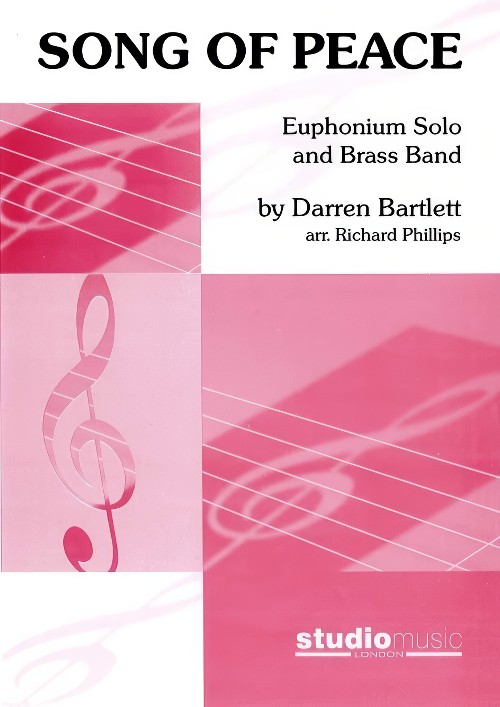 £42.95
Song of Peace (Euphonium Solo with Brass Band - Score and Parts) - Bartlett, Darren - Phillips, Richard
Originally written for the BBC Choirboy of the Year 2002, James Eager, who was a Chorister at Llandaff Cathedral and attended the Cathedral Choir school. The concept for the song was to combine classical music with a contemporary flavour including a subtle Celtic influence. After being recorded by Llandaff Cathedral Choir and the BBC National Orchestra of Wales, Richard Phillips arranged it for the world famous Brass Band, YBS. It is hoped that this version as a Euphonium Solo will breathe new life into this ethereal melody. - Darren Bartlett
Estimated dispatch 7-14 working days
 View Music