
Results
-
 £109.99
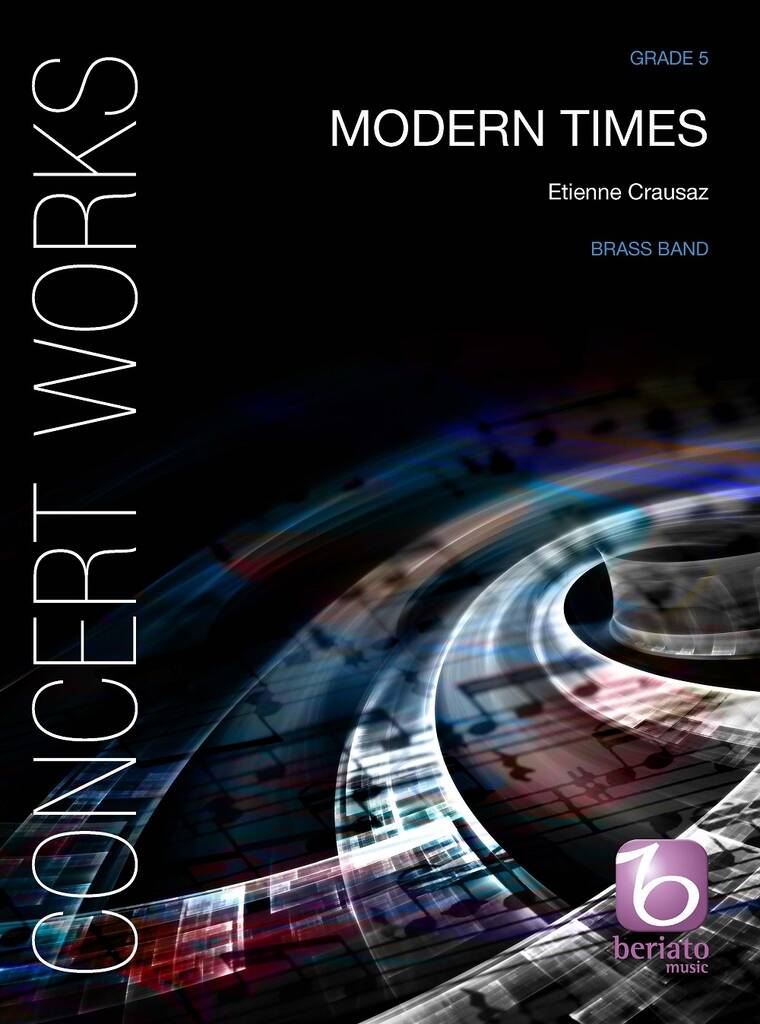
Modern Times - Etienne Crausaz
Modern Times is a concert suite from the musical and theatrical show Le Temps de Lyre, written and directed by Nicolas Bussard. The work was commissioned for the 100th anniversary of the Lyre de La Roche, directed by Marc-Olivier Broillet, with the premiere taking place in July 2024 in front of an audience of over 2,000.This suite highlights three of the dozen tableaux in the show. After an introduction evoking a sort of journey back in time, the first tableau (bar 20) illustrates various disasters that have occurred in the village over the years. The sky darkens, the thunder rumbles, the rain lashes down, and violent gusts of wind are unleashed on this corner of the country. The storm finally calms down, giving way to great desolation.The second tableau (bar 117) describes the resilience of the villagers, who summon up all their courage to repair the damage. The music is soft, calm, and hopeful.On the strength of this new beginning, the village can embrace modernity: motor vehicles replace horses, a dam is built, and tourism develops, encouraging a society open to other cultures. The third tableau in this suite illustrates all these advances (bar 177). Musically, this final section pays tribute to George Gershwin and Leonard Bernstein, two of the 20th century's great musicians and composers, who worked during the fascinating period of modern times and well beyond.
Estimated dispatch 5-14 working days
-
 £131.00
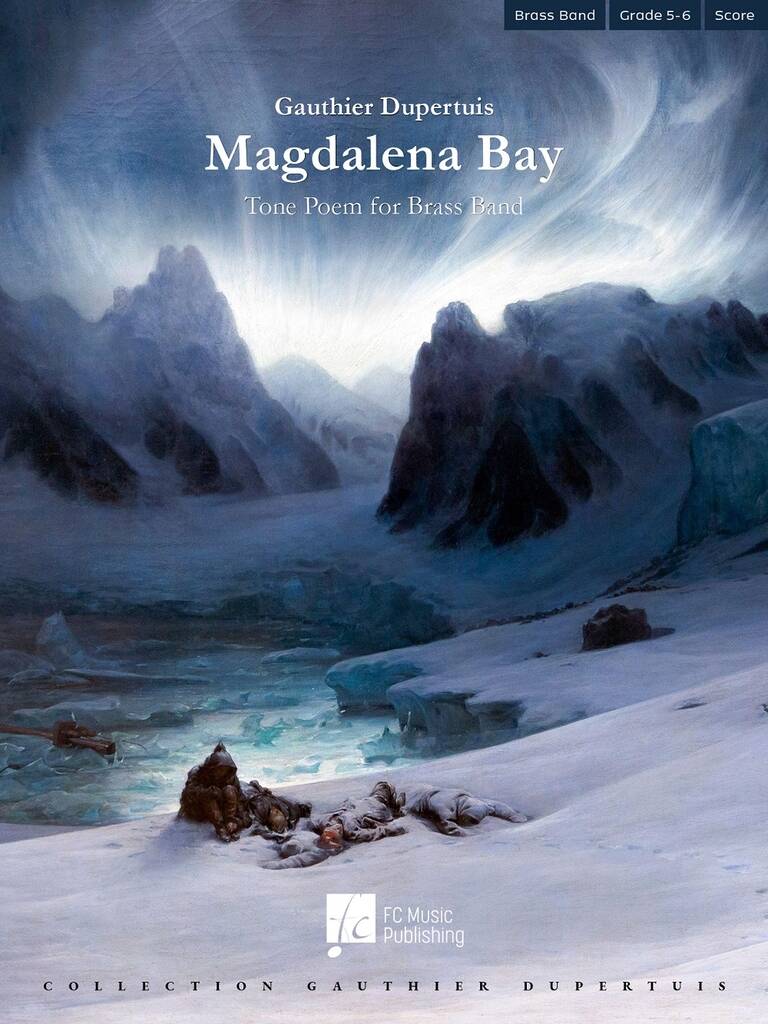
Magdalena Bay - Gauthier Dupertuis
While admiring many masterpieces at the Louvre Museum in Paris, Gauthier Dupertuis' attention was drawn to a less famous painting: Magdalena Bay, by French painter Francois-Auguste Biard (1799-1882).The work depicts a magnificent snowy landscape on the Norwegian island of Spitsbergen. However, in the foreground, the presence of the wreckage of a ship, bodies covered in snow and a visibly dying character make us understand that tragic events took place there. Thus, a strong contrast is formed between death and the sublime, between the desolation of the survivors of the shipwreck and the magnificence of the landscape. When we look in more detail at the painting, we notice that footprints have been made in the snow: so, could someone have gone to get help? This little glimmer of hope makes the picture even more touching. In this work, Gauthier Dupertuis tried to describe the different elements of the painting, using contrasting sections and dissonances (in particular, the conflict between the minor and the major) to convey the duality between death and the sublime. The work also attempts to highlight a wide palette of orchestral colors, from the most shimmering lines to the darkest low brass colours. In 2024, Magdalena Bay was awarded the first Prize as well as the band Prize at the 9th European Composition Competition for Brass Band, which was held in Palanga (LT). It was premiered on May 2, 2024 by The Cory Band, conducted by Philip Harper.
Estimated dispatch 5-14 working days
-
 £114.99
Keystone - Thierry Deleruyelle
Keystone tells the story of the Odeon of Vriezenveen, a town in the Netherlands. Historically speaking, "odeon" (or "odeum") was the name for ancient Greek and Roman buildings used for activities such as singing, music and poetry. This was the name chosen in 1998 by several members of the 'Vriezenveense Harmonie' for the cultural centre they decided to have built. The piece starts slowly with the bass instruments, then speeds up in a counterpoint passage where the main motif moves from one set of instruments to another. After a slower section, the music speeds up again to reach a majestic chorale symbolising the splendid Odeon. This composition has been orchestrated for brass band to serve as the test piece in the first division of the French National Brass Band Championship of 2023.
Estimated dispatch 5-14 working days
-
 £159.99
Omaggio - Philip Sparke
Omaggio was commissioned by Steven Mead in celebration of his 60th birthday and in memory of his father, Rex. He gave the premiere of the brass band version in Rome in March 2022, accompanied by the Italian Brass Band conducted by Filippo Cangiamilla. The concert band premiere took place on 6th July that year as part of the 2022 Spanish International Tuba Euphonium Conference, accompanied by the Banda municipal de musica de Malaga. The concerto is set in 3 continuous movements, which are united by a recurring syncopated interval of a fifth. The first movement, FANTASIA, opens with this motive accompanying an extended monologue for the soloist. This is followed by a lengthy bridge passage by the band (piano), which is eventually joined by the soloist, who guides the music back to the opening soliloquy, leading to an energetic central section. This develops until the opening material again returns to introduce the second movement, BALLAD, which revolves around an expressive melody for the soloist, interspersed by accompanied cadenzas. The third movement, THE KING TRIUMPHANT, pays homage to Steven's late father, Rex, and its title alludes both to Rex's name ('Rex' being Latin for 'king') as well as his love of Eric Ball's Salvationist masterpiece, The Kingdom Triumphant. The finale is an energetic tour-de-force featuring an acrobatic 6/8 melody, which is interrupted twice by the magnificent hymn tune, Helmsley, which Ball uses so effectively in The Kingdom Triumphant. A galloping coda brings the work to a close.
Estimated dispatch 5-14 working days
-
 £115.60
Griffenfeldt - John Philip Hannevik
Here we present "Griffenfeldt, a folk-dance in the style of a Norwegian reinlender.This arrangement can be used as the first item in a concert, or after an interval.The musicians can come on stage as they join in. That is why two of the measures are notated "repeat till ready", here you have to wait until everyone is in place! If everyone is ready from the start, the repetition can be omitted.Be sure to play with a bouncy but singing style, not with short and harsh articulations.Do the trills on the beat, but these can also be omitted if it makes it too difficult.To bring out the folk music style a little extra, you can ask the musicians to play on the "backbeat", i.e. emphasize the last half of each quarter-note.In addition, the music will really come to life if all "solo" places are done standing up.The musician Anon Egeland tells this story:This song got its name from a party where it all just got a bit too lively: one of the party-goers started shooting into the ceiling with a gun just as this reinlender was being played. The fiddler - or was it the man with the gun? - was called Griffenfeldt, and that gave the name for the song.
Estimated dispatch 5-14 working days
-
 £115.60
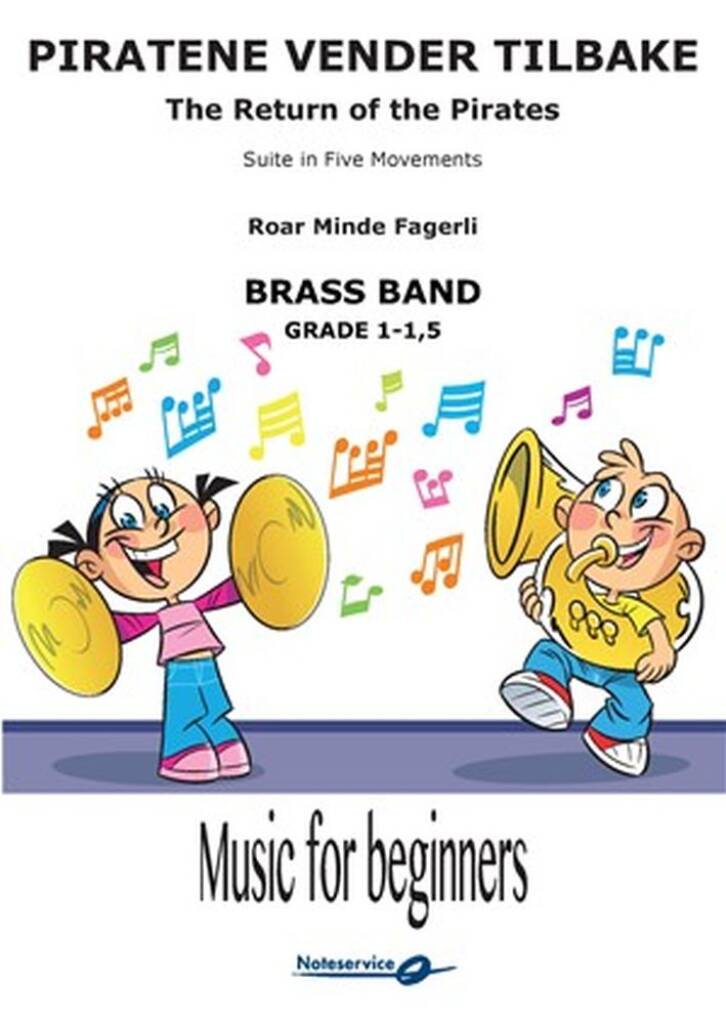
Pratene vender tilbake - Roar Minde Fagerli
"The Return of the Pirates" is a five movement suite of music originally composed for a summer course arranged by The Norwegian Band Federation.The five movements describes scenes for the pirates' story. In the first movement they sing a shanty while preparing their ship to sail. I the second movement the pirates sails into a storm. In the third movement they sing a song to open a treasure chest. The fourth movement is a dramatic swordfight. In the fifth movement the pirates win at last.
Estimated dispatch 5-14 working days
-
 £72.99
Little Clover - Etienne Crausaz
Cornet solo commissioned by Carole Rudaz, a Swiss cornetist, on the occasion of her 40th birthday. Due to its rarity, the four-leaf clover is considered lucky in western culture. But the common three-leaf shamrock, also known as Little Clover, is one of the symbols of Ireland, whose traditional music greatly influenced the general aesthetics of this piece. The work is in three parts: the first, in 6/8, is very lively and virtuosic. After a short cadenza, the second part introduces a theme tinged with melancholy, while the last part is a dance in 2/2 that reprises the theme of the second part to conclude the piece.
Estimated dispatch 5-14 working days
-
 £115.60
Piratene Kommer! - Roar Minde Fagerli
The Pirates are comming! is a four movement suite of music originally composed for a summer course arranged by The Norwegian Band Federation. The four movments describes the pirates tale. In the first movement they set the sails for new adventures. In the second movememt we meet the pirates early one morning when the sun rises. I the third movememt the pirates are looking for a treasure map at the Isle of the Dead. In the fourth and last movememt, they hunt the teasure! The Composer has been inspired by TV-series and films with pirate themes. The Music is written especially for beginners.
Estimated dispatch 5-14 working days
-
 £174.99
Tales & Legends - Etienne Crausaz
This three-movement work by the Swiss composer Etienne Crausaz reflects three true stories and fascinating legends from the Middle Ages. The first movement tells the dramatic story of the 'witch' Catherine 'Catillon' Repond (1662 1731). She was the last woman ever to be executed for sorcery. In the second movement, the famous court jester Girard Chalamala occupies centre stage. This jester, the last one at the castle of Count Greyerz, could make everyone laugh. The third movement tells the story of Count Michael. He went down in history as a spendthrift bon-vivant. His burden of debt became so high that he did a moonlight flit and never came back!
Estimated dispatch 5-14 working days
-
 £84.99
Festivus Americas - Stephen Bulla
Dedicated to the North American Brass Band Association, this is music that is full of energy and dynamic extremes. In form it draws from the overture style, although the themes are self-existing and the piece is programmatic. Working well asa festival opener, it sets a mood of excitement. Following the rhythmic fanfares of the opening, the first theme is presented in the cornets followed by a return to the same rhythmic material. A second theme appears in the horn section and isdeveloped, changing into a darker and sinister form of the same motif. Eventually a Maestoso section is reached, full of sustained block chords in the cornets and trombones, as the rest of the band counters with cascading lines that weavestraight through the brighter instruments.
Estimated dispatch 5-14 working days
 View Music