
Results
-
 £70.00
General Series Band Journal December 2017 Numbers 2174-2177
Festival March - Stowmarket 125 (Steven Ponsford)This festival march is traditional in style, abounds in energy and features the lesser known chorus 'In that city built four square' which the corps at Stowmarket have featured through the years.At the cross (Paul Sharman)This meditation was originally written for the Disciples of the Cross commissioning and features 'To thy cross, I come Lord', 'At the cross where I first saw the light' and other melodic references to 'The Cross of Christ' are also found within.Flugel Horn Solo How deep the fathers love (Andrew Mackereth)The beautiful contemporary song has been set in a developed Flugel Horn Solo which should have an instant appeal to both soloist and band.Evry time I feel the spirit (Dean Jones)The classic spiritual is given an up-tempo feel and has been featured by the International Staff Band in recent programmes.
Estimated dispatch 7-14 working days
-
 £38.95
Unity Series Band Journal February 2015 Number 426 - 429
No. 426 March - Trinity Praise (Martin Cordner)Written in 2013 for the first anniversary of the Trinity Brass training band (a joint initiative between Rock Ferry and Birkenhead corps), this march celebrates God the Father, Son and Holy Spirit and calls to mind two songs: Father, we love you and verse 5 of Will J. Brand's song, Sing we many years of blessing.No. 427 A mighty fortress is our God (George Twitchen)The words and melody to this great hymn were written by Martin Luther and are based on PSalm 46. It has been called 'The battle hymn of the Reformation' for the effect it had on increasing support for the Reformer's cause. The words and melody are so closely associated with its author, that the first lines are inscribed on Luther's monument at Wittenberg.No. 428 Song Arrangement - I'd rather have Jesus (Peter Kim)Bandmaster Peter Kim from the USA Central Territory presents an arrangement of the popular gospel song, 'I'd rather have Jesus than silver or gold.' The lyrics were written by Rhea F. Miller in 1922 and have proved popular with many Christian denominations ever since.No. 429 Bound for Glory (Ian Feltwell)The song 'I'm a soldier bound for glory' was first published in 1922, is a great Salvation Army song of testimony and still remains a firm favourite today.
Estimated dispatch 7-14 working days
-
 £30.00
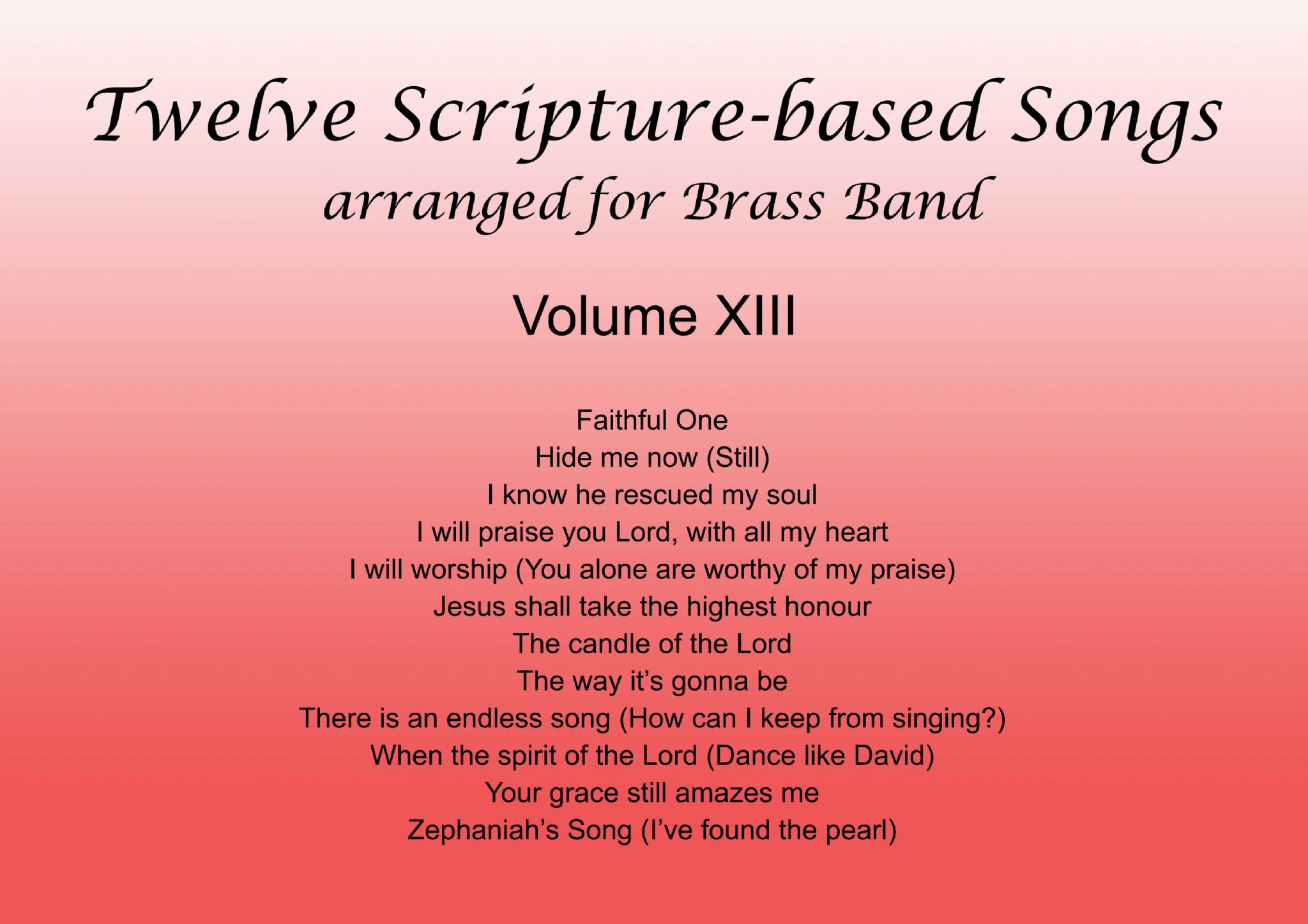
Twelve Scripture-Based Songs Volume XIII
Twelve scripture-Based Songs arranged for Brass Band (Volume XIII) are packaged and marketed in complete sets which include a full score and a set of master parts. It is intended that these parts be used as 'masters', for the purpose of photocopying a quantity of parts to accommodate the precise instrumentation needs of the band for which this has been purchased.Faithful One Brian Doerksen arr. Mervyn ClarkeHide me now (Still) Reuben Morgan arr. Paul SharmanI know he rescued my soul (My redeemer lives) Reuben Morgan arr. Dean JonesI will praise you Lord, with all my heart Dick KrommenhoekI will worship (You alone are worthy of my praise) David Ruiss arr .Dean JonesJesus shall take the highest honour Chris Bowater arr. Steven PonsfordThe candle of the Lord Joy Webb arr. Michael KenyonThe way it's gonna be Doug Horley arr. Dean JonesThere is an endless song (How can I keep from singing?) Chris Tomlin, Matt Redman and Ed Cash arr. Brian HoggWhen the spirit of the Lord (Dance like David) Anon arr. Andrew MackerethYour grace still amazes me Craig Phillips and Dean Phillips arr. David E JonesZephaniah's Song (I've found the pearl) arr. William Himes
Estimated dispatch 7-14 working days
-
 £82.95
Vivat! (Score and Parts)
VIVAT! was commissioned by Kapitol for the 2012 National Championship of Great Britain first section final as a celebration of the Queen's Diamond Jubilee. The work is split into three contrasting sections that run continuously, with music derived from elements of Parry's coronation anthem I Was Glad. In Memoriam evokes the noble but gentle personality of the Queen's father, George VI. Opening with an atmospheric baritone solo (and later featuring solo horn, flugel, euphonium & solo cornet), the music explores themes of grief, sentimentality and hope. Coronation, a fanfare and subsequent theme, is grandiose in style capturing the spirit and excitement of British pomp and ceremony.The closing Jubilate is a celebration of life and family values, Vivat being the Latin for life or long live. The music passes through moments of tension, virtuosity, humour and jubilance before a finale constructed from connected musical fragments drawn from throughout the work, forming (for the first time) Parry's majestic I was Glad theme.
Estimated dispatch 7-14 working days
-
 £158.00
Spiritus Vita - Anton Weeren
Spiritus Vita stands for "Breath of Life". The breath of life that is literally blown into instruments to produce beautiful wind music. This piece is a virtuosic fantasy for brass band. Extremely rhythmic, groovy, cheerful, flashy, and danceable, interspersed with long dramatic lines, sometimes combined with less common harmonies. The spirit and fire of life, with all its ups and downs, cheerfulness, sadness, reflection, peace, but also madness and despair. All emotions and energy expressed in this special, colorful, rhythmic composition.
Estimated dispatch 10-14 working days
-
 £29.50
Christmas Scene - Gavin Somerset
This festive number sees an original theme from the pen of Gavin Somerset interspersed with festive favourites that seem to appear in an unfamiliar manner. There is plenty of Christmas spirit to be found in this work and will see your percussion section taking the limelight. Whilst they're not essential, it does add some entertainment value to the piece. As the little drummer boy rises over the hill, your audience will be left with smiling throughout the music in a work that really does add fantastic entertainment value to any Christmas concert.
In Stock: Estimated dispatch 1-3 working days
-
 £24.50
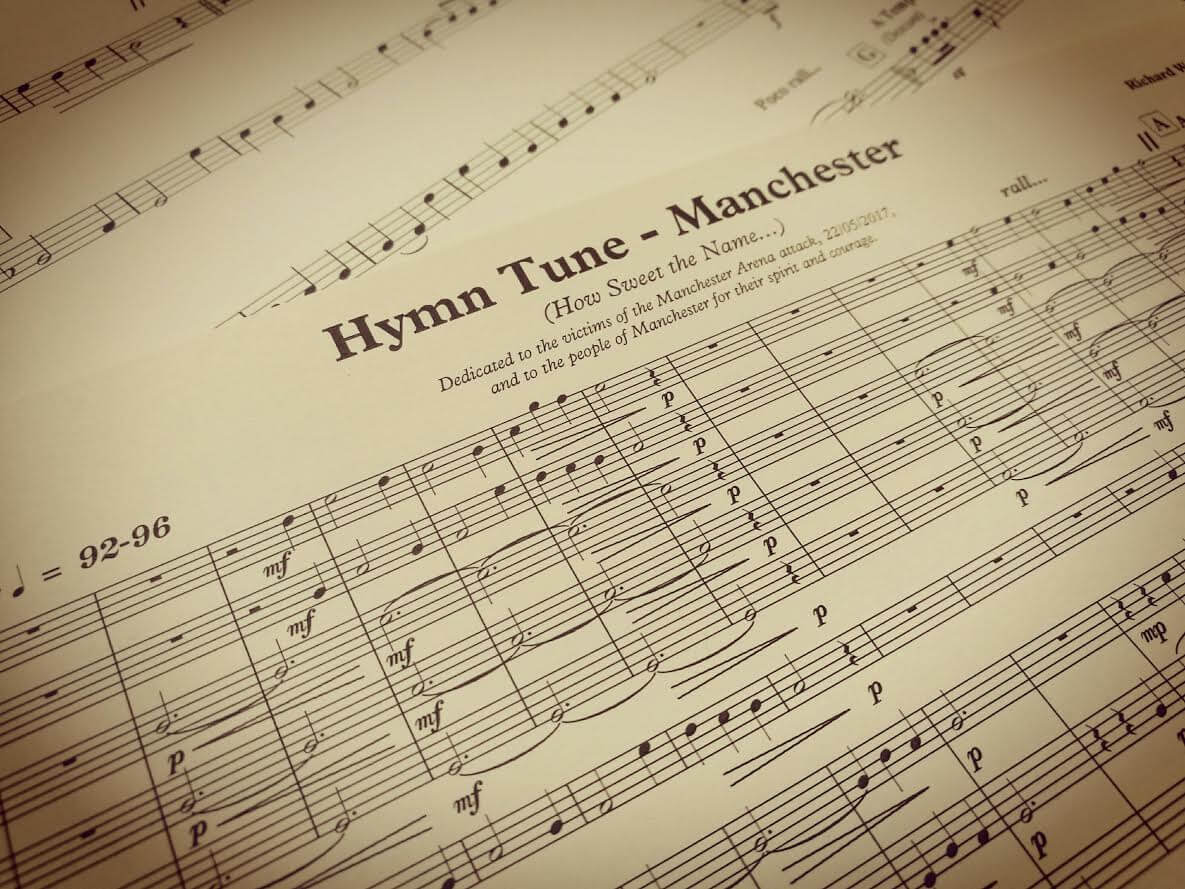
Manchester - Richard Wainwright - Andi Cook
Following the terrible events that took place in the Manchester Arena on 22nd of May 2017, this specially arranged and dedicated setting of the hymn tune, 'Manchester' has been put together as a tribute to all those caught up in the attacks, and as a salute to the people of Manchester for their spirit and courage in the aftermath. �10.00 from every purchase is being donated to the Manchester Evening News fundraising page, to help them achieve their target of �2,000,000. This can be found at https://www.justgiving.com/crowdfunding/westandtogethermanchester.
In Stock: Estimated dispatch 1-3 working days
-
£29.50
Manchester (Wind Band) - Richard Wainwright - Cook/Clarke
Following the terrible events that took place in the Manchester Arena on 22nd of May 2017, this specially arranged and dedicated setting of the hymn tune, 'Manchester' has been put together as a tribute to all those caught up in the attacks, and as a salute to the people of Manchester for their spirit and courage in the aftermath. �10.00 from every purchase is being donated to the Manchester Evening News fundraising page, to help them achieve their target of �2,000,000. This can be found at https://www.justgiving.com/crowdfunding/westandtogethermanchester.
In Stock: Estimated dispatch 1-3 working days
-
 £37.50
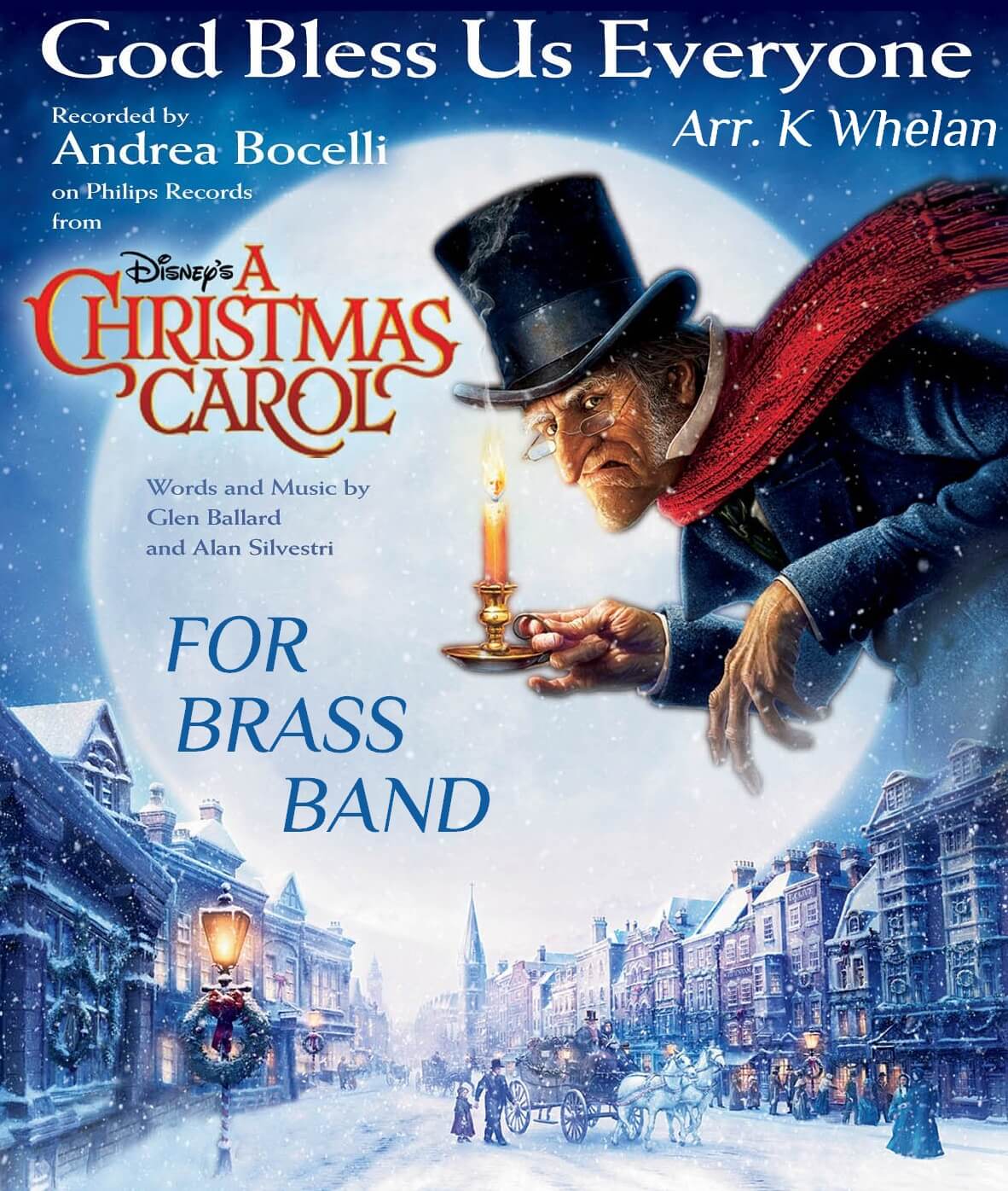
God Bless Us Everyone - Alan Silvestri - Karl Whelan
From Disney's hit movie A Christmas Carol comes the compelling theme song that will fill every heart with the holiday spirit. This inspiring message of peace and goodwill is a holiday call to kindness, and the festive orchestration is the icing on the cookies. Arranged by Karl Whelan, this new festive release is accessible to all bands and something familiar yet original for your Christmas concerts this year.
In Stock: Estimated dispatch 1-3 working days
-
 £154.99
Spiriti (Brass Band - Score and Parts)
A Bach chorale stands at the centre of this work (F?r deinen Thron tret? ich hiermit).Anton Bruckner was one of Johann Sebastian Bach's great admirers. His work is full of the spirit of that musical genius. For Thomas Doss, it was Bruckner's spirit that always seemed to be with him while working on Spiriti. Bruckner's spirit is captured in this composition by a quote from the chorale of his Fifth Symphony at the end of the piece.The introduction, written in the style of a funeral march, already displays the first fragments of the chorale. Like splinters they are strewn throughout the first Allegro, combining and recombining in turbulent, powerful tutti passages. As the music becomes more rambunctious, the Bach-like fragments begin to swirl around each other, only to be scattered once more.The middle-section is of a more pensive nature. The Religioso character gives the audience time to reflect. The music is meditative and the quarter-note (or crotchet) elements mimic a soul that is yearning and crying out.The third part of the piece finally leads, by way of minimalist elements and the fragments mentioned earlier, to a magnificent presentation of the Bach chorale. As the church bells ring out, one can almost hear the great masters presiding at the organ. 17:00
Estimated dispatch 7-14 working days
 Listen to MP3
 View Music