
Results
-
 £80.00
The Unfortunate Traveller (Brass Band - Score and Parts)
Imogen Holst (1907-1984) submitted The Unfortunate Traveller (1929) as her final work as a student portfolio at the Royal College of Music, where her composition teacher was Gordon Jacob. The title was taken from Thomas Nashe's famous 1594 picaresque novel of the same title. The Suite was first performed on 12 February 1933 at her Majesty's Theatre, Carlisle, by the St. Stephen's Band, with the composer conducting. Te concert was given in memory of Holst's uncle, Dr. H.A. Lediard. Holst had been impressed with the band's performance of his A Moorside Suite at the 1928 National Brass Band Championships (The Crystal Palace, South London) and was keen to work with them. Writing in Imogen Holst, a life in music, Christopher Grogan indicates that it was Gustav Holst's suggestion to include his daughter's work in the programme, quoting Imogen Holst's remarks made in interview to The Daily Mail as follows: "....it is the first time, so far as I know, that a woman has conducted a brass band at a public concert....It has been a delight to rehearse the St. Stephen's Band. It was their performance at the Crystal Palace Festival that inspired me to write this Suite, which I have dedicated to them."Imogen Holst accompanied her father to the Crystal Palace in 1928 to hear the performances of A Moorside Suite, and was so excited by the played and, audibly, by her father's music that she decided to write a brass band piece for her final examination. Te result was The Unfortunate Traveller (1929). However, it was not possible for her to present a brass band work for examination. She arranged it for string orchestra so that it could be played before she left the RCM in July 1930. Following the premiere of the original in 1933, the manuscripts did not resurface until 1969 Imogen found them among her late mother's effects. Although she requested score and parts be destroyed, they ended up in the possession of Manchester composer John Golland, who marked up the score presumably with the intention of creating a new performing edition. The original scoring reveals a lack of experience with what can be a tricky medium.With the agreement of the Holst Foundation, a revised edition, with additional percussion, was prepared in 2011 since when the work has been fortunate to travel round the world as a concert and contest piece. The original includes drums in the March only. The title was taken from Tomas Nashe's famous 1594 picaresque novel of the same title. Several Morris Dance tunes are introduced during the course of the four short movements, including Bonnie Green Garters, Shepherd's Hey, The Rose and The Wind Blaws Cauld. Quirky twists and turns of harmony and spirited rhythms that remind us how much Imogen Holst loved tradition English dance music.In September 2025, I made a performing edition of the composer's arrangement for string orchestra. The manuscript lacks the final movement, which I arranged in a similar style, ie. without extending the upper ranges. Making this edition raised some issues regarding the accuracy of my band version and some of the solutions I used to smooth out the voicing. I have used the composer's second thoughts to refine my performing edition and to correct a textual errors.- Paul HindmarshDuration: 10.00
Estimated dispatch 7-14 working days
-
£40.00
The Unfortunate Traveller (Brass Band - Score only)
Imogen Holst (1907-1984) submitted The Unfortunate Traveller (1929) as her final work as a student portfolio at the Royal College of Music, where her composition teacher was Gordon Jacob. The title was taken from Thomas Nashe's famous 1594 picaresque novel of the same title. The Suite was first performed on 12 February 1933 at her Majesty's Theatre, Carlisle, by the St. Stephen's Band, with the composer conducting. Te concert was given in memory of Holst's uncle, Dr. H.A. Lediard. Holst had been impressed with the band's performance of his A Moorside Suite at the 1928 National Brass Band Championships (The Crystal Palace, South London) and was keen to work with them. Writing in Imogen Holst, a life in music, Christopher Grogan indicates that it was Gustav Holst's suggestion to include his daughter's work in the programme, quoting Imogen Holst's remarks made in interview to The Daily Mail as follows: "....it is the first time, so far as I know, that a woman has conducted a brass band at a public concert....It has been a delight to rehearse the St. Stephen's Band. It was their performance at the Crystal Palace Festival that inspired me to write this Suite, which I have dedicated to them."Imogen Holst accompanied her father to the Crystal Palace in 1928 to hear the performances of A Moorside Suite, and was so excited by the played and, audibly, by her father's music that she decided to write a brass band piece for her final examination. Te result was The Unfortunate Traveller (1929). However, it was not possible for her to present a brass band work for examination. She arranged it for string orchestra so that it could be played before she left the RCM in July 1930. Following the premiere of the original in 1933, the manuscripts did not resurface until 1969 Imogen found them among her late mother's effects. Although she requested score and parts be destroyed, they ended up in the possession of Manchester composer John Golland, who marked up the score presumably with the intention of creating a new performing edition. The original scoring reveals a lack of experience with what can be a tricky medium.With the agreement of the Holst Foundation, a revised edition, with additional percussion, was prepared in 2011 since when the work has been fortunate to travel round the world as a concert and contest piece. The original includes drums in the March only. The title was taken from Tomas Nashe's famous 1594 picaresque novel of the same title. Several Morris Dance tunes are introduced during the course of the four short movements, including Bonnie Green Garters, Shepherd's Hey, The Rose and The Wind Blaws Cauld. Quirky twists and turns of harmony and spirited rhythms that remind us how much Imogen Holst loved tradition English dance music.In September 2025, I made a performing edition of the composer's arrangement for string orchestra. The manuscript lacks the final movement, which I arranged in a similar style, ie. without extending the upper ranges. Making this edition raised some issues regarding the accuracy of my band version and some of the solutions I used to smooth out the voicing. I have used the composer's second thoughts to refine my performing edition and to correct a textual errors.- Paul HindmarshDuration: 10.00
Estimated dispatch 7-14 working days
-
 £29.95
Aria for Philip (Brass Quintet - Score and Parts)
Instrumentation:2 Trumpets in CHorn in FTromboneTubaWritten in memory of Philip Jones, this short work was first performed at his memorial concert held at the Royal Northern College of Music in 2000. Scored for Brass Quintet, it was performed by former members of the Philip Jones Brass Ensemble.My friendship with Philip Jones stretched back to my student days, when my Quintet for Brass was performed during my final year at the Royal Academy of Music. Philip was present at that premiere in 1967, and soon after that his ensemble performed and broadcast the Quintet on a UK Tour, including a performance in the finals of the BBC Young Composer's Competition. I owe him a huge debt of gratitude for promoting a work by a then unknown young composer.I use a brief quote from the opening of my 1967 Brass Quintet in this work, which is generally rather sombre in character, except for the sudden change of mood and tempo in the short final section, when the clouds suddenly lift and the sun shines through.- Edward GregsonDuration: 5.00
Estimated dispatch 7-14 working days
-
 £29.95
St. Andrew's Variations (Score Only)
This piece, written for the East Anglian Brass Band Festival in 1998, takes the form of eight variations and a finale, loosely based on the descending third motif heard in the initial theme. It was initially composed for junior band, and expanded and rescored for full band in 2006. There is no significance in the title, other than the fact it was written by a Scotsman to be played in the St Andrew's Hall, in Norwich!Alan Fernie was born and brought up in the Scots mining village of Newtongrange. From the age of 13 he learned to play the trombone both at school and with the local brass band, going on to study music in Glasgow and London. After a short period working as an orchestral musician, Alan moved into instrumental education, spending over 20 years teaching brass in schools all over the East of Scotland. It was during this time that he began to conduct and he has since directed bands at all levels, winning many awards. He first wrote for brass whilst still a student, and his music is now played, recorded and published throughout the world.In 2009, Alan was honoured with the "President's Award" from the Scottish Brass Band Association for services to banding. He is also proud to be associated as composer in residence with the acclaimed charity "Brass for Africa", with whom he spent two months recently teaching in Kampala, Uganda. Living in the Scottish Borders, Alan now works as a freelance musician, finding time to write, teach, conduct, judge, perform and act as compere throughout the UK and beyond.
Estimated dispatch 7-14 working days
-
 £9.95
£9.95First Quartet (Brass Quartet - Score and Parts)
My first Brass Quartet was written in 1968, immediately after I finished my studies at the Royal Academy of Music, and was in response to a request from my then publisher, R Smith & Co, to write some chamber music for brass band instruments. It is scored for two cornets, horn and euphonium. In the same year I also wrote another quartet (No. 2) which is scored for the more unusual combination of two horns, baritone, and tuba. The First Quartet is really a miniature in terms of length, lasting less than six minutes. However, it packs a lot of punch in its two connected movements, a Prelude and a Capriccio. The Prelude is lyrical in style and opens with a rising figure (covering a major seventh) on euphonium answered by muted cornets. These ideas form the material for the movement which is arch shape in structure. The opening returns, immediately followed by a transition passage which leads directly into the turbulent Capriccio. This is rather Bartokian in style (I was very influenced by Bartok in my student days and had closely studied his six string quartets), in the manner of a Hungarian dance in 5/8 time. The constantly changing metric patterns give the music a rather disruptive quality, but also an opportunity for the players to show their virtuoso abilities. - Edward Gregson
Estimated dispatch 7-14 working days
-
 £95.00
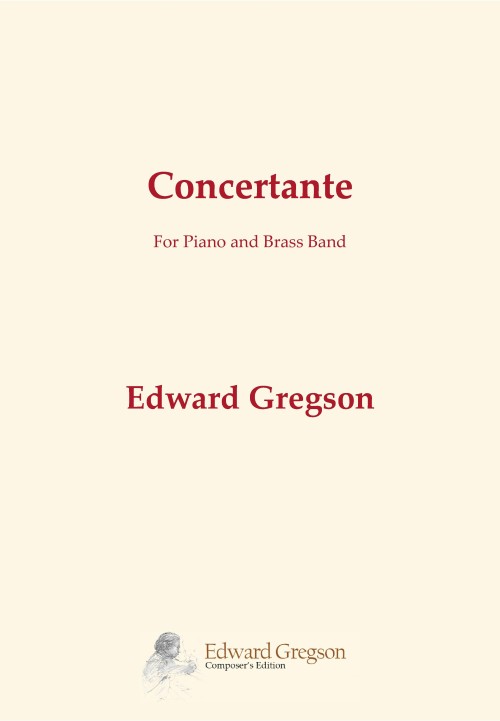
Concertante (Piano Solo with Brass Band - Score and Parts) - Gregson, Edward
This work was written in 1966, when I was a student at the Royal Academy of Music in London. It was the first major work to be written for this combination. The Concertante is unashamedly romantic in idiom and is cast in three movements: Prelude, Nocturne and Rondo.The Prelude is in sonata form with a contracted recapitulation. There are two main themes, the first announced after the opening flourish on piano. The second theme is lyrical in character and the interplay between these two themes forms the main focus of the movement.The pensive Nocturne opens with an introduction from the band which contains hints of the two main ideas to follow. The solo piano announces the main theme, which has a slightly 'blues' character in its flattened third and seventh notes of the scale. The band enters with the chorale theme already heard in the introduction. Eventually the first theme returns, this time from piano and band and building to a powerful climax before subsiding to a peaceful ending.The Rondo is full of energetic rhythms and changing time patterns. The main theme is 'giocoso' in character and in the first episode there is more than a hint of the tune 'Onward Christian Soldiers' in what amounts to a good humoured parody. Before the final coda there is a long piano cadenza underlying the virtuoso element of the work.The work had a number of public performances leading up to a memorable one in the Royal Albert Hall in 1989 as part of the Gala Concert that used to be held after the National Brass Band Championship in the Royal Albert Hall. That year, the 'centre band' in the massed bands concert were the GUS Band (then known for sponsorship reasons as 'Rigid Containers Group Band'!) conducted by my great friend and champion, Bramwell Tovey, with myself as the soloist.- Edward GregsonDuration: 18.00
Estimated dispatch 7-14 working days
-
£35.00
Concertante (Piano Solo with Brass Band - Score only) - Gregson, Edward
This work was written in 1966, when I was a student at the Royal Academy of Music in London. It was the first major work to be written for this combination. The Concertante is unashamedly romantic in idiom and is cast in three movements: Prelude, Nocturne and Rondo.The Prelude is in sonata form with a contracted recapitulation. There are two main themes, the first announced after the opening flourish on piano. The second theme is lyrical in character and the interplay between these two themes forms the main focus of the movement.The pensive Nocturne opens with an introduction from the band which contains hints of the two main ideas to follow. The solo piano announces the main theme, which has a slightly 'blues' character in its flattened third and seventh notes of the scale. The band enters with the chorale theme already heard in the introduction. Eventually the first theme returns, this time from piano and band and building to a powerful climax before subsiding to a peaceful ending.The Rondo is full of energetic rhythms and changing time patterns. The main theme is 'giocoso' in character and in the first episode there is more than a hint of the tune 'Onward Christian Soldiers' in what amounts to a good humoured parody. Before the final coda there is a long piano cadenza underlying the virtuoso element of the work.The work had a number of public performances leading up to a memorable one in the Royal Albert Hall in 1989 as part of the Gala Concert that used to be held after the National Brass Band Championship in the Royal Albert Hall. That year, the 'centre band' in the massed bands concert were the GUS Band (then known for sponsorship reasons as 'Rigid Containers Group Band'!) conducted by my great friend and champion, Bramwell Tovey, with myself as the soloist.- Edward GregsonDuration: 18.00
Estimated dispatch 7-14 working days
-
 £80.00
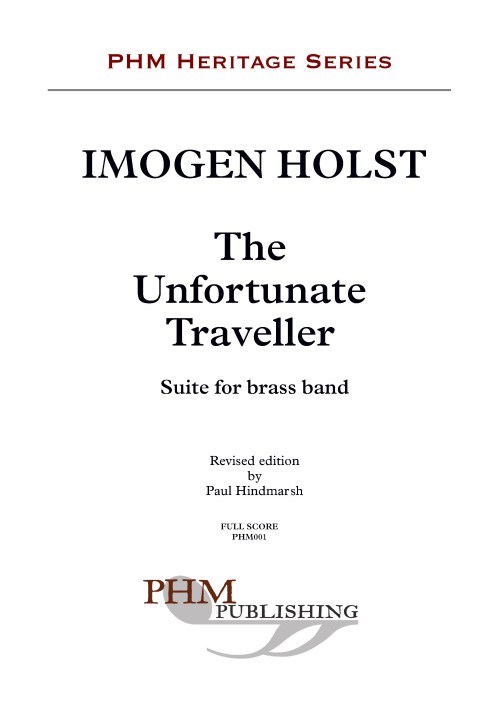
The Unfortunate Traveller (Brass Band - Score and Parts) - Holst, Imogen - Hindmarsh, Paul
Imogen Holst (1907-1984) submitted The Unfortunate Traveller (1929) as her final work as a student portfolio at the Royal College of Music, where her composition teacher was Gordon Jacob. The title was taken from Thomas Nashe's famous 1594 picaresque novel of the same title. The Suite was first performed on 12 February 1933 at her Majesty's Theatre, Carlisle, by the St. Stephen's Band, with the composer conducting. Te concert was given in memory of Holst's uncle, Dr. H.A. Lediard. Holst had been impressed with the band's performance of his A Moorside Suite at the 1928 National Brass Band Championships (The Crystal Palace, South London) and was keen to work with them. Writing in Imogen Holst, a life in music, Christopher Grogan indicates that it was Gustav Holst's suggestion to include his daughter's work in the programme, quoting Imogen Holst's remarks made in interview to The Daily Mail as follows: "....it is the first time, so far as I know, that a woman has conducted a brass band at a public concert....It has been a delight to rehearse the St. Stephen's Band. It was their performance at the Crystal Palace Festival that inspired me to write this Suite, which I have dedicated to them."Imogen Holst accompanied her father to the Crystal Palace in 1928 to hear the performances of A Moorside Suite, and was so excited by the played and, audibly, by her father's music that she decided to write a brass band piece for her final examination. Te result was The Unfortunate Traveller (1929). However, it was not possible for her to present a brass band work for examination. She arranged it for string orchestra so that it could be played before she left the RCM in July 1930. Following the premiere of the original in 1933, the manuscripts did not resurface until 1969 Imogen found them among her late mother's effects. Although she requested score and parts be destroyed, they ended up in the possession of Manchester composer John Golland, who marked up the score presumably with the intention of creating a new performing edition. The original scoring reveals a lack of experience with what can be a tricky medium.With the agreement of the Holst Foundation, a revised edition, with additional percussion, was prepared in 2011 since when the work has been fortunate to travel round the world as a concert and contest piece. The original includes drums in the March only. The title was taken from Tomas Nashe's famous 1594 picaresque novel of the same title. Several Morris Dance tunes are introduced during the course of the four short movements, including Bonnie Green Garters, Shepherd's Hey, The Rose and The Wind Blaws Cauld. Quirky twists and turns of harmony and spirited rhythms that remind us how much Imogen Holst loved tradition English dance music.In September 2025, I made a performing edition of the composer's arrangement for string orchestra. The manuscript lacks the final movement, which I arranged in a similar style, ie. without extending the upper ranges. Making this edition raised some issues regarding the accuracy of my band version and some of the solutions I used to smooth out the voicing. I have used the composer's second thoughts to refine my performing edition and to correct a textual errors.- Paul HindmarshDuration: 10.00
Estimated dispatch 7-14 working days
-
£40.00
The Unfortunate Traveller (Brass Band - Score only) - Holst, Imogen - Hindmarsh, Paul
Imogen Holst (1907-1984) submitted The Unfortunate Traveller (1929) as her final work as a student portfolio at the Royal College of Music, where her composition teacher was Gordon Jacob. The title was taken from Thomas Nashe's famous 1594 picaresque novel of the same title. The Suite was first performed on 12 February 1933 at her Majesty's Theatre, Carlisle, by the St. Stephen's Band, with the composer conducting. Te concert was given in memory of Holst's uncle, Dr. H.A. Lediard. Holst had been impressed with the band's performance of his A Moorside Suite at the 1928 National Brass Band Championships (The Crystal Palace, South London) and was keen to work with them. Writing in Imogen Holst, a life in music, Christopher Grogan indicates that it was Gustav Holst's suggestion to include his daughter's work in the programme, quoting Imogen Holst's remarks made in interview to The Daily Mail as follows: "....it is the first time, so far as I know, that a woman has conducted a brass band at a public concert....It has been a delight to rehearse the St. Stephen's Band. It was their performance at the Crystal Palace Festival that inspired me to write this Suite, which I have dedicated to them."Imogen Holst accompanied her father to the Crystal Palace in 1928 to hear the performances of A Moorside Suite, and was so excited by the played and, audibly, by her father's music that she decided to write a brass band piece for her final examination. Te result was The Unfortunate Traveller (1929). However, it was not possible for her to present a brass band work for examination. She arranged it for string orchestra so that it could be played before she left the RCM in July 1930. Following the premiere of the original in 1933, the manuscripts did not resurface until 1969 Imogen found them among her late mother's effects. Although she requested score and parts be destroyed, they ended up in the possession of Manchester composer John Golland, who marked up the score presumably with the intention of creating a new performing edition. The original scoring reveals a lack of experience with what can be a tricky medium.With the agreement of the Holst Foundation, a revised edition, with additional percussion, was prepared in 2011 since when the work has been fortunate to travel round the world as a concert and contest piece. The original includes drums in the March only. The title was taken from Tomas Nashe's famous 1594 picaresque novel of the same title. Several Morris Dance tunes are introduced during the course of the four short movements, including Bonnie Green Garters, Shepherd's Hey, The Rose and The Wind Blaws Cauld. Quirky twists and turns of harmony and spirited rhythms that remind us how much Imogen Holst loved tradition English dance music.In September 2025, I made a performing edition of the composer's arrangement for string orchestra. The manuscript lacks the final movement, which I arranged in a similar style, ie. without extending the upper ranges. Making this edition raised some issues regarding the accuracy of my band version and some of the solutions I used to smooth out the voicing. I have used the composer's second thoughts to refine my performing edition and to correct a textual errors.- Paul HindmarshDuration: 10.00
Estimated dispatch 7-14 working days
-
 £44.95
The Great Salvation War (Brass Band - Score and Parts) - Curnow, James
James Curnow was inspired to compose this work after reading 'Marching to Glory', a history of The Salvation Army in the USA. The writer of the book, Dr. Edward H. McKinley, was a colleague of Curnow on the faculty of Asbury College and a member of The Salvation Army Student Fellowship Band. The work was written for this band and premiered by them at the Centennial National Congress in 1980 which was held at Asbury College. Curnow has endeavoured to capture the spirit of early day Salvationists as they gave themselves completely to the great salvation war. Three songs support the three-part structure; 1) Stand like the brave 2) In Thee, O Lord, do I put my trust 3) Rescue the perishing.
Estimated dispatch 7-14 working days
 View Music