
Results
-
 £125.00
New London Pictures - Nigel Hess
New London Pictures represents elements of London in the 21st Century. The Millennium Bridge describes the pedestrian's journey across this wonderful new landmark bridge over the Thames,starting at the imposing Tate Modern, crossing the busy river, and onwards to St. Paul's Cathedral with its bells ringing out over the great city. London Eye is an incredibly large ferris wheel situated onthe South Bank of the River Thames. This movement depicts a 'flight' on this riverside wheel, at the top of which the panoramic view of London is breath-taking and the expanse of the music is a suitable depiction oftheview. As with all modern cities, London is over-crowded with motor vehicles. London is the first major city in Europe to adopt a Congestion Charge, and this piece (with its stop and go traffic lights) is both racyand comical. Here are Londoners attempting to go about their business in the face of overwhelming odds.....Brass Band Grades 4/5: Premier Youth and 2nd Section Duration: 15 minutes
Estimated dispatch 5-14 working days
-
 £60.99
Fanfare in Iubilo - Thomas Doss - Brian Johnson
The power of this bright fanfare reflects the optimism, joy and commitment to tradition that the people of the Italian town of Schlanders have deep within their souls. The golden trumpets from the valleys of South Tyrol echo across the mountains on both sides of the Austrian-Italian border and help to convey the composer's message: just as the sun shines on all parts of the world, music knows no boundaries. This message echoes throughout this brilliant fanfare.
Estimated dispatch 5-14 working days
-
 £40.00
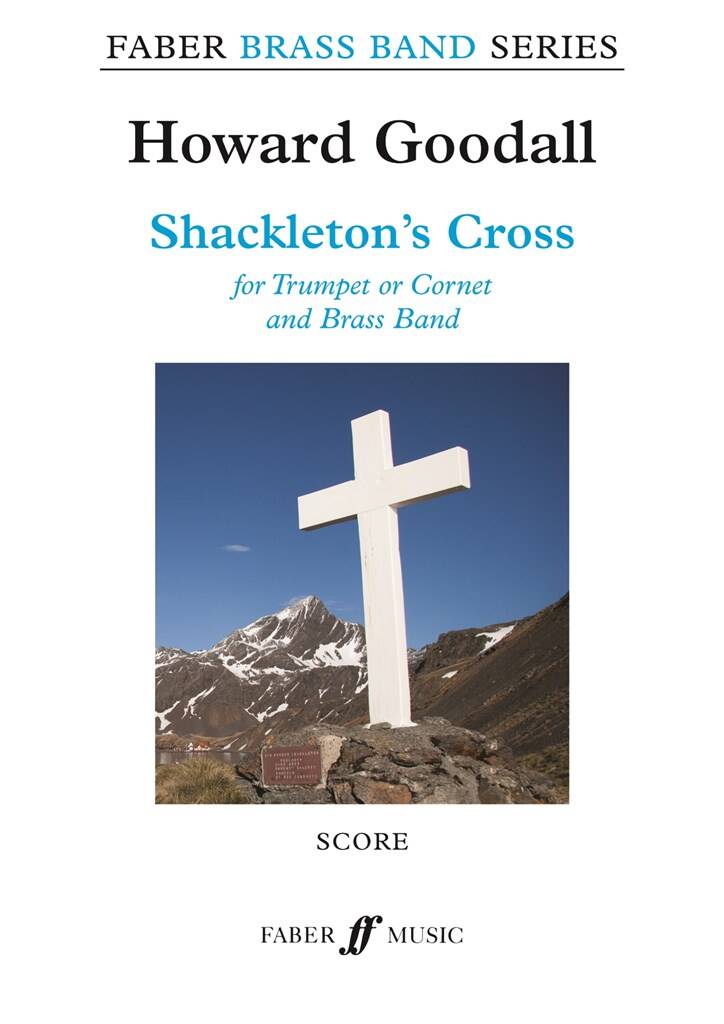
Shackleton's Cross - Howard Goodall
Shackleton s Cross was inspired by a painting created in 1957 by the English artist Edward Seago (1910 1974). The title refers to a cross which was erected to the memory of Sir Ernest Shackleton, who led a number of explorations to the Antarctic. Shackleton died in 1922 whilst on a Polar expedition, and the cross can be found on a promontory at the entrance to the bay at Grytviken Whaling Station in South Georgia. The painting is owned by HRH The Duke of Edinburgh, and was part of an exhibition at Buckingham Palace from October 2011 to April 2012. Originally scored for oboe, trumpet and small orchestra, Daniel Hall s sensitive arrangement fortrumpet or cornet and brass band follows the composer s alternative version for solo trumpet and organ, created for Crispian Steele-Perkins (trumpet) and David Goode (organ).
Estimated dispatch 5-14 working days
-
£109.99
Wounded Knee - Pascal Favre
Wounded Knee portrays in musical pictures the tragic events which took place in 1890 when over 300 Indians perished in South Dakota. The work spans a range of aspects from the spiritual beliefs of the Indians to the fate of the North American Indians today.
Estimated dispatch 5-14 working days
-
 £76.99
Ever so samba - Peter Martin
The rhythm of the samba was originally created in Africa and brought to Brazil by the slaves . Here it became the national dance. For every festive occasion and especially the carnival festivities (Rio de Janeiro) samba music is played. The World's Fair in New York (1939) was the reason to the biggest spread of the samba. The cornet section gets an opportunity to feature in Ever so Samba. Together with the swinging percussion section they let you enjoy a South American party.
Estimated dispatch 5-14 working days
-
 £109.99
Antarctica - Carl Wittrock
Carl Wittrock became inspired by huge icefields surrounding the South Pole. Colourfull and majestic sounds provide the composition a fascinating view of this "6th" continent.'Antarctica' is a free impression of the scenery in the Antarctic.Melodies are linked together to convey the various aspects of the landscape.These melodies together with their simple harmonic accompaniments make this work pleasant for both the listener and the musician.
Estimated dispatch 5-14 working days
-
 £89.99
Dragonfly - Thierry Deleruyelle
Dragonfly was commissioned by Bastien Baumet, an international French soloist, as a new departure in euphonium repertoire. The concerto can be accompanied by wind band or brass band, as well as with piano accompaniment.Written in three uninterrupted parts, a slow and warm theme separates two dynamic, swift, and agile sections. Like a dragonfly, the music flies sometimes with jolts, sometimes with serenity, allowing us to discover landscapes, colours, and changing horizons. Dragonfly showcases the soloist's inspired melodic curves, beautiful tone, and virtuosity.A graduate of the Paris Conservatoire and first prize winner in the prestigious Jeju International Competition in South Korea, Bastien Baumet is a leading figure in the euphonium world. He will be performing this concerto all over the world, to triumphant acclaim wherever he goes.
Estimated dispatch 5-14 working days
-
 £40.00
London Eye - Nigel Hess
London Eye is an incredibly large rotating wheel situated on the South Bank of the River Thames.
Estimated dispatch 5-14 working days
-
 £79.95
Amundsen - Jonathan Bates
DURATION: 14'00". DIFFICULTY: 1st+. 'Amundsen' was commissioned by rskog Brass, Norway for their winning performance at the 2020 Norwegian National Championships held at the Grieghallen in Bergen. In December 1911, Norwegian Roald Amundsen gained global fame by becoming the first explorer to lead a team to the geographic South Pole. Amundsen and 4 other members of his team arrived 5 weeks ahead of a rival team from the UK led by Robert Falcon Scott, all of which perished on their attempted return from the pole. Initially when Amundsen's team set out in 1910, they were under the impression that they would be making the far shorter journey to the arctic drift to attempt to reach the North Pole, but Amundsen had received news that American explorers Peary and Cook had beaten them to this goal, and so Amundsen's focus changed southward. 'Fram, Forward' - 'Fram' (translating to English as "forward") was the name of the ship Amundsen used for this particular polar expedition. Amundsen had only informed 2 people of his real intentions of conquering the South Pole when the ship first left port in Kristiansand before heading south to the Portuguese island of Madeira in the Atlantic Ocean. After weeks at sea - causing the uninformed members of the crew to raise a number of questions and produce a general feel of uncertainty and low spirits - it was here that Amundsen announced his true plans to the rest of his crew. They were asked whether they wished to continue with their expedition, to which all - some begrudgingly - agreed to sail on to the South Pole, through the great Ice Barrier before docking in the Bay of Whales on the Ross Ice Shelf. 'Ross Ice Shelf' - Upon Amundsen's arrival in the Bay of Whales, the team were greeted by the sight of the enormous ice plateau's and glaciers, towering into the Antarctic sky. In 1907, Ernest Shackleton had attempted - and failed - to reach the South Pole, but his route and mapping was by now well documented. Scott and the UK team were to follow this route, whereas Amundsen and his men forged their own way to the pole through unchartered territory and deadly terrain littered with deep crevasses and canyons. The music here though, is a picture of tranquility. The eerie silence of total emptiness with only the heavy snow falling around Amundsen as Fram and the Bay of Whales disappears into the distance, faced by the maginute of the expedition ahead. 'Advance to Polheim' - The first new challenge Amundsen discovered on this route was a rough, sharp and extremely steep glacier (which was later named the Axel heiberg Glacier after the Norwegian monarch who funded much of the expedition), which would take his team up from sea level to an altitude of over 9,000ft in just 20 miles, with most of this over just 7 miles. Once scaled, only the vast Antarctic Plateau stood between Amundsen and the pole. Here the race began, with only one aim - victory for himself, his team, and for the whole of Norway. .
In Stock: Estimated dispatch 1-3 working days
-
 £10.00
Endurance
DescriptionMen wanted for hazardous journey. Small wages, bitter cold, long months of complete darkness, constant danger, safe return doubtful. Honour and recognition in case of success. - Ernest Shackleton, 4 Burlington StreetEndurance takes its title from the ship used by Sir Ernest Shackleton's Imperial Trans-Antarctic Expedition in 1914-15. After many months of fundraising (and reputedly running the above advert in The Times) the Endurance set sail from Plymouth on 6 August 1914. Whilst at sea news of the outbreak of war led Shackleton to put his ship and crew at the disposal of the Admiralty, but their services were not required and they were encouraged to continue. On October 26 1914 they left Grytviken on South Georgia for the Antarctic continent, hoping to find the pack ice shrinking in the Antarctic spring. Two days later, however, they encountered unseasonable ice which slowed their progress considerably. On 15 January 1915, when Endurance was only 200 miles from her intended landfall at Vahsel Bay, the ship became beset by ice which had been compressed against the land to the south by gale force winds. Trapped in the ice of the Weddell Sea, the ship spent the Antarctic winter driven by the weather further from her intended destination until, on 21 November 1915 Endurance broke up forcing the crew to abandon ship and set up camp on the ice at a site they named "Patience Camp".The crew spent several weeks on the ice. As the southern spring started to reduce the extent of the ice shelf they took to their three lifeboats, sailing across the open ocean to reach the desolate and uninhabited Elephant Island. There they used two of the boats to build a makeshift shelter while Shackleton and five others took the largest boat, an open lifeboat named the 'James Caird' and sailed it for 800 terrifyingly dangerous miles across the vast and lonely Southern Atlantic to South Georgia - a journey now widely regarded as one of the greatest and most heroic small-boat journeys ever undertaken. After landing on the wrong side of the island and having to climb over a mountain range in the dark with no map, Shackleton and his companions finally stumbled back into the Grytviken whaling station on 19 May 1916.After resting very briefly to recover his strength, Shackleton then began a relentless campaign to beg or borrow a ship to rescue the rest of his crew from Elephant Island; whaling ships were not strong enough to enter polar ice, but on 30 August 1916, over two years after their departure from Plymouth, Shackleton finally returned to Elephant Island aboard a steam tug borrowed from the Chilean government. Although some were in poor health, every member of the Endurance crew was rescued and returned home alive.Endurance is dedicated to the memory of my mum, who passed away in September 2017.Listen to a computer generated preview and follow the score below:
Estimated dispatch 7-14 working days
 View Music