
Results
-
 £17.50
March Of The Hours (Brass Band - Score only) - Soderstrom, Emil
March of the Hours was first performed at Star Lake Music Camp in 1962 with the composer supplying an informative listening guide which was printed in the published score; "The phrases are of 12 crotchets each (three bars) signifying the 12 hours. Up to the trio, the music describes the headlong search for pleasure by the thoughtless. Abruptly, the trio brings 'I need thee every hour', but an episode employing the original theme pushes it aside until it reappears, this time against a background of chimes of the full hour (Westminster chimes). While the hour strikes 12, a paraphrase of the opening strains of 'When the trumpet of the Lord shall sound and time shall be no more' is heard. Here the music stops, to be followed by the trumpet sounding (cornets and trombones) and the rest of the band responds with 'When the roll is called up yonder' with a final 'I'll be there'."
Estimated dispatch 7-14 working days
-
£29.95
Army Of God (Brass Band - Score and Parts) - Soderstrom, Emil
This march was awarded first prize in the 1930 American Golden Jubilee National Music Competition and was published the same year in the first edition of the American Festival Series. It was subsequently re-printed in the General Series of 1984. Soderstrom's imaginative use of syncopation and chromatic harmony brought a new, American sound to the Salvation Army march. For example, he took the old Salvation Army fight song Hark, hark my soul written and changes its metre from 6/8 to 4/4 while also syncopating it!
Estimated dispatch 7-14 working days
-
£14.95
Army Of God (Brass Band - Score only) - Soderstrom, Emil
This march was awarded first prize in the 1930 American Golden Jubilee National Music Competition and was published the same year in the first edition of the American Festival Series. It was subsequently re-printed in the General Series of 1984. Soderstrom's imaginative use of syncopation and chromatic harmony brought a new, American sound to the Salvation Army march. For example, he took the old Salvation Army fight song Hark, hark my soul written and changes its metre from 6/8 to 4/4 while also syncopating it!
Estimated dispatch 7-14 working days
-
 £24.95
Beautiful World (Brass Band - Score and Parts) - Downie, Kenneth
This beautiful impressionistic work by Kenneth Downie features fragments of the hymn 'All things bright and beautiful', and paints a soft sound image of an idyllic English countryside.
Estimated dispatch 7-14 working days
-
£12.50
Beautiful World (Brass Band - Score Only) - Downie, Kenneth
This beautiful impressionistic work by Kenneth Downie features fragments of the hymn 'All things bright and beautiful', and paints a soft sound image of an idyllic English countryside.
Estimated dispatch 7-14 working days
-
 £59.95
Festival Suite (Brass Band - Score and Parts) - Downie, Kenneth
This three movement suite for brass band was commissioned by the Solothurnischer Blasmusikverband (SOBV) in Switzerland for their 2009 Festival. The first movement, Energy, is appropriately lively in character. It is dominated by an agitated theme on trombones and cornets, driven by a percussion accompaniment, and complemented by pulsating counterpoint from the rest of the band. The second movement is called Repose and its opening melodious theme on cornets provides a welcome respite from the restlessness and verve of the opening movement. The lyrical nature of the music is sustained throughout. The finale, Suspense, opens with a theme containing more than a hint of foreboding which recurs several times. There are numerous abrupt changes of dynamics, and also a brightening of mood, before everything finishes in a blaze of sound.
Estimated dispatch 7-14 working days
-
£29.95
Festival Suite (Brass Band - Score Only) - Downie, Kenneth
This three movement suite for brass band was commissioned by the Solothurnischer Blasmusikverband (SOBV) in Switzerland for their 2009 Festival. The first movement, Energy, is appropriately lively in character. It is dominated by an agitated theme on trombones and cornets, driven by a percussion accompaniment, and complemented by pulsating counterpoint from the rest of the band. The second movement is called Repose and its opening melodious theme on cornets provides a welcome respite from the restlessness and verve of the opening movement. The lyrical nature of the music is sustained throughout. The finale, Suspense, opens with a theme containing more than a hint of foreboding which recurs several times. There are numerous abrupt changes of dynamics, and also a brightening of mood, before everything finishes in a blaze of sound.
Estimated dispatch 7-14 working days
-
 £42.95
Blue Jeans (Trombone Solo with Brass Band - Score and Parts) - Wiffin, Rob
In 2008 the trombonist, Chris Jeans, was invited to be a featured soloist at a British Trombone Society event. He contacted Stan Kitchen at Studio Music Company to see if he had any new material for trombone. Stan then got in touch with me, as I had already written a piece for another trombone player, Brett Baker. This piece, Shout! was programmed for the same event so we needed to find something new for Chris.The title 'Blue Jeans' came to my mind, thus linking a blues-style piece with the obvious reference to Chris's surname. I spoke to Chris and he liked the sound of it so then I had to go away and write a solo to match the title!I managed to get a version with piano accompaniment done in time for Chris to perform at the trombone event and have now had a chance to complete the band version.Chris is a great chap, a good friend and a wonderful trombone player so I hope people enjoy listening to this solo that bears his name.- Rob WiffinDuration: 3.30
Estimated dispatch 7-14 working days
-
 £84.99
Batman (Brass Band - Score and Parts) - Elfman, Danny - Sahashi, Toshihiko
The continued collaboration between director Tim Burton and film score composer Danny Elgman has led to numerous unforgettable soundtracks, such as Beetlejuice and Mars Attacks! as well as Batman. Elfman's music captures the vivid dark undertones of the movie, and manages to maintain comic elements. Batman is such a popular character that even the likes of pop-star Prince contributed to the sound track with the song Batdance. Toshihiko Sahashi creates a brilliant medley with The Batman Theme, Batdance, and Party Man. Duration: 4.30
Estimated dispatch 7-14 working days
-
 £60.99
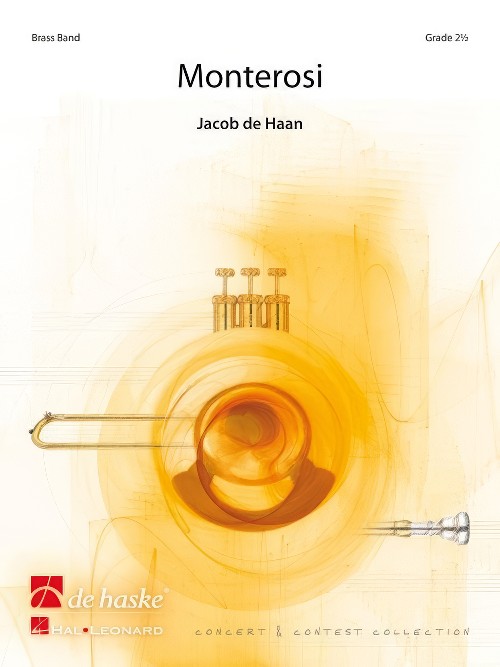
Monterosi (Brass Band - Score and Parts - De Haan, Jacob
Monterosi is a village in the Italian province of Viterbo in the Lazio region. This work has been dedicated to the Accademia Musicale Francigena in Monterosi, to celebrate the occasion of the third "Tommaso Albani", a national competition for wind orchestras. The first performance of Monterosi was conducted by the composer, who had been invited for the third time to be a jury member and guest conductor. It is a solemn piece, with lyrical tendencies, which demonstrates the glorious, full sound of the band.Duration: 4:15
Estimated dispatch 7-14 working days
 View Music