
Results
-
 £27.95
Queen of the Night Aria (Soprano Cornet Solo with Brass Band - Score and Parts) - Mozart, Wolfgang Amadeus - Golland, John
Soprano Cornet & Brass Band. Also available with Piano accompaniment
Estimated dispatch 7-14 working days
-
 £44.95
Meditation (from The Triumph of Time) (Flugel Horn and Baritone Duet with Brass Band - Score and Parts) - Graham, Peter
Meditation is the central theme from The Triumph of Time, a work commissioned for The Black Dyke Band by Music Director Nicholas Childs. The original brief was for a piece which would showcase the talents of the band's many fine soloists, among them Zoe Hancock on Flugel horn and Baritone soloist Katrina Marzella. This extract brings both instruments together in an extended stand-alone arrangement.Although scored for Flugel and Baritone, a number of options can be explored at the discretion of the conductor (eg. Flugel/Cornet and Euphonium/Trombone; two Bb Cornets etc. in which case cued lines in the Solo Horn and Soprano cornet parts may be played).Duration: 05:00
Estimated dispatch 7-14 working days
-
 £37.95
TOPS, The (Cornet Quintet with Brass Band) - Powell, T. J.
for Soprano Cornet and 4 Bb Cornets
Estimated dispatch 7-14 working days
-
 £44.95
Deliverance (from War of the Worlds Suite) (Soprano Cornet or Tenor Horn Solo with Brass Band - Score and Parts) - Graham, Peter
Deliverance is the fourth movement of the suite War of the Worlds which was commissioned by the Senzoku Gakuen College of Music Saxophone Orchestra and first performed by them in the Maeda Hall, Japan on June 29 2012, the composer conducting. The music is dedicated to Professor Shin-ichi Iwamoto. The transcription for brass band was first performed by the Brighouse & Rastrick Band, conductor David King, in the Bridgewater Hall Manchester on September 8 2012.The suite takes inspiration from the 1953 film script adaptation of the famous HG Wells novel and key scenes from the film are set as individual movements: Deliverance - survivors seek sanctuary in the Church of Santa Maria, still standing among the burning ruins of Los Angeles, and pray for deliverance from the invaders.Each movement of War of the Worlds is available separately allowing for a variety of "mini-suite" combinations eg: Movements 1,2 and 5 or 3,4 and 5 etc.
Estimated dispatch 7-14 working days
-
 £34.22
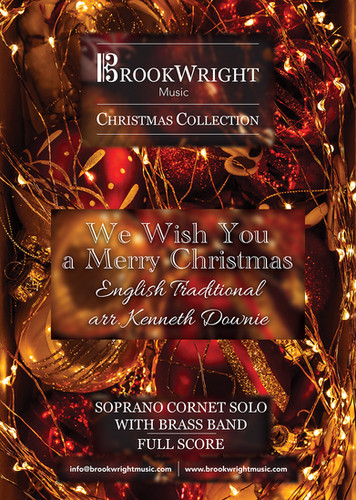
We Wish You a Merry Christmas (Soprano Cornet Solo with Band) arr.Kenneth Downie
This light-hearted soprano cornet feature offers a fresh and entertaining take on the well-known Christmas carol We Wish You a Merry Christmas. Thought to date back to 16th-century England, the carol reflects a tradition of festive singing outside the homes of the well-to-do - often accompanied by requests for treats such as figgy pudding, a forerunner of today's Christmas pudding.Kenneth Downie's arrangement embraces the jovial spirit of the original, pairing nimble soprano cornet writing with bright, colourful scoring for brass band. The famous refrain, 'And we won't go until we've got some', sets the tone: cheerful, a touch cheeky, and full of seasonal good humour.To view a rolling score video of the work featuring Gary Fountain, please visit www.youtube.com/watch?v=3WCW9oBw-mYA version of this solo is available as part of the Sounds of the Season series, with both piano accompaniment and MP3 orchestral backing track, available here.Difficulty Level: 3rd Section +PDF download includes parts and score.Sheet music available at www.brassband.co.uk (UK) or https://satradecentral.org (USA)Instrumentation:Soprano Cornet Soloist EbSolo Cornet BbRepiano Cornet Bb2nd Cornet Bb3rd Cornet BbFlugel Horn BbSolo Horn Eb1st Horn Eb2nd Horn Eb1st Baritone Bb2nd Baritone Bb1st Trombone Bb2nd Trombone BbBass TromboneEuphonium BbBass EbBass BbPercussion 1-4
In Stock: Estimated dispatch 1-3 working days
-
 £34.22
Jingle Bells Forever (Brass Band) Pierpont/Sousa/Smith arr. Lythaby
Jingle Bells Forever is a setting of two American favourites that weaves the melodic line from Pierpont's Jingle Bells with Sousa's umistakable march style. Drawn from The Stars and Stripes Forever, Sousa's immortal march that has become the official national march of the United States of America, the familiar strains provide the perfect accompaniment for the most festive of Christmas melodies. Sousa's famous grandioso with the piccolo descant (here scored for soprano cornet) and trombone countermelody draw this festive standard to a rousing conclusion.PDF download includes score and parts.Sheet music available from:UK - www.brassband.co.ukUSA - www.solidbrassmusic.comDifficulty Level: 4th Section +Instrumentation:Soprano Cornet EbSolo Cornet BbRepiano Cornet Bb2nd Cornet Bb3rd Cornet BbFlugel Horn BbSolo Horn Eb1st Horn Eb2nd Horn Eb1st Baritone Bb2nd Baritone Bb1st Trombone Bb2nd Trombone BbBass TromboneEuphonium BbBass EbBass BbTimpaniDrum SetCymbalsSleigh BellsGlockenspiel
In Stock: Estimated dispatch 1-3 working days
-
 £34.22
Les Chasseresses from 'Sylvia' (Brass Band) Delibes arr. Rob Bushnell
Clement Philibert Leo Delibes was a French composer, best known for his ballets and operas, including works such as Lakme (with its famous "Flower Duet"), Coppelia and Sylvia (both key works in the development of modern ballet). The latter started as a play, Aminta, by the Italian poet Torquato Tasso, which Delibes set to music. It was then adapted for the Paris Opera with rehearsals starting in August 1875. The premiere took place on 14 June 1876 and was the first ballet to be shown at the newly-built Opera Garnier. Whilst the scenery and costumes were created by top artists and designers (Cheret and Lacoste), it was Delibes's music that shown thrown, being said to have saved the production, preventing the ballet from drifting into obscurity.Sylvia is said to be one of the first modern ballets, with Tchaikovsky remarking to composer Sergei Taneyev upon its ingenuity: "... the first ballet, where the music constitutes not only the main, but the only interest. What charm, what elegance, what richness of melody, rhythm, harmony." Although Swan Lake, a contemporary to Sylvia, is considered one of the best ballets there is, Tchaikovsky preferred Sylvia to his own work, saying Swan Lake was "poor stuff in comparison". Tchaikovsky said to Taneyev, "I was ashamed. If I had known this music early then, of course, I would not have written Swan Lake". The music to Sylvia, rather than setting only the mood, also sets the action and is noted for its use of leitmotifs - Delibes was an admirer of Wagner - and more dominant use of brass and wind. The most famous piece from this ballet is the Pizzicati in the third act.Act I of the ballet takes place in sacred wood, where creatures are worshipping before Eros when Sylvia arrives with her huntresses to mock the god of love. Aminta, a lowly shepherd and infatuated with Sylvia, protects the deity and Sylvia is wounded by Eros's arrow. The hunter Orion kidnaps Sylvia, whilst Eros revives Aminta. Act II takes place in Orion's Island cave, where Sylvia tries to bribe Orion with jewels and wine. Unsuccessful, she appeals to Eros for help, who arrives and takes her to the temple of Diana (where the final act takes place). Orion and Aminta fight, Sylvia and Orion cause the goddess of the hunt, Diana, to be outraged, smiting Orion and denying the love of Aminta and Sylvia. Eros shows Diana a vision, which changes her mind and the couple finally come together.This brilliant and lively fanfare that introduces the huntresses in the first act is arranged here for the UK-style brass band, with alternative parts for horns in F and bass-clef lower brass. The piece has been lowered by a tone compared to the original.A recording of the original composition can be found here https://youtu.be/6yoGrUH38PI?si=0L0bFa1qXnYNvkR3Duration: Approx. 3.10 minutesDifficulty Level: 1st Section +This PDF download includes the full score and parts. Includes alternative parts for soloist in Eb, horns in F and lower brass in bass clef.Sheet music available at www.brassband.co.uk (UK) or https://satradecentral.org (USA)Instrumentation:Soprano Cornet EbSolo Cornet BbRepiano Cornet Bb2nd Cornet Bb3rd Cornet BbFlugel Horn BbSolo Horn Eb1st Horn Eb2nd Horn Eb1st Baritone Bb2nd Baritone Bb1st Trombone Bb2nd Trombone BbBass TromboneEuphonium BbBass EbBass BbTimpaniPercussion - Triangle, Cymbal & Bass Drum
In Stock: Estimated dispatch 1-3 working days
-
 £30.42
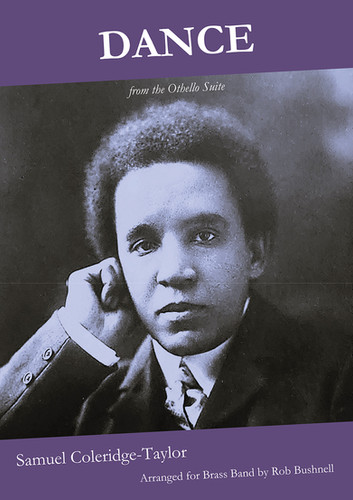
Dance from the Othello Suite (Brass Band) Coleridge-Taylor arr. Bushnell
Samuel Coleridge-Taylor is a British composer, who, from a young age, showed talent on the violin and entered the Royal College of Music, studying with Charles Villers Standford. His music become so popular that his Hiawatha trilogy was the second most performed choral piece (joint with Mendelssohn's Elijah, and only beaten by Handel's Messiah) with choral societies up and down the British Isles. In fact, Hiawatha was arranged by Charles Godfrey as a test-piece for the 1902 National Brass Band Championship of Great Britain, held at Crystal Palace.Commissioned by the theatre impresario Herbert Beerbohm, Coleridge-Taylor composed incidental music for His Majesty's Theatre London production of the Shakespeare play, Othello, in the West End, in 1909. In 1912, the play opened to the public, with a suite of five movements put together soon afterwards. The Dance, arranged here by Rob Bushnell, makes a great concert opener.This arrangement is for the British-style brass band, with alternative parts for horns in F and bass-clef lower brass.A recording of the original composition can be found at www.youtube.com/watch?v=OQeO_Ij9CV8Duration: approx. 2.30 minutesDifficulty Level: 3rd Section +PDF download includes parts and score.Sheet music available at www.brassband.co.uk (UK) or https://satradecentral.org (USA)Instrumentation:Soprano Cornet EbSolo Cornet BbRepiano Cornet Bb2nd Cornet Bb3rd Cornet BbFlugel Horn BbSolo Horn Eb1st Horn Eb2nd Horn Eb1st Baritone Bb2nd Baritone Bb1st Trombone Bb2nd Trombone BbBass TromboneEuphonium BbBass EbBass BbTimpaniPercussion - Triangle, Cymbal & Bass Drum
In Stock: Estimated dispatch 1-3 working days
-
 £34.22
Je te veux (Brass Band) Satie arr. Rob Bushnell
Je te veux, or I Want You, is a valse chantee (sung waltz) by the French composer Erik Satie, with lyrics by Henry Pacory. It was written for Paulette Darty, who first sang it in 1903 at La Scala, Paris, with Satie accompanying. There are various versions that Satie produced, the original for piano and voice, a version for brass 'orchestra', for full orchestra (where a trio section was added), and a version for solo piano (but including the new trio section).This arrangement is for the UK-style brass band, with alternative parts for horns in F and bass-clef lower brass, and is of the longer version (with the trio section). As a result, it lends itself to being performed in a various of ways, with the ensemble has the option of selecting the part of it compound ternary form to play: (A-B-A)(C-D-C)(A-B-A).A recording of the original composition can be found here: www.youtube.com/watch?v=FA3JJdmwJU8Difficulty Level: 4th Section +Duration: 4 or 5 minutes (depending on tempo and without any cuts)PDF download includes parts and score.Sheet music available at www.brassband.co.uk (UK) or https://satradecentral.org (USA)Instrumentation:Soprano Cornet EbSolo Cornet BbRepiano Cornet Bb2nd Cornet Bb3rd Cornet BbFlugel Horn BbSolo Horn Eb1st Horn Eb2nd Horn Eb1st Baritone Bb2nd Baritone Bb1st Trombone Bb2nd Trombone BbBass TromboneEuphonium BbBass EbBass BbTimpaniDrum KitAuxiliary Percussion (Glockenspiel, Cymbal & Triangle)
In Stock: Estimated dispatch 1-3 working days
-
 £60.85
Sleigh Ride Suite (Brass Band) Leopold Mozart arr. Alex McGee
Today Leopold Mozart (1719-1787) is known almost exclusively as the stern father of Wolfgang, but he was a prominent and successful musician in his own time. The Sleigh Ride, composed just before Wolfgang was born, certainly shows that Mozart the elder had as good a sense of humour as his more famous son. Wolfgang must, in fact, have known and enjoyed his father's piece - he included a short Sleigh Ride in his German Dances, K.605, in 1791.Leopold's more complicated piece is a programmatic serenade, with short titles for each section: a musical picture of a cold evening's ride to a party. The score calls for sleigh bells, rattle, a whip, and triangle. The action begins with a short overture (Intrada), followed by the Sleigh Ride itself, a lively duple-meter dance accompanied by jangling sleigh bells and punctuated by the cracking of a whip. There is then a nice bit of musical pantomime - The Young Lady Shivers With Cold. The sleigh finally arrives at the party, a ball with a small dance orchestra. The Ball Begins, not surprisingly, with a courtly menuet, and the End of the Ball is a spirited Kehraus, a lively rondo-form dance.This transcription faithfully seeks to convey the light touch of the Age of Enlightenment to the modern brass band and provides ensembles with new material for their annual Christmas concerts.To view a rolling score video of the work please visit https://www.youtube.com/watch?v=tgrBe1u8XagDuration: Approx. 11.45 minutesDifficulty Level: 3rd Section +PDF download includes parts and score.Sheet music available from www.brassband.co.ukInstrumentation:Soprano Cornet EbSolo Cornet BbRepiano Cornet Bb2nd Cornet Bb3rd Cornet BbFlugel Horn BbSolo Horn Eb1st Horn Eb2nd Horn Eb1st Baritone Bb2nd Baritone Bb1st Trombone Bb2nd Trombone BbBass TromboneEuphonium BbBass EbBass BbTimpaniPercussion 1-2
In Stock: Estimated dispatch 1-3 working days
 View Music
 Watch video