
Results
-
 £23.95
SAR Force (Brass Band - Score and Parts) - Wiffin, Rob
This traditional march is dedicated to the audacious courage of the Search and Rescue Services of both the Royal Navy and the Royal Air Force. It was commissioned by the SAR Force with the mandate of writing something that was descriptive of its working life and incorporates the J B Dykes hymn tune Melita which is associated with the words 'Eternal Father, Strong to Save (For those in peril on the sea)'.Duration: 2.45
Estimated dispatch 7-14 working days
-
 £62.00
Set To (Brass Band - Score and Parts) - Turnage, Mark-Anthony - Houlding, Christopher
Set To is dedicated to London Brass and arranged for brass band by Christopher Houlding. It was commissioned by the Aldeburgh Foundation and received its first performance on August 24th 1993 at the Maltings, Snape. Originally divided into two movements, a pensive and richly harmonic Blues and an aptly named Bacchanale, sometimes slow but mostly fast and furious. "I remember playing the original brass ensemble version of "Set To" numerous times in the early nineties with London Brass and always wondered if the composer would consider writing something for Brass Band. As Director of The Guildhall Brass Band, a possible performance opportunity arose in 2010 and I successfully approached Mark and gained his permission to scale it up for brass band with added percussion parts. I conducted the premier of this new Brass Band version at the Guildhall School of Music & Drama in February 2011 with the composer present and he liked it. Although very contemporary compared to most brass music, I feel that Mark's easily accessible style makes this rhythmically quirky and harmonically 'bluesy' work a really interesting concert piece, suitable for any occasion" - Chris Houlding. Duration: 7.30. Suitable for Championship Section Bands
Estimated dispatch 7-14 working days
-
 £40.00
Abide With Me (Euphonium Solo with Brass Band - Score and Parts) - McGhee, Paul
My arrangement of William H. Monk's tune of 1861, uses the euphonium soloist as the central figure for the melodic line in the three verses. Surrounding the solo line is an irregular pulsed figure in the percussion to give the music an unsettled feel whilst the muted ensemble lightly colour the melodic contour of the soloist. From the low beginnings of the piece, where no high instrumentation is used, we are led through the darkened texture to a bright finale, although the sense of the forbidding is always present.Abide With Me has always been a favourite hymn of mine and it was when watching the film 28 Days Later that I believed it would make a rather striking arrangement for brass band. This was confirmed further when the hymn was used at the 2012 opening ceremony of the London Olympics. The juxtaposition between the static, slow moving melody and the rhythmic effects of the dancers was something that I thought could be captured in an arrangement.- Paul McGheeDuration: 5.00
Estimated dispatch 7-14 working days
-
 £34.95
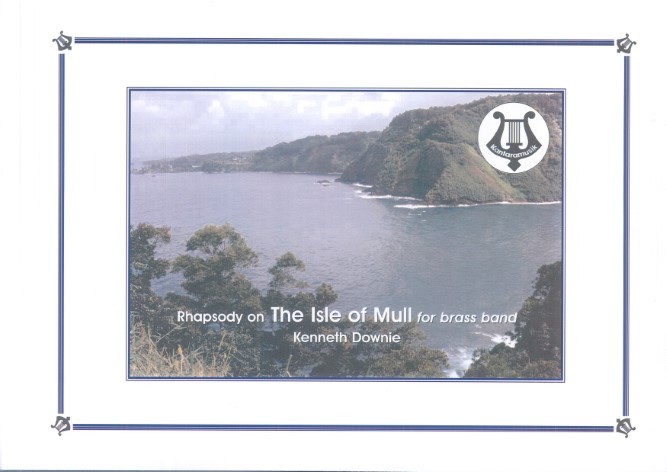
Rhapsody On The Isle Of Mull (Brass Band - Score and Parts) - Downie, Kenneth
Mull is an island off the west coast of Scotland and it gives its name to the lovely tune which forms the basis of this music. It is very scenic, with some beautiful mountains and the composer has tried to suggest something of the atmosphere of grandeur in his score. The largely pentatonic nature of the tune heavily colours the musical texture.
Estimated dispatch 7-14 working days
-
£17.50
Rhapsody On The Isle Of Mull (Brass Band - Score Only) - Downie, Kenneth
Mull is an island off the west coast of Scotland and it gives its name to the lovely tune which forms the basis of this music. It is very scenic, with some beautiful mountains and the composer has tried to suggest something of the atmosphere of grandeur in his score. The largely pentatonic nature of the tune heavily colours the musical texture.
Estimated dispatch 7-14 working days
-
 £29.95
To Regions Fair (Brass Band - Score and Parts) - Bearcroft, Norman
Clive Bright, in his score note when To Regions Fair was originally published in 1958, predicted that the march would 'have a good run'. In retrospect, this turned out to be something of an understatement as this march (and many other Bearcroft marches) remains vibrantly active fifty years after its original publication. The title is derived from the song 'Meet in bliss' which is featured in the trio section.
Estimated dispatch 7-14 working days
-
£14.95
To Regions Fair (Brass Band - Score only) - Bearcroft, Norman
Clive Bright, in his score note when To Regions Fair was originally published in 1958, predicted that the march would 'have a good run'. In retrospect, this turned out to be something of an understatement as this march (and many other Bearcroft marches) remains vibrantly active fifty years after its original publication. The title is derived from the song 'Meet in bliss' which is featured in the trio section.
Estimated dispatch 7-14 working days
-
 £42.95
Blue Jeans (Trombone Solo with Brass Band - Score and Parts) - Wiffin, Rob
In 2008 the trombonist, Chris Jeans, was invited to be a featured soloist at a British Trombone Society event. He contacted Stan Kitchen at Studio Music Company to see if he had any new material for trombone. Stan then got in touch with me, as I had already written a piece for another trombone player, Brett Baker. This piece, Shout! was programmed for the same event so we needed to find something new for Chris.The title 'Blue Jeans' came to my mind, thus linking a blues-style piece with the obvious reference to Chris's surname. I spoke to Chris and he liked the sound of it so then I had to go away and write a solo to match the title!I managed to get a version with piano accompaniment done in time for Chris to perform at the trombone event and have now had a chance to complete the band version.Chris is a great chap, a good friend and a wonderful trombone player so I hope people enjoy listening to this solo that bears his name.- Rob WiffinDuration: 3.30
Estimated dispatch 7-14 working days
-
 £60.99
Simply the Best (Brass Band - Score and Parts) - Chapman & Knight - Sebregts, Ron
Simply the Best was first performed by the little known Bonnie Tyler in 1988, but did not gain wide-spread popularity until Tina Turner recorded it barely one year later. The song has become one of Tina Turner's all time greatest hits and is a favourite around the world when something needs celebrating. Ron Sebregts' arrangement really rocks and will make sure your next concert is Simply the Best!Duration: 3.00
Estimated dispatch 7-14 working days
-
 £60.99
High School Musical (Brass Band - Score and Parts) - Blanken & Longfield
The music is full of energy and emotion and has been an essential part of the films success. This fun-filled medley features three songs from the original film:Start of Something NewBreaking FreeWe're All in This TogetherDuration: 6:15
Estimated dispatch 7-14 working days
 View Music