
Results
-
 £14.99
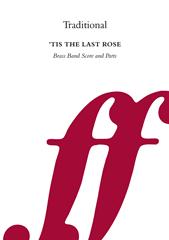
Tis the Last Rose of Summer (Flugel Horn Solo with Brass Band - Score and Parts)
It is often thought that Tis the Last Rose of Summer came from the Victorian era, when Irish songs were very popular. However this was first published in 1813 and has been adapted and arranged by many composers and arrangers over the years. This arrangement, as a Flugel Horn solo, by Gary Westwood reveals the tenderness in this wistful love song. Suitable for Advanced Youth/3rd Section Bands and above. Duration: 5.00
Estimated dispatch 7-14 working days
-
 £55.00
Purcell Variations (Brass Band - Score and Parts)
Purcell Variations, composed in 1995, the year of the tercentenary of the death of the great English composer, was a watershed work in that it was Downie's first extended composition to be published independently of The Salvation Army and intended for wider use.For his theme, Downie has chosen what has come down to us as the hymn tune Westminster Abbey, which is in fact an adaptation made in 1842 by Ernest Hawkins, who was a Canon of Westminster Abbey where Purcell himself had been organist. Purcell's original is actually the closing section of an anthem, O God, Thou art my God, where it provides the final paean of praise, sung to repeated 'Hallelujahs'. Purcell's tune, particularly the opening triadic gesture, is used as a source of thematic and harmonic material - a quarry for ideas if you like: "I was obsessed with the intervals of thirds in Purcell's tune, rather like Brahms in his Third Symphony", the composer says.There are five variations, preceded by an extended introduction and theme. In the first variation, Purcell's lilting dance pulse has been transformed into a bright, playful sequence, in which each phrase of the melody is given its own transformation. In the second, Purcell's opening gambit is extended into a graceful, flowing waltz, featuring solo and first horn at the top of the register. The composer offers a range of metronome speeds in this movement, in which he is emulating the wistful elegance of Erik Satie's famous Gymnopedie. We enter the world of big band jazz in variation three, where Purcell's tune strides along with added syncopation and bluesy major/minor thirds to the fore. After the breathless energy and blazing brass of the big band, Downie moves into his 'home territory' for a beautifully worked lyrical variation. There is an enhanced urgency about the final variation, which opens with an extended reprise of the work's introduction. Purcell's second and third phrases provide the preparation for the exuberant return, in customary triumph of Purcell's 'Hallelujah'.
Estimated dispatch 7-14 working days
-
 £77.00
General Series Brass Band Journal, Numbers 2265 - 2268, April 2026
2265: Holy God, we praise your name (Micael Dikantsa)This bolero introduces composer Micael Dikantsa of the Amriswil Corps, Switzerland, and is based on the hymn Holy God, We Praise Your Name (Grosser Gott, wir loben dich). Set in the traditional slow, dramatic bolero style, the work builds steadily from a distinctive percussion figure as the melody passes through different instrumental groups. With its growing intensity and rich scoring, this piece offers an engaging and atmospheric addition to concert programmes.2266: Tell the story (Barrie Gott)This work continues the Swing series that began nearly 40 years ago with Light'Walk. After a bold introduction, the melody unfolds through unison and close'harmony writing, leading to a Flugel Horn solo with scope for improvisation. The well'known hymn I Love to Tell the Story is heard in a New Orleans style before a modulation launches an energetic shout chorus and lively coda. Smooth, relaxed swing style is key throughout.2267: The old rugged cross (Erik Leidzn)This arrangement by Erik Leidzn is an early and lesser'known setting of a well'loved hymn, rediscovered during research into his work. Edited from a rare score found in the USA East Music Department archives, it demonstrates Leidzn's economical and effective style, creating a practical and expressive arrangement at a time when concise, serviceable hymn settings were greatly needed.2268: Heaven came down! (Michael Cooper)Inspired by William Booth's famous challenge to use contemporary styles for sacred purpose, this piece blends high'energy jazz'fusion big'band writing with a joyful gospel hymn. Driven by rhythm, syncopation and precision, the music proclaims its message of transformation and spiritual joy with vitality, clarity and infectious swing.
Estimated dispatch 7-14 working days
-
 £55.00
Triumph Series Brass Band Journal, Numbers 1343 - 1346, November 2022
1343: March - Spreading the Word (Ian Clarke)This lively march features the songs Look, ye saints! the sight is glorious (S.A.S.B. 227), When we walk with the Lord (S.A.S.B. 690), I want to tell what God has done (S.A.S.B. 852), and makes reference to the old chorus When I remember that he died for me I'll never go back any more.1344: Prelude on 'Anstasis' (Sam Creamer)The Greek word anstasis translates to resurrection and particularly refers to the resurrection of Jesus Christ. The popular worship song O praise the name (Anstasis) forms the basis of this prelude. While the theme of this work is most applicable for Easter use, it could well find its place in programme and worship repertoire all year round.1345: Flugel Solo - The old rugged cross (Eiliv Herikstad)This Flugel Horn Solo (also playable by Cornet) includes chords on the soloist part so that the soloist can have improvisational freedom, or can play the written out solo.1346: March - Showers of blessing (Zachary Docter)This energetic march uses Gary Rose's melody Showers of blessing (STTL Vol.24, Pt.1).
Estimated dispatch 7-14 working days
-
 £34.95
Away in a Manger (Flugel Horn Solo with Brass Band)
The traditional carol in a beautiful yet simple setting for flugel horn (or Bb cornet) and band. (Also available with piano accompaniment).
Estimated dispatch 7-14 working days
-
 £54.20
La Verbena (Brass Band - Score and Parts)
This series is for Brass Bands with a reduced number of playersThis series is without Repiano, 2nd Horn in Eb and 2nd TromboneParts included for:1 Eb Soprano Cornet5 Solo Bb Cornet3 2nd Bb Cornet2 3rd Bb Cornet1 Bb Flugel Horn1 Solo Eb Horn2 1st Eb Horn1 1st Bb Baritone2 2nd Bb Baritone (2nd Bb Trombone)1 1st Bb Trombone1 Bass Trombone2 Bb Euphonium2 Eb Bass2 Bb Bass1 Timpani2 Percussion/Drum SetOptional parts also included for:1 1st Trombone BC1 2nd Trombone BC1 Bass Trombone TC
Estimated dispatch 7-14 working days
-
 £54.20
Four Christmas Carols (Brass Band - Score and Parts)
This series is for Brass Bands with a reduced number of playersThis series is without Repiano, 2nd Horn in Eb and 2nd TromboneParts included for:1 Eb Soprano Cornet5 Solo Bb Cornet3 2nd Bb Cornet2 3rd Bb Cornet1 Bb Flugel Horn1 Solo Eb Horn2 1st Eb Horn1 1st Bb Baritone2 2nd Bb Baritone (2nd Bb Trombone)1 1st Bb Trombone1 Bass Trombone2 Bb Euphonium2 Eb Bass2 Bb Bass1 Timpani2 Percussion/Drum SetOptional parts also included for:1 1st Trombone BC1 2nd Trombone BC1 Bass Trombone TC
Estimated dispatch 7-14 working days
-
 £50.90
A Christmas Medley (Brass Band - Score and Parts)
This series is for Brass Bands with a reduced number of playersThis series is without Repiano, 2nd Horn in Eb and 2nd TromboneParts included for:1 Eb Soprano Cornet5 Solo Bb Cornet3 2nd Bb Cornet2 3rd Bb Cornet1 Bb Flugel Horn1 Solo Eb Horn2 1st Eb Horn1 1st Bb Baritone2 2nd Bb Baritone (2nd Bb Trombone)1 1st Bb Trombone1 Bass Trombone2 Bb Euphonium2 Eb Bass2 Bb Bass1 Timpani2 Percussion/Drum SetOptional parts also included for:1 1st Trombone BC1 2nd Trombone BC1 Bass Trombone TC
Estimated dispatch 7-14 working days
-
 £89.95
Diversions for Brass Band, Op.97 (Brass Band - Score and Parts)
This work was commissioned in1985 by Skellerup, Christchurch, New ZealandMovements:Allegro VivaceAndante Con Moto Molto ExpressivoAllegro VivaceDerek Bourgeois wrote Diversions in the summer of 1985 to a commissioned from the Skellerup Brass Band.Bourgeois previous test piece, Blitz, was aggressive and forceful, therefore the composer decided to write a work of a completely different character, which although technically very demanding, is light-hearted in style, and easy on the ear, as the title suggests.The first and third movements share the same tempo, but are rather different in character. The first movement is a sonata allegro contrasting two main themes. The first is bold and jaunty and is heavily scored, the second announced by the solo horn is more lyrical in character. The development section and recapitulation are merged into a continuous interplay of the two themes.The second movement is an expressive andante in free rondo form. It is lightly scored for the most part with a lot of solo passages that make demands on the musicianship of the players and conductor alike. The very simplicity of its textures and the breadth of its melodic writing demand firm control of vibrato, phrasing and rubato.The brief finale is nothing short of a romp. Its ternary structure is highly rhythmic in character and only rarely do the performers enjoy the luxury of two consecutive bars in the same time signature!Duration: 11.00
Estimated dispatch 7-14 working days
-
 £44.95
Greensleeves (Tenor Horn Solo with Brass Band)
Written for tenor horn soloist Sheona White, this gorgeous setting has already been performed in Westminster Abbey.
Estimated dispatch 7-14 working days