
Results
-
£72.00
Sa ta mitt hjerte - Moldestad-Ditlevsen - Idar Torskangerpoll
This is a tune by Sigrid Moldestad (b. 1972), a Norwegian folk artist. She has based it on a warm and beautiful poem by Danish author Tove Ditlefsen. A text for and about love.Sigrid Moldestad won the "Spellemannsprisen" (the Norwegian equivalent to Grammy) in 2005 as a part of the group Gamaltnymalt. She won the price two years later, this time as solo artist for the record album Taus. Both times in the Folk Music category.So Take My Heart was released in 2012 as a part of the album Himlen har sove bort morkret.
Estimated dispatch 7-14 working days
-
 £30.00
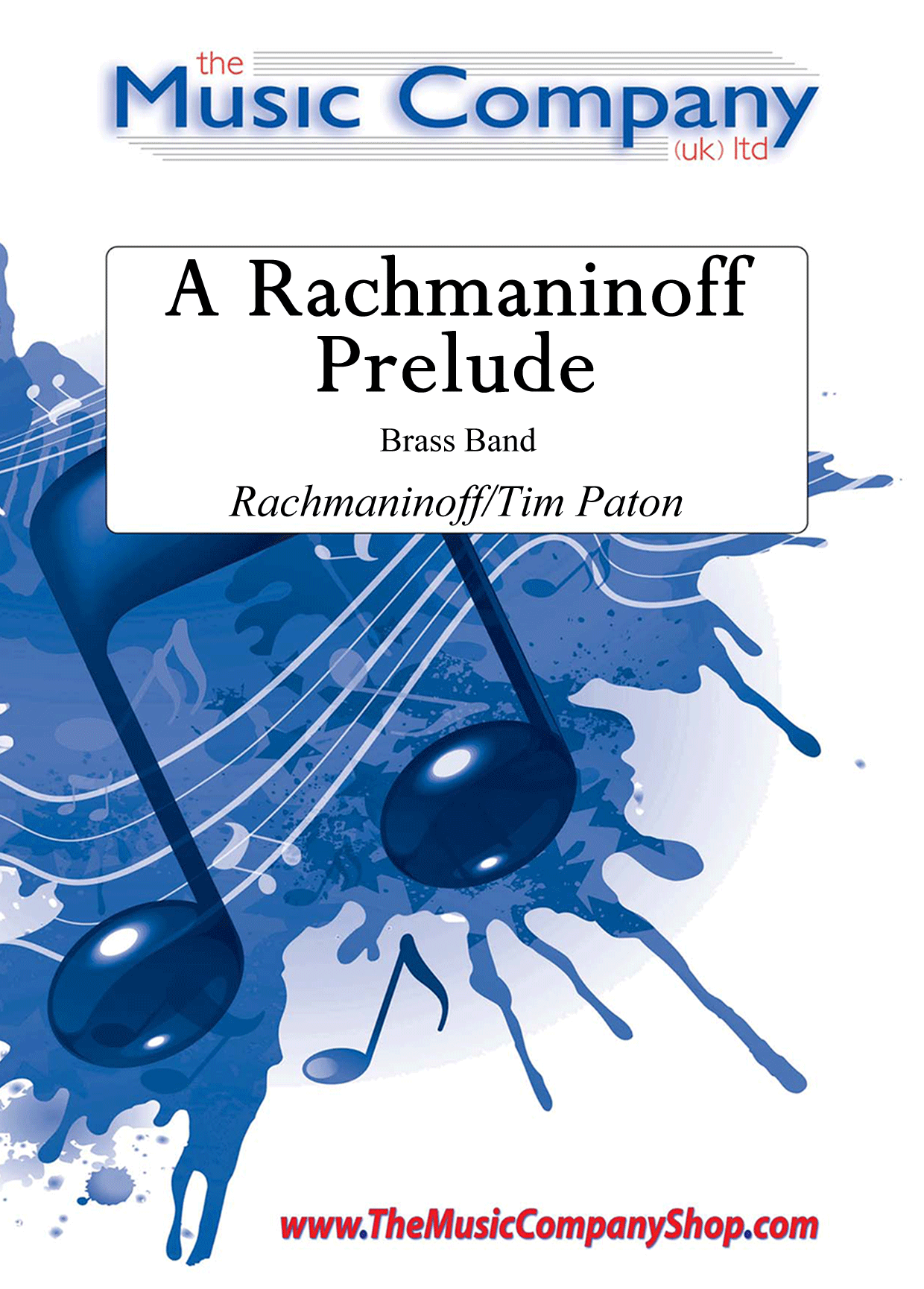
A Rachmaninoff Prelude - Rachmaninoff
An arrangement by Tim Paton of this Rachmaninoff favourite for brass band.Comments from Tim:I first heard the Rachmaninoff Prelude in G minor when my brother, (Dr) Rod Paton, used to play it on the piano. The martial sound of the opening theme caught my imagination, and I knew then that this piece would sound magnificent if played by a brass band - if you like the music of Rachmaninoff, then you will love this piece! That spectacular sound that we all know, with busy, melodic bass lines, and a middle section in his well known 'romantic' style - I could already hear the euphonium playing those rippling arpeggios. In response to the enthusiasm for this magnificent piece, I have lightheartedly commented that maybe he wrote it for brass band, but there wasn't one available, so he did it for piano instead!Look and Listen (Score-reading digital sound sample):
In Stock: Estimated dispatch 3-5 working days
-
 £74.72
Blaenwern Diversions (Brass Band) Karl Whelan
Commissioned by Micah Dominic Parsons, Blaenwern Diversions is based on the well loved hymn, Love Divine. The composer writes: 'Originally intended to be a set of variations, I found myself wandering around the notes of the hymn tune at the piano and found that the variations almost took on a life of their own resulting in what we have here - diversions. There are 8 diversions in total; the introductory diversion; diversions 1 - 6; and the finale which are divided into three linked movements. Blaenwern Diversions represents my entry into the world of contest works, so even though the piece aims to test the band, it is important that the band enjoy the music within no matter how treacherous!' To view a follow-the-score video please visit www.youtube.com/watch?v=6X5gTMTHkfg PDF download includes score and parts. Sheet music available from: UK - www.brassband.co.uk USA - www.solidbrassmusic.com Difficulty Level: Championship Instrumentation: Soprano Cornet Eb Solo Cornet Bb Repiano Cornet Bb 2nd Cornet Bb 3rd Cornet Bb Flugel Horn Bb Solo Horn Eb 1st Horn Eb 2nd Horn Eb 1st Baritone Bb 2nd Baritone Bb 1st Trombone Bb 2nd Trombone Bb Bass Trombone Euphonium Bb Bass Eb Bass Bb Timpani Percussion 1-3
In Stock: Estimated dispatch 1-3 working days
-
 £34.95
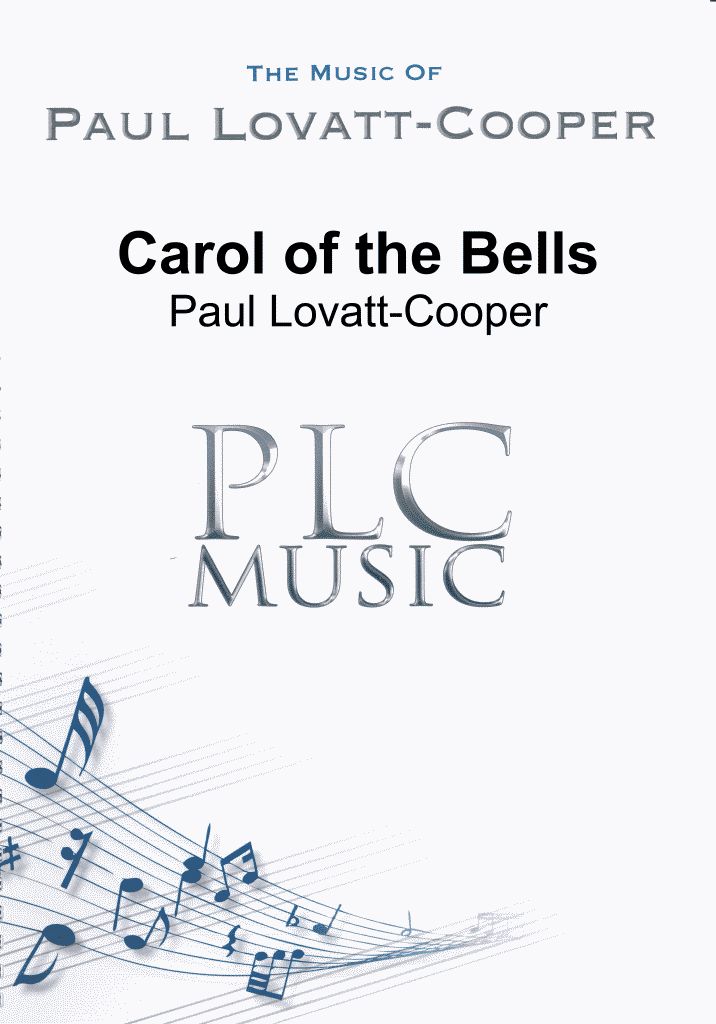
Carol of the Bells (Brass Band - Score and Parts)
Christmas time is my favourite time of year. I love the festive spirit and all the Christmas music both traditional and modern.This piece is based on the traditional Ukrainian Bell Carol that was composed by the Ukrainian composer Mykola Dmytrovych Leontovych. Throughout the piece you hear a four note ostinato that is the backbone to the music. I have taken those ideas and motifs and have mixed them with some of my own to create this piece of Christmas music.For something different I have given this piece two endings for the conductor to choose. The first ending is at bar 189 (page 18 in the score) where there is the repeated four bar ostinato section in the solo cornets and percussion that is marked "Keep repeating and fade to nothing". This is so the piece can either fade to nothing or for a bit of originality the piece can fade into the next piece during a concert programme.For ending number two you need to cut from bar 189 to 193 (bypassing ending one). And continue to the end. The choice of endings should bring some interesting performances of this wonderful traditional Christmas piece.Paul Lovatt-Cooper
Estimated dispatch 7-14 working days
-
 £30.00
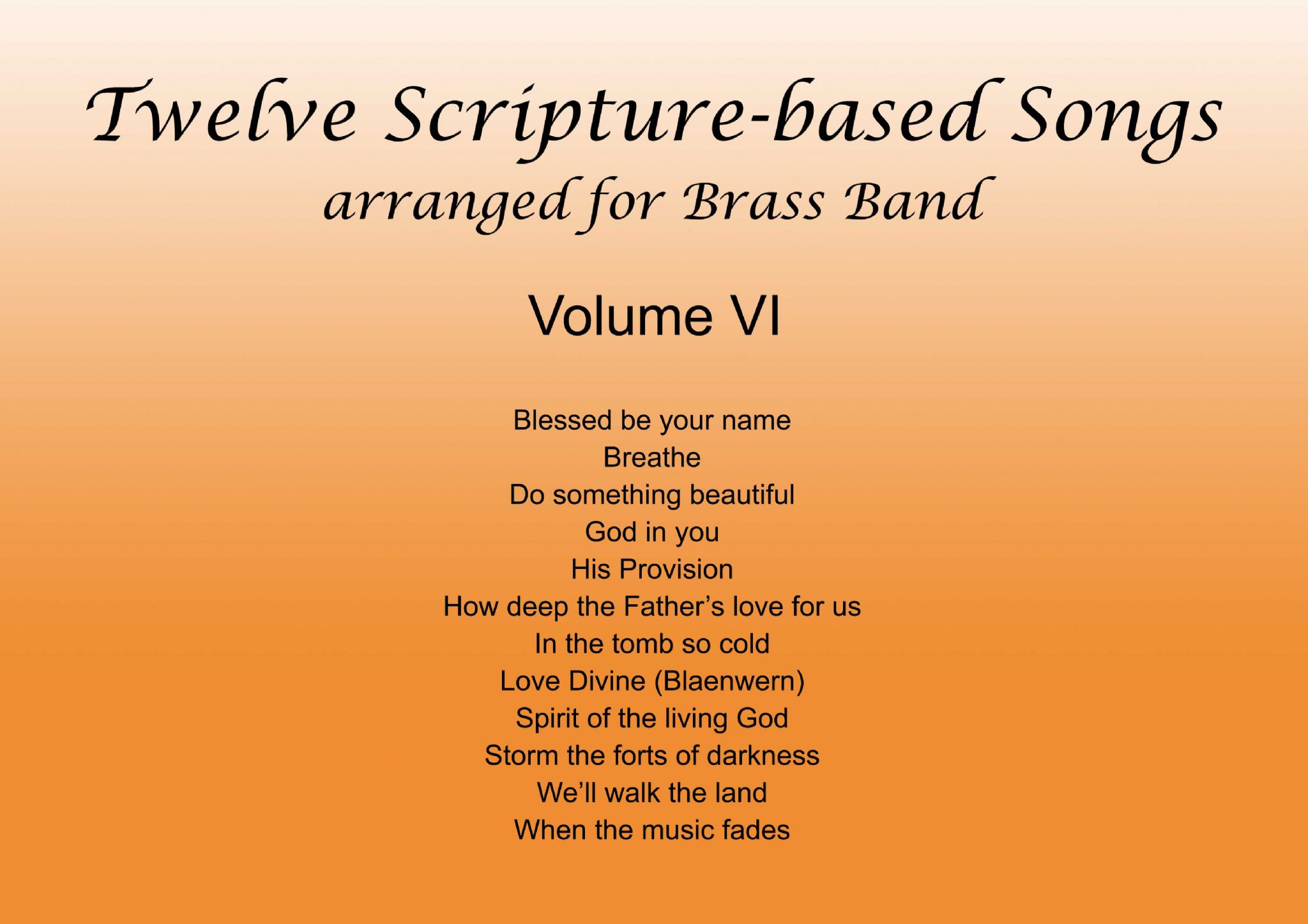
Twelve Scripture-Based Songs Volume VI
Twelve scripture-Based Songs arranged for Brass Band (Volume VI) are packaged and marketed in complete sets which include a full score and a set of master parts. It is intended that these parts be used as 'masters', for the purpose of photocopying a quantity of parts to accommodate the precise instrumentation needs of the band for which this has been purchased.Blessed be your nameBreatheDo something beautifulGod in youHis ProvisionHow deep the Father's love for usIn the tomb so coldLove Divine (Blaenwern)Spirit of the living GodStorm the forts of darknessWe'll walk the landWhen the music fades
Estimated dispatch 7-14 working days
-
 £35.00
Swan Lake (Finale). Tchaikovsky.
Recommended - Championship & 1st Section The Finale from Swan lake is the turbulent and dramatic conclusion to Tchaikovsky's celebrated ballet so as a 'finisher' this music is as exciting as it gets! The music begins at whirlwind speed before giving way to the famous tender love theme, which is skilfully developed before the music builds to a thrilling and exciting conclusion. This arrangement won the prize for the best new arrangement at 'Spennymore' in 1996, played by the Fodens Band. Includes score & Parts
-
 £80.00
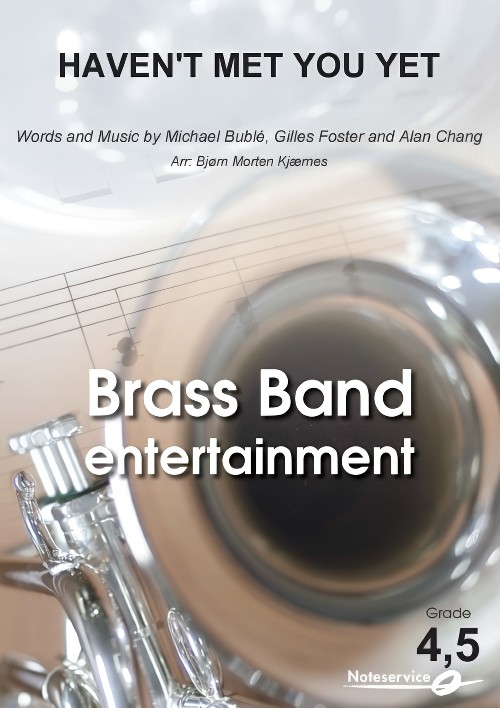
Haven't Met You Yet (Optional Vocal Solo with Brass Band - Score and Parts) - Kjaernes, Bjorn Morten
Haven't Met You Yet is the first single from Canadian singer Michael Buble's sixth album, Crazy Love, released on August 31, 2009. According to Buble, the single and its official music video are about everyone's dream of finding a relationship and love. Buble co-wrote Haven't Met You Yet with Alan Chang and Amy Foster-Gillies, and dedicated it to his then fiancee and now wife, Luisana Lopilato (who appears as his love interest in the music video).In 2012, Nick Jonas covered the song in the TV series Smash, so this music can also be used in a TV/Movie theme concert.
Estimated dispatch 7-14 working days
-
 £31.95
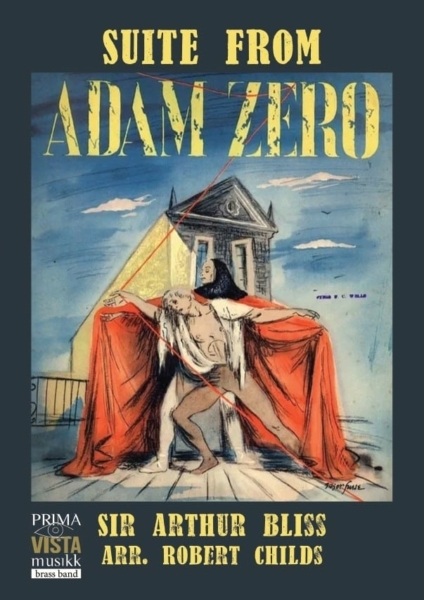
Adam Zero, Suite from (Brass Band - Score only) - Bliss, Arthur - Childs, Robert
Selected as the Section 2 test piece for the National Brass Band Championships of Great Britain 2025Following his ballet Checkmate, Bliss composed another score for the, by then, Sadler's Wells Ballet, Miracle in the Gorbals, which was choreographed by Robert Helpmann, to a scenario by Michael Benthall. Premired in 1944, the ballet made a considerable impact and was a box-office success. It was followed in turn by a further collaboration with Helpmann and Benthall, Adam Zero. This would serve Helpmann, in the eponymous role, as a vehicle in two respects: demonstrating his gifts as a dancer-actor and as a choreographer. First performed at the Royal Opera House, Covent Garden, on 8 April 1946, Adam Zero was conducted by Constant Lambert, the work's dedicatee. Bliss considered it 'his most varied and exciting ballet score'. Benthall provided a synopsis for the programme:There is a philosophy that life moves in an endless series of timeless cycles. As Nature passes through Spring, Summer, Autumn and Winter, so man is born, makes a success in his own particular sphere, loses his position to a younger generation, sees his world crumble before his eyes and only finds peace in death. This age-old story is told in terms of a Company creating a ballet and calling on the resources of the theatre to do so. Lighting, stage mechanism, dance conventions, musical forms and costumes and scenery of all periods are used to symbolize the world of 'Adam Zero'.Apart from Adam, as the Principal Dancer, other main roles included the Stage Director (representing Omnipotence), and Adam's Fates (Designer, Wardrobe Mistress, and Dresser). 'The Woman in this allegory', wrote Bliss, 'under the symbol of the Choreographer, was both the creator and destroyer of Adam: his first love, his wife, his mistress, and finally the figure of beneficent Death.' When the curtain rose, the 'audience saw the Covent Garden stage right back to the wall, completely empty except for the protagonists, 'the Company poised, still and expectant, as they await the birth of... Adam Zero.'Unfortunately, soon after the premire, Helpmann injured himself and had to withdraw from the remaining performances. Despite generally positive reviews, the ballet did not capture the imagination of audiences and, to Bliss's considerable disappointment, was not revived. Seventy years would elapse before its first major return to the stage, in 2016, performed by the ballet company of Stadttheater Bremerhaven with choreography by Sergei Vanaev.Bliss extracted a concert suite from the ballet, conducting its first performance with the City of Birmingham Symphony Orchestra on 28 October 1948. For his own suite, arranged for brass band in 2023, Dr Robert Childs chose three dances linked to the seasons, book-ending them with the ebullient 'Fanfare Overture' and 'Fanfare Coda'. After Adam has grown to manhood, his Fates clothe him in a costume synonymous with confident youth, appropriate for the virile, ardent 'Dance of Spring'. In the 'Approach of Autumn', Adam, now wearing a sombre costume, has grown older: his Fates have streaked grey in his hair and put lines on his face. But they had earlier raised Adam to the zenith of his power, and the 'Dance of Summer' depicts him in the prime of life, in music of sweeping grandeur. The 'Fanfare Coda' signals that the next cycle of life is about to begin.Duration: 10.30
Estimated dispatch 7-14 working days
-
£21.65
Adam Zero, Suite from (Brass Band - Study Score) - Bliss, Arthur - Childs, Robert
Selected as the Section 2 test piece for the National Brass Band Championships of Great Britain 2025Following his ballet Checkmate, Bliss composed another score for the, by then, Sadler's Wells Ballet, Miracle in the Gorbals, which was choreographed by Robert Helpmann, to a scenario by Michael Benthall. Premired in 1944, the ballet made a considerable impact and was a box-office success. It was followed in turn by a further collaboration with Helpmann and Benthall, Adam Zero. This would serve Helpmann, in the eponymous role, as a vehicle in two respects: demonstrating his gifts as a dancer-actor and as a choreographer. First performed at the Royal Opera House, Covent Garden, on 8 April 1946, Adam Zero was conducted by Constant Lambert, the work's dedicatee. Bliss considered it 'his most varied and exciting ballet score'. Benthall provided a synopsis for the programme:There is a philosophy that life moves in an endless series of timeless cycles. As Nature passes through Spring, Summer, Autumn and Winter, so man is born, makes a success in his own particular sphere, loses his position to a younger generation, sees his world crumble before his eyes and only finds peace in death. This age-old story is told in terms of a Company creating a ballet and calling on the resources of the theatre to do so. Lighting, stage mechanism, dance conventions, musical forms and costumes and scenery of all periods are used to symbolize the world of 'Adam Zero'.Apart from Adam, as the Principal Dancer, other main roles included the Stage Director (representing Omnipotence), and Adam's Fates (Designer, Wardrobe Mistress, and Dresser). 'The Woman in this allegory', wrote Bliss, 'under the symbol of the Choreographer, was both the creator and destroyer of Adam: his first love, his wife, his mistress, and finally the figure of beneficent Death.' When the curtain rose, the 'audience saw the Covent Garden stage right back to the wall, completely empty except for the protagonists, 'the Company poised, still and expectant, as they await the birth of... Adam Zero.'Unfortunately, soon after the premire, Helpmann injured himself and had to withdraw from the remaining performances. Despite generally positive reviews, the ballet did not capture the imagination of audiences and, to Bliss's considerable disappointment, was not revived. Seventy years would elapse before its first major return to the stage, in 2016, performed by the ballet company of Stadttheater Bremerhaven with choreography by Sergei Vanaev.Bliss extracted a concert suite from the ballet, conducting its first performance with the City of Birmingham Symphony Orchestra on 28 October 1948. For his own suite, arranged for brass band in 2023, Dr Robert Childs chose three dances linked to the seasons, book-ending them with the ebullient 'Fanfare Overture' and 'Fanfare Coda'. After Adam has grown to manhood, his Fates clothe him in a costume synonymous with confident youth, appropriate for the virile, ardent 'Dance of Spring'. In the 'Approach of Autumn', Adam, now wearing a sombre costume, has grown older: his Fates have streaked grey in his hair and put lines on his face. But they had earlier raised Adam to the zenith of his power, and the 'Dance of Summer' depicts him in the prime of life, in music of sweeping grandeur. The 'Fanfare Coda' signals that the next cycle of life is about to begin.Duration: 10.30
Estimated dispatch 7-14 working days
-
£74.95
Adam Zero, Suite from (Brass Band - Score and Parts) - Bliss, Arthur - Childs, Robert
Selected as the Section 2 test piece for the National Brass Band Championships of Great Britain 2025Following his ballet Checkmate, Bliss composed another score for the, by then, Sadler's Wells Ballet, Miracle in the Gorbals, which was choreographed by Robert Helpmann, to a scenario by Michael Benthall. Premired in 1944, the ballet made a considerable impact and was a box-office success. It was followed in turn by a further collaboration with Helpmann and Benthall, Adam Zero. This would serve Helpmann, in the eponymous role, as a vehicle in two respects: demonstrating his gifts as a dancer-actor and as a choreographer. First performed at the Royal Opera House, Covent Garden, on 8 April 1946, Adam Zero was conducted by Constant Lambert, the work's dedicatee. Bliss considered it 'his most varied and exciting ballet score'. Benthall provided a synopsis for the programme:There is a philosophy that life moves in an endless series of timeless cycles. As Nature passes through Spring, Summer, Autumn and Winter, so man is born, makes a success in his own particular sphere, loses his position to a younger generation, sees his world crumble before his eyes and only finds peace in death. This age-old story is told in terms of a Company creating a ballet and calling on the resources of the theatre to do so. Lighting, stage mechanism, dance conventions, musical forms and costumes and scenery of all periods are used to symbolize the world of 'Adam Zero'.Apart from Adam, as the Principal Dancer, other main roles included the Stage Director (representing Omnipotence), and Adam's Fates (Designer, Wardrobe Mistress, and Dresser). 'The Woman in this allegory', wrote Bliss, 'under the symbol of the Choreographer, was both the creator and destroyer of Adam: his first love, his wife, his mistress, and finally the figure of beneficent Death.' When the curtain rose, the 'audience saw the Covent Garden stage right back to the wall, completely empty except for the protagonists, 'the Company poised, still and expectant, as they await the birth of... Adam Zero.'Unfortunately, soon after the premire, Helpmann injured himself and had to withdraw from the remaining performances. Despite generally positive reviews, the ballet did not capture the imagination of audiences and, to Bliss's considerable disappointment, was not revived. Seventy years would elapse before its first major return to the stage, in 2016, performed by the ballet company of Stadttheater Bremerhaven with choreography by Sergei Vanaev.Bliss extracted a concert suite from the ballet, conducting its first performance with the City of Birmingham Symphony Orchestra on 28 October 1948. For his own suite, arranged for brass band in 2023, Dr Robert Childs chose three dances linked to the seasons, book-ending them with the ebullient 'Fanfare Overture' and 'Fanfare Coda'. After Adam has grown to manhood, his Fates clothe him in a costume synonymous with confident youth, appropriate for the virile, ardent 'Dance of Spring'. In the 'Approach of Autumn', Adam, now wearing a sombre costume, has grown older: his Fates have streaked grey in his hair and put lines on his face. But they had earlier raised Adam to the zenith of his power, and the 'Dance of Summer' depicts him in the prime of life, in music of sweeping grandeur. The 'Fanfare Coda' signals that the next cycle of life is about to begin.Duration: 10.30
Estimated dispatch 7-14 working days
 View Music