Results
-
 £69.95
Ceremony - Jonathan Bates
DIFFICULTY: 2nd+. DURATION: 10'00". 'Ceremony' was commisioned by Musica da Domat, Switzerland and their Musical Director Gian Stecher in 2019. The concept of the work revolves around a number of religious processions which take place around the mountainous region of Graubunden in the south of the country and in more musical terms, a specific setting of the 'Stabat Mater' (heard in fragments throughout the piece, but only at the finale is it heard in it's entirety) which is traditionally the ceremonies around this area. Through-composed yet in 4 clear sections, 'Ceremony' opens with 3 fanafare trumpets/cornets positioned antiphonally across the back of the stage, each paired with a different pitched tenor drum, and in a different key - inspired by the idea of being able to hear the different ceremonies from all regions of Graubunden echoing up the valley in equal strength. Following this opening fanfare section, the procession around the hills begins with a tongue-in-cheek quasi-march in a far more upbeat and jovial mood. The centrepiece of the work is simply entitled 'Echoes', and once again returns to the idea of music breaking the almost eerie-silence as it reverberates around the vast valleys, before the culmination of the piece returns to material from the opening 'Ceremony' section in a more grandioso and bold style. . .
In Stock: Estimated dispatch 1-3 working days
-
 £34.99
Submerged... (Cornet Concerto No.2) - Jonathan Bates
'Submerged..' is a virtuoso concerto for Cornet composed as a response to the 'lost' Derbyshire villages of Ashopton & Derwent,. both of which were drowned in the early 1940's to make way for a new reservoir to aid the ever-increasing water demand from nearby. Sheffield and it's steel industry during World War 2. The work is through-composed but is defined by 3 clear main sections, 'The . Packhorse Bridge, Derwent', 'Ashopton Chapel' and 'Operation Chastise'. Much of the melodic and harmonic material throughout the. concerto is inspired by 3 contrasting sources; an original motif of towering block chords which opens the concerto, the famous opening. fragment of Eric Ball's 'High Peak' (1969) which was composed as a tribute to the district of Derbyshire where Ashopton & Derwent lie, . and finally Claude Debussy's haunting 'La Cath drale Engloutie' or 'The Sunken Cathedral', which was composed in 1910 around the legend of. the submerged cathedral of Ys. . I. Packhorse Bridge, Derwent (1925). One of the most striking features of the former village of Derwent was it's Packhorse Bridge, which spanned the River Derwent. adjacent to the Derwent Hall - a grand, picturesque Jacobean country house. In 1925, the renowned impressionist artist Stanley. Royle painted a striking image of the two in midwinter, with the partially frozen river sat quietly underneath the snow-topped. bridge in the foreground, while the old hall sits peacefully and dark in the background. The opening setion of this concerto paints. this picture in a quite schizophrenic manner; with frosty, shrill march-like material picturing the villagers crossing the narrow icy. bridge, combined with wild and frenzied waltz music of the grand hall and it's masquerade balls laying, for now, quietly mysterious. across the river. . II. Ashopton Chapel (1939). Ashopton was much the smaller and less-populated of the 2 'lost' villages, but still bore home to a Roman Catholic Chapel which was. the focal point of the village. The chapel - along with the rest of Ashopton - was drowned in 1943, but the final service to take place there. was held in 1939, with the final hymn being 'Day's Dying in the West'. This hymn forms a haunting coda to the 2nd section, with firstly the . piano leading the melody before an audio track containing an old recording of the hymn is accompanied by the sound of flowing water and . the rumble of storms as the village hypothetically disappears from existence with the hymn tune still echoing around the valley, before . subsiding into the growing roar of the engine of a Lancaster Bomber as it soars overhead towards Derwent to practise it's 'Dam-Buster' raid. . III. Operation Chastise (1943). The Derwent Reservoir lies adjacent to Ladybower Reservoir (of which Ashopton & Derwent were flooded to make way for) in the . Derbyshire High Peak, and during the 2nd World War was used as one of the central low-atitude practise areas of the 617 Squadron - more . commonly known affectionately as the 'Dambusters'. Before the destruction of Derwent, it's 'Packhorse Bridge' was dismantled stone by stone . and re-assembled upstream at Howden Dam to the north end of Derwent Reservoir. This is where the music begins, with a reconstruction of . the opening material before taking flight into a whirlwind tour of virtuosity from the soloist. .
In Stock: Estimated dispatch 1-3 working days
-
£45.00
Born On The Fourth of July - John Williams
The theme music from the original motion picture, Born on the Fourth of July, starring Tom Cruise. The music was composed by John Williams and this arrangement for brass band is by Andrew Duncan.Brass Band Grade 3/4: Youth and 4th Section/Advanced Youth and 3rd SectionDuration: 5 minutes
In Stock: Estimated dispatch 1-3 working days
-
 £42.00
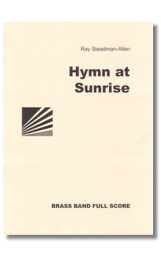
Hymn at Sunrise (Score only) - Ray Steadman-Allen
The idea for this work was prompted by a poem - Hymn Before Sunrise - which describes the majesty of a mountain in darkness, the sounds of a nearby waterfall and so on. Nothing came of the exposure to these pictures except for general thoughts about the dawn of day and a series of movements expressing a personal response to the wonder of creation in an imaginary moment in time. The movement titles, which were added later, are intended to underline a prevailing sense of worship, wonder and exaltation. The music is pure, not pictoral, though listeners may conjure their own images. An actual hymn - Tallis' Cannon - is incorporated. There are five movements: 1. Thanksgiving: A short prelude in two parts. First a brief passage of 'dawn music' before things become more vigorous: fanfare-like music ushers in the trombone section's presentation of the Tallis tune. A broad band version concludes the movement. 2. De Profundis: A slow movement shot through with anxious questionings featuring flugel and trombone. The mood lightens a little in the centre where the soprano cornet is featured and the movement ends serenely. 3. Celebration is characterised by rhythmic drive, this is buoyant with plenty of incident pointed up by the percussion. 4. Invocation: Melodic in nature and sober in mood, the first section is a series of short solos mingled with chorale-like statements. Central to the movement is a chorale-prelude style presentation of the Tallis tune. The third section reintroduces the earlier solo music by the full ensemble. Dissolving, the music enters the last movement without a break. 5. Paean: Marked allegro con spirito there is, quite rightly, a fair amount of fun in the rejoicing. Snatches of Tallis are heard, then comes a gentle passage with a cornet solo leading to fanfare music and recapitulation. Two recitatives are succeeded by a coda which brings the work to a sonorous and exultant conclusion.
Estimated dispatch 7-9 working days
-
 £52.00
Hymn at Sunrise (Parts only) - Ray Steadman-Allen
The idea for this work was prompted by a poem - Hymn Before Sunrise - which describes the majesty of a mountain in darkness, the sounds of a nearby waterfall and so on. Nothing came of the exposure to these pictures except for general thoughts about the dawn of day and a series of movements expressing a personal response to the wonder of creation in an imaginary moment in time. The movement titles, which were added later, are intended to underline a prevailing sense of worship, wonder and exaltation. The music is pure, not pictoral, though listeners may conjure their own images. An actual hymn - Tallis' Cannon - is incorporated. There are five movements: 1. Thanksgiving: A short prelude in two parts. First a brief passage of 'dawn music' before things become more vigorous: fanfare-like music ushers in the trombone section's presentation of the Tallis tune. A broad band version concludes the movement. 2. De Profundis: A slow movement shot through with anxious questionings featuring flugel and trombone. The mood lightens a little in the centre where the soprano cornet is featured and the movement ends serenely. 3. Celebration is characterised by rhythmic drive, this is buoyant with plenty of incident pointed up by the percussion. 4. Invocation: Melodic in nature and sober in mood, the first section is a series of short solos mingled with chorale-like statements. Central to the movement is a chorale-prelude style presentation of the Tallis tune. The third section reintroduces the earlier solo music by the full ensemble. Dissolving, the music enters the last movement without a break. 5. Paean: Marked allegro con spirito there is, quite rightly, a fair amount of fun in the rejoicing. Snatches of Tallis are heard, then comes a gentle passage with a cornet solo leading to fanfare music and recapitulation. Two recitatives are succeeded by a coda which brings the work to a sonorous and exultant conclusion.
Estimated dispatch 7-9 working days
-
 £25.00
March - Spirit of Victory
Andrea Price Composed in 2004 for the 'Mouthpiece.com March Competition,' Spirit of Victory is a light-hearted concert march that takes influence from marches within the Salvation Army catalogue. It's tuneful nature and approachable scoring makes it accessible for confident Junior Bands, Fourth Section and above, offering an alternative choice to the traditional classics. Duration : 00:03:30 Grade : 2.5/3
Estimated dispatch 5-7 working days
-
 £30.00
Saint Clements. CC Scholefield.
Recommended - Championship to 3rd Section Saint Clements (also known as The day Thou Gavest Lord is Ended) is a setting in 3 verses of the beautiful Victorian hymn by C. C. Scholefield. Saint Clements is suitable as a concert item or as a hymn tune arrangement for a contest when this is required. Includes score & parts Also see: Aurelia
-
£24.00
O Magnum Mysterium (Score & Parts) - Morten Lauridsen
For centuries, composers have been inspired by the beautiful O Magnum Mysterium text depicting the birth of the new-born King among the lowly animals and shepherds. This arrangement for symphonic band has been transcribed from the original unaccompanied choral setting. Morten Lauridsen is one of America's most-loved and most-performed living composers, and this arrangement is rich in colour, deeply spiritual and intensely moving.Brass Band Grade 3: Youth and 4th SectionDuration: 6 minutesThis piece has been recorded by the Leyland Band, conducted by Jason Katsikaris, and is a hidden bonus track on the CD entitled Penlee.
In Stock: Estimated dispatch 1-3 working days
-
£50.00
Malaguena (Score & Parts) - Ernesto Lecuona
A 'Malaguena' is a woman living in the Spanish port city of Malaga, on the southern coast of Spain, in the province of Andalucia. Lecuona's Malaguena was originally the sixth movement of his Suite Andalucia and has been performed in many versions by artists such as Connie Francis, Stan Kenton's Orchestra and Bill Haley and the Comets as well as featuring as part of the Broadway musical entitled Blast! This brass band arrangement has been made by Mark Freeh. Brass Band Grade 3: Youth and 4th Section Duration: 6 minutes
In Stock: Estimated dispatch 1-3 working days
-
£50.00
The Peanut Vendor (Score & Parts) - Moises Simons
A fun, lively arrangement of The Peanut Vendor by Mark Freeh for brass band.Brass Band Grade 4: Advanced Youth and 3rd SectionDuration: 3 minutes
In Stock: Estimated dispatch 1-3 working days