
Results
-
 £40.00
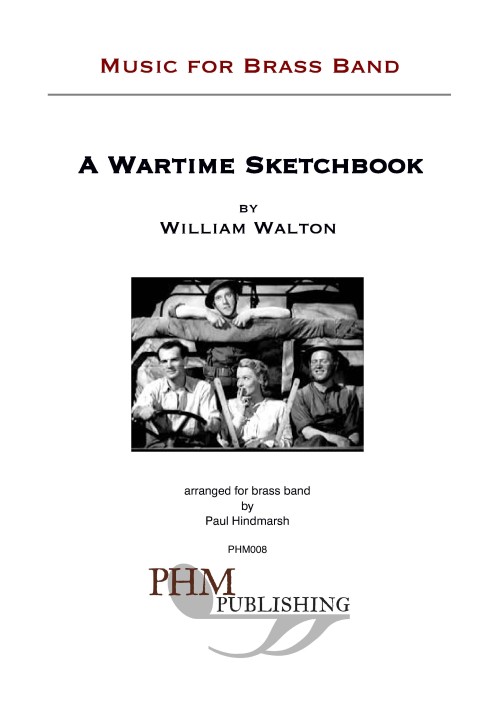
A Wartime Sketchbook (Brass Band - Score only) - Walton, William - Hindmarsh, Paul
Early in 1941 William Walton, 39, received his call-up papers. He was by then one of the most eminent of British composers and was exempted from military service on condition that he provided music for films deemed to be of 'national importance'. Scoring Lawrence Olivier's Shakespeare epic Henry V in 1943 was the most substantial of these wartime projects. His role in patriotic films from 1941 and 42 like The Foreman went to France, Next of Kin, Went the day Well and The First of the Few was to provide appropriate title music and some underscoring at key moments. Walton extracted the most substantial portions of the latter as the popular Spitfire Prelude and Fugue for orchestra. The remaining music remained unpublished until 1990, when Christopher Palmer assembled the highlights into A Wartime Sketchbook. I was intrigued to hear these examples of Walton's wartime music and having discovered that they would fit naturally and idiomatically onto the brass band, I arranged six of the numbers into a suite for Besses o' th' Barn Band, which I was conducting at the time.In 1995 the brass band suite was recorded by the famous Black Dyke Mills Band as part of an all Walton album which I produced for the ASV label (ASV CD WHL 2093). This award- winning CD also included Walton's First Shoot, in the edition by Elgar Howarth, my transcription of movements from Music for Children and two substantial brass versions by Edward Watson of the suite from Henry V (with narrator) and the March and Siegfried Music from The Battle of Britain music.Prologue: This is the stirring title music from Went the day Well, a screen play by Graham Greene about a German airborne invasion of an English village. The main theme leads toBicycle Chase: Characteristic musical high-jinks for J.B.Priestley's The Foreman went to France.Refugees: From the same film, this is a poignant accompaniment to the long march of refugees. As Ernest Irving, the film's musical director, put it, "this really makes your feet sore and your knees sag."Young Siegfrieds: This lively movement comes from the music that Walton composed for The Battle of Britain in 1968, with the assistance of Malcolm Arnold, but which the film's producer rejected. It portrays first the Berliners, cheerfully ignoring the black-out and then, in the trio, the Young Siegfrieds of the Luftwaffe, courtesy of a parody of Siegfried's horn call from Wagner's opera.Romance: A soldier and a Dutch refugee snatch a few tender moments together in Next of Kin.Epilogue: At the end of The Foreman went to France, the French look forward with hope and optimism to eventual liberation.- Paul HindmarshDuration: 14.00
Estimated dispatch 7-14 working days
-
 £42.95
The Seal Lullaby (Flugel Horn Solo with Brass Band - Score and Parts) - Whitacre, Eric - Sharman, Paul
This loving and dreamlike work captures the undulating rhythm of a mother rocking her child to sleep. The piece was inspired by classic Rudyard Kipling: "Oh! Hush thee, my baby, the night is behind us, And black are the waters that sparkled so green. The moon, o'er the combers, looks downward to find us, At rest in the hollows that rustle between."Magical!
Estimated dispatch 7-14 working days
-
 £40.00
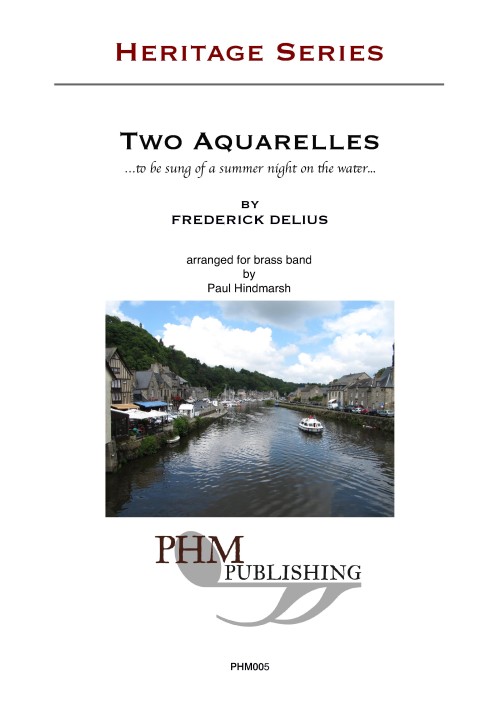
Two Aquarelles (Euphonium Feature with Brass Band - Score and Parts) - Delius, Frederick - Hindmarsh, Paul
In the late spring of 1917, the Bradford born composer, Frederick Delius (1856 - 1934) composed two short part-songs at his home in Grez-sur-Loing. The river ran along the bottom of his garden and he called the two miniatures To be sung of a summer night on the water. The First World War was at its height, but one would never guess that from the languid and serene quality of these richly textured nocturnes. The songs were first heard in London on 28 June, sung by the Oriana Madrigal Society, conducted by Charles Kennedy Scott. In 1932 Delius's amanuensis, Eric Fenby, arranged them for string orchestra as Two Aquarelles. While I have taken Fenby's title, my arrangement is a note-for-note transcription of the choral original. It was prepared in early in 1993 for Besses o' th' Barn Band, of which I was Musical Director at the time. In the second song, the prominent tenor solo has been given to the solo euphonium, who should stand apart from the band in performance.- Paul HindmarshDuration: 5.00
Estimated dispatch 7-14 working days
-
 £42.95
Illuminate (Brass Band - Score and Parts) - Wainwright, Andrew
Composed for the Chicago Staff Band's performance at the Boundless International Congress 2015, at London's O2 Arena. Featuring the songs?Shine on Us, Speak O Lord?and?The World for God.?
Estimated dispatch 7-14 working days
-
 £69.99
A Flemish Christmas (Brass Band - Score and Parts) - Hadermann, Jan
In A Flemish Christmas, Jan Hadermann tells the Christmas story by means of four Old Flemish Christmas Songs.Mary is chosen to bring Jesus Christ, the son of God, into the world: Het was een maged uitverkoren ('She was a virgin chosen').On the occasion of a census, Mary, who is with child, and Joseph, her husband to be, travel from Nazareth to Bethlehem, where Jesus will be born in a humble stable: Maria die zoude naar Bethlehem gaan (Mary would go to Bethlehem').O kerstnacht, schoner dan de dagen ('Oh Christmas Night, more beautiful than the days') is a stately chorale that sings the praises of Jesus' birth.Three wise men from the East, Caspar, Melchior and Balthazar, follow a bright star in the sky, which leads them to Bethlehem. There, they worship the newborn King, and offer him gold, frankincense and myrrh: Wij komen van Oosten (We've come from the East').This musical Christmas story ends with a festive repeat of the third movement, the stately chorale.Duration: 6:30
Estimated dispatch 7-14 working days
-
 £24.95
Cwm Rhondda (Brass Band - Score and Parts) - Downie, Kenneth
This is one hymn tune that everybody knows! Invariably sung to the words, 'Guide me, O Thou Great Jehovah', the strong Welsh melody is given a dramatic treatment to match the passion and fervour of William Williams' words.
Estimated dispatch 7-14 working days
-
£12.50
Cwm Rhondda (Brass Band - Score Only) - Downie, Kenneth
This is one hymn tune that everybody knows! Invariably sung to the words, 'Guide me, O Thou Great Jehovah', the strong Welsh melody is given a dramatic treatment to match the passion and fervour of William Williams' words.
Estimated dispatch 7-14 working days
-
 £24.95
Healing Waters (Cornet Solo with Brass Band - Score and Parts) - Downie, Kenneth
This is an original, poignant setting by Kenneth Downie of words by Albert Osborn, the 6th General of The Salvation Army. The words of the chorus are perhaps better known than the verses; 'From a hill I know, Healing waters flow, O rise Immanuel's tide, And my soul overflow!'
Estimated dispatch 7-14 working days
-
 £72.99
Christmas Troika (Brass Band - Score and Parts) - Curnow, James
Troika is a Russian word that means a group of three but it also means a light Russian sleigh pulled by three horses. Christmas Troika portrays the joy of Christmas via a musical sleigh-ride. One can almost see the frost on the trees and hear the wind blow and the sleigh-bells ring as the tune O Come, All Ye Faithful winds its way through the music.Duration: 5.15
Estimated dispatch 7-14 working days
-
 £29.95
Carolcade (Brass Band - Score and Parts) - Davis, Trevor
An 'easy-listening' arrangement for brass band (in the 'hooked on' style) of several Christmas carols and songs including 'Good King Wenceslas', 'O little town of Bethlehem', 'Ding dong merrily on high', 'Angels from the realms of Glory' and 'We wish you a merry Christmas'.
Estimated dispatch 7-14 working days
 View Music