
Results
-
 £29.95
Corineus (Brass Band - Score only) - Bond, Christopher
Regionals 2024 - 3rd Section test piecePremiered by Cory Band at the 2018 Festival of Brass, Manchester. Selected as the set-work for the Championship Section at the 2019 National Youth Championships of Great Britain.Corineus, in medieval British legend, was a prodigious warrior, a fighter of giants, and the eponymous founder of Cornwall. The first of the legendary rulers of Cornwall, he is described as a character of strength and power. It is on the medieval ruler that this new work, Corineus, is based, presented in three contrasting sections. The work opens with heraldic fanfares and a sense of jubilance before presenting musical material which changes and develops organically, portraying the journey taken by Corineus, Brutus, and the Trojans from modern-day mainland Europe to Britain. The central section of the work is slower, creating a feeling of longing. Brutus' son, Locrinus, had agreed to marry Corineus' daughter, Gwendolen, but instead fell in love with a German princess. In writing this part of the work, the composer portrays the longing of Gwendolen for her husband, knowing he is in love with somebody else. After Corineus died, Locrinus divorced Gwendolen, who responded by raising an army in Cornwall and making war against her ex-husband. Locrinus was killed in battle, and legend suggests that Gwendolen threw Locrinus' lover into the River Severn. This dramatic battle provides the inspiration for the final part of the work. In writing this work, the composer hopes to flare the imagination of young brass players around the country, in an engaging new take on a firm fixture in British folklore.Duration: 11.00
Estimated dispatch 7-14 working days
-
 £48.00
Red Vest Man (Brass Band - Score and Parts) - Waterman, Steve
Red Vest Man was composed as a dedication to cornet player Buddy Bolden, one of the first jazz musicians. He was reputed to always perform wearing a red vest. The piece is a New Orleans funeral march, something Bolden would have been called to do many times in his career. It starts with a slow mournful march, featuring solos from trumpet and trombone and finishes with a joyful 2nd line New Orleans rhythm. Duration: 8.00. Suitable for 2nd Section Bands and above.
Estimated dispatch 7-14 working days
-
 £87.99
Moon Song, Sun Dance (Flugel Horn Solo with Brass Band - Score and Parts) - Sparke, Philip
Moon Song, Sun Dance was commissioned by flugel horn virtuoso, Claude Romailler, and premiered by him at the Swiss National Solo and Quartet Championships in April 2012. As the title implies, the work is in two contrasting movements, which can be performed separately or together. Moon Song opens with a flowing modal theme, which the soloist embellishes before the band takes centre stage. A central section brightens the mood with a new melody over the lightest of accompaniments; this is once again developed by the soloist until the original theme reappears, played by the band. This introduces a cadenza for the soloist which either closes the movement, or can be extended to link directly to the second movement. Sun Dance is a vivace 6/8 scherzo which opens with a flourish from the band. The soloist then introduces the main theme, which in turn is taken up by the band. A short bridge passage heralds a change of key and a new melody from the soloist. A brief central interlude then introduces a change of meter and recalls the main melody of Moon Song, before a recapitulation leads to a florid coda, which brings the work to a close.Duration: 8:45
Estimated dispatch 7-14 working days
-
 £44.00
Ceremonial Fanfare (Brass Band - Score and Parts) - De Meij, Johan
The Ceremonial Fanfare was originally written for orchestral brass and percussion, commissioned by The Orchestra Osaka Symphoniker from Osaka, Japan. The world premiere performance took place on April 12, 2005 at The Symphony Hall in Osaka, conducted by maestro Heiichiro Ohyama.In April 2009, the combined brass sections of the New York Philharmonic and the Royal Concertgebouw Orchestra gave an impressive performance in New York City. The concert commemorated the Henry Hudson Quadricentennial and 400 years of friendship between The United States and The Netherlands. This version for brass band was written at the request of EBBC, the European Brass Band Contest 2012in Rotterdam, to serve as the opening fanfare of the festival.Duration: 4.30
Estimated dispatch 7-14 working days
-
 £59.95
Celestial Prospect (Brass Band - Score and Parts) - Heaton, Wilfred
Selected as 2nd Section test piece for 2003 'Regionals'Wilfred Heaton originally composed Celestial Prospect in the 1940's but, so the story goes, it was rejected by the SA Editorial 'chiefs' as being too modern. The original manuscript was lost for many years, turning up in the 1980's in New York. Heaton re-worked it for the New York Staff Band, and it is now accepted as a classic of the SA 'Festival' genre.
Estimated dispatch 7-14 working days
-
£29.95
Celestial Prospect (Brass Band - Score only) - Heaton, Wilfred
Selected as 2nd Section test piece for 2003 'Regionals'Wilfred Heaton originally composed Celestial Prospect in the 1940's but, so the story goes, it was rejected by the SA Editorial 'chiefs' as being too modern. The original manuscript was lost for many years, turning up in the 1980's in New York. Heaton re-worked it for the New York Staff Band, and it is now accepted as a classic of the SA 'Festival' genre.
Estimated dispatch 7-14 working days
-
 £58.99
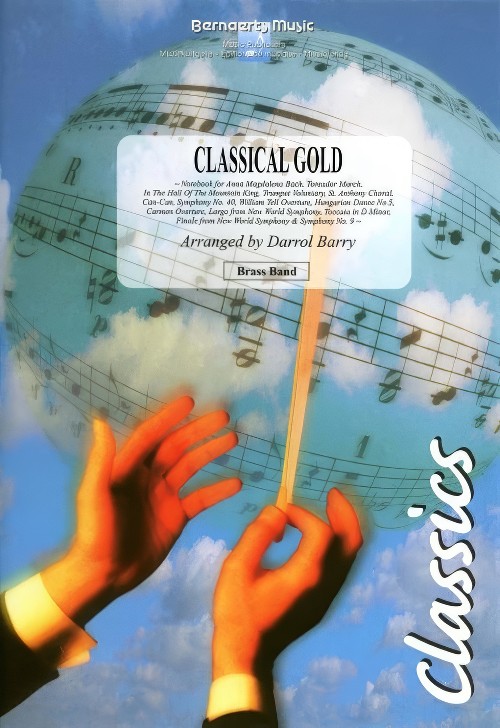
Classical Gold (Brass Band - Score and Parts) - Barry, Darrol
Including: Notebook For Anna Magdalena Bach, Toreador March, In The Hall Of The Mountain King, Trumpet Voluntary, St. Anthony Choral, Can-Can, Mozart's Symphony No. 40, William Tell Overture, Hungarian Dance No. 5, Carmen Overture, Largo From New World Symphony, Toccata In D Minor, Finale From New World Symphony & Beethoven's Symphony No. 9. Duration: 06:45
Estimated dispatch 7-14 working days
-
 £106.99
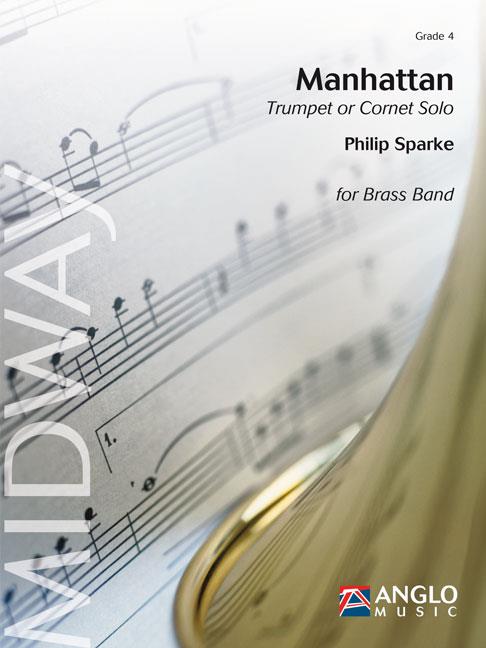
Manhattan (Cornet Solo with Brass Band - Score and Parts) - Sparke, Philip
Cornet or Trumpet Solo with Brass BandManhattan was commissioned by the United States Army Band for their solo cornet player Woodrow English and first performed by them in Carnegie Hall, New York, in November 2003. The two-movement work demonstrates both the lyrical and technical abilities of this outstanding player. The 'theme' is a weekend in New York and the opening bluesy movement, Saturday Serenade, describes the city on a Saturday night. While writing Sunday Scherzo, the composer pictured an early morning jog in Central Park. This vivaciously rhythmic second movement ends with an even quicker coda bringing the work to a brilliant close. Each movement can also be played individually when a shorter solo is required.Duration: 9:30
Estimated dispatch 7-14 working days
-
£74.99
Brilliant Beatles (Brass Band - Score and Parts) - Schaars, Peter Kleine
There have been many arrangements of Beatles' songs for various kinds of ensembles, so rather than just producing a further medley of Beatles' hits, Peter Kleine Schaars has added a new twist to them with this excellent new work. All You Need Is Love and With a Little Help from my Friends pass by in a swing march, Michelle sounds like a newly composed ballad and When I'm Sixty Four is played in Dixie swing style. A Hard Day's Night is transformed into a funk theme with a samba interlude, Let It Be into a slow march, and Ob-La-Di, Ob-La-Da in a rock beat. Experience The Beatles as you have never heard them before.Duration: 7:00.
Estimated dispatch 7-14 working days
-
 £44.95
Catnap (from Cats Tales) (Trombone Solo with Brass Band - Score and Parts) - Graham, Peter
Catnap?is part of Cats Tales which pays tribute to four wonderful musicians who shared a love of jazz and New York City. New York born George Gershwin provides the inspiration for?Catnap?which is a jazz "contrafact" treatment of one of his most familiar songs. (Features solo trombone).
Estimated dispatch 7-14 working days
 View Music