
Results
-
 £104.99
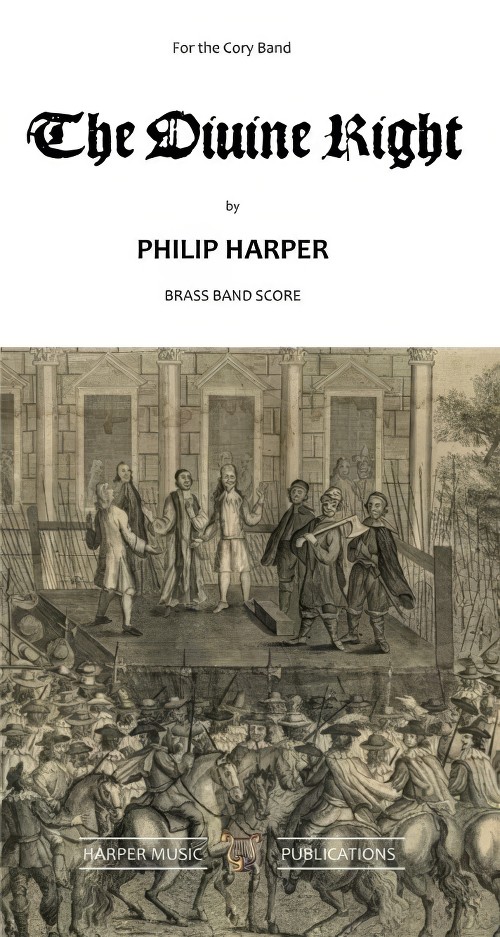
The Divine Right (Brass Band - Score and Parts) - Harper, Philip
At the time of composing this piece, the Arab Spring was sweeping through the Middle East. It seemed that almost every week a new country's people had risen up against the regimes and dictatorships which had prevailed for generations, leaving many nations at a defining crossroads in their history. There were so many possible ways ahead: so many hopes, yet so many uncertainties.This music is a depiction of these revolutionary times, and several musical themes are in turn presented, discussed, considered, fought over, altered, rejected or accepted.Most nations have had, or probably will have, their own Arab Spring, including the United Kingdom. Events of 17th Century Britain provide the context for this piece, particularly those following the execution of the tyrant King Charles I on 30 January 1649. The regicide was in part due to Charless steadfast belief in the Divine Right of Kings, and led to a tumultuous interregnum, where England stood at its own defining crossroads. The music begins turbulently, before King Charles appears and is led to the gallows outside Banqueting House in central London where he is brutally decapitated. From the assembled crowd rose, according to one observer,a moan as I never heard before and desire I may never hear again.The music descends to emptiness.The musical argument which follows is not strictly programmatic, but a number of musical themes are all thrown into the melting pot, representing ideas such as: religion; military force; reasoned Parliamentary debate; and the chattering, irrepressible voice of the people. Additionally, there are some quotations from the music of royalist composer Thomas Tomkins (1572-1656), who was often in tune with the feeling of the times.This defining episode in England's history was brought to a close with the Restoration of the monarchy in 1660, and as the exiled King Charles II rode back into London the diarist John Evelyn wrote:Never was so joyful a day seen in this nation. I stood in the Strand and beheld it, and blessed God.At the end of the piece the bells ring out, and the musical appearance of the King has transformed from turbulent to triumphant.Duration: 17.00
Estimated dispatch 7-14 working days
-
 £59.99
Salute to a Hero (Brass Band - Score and Parts) - Sparke, Philip
It is a tradition at Marlow High School, Oklahoma, that the band members' parents host a Band Banquet every May, at which the senior members of the band present a gift to the band director as a token of gratitude for his year's work. In 2009, clarinet player Brenna Hensley had the idea to commission a new piece from composer Philip Sparke to present to band director Billy Daniel, which would be played at the Spring Concert later that month. Salute to a Hero was the result. The piece opens with a decorated fanfare played on cornets and trombones and, after a short bridge passage, this reappears, played by the full band. A central lyrical section brings a mood of calm, utilising different brass colours, before the fanfare returns to close the work.Duration: 2:15
Estimated dispatch 7-14 working days
-
 £59.99
Old Hundredth (Brass Band - Score and Parts) - Sparke, Philip
The tune Old Hundredth is one of the best-known melodies in all Christian musical traditions and first appeared in the 1551 psalter "Pseaumes Octante Trois de David", where it is used as a setting for a version of Psalm 134; it is usually attributed to the French composer Louis Bourgeois (c.1510 - c.1560). The melody was then used in 1561 by the Scots clergyman, William Kethe in Sternhold and Hopkins' Psalter for his paraphrase of Psalm 100 All People that on Earth do Dwell, which is still the most familiar hymn sung to this noble tune. When Tate and Brady's "New Version of the Psalms" was published in 1696, the melody became know as the 'old' version - hence its current title. This arrangement presents three contrasting verses and is effective as a concert piece as well as an instrumental interlude as part of a church service or wedding.Duration: 2:30
Estimated dispatch 7-14 working days
-
 £89.95
Infinity (Brass Band - Score and Parts) - Redhead, Robert
In the post-modern age in which we live, 'absolutes' are difficult for many to comprehend. Yet infinity, which means absolute, total, all-embracing, having no limits or boundaries in time, space, extent, or magnitude, has always been central to the Christian's concept of God.Through the ages, as human understanding has grown, particularly at a remarkable rate from the latter part of the twentienth century, Christianity has been continually challenged to interpret traditional beliefs in the light of new discoveries, but always within the reality of the infinite Being. In addition, scripture tells us that 'humanity was made in God's image'. Humankind is part of God's creation and as such, responsible for its upkeep. Such a commission has never been more relevant than in this present age. Psalm 8 creates a great picture of the majesty, eternal, infinte quality of God and yet reveals the desire of God to share in spirit with humankind. It recognises humankind as being, not a tool of the infinite, but as a creative contributing part of the ongoing movement and activity of the infinite. The music is deliberately melodic in context, creating a sense of unity with the infinite, in tandem with the varying expressions of individuality. It is not based on the Psalm but reflects some of the sentiments lying therein. The 'hymn-like' theme expresses the nature of the Divine using the Old Testament image of the infinite God coming to finite humankind, not in the 'wind', the 'earthquake', the 'fire', but in the 'still small voice' of quietness (1 Kings 19: 11-13). The ensuing musical development, in different styles and patterns, expresses this continual link between infinite and finite. Thus the conclusion, rather than being a symbol of might, power and magnificence, reflects the same sentiment as the opening.
Estimated dispatch 7-14 working days
-
£44.95
Infinity (Brass Band - Score only) - Redhead, Robert
In the post-modern age in which we live, 'absolutes' are difficult for many to comprehend. Yet infinity, which means absolute, total, all-embracing, having no limits or boundaries in time, space, extent, or magnitude, has always been central to the Christian's concept of God.Through the ages, as human understanding has grown, particularly at a remarkable rate from the latter part of the twentienth century, Christianity has been continually challenged to interpret traditional beliefs in the light of new discoveries, but always within the reality of the infinite Being. In addition, scripture tells us that 'humanity was made in God's image'. Humankind is part of God's creation and as such, responsible for its upkeep. Such a commission has never been more relevant than in this present age. Psalm 8 creates a great picture of the majesty, eternal, infinte quality of God and yet reveals the desire of God to share in spirit with humankind. It recognises humankind as being, not a tool of the infinite, but as a creative contributing part of the ongoing movement and activity of the infinite. The music is deliberately melodic in context, creating a sense of unity with the infinite, in tandem with the varying expressions of individuality. It is not based on the Psalm but reflects some of the sentiments lying therein. The 'hymn-like' theme expresses the nature of the Divine using the Old Testament image of the infinite God coming to finite humankind, not in the 'wind', the 'earthquake', the 'fire', but in the 'still small voice' of quietness (1 Kings 19: 11-13). The ensuing musical development, in different styles and patterns, expresses this continual link between infinite and finite. Thus the conclusion, rather than being a symbol of might, power and magnificence, reflects the same sentiment as the opening.
Estimated dispatch 7-14 working days
-
£10.00
Infinity (Brass Band - Study Score) - Redhead, Robert
In the post-modern age in which we live, 'absolutes' are difficult for many to comprehend. Yet infinity, which means absolute, total, all-embracing, having no limits or boundaries in time, space, extent, or magnitude, has always been central to the Christian's concept of God.Through the ages, as human understanding has grown, particularly at a remarkable rate from the latter part of the twentienth century, Christianity has been continually challenged to interpret traditional beliefs in the light of new discoveries, but always within the reality of the infinite Being. In addition, scripture tells us that 'humanity was made in God's image'. Humankind is part of God's creation and as such, responsible for its upkeep. Such a commission has never been more relevant than in this present age. Psalm 8 creates a great picture of the majesty, eternal, infinte quality of God and yet reveals the desire of God to share in spirit with humankind. It recognises humankind as being, not a tool of the infinite, but as a creative contributing part of the ongoing movement and activity of the infinite. The music is deliberately melodic in context, creating a sense of unity with the infinite, in tandem with the varying expressions of individuality. It is not based on the Psalm but reflects some of the sentiments lying therein. The 'hymn-like' theme expresses the nature of the Divine using the Old Testament image of the infinite God coming to finite humankind, not in the 'wind', the 'earthquake', the 'fire', but in the 'still small voice' of quietness (1 Kings 19: 11-13). The ensuing musical development, in different styles and patterns, expresses this continual link between infinite and finite. Thus the conclusion, rather than being a symbol of might, power and magnificence, reflects the same sentiment as the opening.
Estimated dispatch 7-14 working days
-
£34.95
The New Born Babe (Brass Band - Score and Parts) - Broughton, Bruce
The chorale which forms the basis of this prelude dates from the sixteenth century and was used by J.S.Bach in his Cantata No.122, 'Das neugeborne Kinderlein'. On his score Bruce Broughton includes a translation by R. Rutledge of the words; 'There comes the true jubilee, what are we eternally lamenting? Look alive! It is a time for singing, for the Christ-child exorcises all sorrow'.
Estimated dispatch 7-14 working days
-
£17.50
The New Born Babe (Brass Band - Score only) - Broughton, Bruce
The chorale which forms the basis of this prelude dates from the sixteenth century and was used by J.S.Bach in his Cantata No.122, 'Das neugeborne Kinderlein'. On his score Bruce Broughton includes a translation by R. Rutledge of the words; 'There comes the true jubilee, what are we eternally lamenting? Look alive! It is a time for singing, for the Christ-child exorcises all sorrow'.
Estimated dispatch 7-14 working days
-
 £59.99
Ukrainian Bell Carol (Brass Band - Score and Parts) - Leontovych, Mykola Dmytrovich - Sparke, Philip
The Ukrainian Bell Carol is part of a large choral work entitled Shchedryk by the Ukrainian composer Mykola Dmytrovich Leontovych (1877-1921). The tune is an adaptation of an old 'shchedrivka', a song traditionally sung on Ukrainian New Year's Eve (January 13th) which hopes for good fortune in the year to come. The tune has since been the inspiration for at least four different Christmas carols, of which Carol of the Bells is the most famous. Philip Sparke has sourced the original Ukrainian melody to create this stirring arrangement.Duration: 3:00
Estimated dispatch 7-14 working days
-
 £59.99
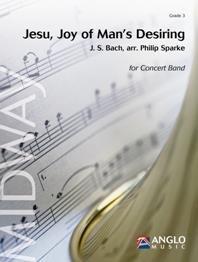
Jesu, Joy of Man's Desiring (Brass Band - Score and Parts) - Bach, Johann Sebastian - Sparke, Philip
Bach's appointment as the Cantor at Leipzig's Thomaskirche in 1723 required him to produce a new cantata for every Sunday service. Jesu, Joy of Man's Desiring is taken from his Cantata No.147 and is unusually elaborate, treated more like an aria than a chorale. It is perhaps the best-loved cantata movement from Bach's entire output and is a certain crowd pleaser for your concert programme.Duration: 2:45
Estimated dispatch 7-14 working days
 View Music