
Results
-
 £90.00
Another world's hell - Simon Dobson
Another World's Hell was commissioned in versions for brass, wind and fanfare bands by the Socit Cantonale des Musiques Vaudoises and the Association Cantonale des MusiquesNeuchteloises for the 2013 Swiss Cantonales festivals. It is inspired by a passage in Aldous Huxley's classic 1932 science-fiction novel Brave New World, which describes in unusually close detail themusic that is being played at a dance. This is Dobson's interpretation of the imagined 'future music' that Huxley dreamed of. Brass Band Grade 5Duration: 13 minutes
Estimated dispatch 5-14 working days
-
 £58.70
Into the Unknown - From Frozen II - Kristen Anderson-Lopez - Haakon Esplo
Composers Kristen Anderson-Lopez and Robert Lopez have once again written music for Disneys sequel film Frozen II after great success in 2013 with Frozen.Many will probably remember Let it Go which became a big hit from this movie.The new movie continue to follow the main character Elsa, who sings her amazing musical number "Into the Unknown" in Frozen II. The song describes Elsa's inner conflict of choice to leave Arendelle or trace the source of a mysterious voice she continues to hear.The song is originally sung by Idina Menzel and the Norwegian artist Aurora and has elements and motifs inspired by Scandinavian herding calls. As always, the music is both magnificent and captivating and will surely be a hit for many years to come.
Estimated dispatch 5-14 working days
-
 £52.50
Farewell With a Little Smile - Thomas Doss
A farewell can have many faces: sad, happy, content, grateful... This special piece was composed as a heart-warming gift for an exceptional musician upon retirement from his beloved music society. The work carries an important message: every farewell is also an opportunity for a new beginning; a moment to cherish with a little smile.This atmospheric work opens with subdued, warm brass sounds that create a sense of intimacy. Through alternating (smaller) instrumentations, it builds up to a sonorous tutti climax, eventually leading to a subdued mood again. The closing passage offers room for reflection, memories, and gratitude.Farewell With a Little Smile is a beautiful, solemn composition suitable for countless occasions. Whether the work serves as a resting point in a concert programme or is used to frame a meaningful farewell, this music will add lustre to numerous precious moments.
Estimated dispatch 5-14 working days
-
 £73.60
West of the Mississippi - Dean Jones
There's always a sense of adventure about America that makes it a really exciting topic to write about. The 3 States that sprang to mind in bringing a piece of music together were: California, Hawaii and Texas.We start out our American journey on the West Coast....California has provided much in the way of film and music for over 100 years. Combining this sense of free expression with the 'Surfing' culture, this initial section of the piece has an easy-going, fun feel in a pop idiom. Maybe wearing some shades might be quite a good look for this section!We move even further West now to the island of Hawaii where the free and easy goes onto a new level! The use of chromatics is a feature of Hawaiian melodies and has a feel a 'sliding' between notes that somehow sums up this feel of living on a tropical island! Have some fun with this section and have a Hawaiian garland to wear!Back into the USA mainland, and the fabulous state of Texas! Here we have the concept of the old fashioned rodeo and the 'Wild West'. Even today, the culture of horses, cowboys and tales of adventure are celebrated in places such as Fort Worth. The music captures some of these themes and has a fun and enjoyment...some get your Cowboy hats at the ready and enjoy the finale!
Estimated dispatch 5-14 working days
-
 £115.60
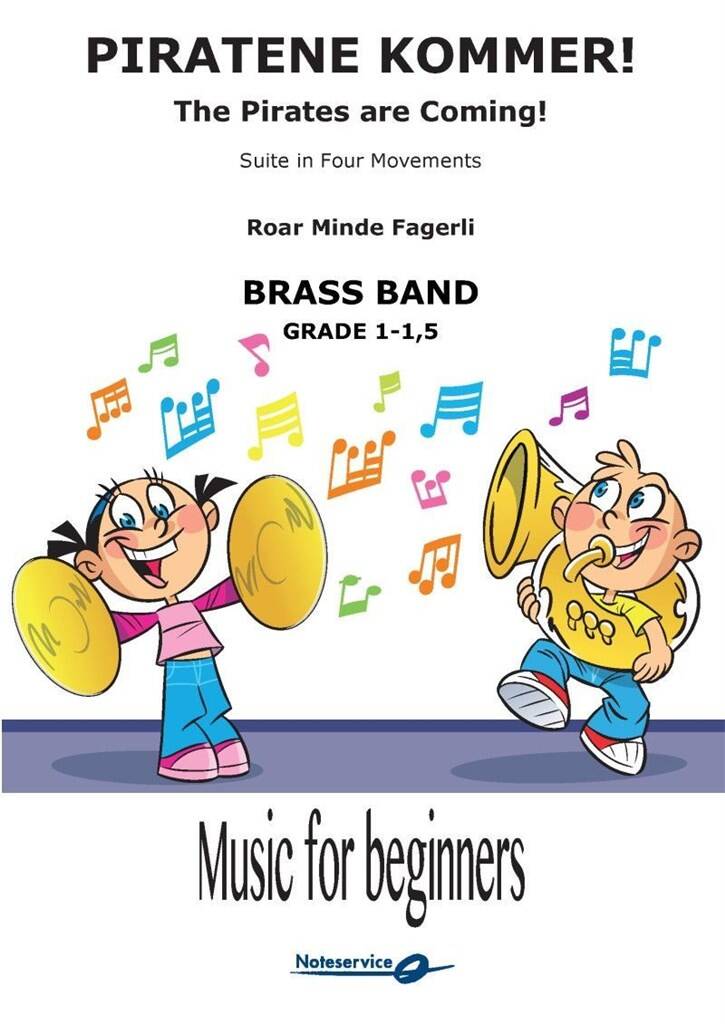
Piratene Kommer! - Roar Minde Fagerli
The Pirates are comming! is a four movement suite of music originally composed for a summer course arranged by The Norwegian Band Federation. The four movments describes the pirates tale. In the first movement they set the sails for new adventures. In the second movememt we meet the pirates early one morning when the sun rises. I the third movememt the pirates are looking for a treasure map at the Isle of the Dead. In the fourth and last movememt, they hunt the teasure! The Composer has been inspired by TV-series and films with pirate themes. The Music is written especially for beginners.
Estimated dispatch 5-14 working days
-
 £228.70
Fanfare and Chorale - Egil Hovland - Ray Farr
This arrangement (or edition) for brass band will give the possibility for more performances of this fine work by Hovland. The composer, before his death, examined my work and made no suggestions for changes, and his approving comments were complimentary and encouraging. The work was originally written for Concert Band in 1966 as Op. 54a to St. Olaf College Band in the US. It was transcribed in 1967 for symphony orchestra as Op. 54b by the composer himself. The challenges in arranging the piece for brass band were mostly concerned with satisfactorily covering the upper register used by piccolo, flutes and clarinets, and while there are wonderful brass players around who have amazing high registers, I have aimed this edition at a level achievable by reasonably good brass band players who are willing to give time and effort into the proper preparation and delivery of the music. Having worked on this new edition with a top-class brass band, I think it sounds wonderful and interestingly different to the original. Besides the obvious differences of tone-colour and absent high notes, I have used in my scoring, the option for using a vibraphone in place of a celeste. Vaughan Williams, in his Variations for brass band writes for celeste, but because the instrument is quite rare, performances have been mostly given using a glockenspiel- but this, of course sounds two octaves higher than it was intended. I think that vibraphone and brass is an excellent combination and recommend it without hesitation in this piece. Every detail of articulation and dynamic has been considered, so in order to keep the integrity of the music, please do not change anything in the name of "interpretation". As Ravel says- "What is there to interpret?" Ray Farr
Estimated dispatch 5-14 working days
-
 £164.99
Raveling Unraveling - Philip Sparke
Winning Performance EBBC Lille 2016 Raveling, Unraveling In Search of 'La Valse' was written for the Cory Band as their own-choice test piece for the 2016 European Brass Band Championships in Lille. The piece found its genesis in Sparke's The Unknown Journey (2014) for concert band, and the use of Ravel's La Valse as a structural undercurrent to the original piece is an act of reverence. Sparke's aim was to produce a work that is organic rather than episodic in nature. The composer's view is that little in music does this better than La Valse and for this reason he uses various sections of this masterpiece, both manipulated and quoted verbatim (including much of itsstunningclosing passages) to provide the overall geography of his new work. As the music progresses, more of the Ravel appears, surfacing completely as the piece reaches its climax - a gesture of homage to the French master.
Estimated dispatch 5-14 working days
-
£47.50
Fusion Factory - James L. Hosay
At the end of the Sixties and the beginning of the Seventies, slowly but surely, a new exciting music style arose in pop music. Pop groups enlarged the musical spectrum by combining jazz harmonies with rock 'n' roll rhythms. These experiments are now known as 'fusion'. Fusion Factory combines elements of early fusion with modern fusion sounds. Listen to the excellent result!
Estimated dispatch 5-14 working days
-
 £76.99
Animal Kingdom - William Vean
In this composition William Vean takes you on a journey through the fascinating and exciting world of animals. Apart from it being a composition filled with "special effects", Animal Kingdom contains many educational elements, such as playing inswing (triplets feeling), chromatics, flutter tonguing, gypsy tuning, varying keys, and, of course, dynamics and articulation. The melodic lines occur in all four voices, as well as in all percussion parts, providing each musician with theopportunity to play a solo or to accompany. Highly recommended for your youth band! William Vean is an educational composer. He knows how to musically shape the special elements from our daily lives. His music is therefore veryexpressive, containing creative solutions to possible problems. Special ways of playing make his music particularly interesting for the winds, but the percussion section is also featured in his special effects. The world of the animalsalways plays on ones imagination. In Animal Kingdom, William Vean has portrayed a number of animals in a special manner: Kevin Kangaroo - The jumping character of this animal can be heard in different voices. The swing style alsoemphasizes the characteristic movements of the kangaroo. Playing in swing style can be practised by using scales. Eddy Elephant - For some of his smaller fellow fauna friends this can be quite an ordeal, but for Eduard (Eddy for friendsand intimates) it is his daily walk. Baldrick Bat - Baldrick the Bat is a mysterious character. This can be heard in the fast moving valves and keys, accompanied by special effects in the percussion section. Curtis Camel - Curtisthe Camel trudges across the desert, feeling bored. The idea that the horizon will never change does not affect him anymore. He has accepted his fate. The distinctive tones from the gypsy scale provide the suitable oriental sounds. BettyButterfly - Butterfly Betty elegantly, and without worries, flutters from flower to flower in the garden. Her motto: Carpe Diem (Seize the Day). Betty is a one-day butterfly. Marvin Monkey - A "swing" monkey stirs up the feelings. Evenmembers of the orchestra will look like real monkeys. How about your audience? Each part has its own difficulties and challenges. Important in the first part is playing "in swing" (triplets feeling). This can be practised usingscales. In the second part ensemble playing and balance are important. In Baldrick additional information on the effects that have to be played might be useful. "New" sounds are, of course, welcome. Curtis the Camel introduces thegypsy scale. Additional explanation of the use of the scale might be useful. Key changes are interesting in this part. A slight accent on the first beat of the bar will add to the charm of this part. Marvin the Monkey brings back the swingrhythm that was introduced in the first part, alternated by a "straight" part with attention to chromatics and articulation. A story teller will definitely be an asset when performing this composition.
Estimated dispatch 5-14 working days
-
 £60.99
Latin Dance Party - William Vean
In 'Latin Dance Party' William Vean takes us along to sunny, seemingly care-free places. Happy faces, catchy music, delicious drinks are images that come to mind when listening to this 'feel good' music which will either get you in a dreamy mood or make you want to step out onto the dance floor. To start we hear the first dance of Cuban origin 'Cha Cha Cha', cheerful, romantic, playful dance . The Cha Cha Cha is probably the most popular dance. Then we have the slower 'Bossa Nova' (new wave), a dance developed from the Samba rhythms with strong syncopation. We end with the 'Samba'. Samba is party. The samba is a mix of polka, Cuban habanera and Africanrhythms, born around 1910 in the slums of Rio de Janeiro, and every year the leading dance during the exuberant carnival.
Estimated dispatch 5-14 working days
 View Music