
Results
-
 £33.20
Extinction:2100! (Brass Band) Joe Galuszka
Extinction:2100!, by Joe Galuszka, takes us on a journey to the present day and shows us the devastating impacts of climate change. With the world reaching crisis, we open with a reminder that the world has suffered in recent years from some of the most raging destruction of our plants and animal life, from wildfires. With the time left becoming smaller and smaller with each day passing, the piece reminds us next of the 'Tolling Bell of Extinction' before the conclusion takes us to a place all too familiar - the present - where with action and with a 'Call for Change', we can hopefully make a difference to our future, our children's future, and save our planet from devastation, from decimation, from extinction! To listen to an audio demo of the work please visit https://on.soundcloud.com/SjxKbnM1Q55hVXck7 Duration: approx. 4.30 mins Difficulty Level: 1st Section + PDF download includes parts and score. Sheet music available from www.brassband.co.uk (UK) or https://satradecentral.org (USA) Instrumentation: Soprano Cornet Eb Solo Cornet Bb Repiano Cornet Bb 2nd Cornet Bb 3rd Cornet Bb Flugel Horn Bb Solo Horn Eb 1st Horn Eb 2nd Horn Eb 1st Baritone Bb 2nd Baritone Bb 1st Trombone Bb 2nd Trombone Bb Bass Trombone Euphonium Bb Bass Eb Bass Bb Timpani Percussion 1-3
In Stock: Estimated dispatch 1-3 working days
-
 £15.00
Pomp and Circumstance No. 1 (Land of Hope and Glory) - Elgar
Performance Notes by Andrew Duncan:This fine march theme is arranged in two distinct parts.From the beginning up to two bars before letter C the melody is played quietly with the Horns carrying the tune - the Horns have to play up to a high F in this section. If this is not something that your band can manage then you have two options of where you can start playing the arrangement from.If your band can manage the chromatic notes, then begin playing from two bars before letter C. Alternatively, simply start playing directly from letter C .The musical concepts of Rallentando and A tempo are encountered in this arrangement. These can be difficult concepts for inexperienced players to grasp, so playing this arrangement should help to establish this technique.The Flexi-Collection ApproachFlexible scoring tailored to your needs - A perfect solution for expanding the repertoire of training and junior brass bands. The Flexi-Collection currently offers two series - Popular Classics and World Tour. Based on four-part harmony, these collections provide groups with the advantage of complete flexibility when they may not be balanced. If players or instruments are missing, the show can still go on!The Flexi-Collection - Popular Classics Series, encapsulates all that is great about the wonderful range of musical styles produced by Holst, Elgar, Handel, Verdi, Tchaikovsky, Grieg, Bizet and Parry.The thoughtful scoring and arranging by Andrew Duncan now means that groups of all abilities have access to a truly flexible set of music for their needs. With world parts, rudimentary theory, terminology translations and large format typesetting, The Flexi-Collection ticks all the boxes when it comes to bringing interesting music to the training and junior band/brass group environment.Available individually or as part of the money-saving Flexi-Collection Popular ClassicsAlbum.Scored for Brass Band and supplied with additional Easy Bb, Easy Eb and world parts - The Flexi-Collection offers flexibility in every sense of the word.
In Stock: Estimated dispatch 3-5 working days
-
 £87.95
Masquerade (Score and Parts)
The first performance took place on the 4th. September 1993 at the Free Trade Hall in Manchester during the British Open Brass Band Championships.Note by Philip Wilby:Masquerade is a centenary tribute to Verdi's last opera Falstaff and takes its final scene as the basis for my own piece. Thus I have used some of Verdi's music, and some of Shalespeare's plot, and woven them into a fabric with highly demanding music of my own to produce a work in the great tradition of operatically-based brass band pieces. Such scores date from the very beginnings of band repertory and are often not direct arrangements in the established sense but new compositions produced in homage to a past master. They may still offer performers and audience alike something familiar interwoven with something new. My own piece reuses some elements from the original story: . .Falstaff has been caught in a web of his own lies by the ladies of the town, who propose to teach him a lesson. The story opens at night in Windsor Great Park. The plotters, variously disguised in Hallowe'en fashion (as fairies,elves hobgoblins etc!) assemble in the park to await Falstaff's arrival (musicologists will, perhaps, note a rare use of 'large bottle in F' being used during this scene of suppressed alcoholic revelry!). Falstaff's companions, Bardolph,Piston and Robin, enter (represented here by the three trombones!), and are variously abused by the masqueraders. At the height of the Tout an alarm sounds and Falstaff (euphonium cadenza) enters as Midnight strikes. From a safe hiding place he watches as the disguised Nanetta (principal comet) sings a serene solo as the moon appcars above the trees. With sudden force the others seize him and drag him from his hiding place. As in the traditional game 'Blind Man's Buff', he is roughly turned seven times (a sequence of solo accelerandi) until, at last, he recognizes his assailants as his sometime friends. Far from complaining, Verdi's character concludes the opera with a good-humoured fugue on the words.... 'All the World's a Joke... Every mortal laughs at the others, But he laughs best who has the final laugh. Philip Wilby.
Estimated dispatch 7-14 working days
-
 £44.95
Masquerade (Score Only)
The first performance took place on the 4th. September 1993 at the Free Trade Hall in Manchester during the British Open Brass Band Championships.Note by Philip Wilby:Masquerade is a centenary tribute to Verdi's last opera Falstaff and takes its final scene as the basis for my own piece. Thus I have used some of Verdi's music, and some of Shalespeare's plot, and woven them into a fabric with highly demanding music of my own to produce a work in the great tradition of operatically-based brass band pieces. Such scores date from the very beginnings of band repertory and are often not direct arrangements in the established sense but new compositions produced in homage to a past master. They may still offer performers and audience alike something familiar interwoven with something new. My own piece reuses some elements from the original story: . .Falstaff has been caught in a web of his own lies by the ladies of the town, who propose to teach him a lesson. The story opens at night in Windsor Great Park. The plotters, variously disguised in Hallowe'en fashion (as fairies,elves hobgoblins etc!) assemble in the park to await Falstaff's arrival (musicologists will, perhaps, note a rare use of 'large bottle in F' being used during this scene of suppressed alcoholic revelry!). Falstaff's companions, Bardolph,Piston and Robin, enter (represented here by the three trombones!), and are variously abused by the masqueraders. At the height of the Tout an alarm sounds and Falstaff (euphonium cadenza) enters as Midnight strikes. From a safe hiding place he watches as the disguised Nanetta (principal comet) sings a serene solo as the moon appcars above the trees. With sudden force the others seize him and drag him from his hiding place. As in the traditional game 'Blind Man's Buff', he is roughly turned seven times (a sequence of solo accelerandi) until, at last, he recognizes his assailants as his sometime friends. Far from complaining, Verdi's character concludes the opera with a good-humoured fugue on the words.... 'All the World's a Joke... Every mortal laughs at the others, But he laughs best who has the final laugh. Philip Wilby.
Estimated dispatch 7-14 working days
-
 £30.00
Russian Rag - George L Cobb, Sandy Coffin
Interpolating the world famous"Prelude" by RachmaninoffCommissioned by John Wallace, this arrangement of Russian Rag has been crafted by Sandy Coffin through close listening of the available recordings of the Harlem Hellfighters Band. Sandy had been heavily involved with the Historic Brass Society symposium 2017 held in New York and assisted John with his research on this fascinating band and the style of music it generated.Eye-witness accounts refer to the 369th band 'dancing' rather than 'marching'. Above all, in modern performance, finding a 'dancing beat' is crucial to a successful performance of this Ragtime march in order to do justice to the great pioneering work of James Reese Europe. Note the cheeky virtuosity and rubato!Look and Listen (courtesy of Tullis Russell Mills Band):Background to the Harlem HellfightersThe US Army 369th Regiment, made up largely of African-Americans from New York, became known as the Harlem Hellfighters because of the heroic reputation which accrued to them during the actions they engaged in during the First World War in Europe.James Reese Europe was one of the most active African-American composer/musical directors in the pre-war American music scene. The legendary Harlem Hellfighters Band, which he assembled in 1917 from African-American and Puerto Rican musicians, came at an important transitional point in musical history. A new form of music called jazz was emerging from Ragtime and the performing style of Europe's band was immersed in the flow of this new direction.Europe's Harlem Hellfighters influenced and inspired everyone who heard them, including the welcoming crowd when they disembarked in France, bowled over by their swinging rendition of La Marseillaise. Reese Europe became a war hero, commanding a machine-gun unit as well as the band.On return from War in 1919 the band led a ticker-tape parade along Fifth Avenue in New York and soon made about 30 shellac recordings. These recordings display some of the fingerprints of their performing style: ragging, improvising, muting, wailing, smearing (their word for glissando) - and from the evidence of their recordings they took the printed page as a blueprint for individuality.In May 1919 during the Hellfighters' triumphant coast-to-coast tour after their return, James Reese Europe was tragically murdered, bringing to premature close, at the age of 39, the work of a great musical innovator.
In Stock: Estimated dispatch 3-5 working days
-
 £34.95
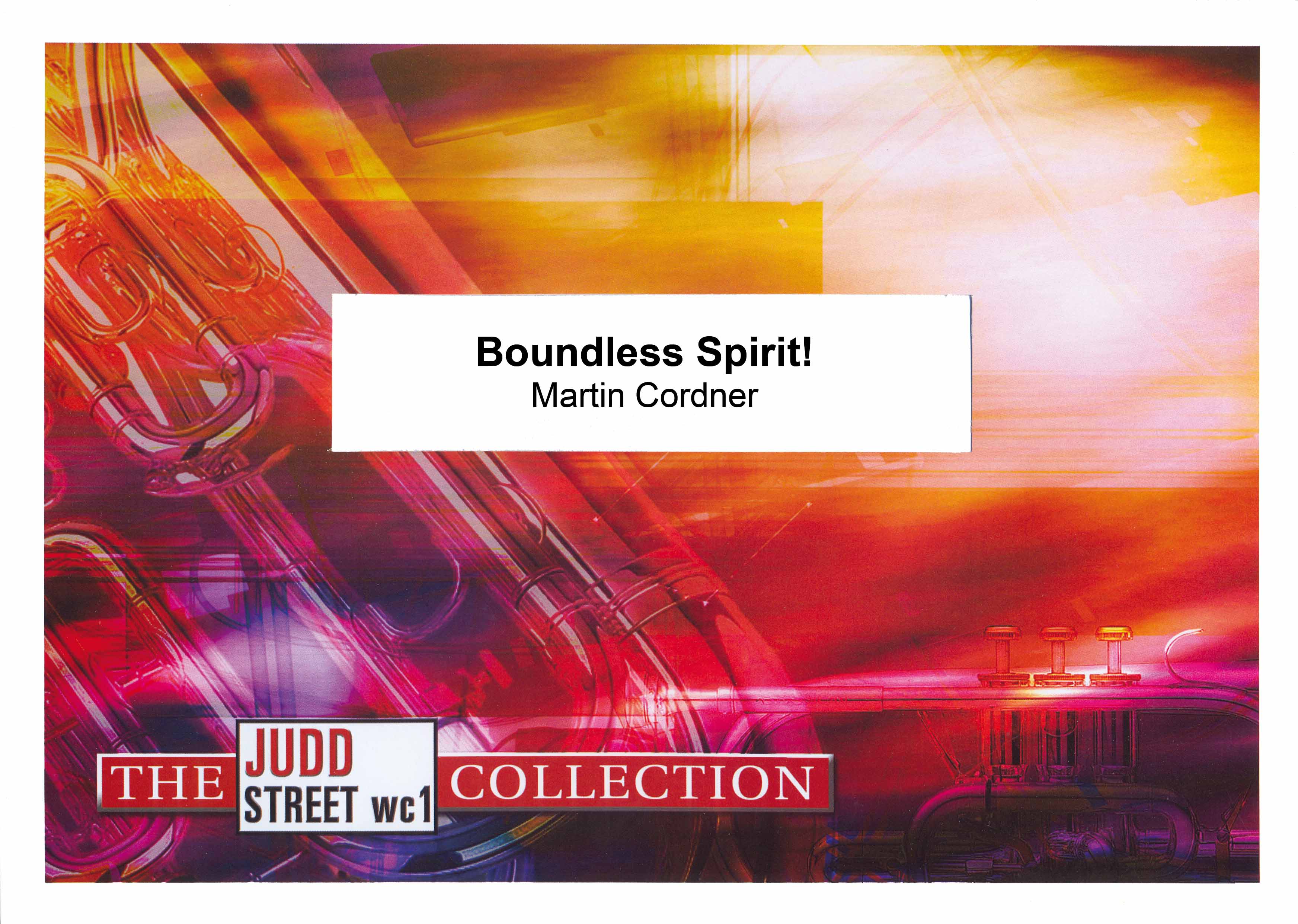
Boundless Spirit (Brass Band - Score and Parts)
This medley contains highlights from music the composer wrote for the opening event of Boundless, The Salvation Army's International Congress held at London's O2 Arena in 2015. The work features original melodies but also recognisable tunes with a global flavour; Moscow (T.B. 198), Europe (T.B. 367), Calabar (T.B. 362), They shall come from the east (T.B. 887), The world for God (T.B. 876) and Happy Song (T.B. 644) which calls to mind the words 'There's salvation for the world'. The objective of the piece is to celebrate the diversity of The Salvation Army around the world through a variety of music styles.
Estimated dispatch 7-14 working days
-
 £95.00
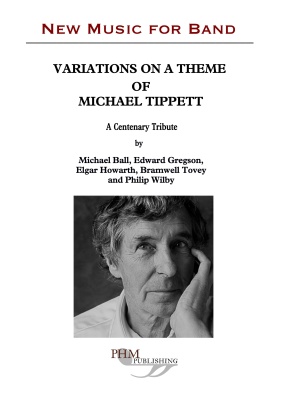
Variations on a Theme of Michael Tippett (Brass Band - Score and Parts)
A Centenary Tribute by Michael Ball, Edward Gregson, Elgar Howarth, Bramwell Tovey and Philip WilbyThis unique 'pice d'occasion' arose out of a telephone conversation in 2004 with Alan Wycherley, who was the soprano cornet player of the Foden's Richardson Band at the time. He indicated that the band would like to include an original birthday tribute for Edward Gregson (60) and Elgar Howarth (70) in its concert at the 2005 RNCM Festival of Brass in Manchester. I have been Artistic Director of Manchester's Festival of Brass since it was established in 1990 as a BBC Radio 3 series, As the centenary of the birth of Sir Michael Tippett fell on 5 January 2005, I devised this collective work as a way of embracing all three anniversaries in a novel way.The idea of joint compositions is not a new one in the classical music world. In the 1860s, Verdi was joined by a number of his contemporaries in a Requiem Mass for Rossini. In this country there have been a number of orchestral examples over the past fifty years, but never before for the brass band. Although Tippett composed only one work for brass band, Festal Brass with Blues, his orchestral works and operas are full of idiomatic brass writing. The theme I chose for this celebration is one of Tippet's most memorable miniatures featuring wind and brass. In the opera Midsummer Marriage it marks the entry of the Ancients. It is also included in the orchestral Suite in D (1948), for the Birthday of Prince Charles.I invited five of the leading contemporary voices in brass band music to add their own creative perspectives to the little Tippett theme, with it's characteristic rhythms, embellishments and modality - the Lydian mode. Each contribution was designed to fit into a tonal and formal template to give the whole work a flow and continuity. In Danse des Amis, Bramwell Tovey has composed a jazzy, humorous variation. Inspiration came from Tippett's love of jazz and, more personally, from the characteristically syncopated gait of the distinguished music critic John Amis, who Tovey once observed leaving a performance of Tippett's opera King Priam before the end. Incidentally, that performance was conducted by Elgar Howarth.We hear Edward Gregson in lyrical mode. His Midsummer Song is redolent of the sound world of Tippett's opera A Midsummer Marriage and it ends with a brief reference to a favourite of Gregson's, Tippett's Concerto for Orchestra. Michael Ball provides a brief moment of light, airy activity bringing to mind perhaps Tippett's love of Shakespearian fantasy, especially The Tempest. Elgar Howarth juxtaposes a slowed down version of the processional theme with distant recollections of fanfares from King Priam. Philip Wilby has rounded the tribute off with a spectacular fugue. During its inexorable progress Wilby ingeniously introduces the two other birthday references - the three-note musical signature that Elgar Howarth includes in much of his music and the characteristic theme which begins Edward Gregson's substantial work for brass an organ The Trumpets of the Angels. An elaborated reprise of Tippett's little theme is followed by a dynamic coda.- Paul HindmarshDuration: 13.00
Estimated dispatch 7-14 working days
-
£40.00
Variations on a Theme of Michael Tippett (Brass Band - Score only)
A Centenary Tribute by Michael Ball, Edward Gregson, Elgar Howarth, Bramwell Tovey and Philip WilbyThis unique 'pice d'occasion' arose out of a telephone conversation in 2004 with Alan Wycherley, who was the soprano cornet player of the Foden's Richardson Band at the time. He indicated that the band would like to include an original birthday tribute for Edward Gregson (60) and Elgar Howarth (70) in its concert at the 2005 RNCM Festival of Brass in Manchester. I have been Artistic Director of Manchester's Festival of Brass since it was established in 1990 as a BBC Radio 3 series, As the centenary of the birth of Sir Michael Tippett fell on 5 January 2005, I devised this collective work as a way of embracing all three anniversaries in a novel way.The idea of joint compositions is not a new one in the classical music world. In the 1860s, Verdi was joined by a number of his contemporaries in a Requiem Mass for Rossini. In this country there have been a number of orchestral examples over the past fifty years, but never before for the brass band. Although Tippett composed only one work for brass band, Festal Brass with Blues, his orchestral works and operas are full of idiomatic brass writing. The theme I chose for this celebration is one of Tippet's most memorable miniatures featuring wind and brass. In the opera Midsummer Marriage it marks the entry of the Ancients. It is also included in the orchestral Suite in D (1948), for the Birthday of Prince Charles.I invited five of the leading contemporary voices in brass band music to add their own creative perspectives to the little Tippett theme, with it's characteristic rhythms, embellishments and modality - the Lydian mode. Each contribution was designed to fit into a tonal and formal template to give the whole work a flow and continuity. In Danse des Amis, Bramwell Tovey has composed a jazzy, humorous variation. Inspiration came from Tippett's love of jazz and, more personally, from the characteristically syncopated gait of the distinguished music critic John Amis, who Tovey once observed leaving a performance of Tippett's opera King Priam before the end. Incidentally, that performance was conducted by Elgar Howarth.We hear Edward Gregson in lyrical mode. His Midsummer Song is redolent of the sound world of Tippett's opera A Midsummer Marriage and it ends with a brief reference to a favourite of Gregson's, Tippett's Concerto for Orchestra. Michael Ball provides a brief moment of light, airy activity bringing to mind perhaps Tippett's love of Shakespearian fantasy, especially The Tempest. Elgar Howarth juxtaposes a slowed down version of the processional theme with distant recollections of fanfares from King Priam. Philip Wilby has rounded the tribute off with a spectacular fugue. During its inexorable progress Wilby ingeniously introduces the two other birthday references - the three-note musical signature that Elgar Howarth includes in much of his music and the characteristic theme which begins Edward Gregson's substantial work for brass an organ The Trumpets of the Angels. An elaborated reprise of Tippett's little theme is followed by a dynamic coda.- Paul HindmarshDuration: 13.00
Estimated dispatch 7-14 working days
-
 £33.00
A Hebridean Lullaby (Score and Parts)
Composed for World Solo Champion Katrina Marzella and the Cornwall Youth Brass Band, A Hebridean Lullaby is a beautiful and haunting melody from the pen of Philip Harper, taking its inspiration from the music and folksong of the Hebrides; a cluster of islands off the west coast of Scotland. Commissioned through a BBC Fame Academy Bursary, this piece is one which is enjoyed and admired by both performers and audiences the world over. The atmosphere created by the score is simply stunning. It's an outstanding addition to the baritone horn's concert repertoire.
Estimated dispatch 7-14 working days
-
 £20.00
A Hebridean Lullaby (Score Only)
Composed for World Solo Champion Katrina Marzella and the Cornwall Youth Brass Band, A Hebridean Lullaby is a beautiful and haunting melody from the pen of Philip Harper, taking its inspiration from the music and folksong of the Hebrides; a cluster of islands off the west coast of Scotland. Commissioned through a BBC Fame Academy Bursary, this piece is one which is enjoyed and admired by both performers and audiences the world over. The atmosphere created by the score is simply stunning. It's an outstanding addition to the baritone horn's concert repertoire.
Estimated dispatch 7-14 working days