
Results
-
 £39.95
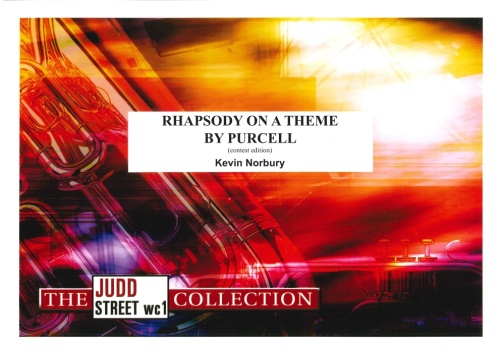
Rhapsody on a Theme by Purcell (Brass Band - Score only)
Contest VersionIn his relatively short lifetime, Henry Purcell (1659 -1695) achieved stellar musical success and was known and admired internationally by his contemporaries. He is justifiably considered one of England's greatest composers.I thought long and hard before using this magnificent theme as the basis for a band piece because I think that Benjamin Britten has said just about everything possible regarding it in his The Young Person's Guide to the Orchestra. Bearing this in mind, I tentatively set about working on this composition. Once started though, the job became fun because the theme still yielded possibilities - even after Britten!The piece is basically a set of linked variations, much like Rachmaninov's great Rhapsody on theme by Paginini. The music starts slowly and makes much use of crisply dotted rhythms - a Purcellian characteristic. The theme is heard twice before the music changes into a jaunty duple time variation based on the opening motif of Purcell's theme. After this, the mood changes to a waltz-like variation in which clear references to the original theme can be heard. The slow movement follows, and is based on rising and descending scalic figures. This variation is an 'A-B-A' movement with two similar passages framing a more vigorous middle section which features antiphonal fanfare-like figures. Without any preamble, the last variation launches itself - a rumbustious dance which has a distinctive feel to it.The theme eventually reappears as a counter-melody to this dance music before a final triumphant treatment of the melody featuring a somewhat athletic bass line. The music accelerates at the Coda and disappears in a 'puff of smoke'.- Kevin Norbury
Estimated dispatch 7-14 working days
-
 £96.99
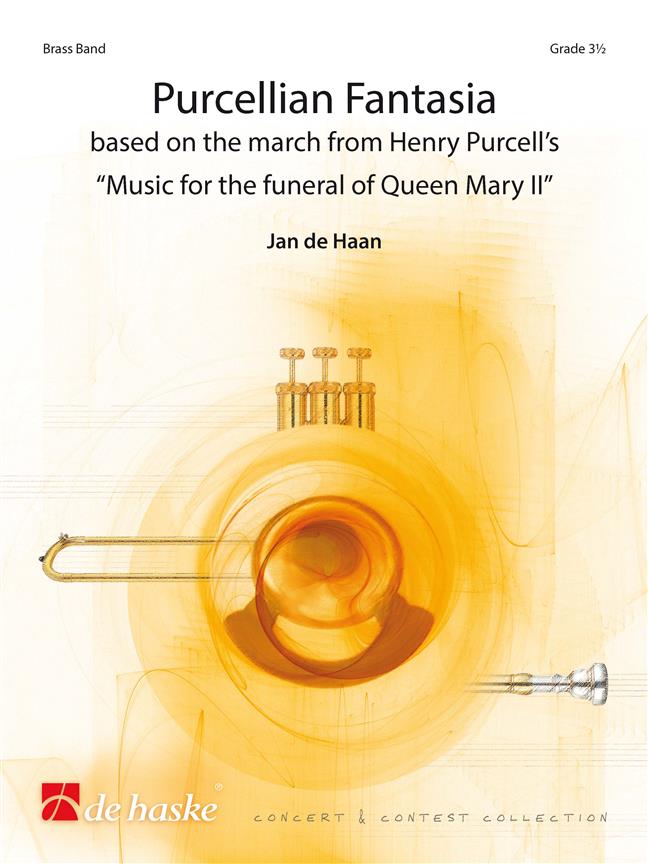
Purcellian Fantasia (Brass Band - Score and Parts)
This composition is based on the march from Henry Purcells Music for the funeral of Queen Mary II, a work written in 1694. In this fantasia, various movements flow from one to the next following the main theme; these movements not only elaborate on the theme, but also contrast with it. At times, the thematic material diverges so much, that the work acquires a character of its own; however, the composer often refers back to fragments of the theme. This work was test piece in the 4th division of the Dutch National Brass Band Championships (NBK) in 2017. Duration: 10.30
Estimated dispatch 7-14 working days
-
 £168.50
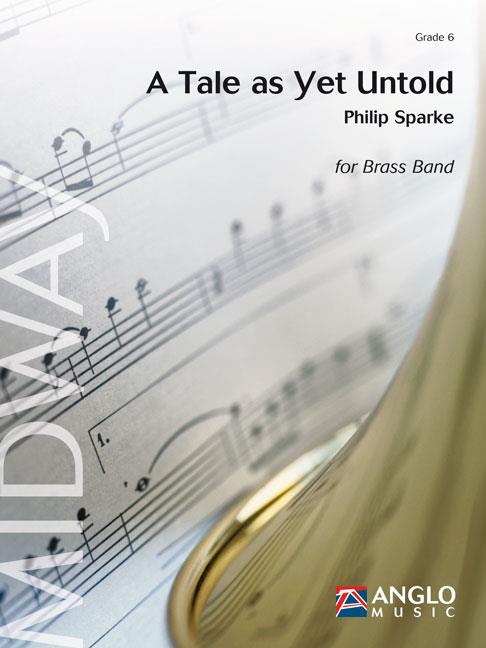
A Tale as Yet Untold (Brass Band - Score and Parts)
2013 Butlins Championship Section. Score and Parts.A Tale as Yet Untold was commissioned by the Cory Band for the European Brass Band Championships in Linz, Austria, 2010, and their winning performance gave them a hattrick of victories at the competition. The theme of this impressive work, which is set in three movements, is one that recurs again and again throughout the music of Philip Sparke, the power of the human spirit to overcome adversity and how the beauty of music can help in this respect.Grade: AdvancedDuration 14:00
Estimated dispatch 7-14 working days
-
 £49.99
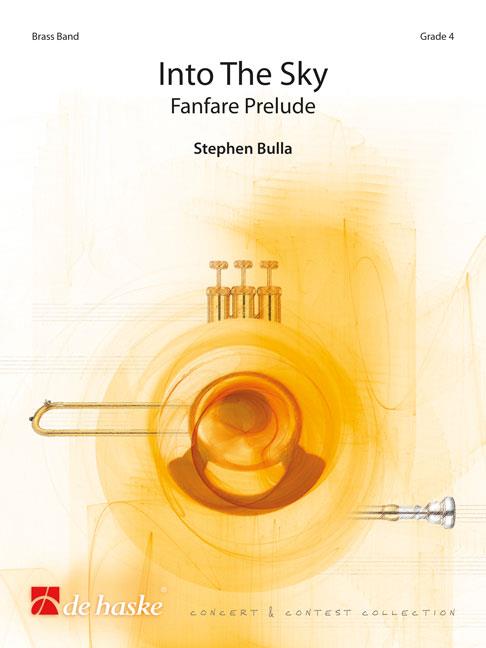
Into the Sky (Brass Band - Score and Parts)
This music is a fanfare prelude that is designed to open concert programs with an impressive display of brass fireworks. It features every section of the band and reflects a modern spin on the style of the great Strauss fanfares for brass from the past.
Estimated dispatch 7-14 working days
-
 £120.00
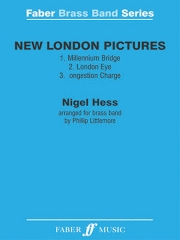
New London Pictures (Brass Band - Score and Parts)
New London Pictures represents elements of London in the 21st Century. The Millennium Bridge describes the pedestrians journey across this wonderful new landmark bridge over the Thames, starting at the imposing Tate Modern, crossing the busy river, and onwards to St. Pauls Cathedral with its bells ringing out over the great city. London Eye is an incredibly large ferris wheel situated on the South Bank of the River Thames. This movement depicts a flight on this riverside wheel, at the top of which the panoramic view of London is breath-taking and the expanse of the music is a suitable depiction of the view. As with all modern cities, London is over-crowded with motor vehicles. London is the first major city in Europe to adopt a Congestion Charge, and this piece (with its stop and go traffic lights) is both racy and comical. Here are Londoners attempting to go about their business in the face of overwhelming odds..... Suitable for Premier Youth/2nd Section Bands and above. Duration: 15.00
Estimated dispatch 7-14 working days
-
 £44.99
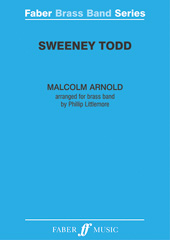
Sweeney Todd (Brass Band - Score and Parts)
Malcolm Arnolds ballet, Sweeney Todd, was first staged in 1959 by The Royal Ballet Company with choreography by John Cranko. The music was later adapted as a concert work and it is from this version that this brass band arrangement, by Phillip Littlemore, is made. The original concert suite lasts some 20 minutes, but this version has been shortened to a more manageable eight minutes. The first performance of this arrangement was given on the 22nd October 2006 at the Malcolm Arnold Festival, Derngate, Northampton by the Rushden Windmill Band conducted by Richard Graves. Suitable for Advanced Youth/3rd Section Bands and above. Duration 8:00
Estimated dispatch 7-14 working days
-
 £44.95
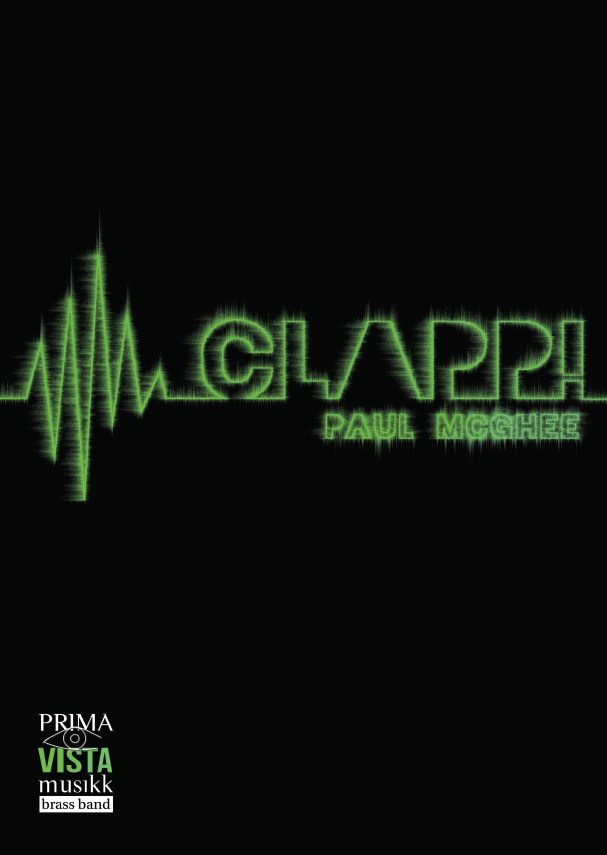
Clapp!!! (Brass Band - Score and Parts)
'Clapp!!!!' was originally written in 2006 whilst studying at the Royal Welsh College of Music and Drama and was written for two players at one piano. The music uses rhythmic phasing with each rhythm assigned it's own tone cluster - as each shift in rhythm occurs the harmonic structure is altered too. Melodic passages are created through the shifts in rhythm and harmony, but these only occur within the given rhythmic parameters. The music can very much be viewed as a study in momentum, with its unrelenting pulse driving us through the music.The Brass Band version of 'Clapp!!!!' was written for Manger Musikklag and Torstein Aagaard-Nilsen, receiving its premiere at the 2010 BrassWind Festival in Bergen, Norway. The Whitburn Band featured Clapp!!!! at their 2012 Brass in Concert programme and the piece was featured by the Grimethorpe Colliery Brass Band on their 'Grimethorpe Entertain' CD.
Estimated dispatch 7-14 working days
-
 £33.62
'Mid all the traffic (Brass Band) Traditional arr. Andy Wareham
This stunning arrangement by British composer Andy Wareham is of the popular hymn 'Mid all the Traffic, which marries the North-American folksong Shenandoah set to lyrics by English journalist, novelist and poet William Arthur Dunkerley (written under the pseudonym of 'John Oxenham'). The hymn is very well-regarded in both the Salvation Army and wider brass band movement thanks to a popular arrangement by renowned Salvationist composer Leonard Ballantine. The arranger writes: 'This setting of 'Mid All The Traffic was originally composed during the Covid-19 pandemic as an octet arrangement for single instrument. My hope was to create an arrangement that offers an alternative view on harmony and could be multi-track recorded; allowing performers to give, and share, a performance whilst in isolation. The music was written in dedication to all of the 'key-workers' in the UK, especially in the NHS, who worked tirelessly throughout difficult conditions during the Covid-19 pandemic.' To view a follow-the-score video of the work please visit https://www.youtube.com/watch?v=naajvdsg9Wo PDF download includes score and parts. Sheet music available from: UK - www.brassband.co.uk USA - www.solidbrassmusic.com Difficulty Level: 3rd Section + Instrumentation: Soprano Cornet Eb Solo Cornet Bb Repiano Cornet Bb 2nd Cornet Bb 3rd Cornet Bb Flugel Horn Bb Solo Horn Eb 1st Horn Eb 2nd Horn Eb 1st Baritone Bb 2nd Baritone Bb 1st Trombone Bb 2nd Trombone Bb Bass Trombone 1st Euphonium Bb 2nd Euphonium Bb Bass Eb Bass Bb Bass Drum Suspended Cymbal
In Stock: Estimated dispatch 1-3 working days
-
 £48.56
Angel Voices (Rhapsody for Soprano Cornet & Band) Brian Bowen
This solo for soprano cornet and brass band was written by the late Brian Bowen for the New York Staff Band in 1989 when Gordon Ward was its very fine soprano cornetist. The title comes from a song by Ernest Rance (music) and Reginald Woods (lyrics) published by The Salvation Army in 1955. In this rhapsody Rance's melody is first alluded to by the horns at the pick-up to bars 19-21, then more fully with the soloist's entry to bar 51 (but in minor mode until bar 55). Much of the original music is ethereal in nature, maybe reflecting the angelic hosts. Published by BrookWright Music in 2023, the score now carries the inscription 'To the memory of Linda Ward' - Gordon Ward's wife who very sadly died in November 2021. The first commercial recording of the rhapsody was released in 1990, performed by Gordon Ward and the New York Staff Band on its Music Makers CD (TRCD 1049), available to listen to here: https://on.soundcloud.com/nHch1 PDF download includes score and parts. Sheet music available from: UK - www.brassband.co.uk USA - www.solidbrassmusic.com Difficulty Level: 2nd Section + Instrumentation: Soprano Cornet Soloist Eb Solo Cornet Bb Repiano Cornet Bb 2nd Cornet Bb 3rd Cornet Bb Flugel Horn Bb Solo Horn Eb 1st Horn Eb 2nd Horn Eb 1st Baritone Bb 2nd Baritone Bb 1st Trombone Bb 2nd Trombone Bb Bass Trombone Euphonium Bb Bass Eb Bass Bb Percussion
In Stock: Estimated dispatch 1-3 working days
-
 £33.62
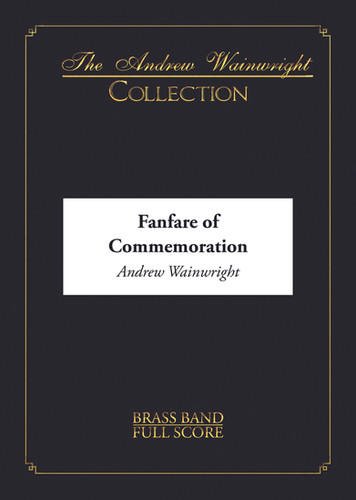
Fanfare of Commemoration - Brass Band (Andrew Wainwright)
Commissioned by The Illinois Brass Band for its 25th anniversary celebrations in 2016, this spectacular fanfare by Andrew Wainwright provides a stirring opener to your band's concert. Includes score and full set of parts. Sheet music available exclusively from World of Brass - www.worldofbrass.com To view a video of Austin Brass Band performing the work please visit www.youtube.com/watch?v=g3WpXzS6I10 Difficulty Level: 1st Section + Instrumentation: Soprano Cornet Eb Solo Cornet Bb Repiano Cornet Bb 2nd Cornet Bb 3rd Cornet Bb Flugel Horn Bb Solo Horn Eb 1st Horn Eb 2nd Horn Eb 1st Baritone Bb 2nd Baritone Bb 1st Trombone Bb 2nd Trombone Bb Bass Trombone Euphonium Bb Bass Eb Bass Bb Timpani Percussion 1-3
In Stock: Estimated dispatch 1-3 working days
 Watch video