
Results
-
 £31.95
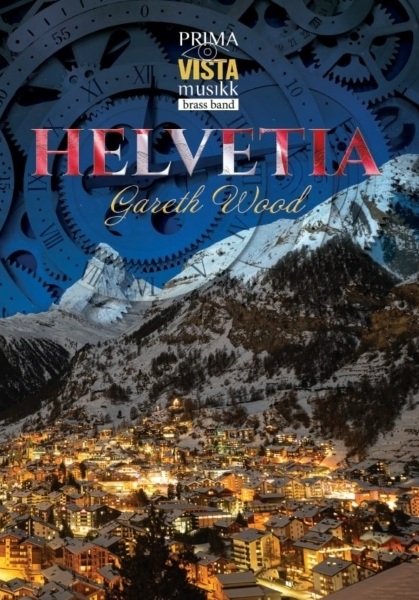
Helvetia (Brass Band - B4 Score only) - Wood, Gareth
I first went to Switzerland in the early 1970's and regularly played at the Lucerne Festival with the Royal Philharmonic Orchestra. It is a beautiful city, one of my favourite European cities.In writing Helvetia (the Roman name for Switzerland) I wanted to encapsulate the moods that remind me of this wonderful place. The work is in four distinct sections and is on the whole, self-explanatory.It opens with An Alpine Dawn and sunrise, the tubas and euphoniums substituting for the Swiss Alphorns. Next The Clock Shop at Mid-day, a loud ticking, chiming and the sad sound of a cuckoo, builds into the cacophony of the mid-day chimes. The third section is A Walk to Wagner's House. Just along the lake from the centre of town is Tribschen. This walk I have done many times, and it is here that Wagner wrote 'Tristan'. I have quoted the Dresden Amen (written by J.G. Naumann) which is much used in Parsifal. The final section is The Cesta Run, the most famous bob-sleigh run in the world. As we take each corner, the feeling of speed is demonstrated as only a brass band can do!The work is dedicated to the Cory Band and also to the memory of James Watson, a great cornet player, trumpeter and conductor. It was he who got me into writing for brass band and I hope this piece is worthy.- Gareth Wood (Feb. 2011)Duration: 11.00
Estimated dispatch 7-14 working days
-
 £74.95
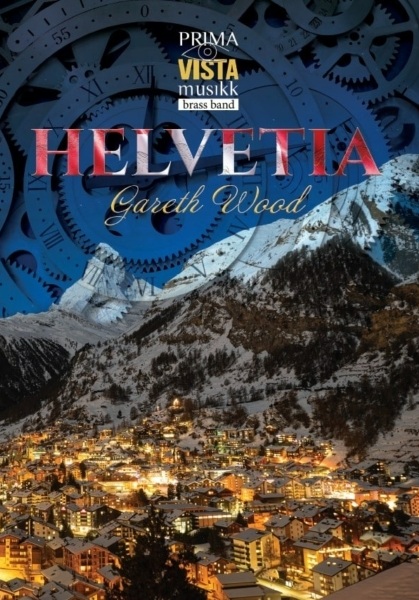
Helvetia (Brass Band - Score and Parts) - Wood, Gareth
I first went to Switzerland in the early 1970's and regularly played at the Lucerne Festival with the Royal Philharmonic Orchestra. It is a beautiful city, one of my favourite European cities.In writing Helvetia (the Roman name for Switzerland) I wanted to encapsulate the moods that remind me of this wonderful place. The work is in four distinct sections and is on the whole, self-explanatory.It opens with An Alpine Dawn and sunrise, the tubas and euphoniums substituting for the Swiss Alphorns. Next The Clock Shop at Mid-day, a loud ticking, chiming and the sad sound of a cuckoo, builds into the cacophony of the mid-day chimes. The third section is A Walk to Wagner's House. Just along the lake from the centre of town is Tribschen. This walk I have done many times, and it is here that Wagner wrote 'Tristan'. I have quoted the Dresden Amen (written by J.G. Naumann) which is much used in Parsifal. The final section is The Cesta Run, the most famous bob-sleigh run in the world. As we take each corner, the feeling of speed is demonstrated as only a brass band can do!The work is dedicated to the Cory Band and also to the memory of James Watson, a great cornet player, trumpeter and conductor. It was he who got me into writing for brass band and I hope this piece is worthy.- Gareth Wood (Feb. 2011)Duration: 11.00
Estimated dispatch 7-14 working days
-
 £21.95
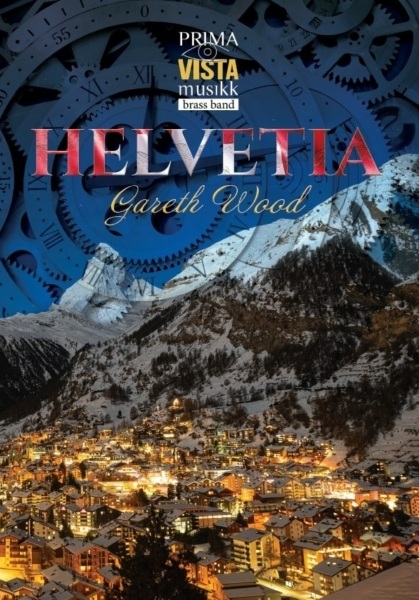
Helvetia (Brass Band - Study Score) - Wood, Gareth
I first went to Switzerland in the early 1970's and regularly played at the Lucerne Festival with the Royal Philharmonic Orchestra. It is a beautiful city, one of my favourite European cities.In writing Helvetia (the Roman name for Switzerland) I wanted to encapsulate the moods that remind me of this wonderful place. The work is in four distinct sections and is on the whole, self-explanatory.It opens with An Alpine Dawn and sunrise, the tubas and euphoniums substituting for the Swiss Alphorns. Next The Clock Shop at Mid-day, a loud ticking, chiming and the sad sound of a cuckoo, builds into the cacophony of the mid-day chimes. The third section is A Walk to Wagner's House. Just along the lake from the centre of town is Tribschen. This walk I have done many times, and it is here that Wagner wrote 'Tristan'. I have quoted the Dresden Amen (written by J.G. Naumann) which is much used in Parsifal. The final section is The Cesta Run, the most famous bob-sleigh run in the world. As we take each corner, the feeling of speed is demonstrated as only a brass band can do!The work is dedicated to the Cory Band and also to the memory of James Watson, a great cornet player, trumpeter and conductor. It was he who got me into writing for brass band and I hope this piece is worthy.- Gareth Wood (Feb. 2011)Duration: 11.00
Estimated dispatch 7-14 working days
-
 £59.99
Almshouse Street Blues (Brass Band - Score and Parts) - Sparke, Philip
In 2007 Philip Sparke was appointed composer-in-residence to Monmouth School, situated on the Welsh/English border. The school, which has a venerable history dating back to 1614, has a thriving music department which boasts two concert bands, in co-operation with the nearby Haberdashers' Monmouth School for Girls, and a brass band.This exciting and innovative appointment involved three visits by the composer during the year as well as the commissioning of a new piece for each of the bands, all of which were premiered in a concert at the end of the year.Almshouse Street Blues was written for the brass band, whose members were allowed to vote for which type of piece they would get! Monmouth School is based in Almshouse Street and the town has a thriving summer festival which, alongside blues bands, features a wide variety of music including jazz, soul, rock and bangra.Duration: 4.45
Estimated dispatch 7-14 working days
-
 £54.99
Festive (Brass Band - Score and Parts)
Bertrand Moren originally composed this march for the brass band Concordia of Bagnes in Switzerland, of which he is the conductor. Festive develops a sparkling and playful melodic line over a strong theme in the low brass section. This version for concert band is full of vitality and will bring a touch of liveliness to any concert. Festive is also suitable for an outdoor performance. 02:50
Estimated dispatch 7-14 working days
-
 £24.95
SALT OF THE EARTH, FINALE (Brass Band Parts) - Scott, Andy
Brass Band parts only. A full band arrangement created by the composer from the third movement of 'Salt of the Earth', a Concerto for Tuba & Brass Band is a fiery mix of Latin rhythms and big band power! With a virtuosic introduction from the solo cornets and percussion, the full band then enters with the catchy melody, before a two part contrapuntal passage that leads into a series of short 'solo breaks'. The main theme returns, re-scored for added impact, before an extended contrapuntal section, which leads to two closing paused chords, which may be separated by an optional extended drum/percussion solo if required. Dur: 3:30
Estimated dispatch 7-14 working days
-
£15.00
SALT OF THE EARTH, FINALE (Brass Band Score) - Scott, Andy
Brass Band score only. A full band arrangement created by the composer from the third movement of 'Salt of the Earth', a Concerto for Tuba & Brass Band is a fiery mix of Latin rhythms and big band power! With a virtuosic introduction from the solo cornets and percussion, the full band then enters with the catchy melody, before a two part contrapuntal passage that leads into a series of short 'solo breaks'. The main theme returns, re-scored for added impact, before an extended contrapuntal section, which leads to two closing paused chords, which may be separated by an optional extended drum/percussion solo if required. Dur: 3:30
Estimated dispatch 7-14 working days
-
 £60.00
From the Shores of the Mighty Pacific (Cornet Solo with Brass Band - Score and Parts) - Clarke, Herbert L. - Wilkinson, Keith M.
Cornet Solo with Brass BandHerbert L. Clarke (1867 - 1945) is regarded by many as one of the finest cornet players of all time, noted not only for his amazing technique but also for his warm, lyrical tone. He has left a multitude of cornet solos as well as collections of studies which are still very widely used. He was a member of The Sousa Band briefly in 1893 and then from 1898 to 1917 where he was not only the distinguished cornet soloist but also became assistant director.From The Shores Of The Mighty Pacific is an all-time favourite rondo-caprice cornet solo and was first published in 1912. A brass band arrangement was requested by Chris Lichtler, principal cornet of Brass Band of the Western Reserve, musical director Dr. Keith M. Wilkinson. Chris has performed it many times with BBWR and it was recorded by them on the CD, Without Reserve!.
Estimated dispatch 7-14 working days
-
 £32.00
Amazing Grace (Brass Band with opt. Bagpipes - Score and Parts) - Wilkinson, Keith M.
There are several occasions when a brass band is invited to play along with bagpipes and one of the first titles to be mentioned is the American traditional hymn melody, "Amazing Grace". This arrangement was prepared for one such occasion when Brass Band of the Western Reserve, musical director, Dr Keith M Wilkinson, was invited to play at a wedding in 2007. Parts for bagpipes are included in Concert Pitch (as shown in the full score) and in Db, the key in which they are normally pitched.There are optional parts which make the arrangement equally effective without bagpipes. A suggestion when this version is used is to place the cornet soloist at the beginning some distance from the band.
Estimated dispatch 7-14 working days
-
 £60.99
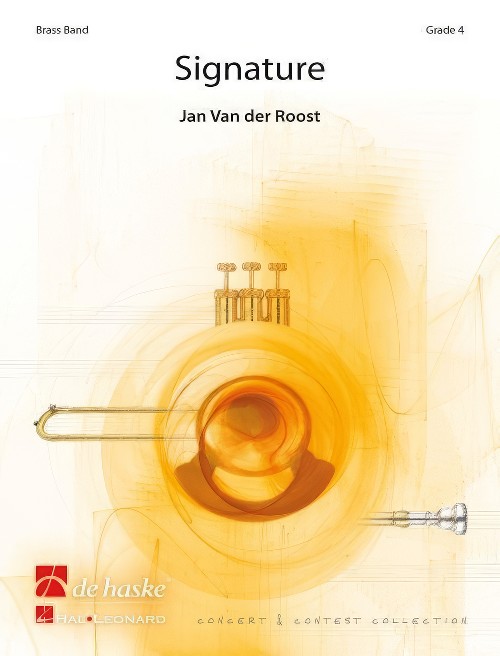
Signature (Brass Band - Score and Parts) - Van der Roost, Jan
This opener was written for the 10th anniversary of Brass Band Midden Brabant (BBMB), the composer's own band. A soft and lyrical middle section follows on the powerful opening fanfare which, if the technical equipment is available, can be used as background music for a spoken text or presentation. The finale is distinctly rhythmical in character, and develops into a somewhat unusual ending. Here, the composer piles ten different notes on top of each other, representing the BBMB anniversary in a musical way. At a later date the composer made two new versions of Signature, namely for wind band and fanfare.Duration: 3:30
Estimated dispatch 7-14 working days
 View Music