
Results
-
 £30.00
Four Moods - Tim Paton
An original composition by Tim Paton, re-crafted from his quartet into a full brass version. Tim wrote this piece at the RNCM, initially for the college trombone quartet. It was subsequently featured on a radio broadcast and, by popular demand, he later created this full brass band version. It is also available for concert band.Four Moods is just that - made up of 4 sections, each presenting a different style and emotion. The piece opens grandly with Nobility and is shortly followed by Sentiment, a smooth and sweet movement. The third element - Humour - takes the melody just heard in the previous Sentiment, and makes fun of it in an amusing style which utilises 'rude' trombone glissandi. The whole piece is then brought to a memorable closing with the final section - Hot 'n' Cool, featuring a jazz/big band style.Good key players make this piece playable by most bands.
In Stock: Estimated dispatch 3-5 working days
-
 £15.00
Jupiter from the Planet Suite - Holst
Programme notes:The hauntingly beautiful theme from Jupiter, from The Planets Suite has a rare qualityexpressing both optimism and dignity which makes it a popular choice for many formalpublic events such as opening and award ceremonies.The tune is originally found in the Jupiter movement from the large-scale work fororchestra called 'The Planets Suite'. Written by the English composer Gustav Holt ThePlanets Suite is thought to be his finest work.The theme has a steady 3/4 rhythm which provides a contrast in terms of tempo andmeter to the rest of the movement, and has been made popular as a patriotic song called'I vow to Thee My Country'.Performance notes:This arrangement makes use of a gradual increase in dynamics, beginning p and ending ff.With this gradual increase in dynamics is a gradual increase in the scoring starting offwith only the lower instruments playing p and ending up with everyone playing ff.The percussion part is very minimal in this arrangement (only 2 notes for the suspendedcymbal) and is an optional part.Just before the final chord there is a cut off marked in the parts. This may be a newconcept for some inexperienced players so it should be fully explained by the conductor.The Flexi-Collection ApproachFlexible scoring tailored to your needs - A perfect solution for expanding the repertoire of training and junior brass bands. The Flexi-Collection currently offers two series - Popular Classics and World Tour. Based on four-part harmony, these collections provide groups with the advantage of complete flexibility when they may not be balanced. If players or instruments are missing, the show can still go on!The Flexi-Collection - Popular Classics Series, encapsulates all that is great about the wonderful range of musical styles produced by Holst, Elgar, Handel, Verdi, Tchaikovsky, Grieg, Bizet and Parry.The thoughtful scoring and arranging by Andrew Duncan now means that groups of all abilities have access to a truly flexible set of music for their needs. With world parts, rudimentary theory, terminology translations and large format typesetting, The Flexi-Collection ticks all the boxes when it comes to bringing interesting music to the training and junior band/brass group environment.Available individually or as part of the money-saving Flexi-Collection Popular ClassicsAlbum.Scored for Brass Band and supplied with additional Easy Bb, Easy Eb and world parts - The Flexi-Collection offers flexibility in every sense of the word.
In Stock: Estimated dispatch 3-5 working days
-
 £27.95
Three Fanfares (Brass Ensemble - Score and Parts)
This set includes three fanfares by Edward Gregson for symphonic brass and percussion ensemble:Fanfare for a New EraFanfare for the NorthFanfare for EuropeFanfare for a New Era: This fanfare was commissioned by Lady Sheila Stoller to celebrate the opening of the Stoller Hall at Chetham's School of Music in Manchester (UK). It is dedicated to Sir Norman Stoller, who generously donated the funding for the new concert hall. It was first performed by students of Chetham's School of Music, conducted by Stephen Threlfall, at the Royal Opening of the Stoller Hall on 24 April 2017. Ideally, the fanfare should be performed using as much spatial arrangement as possible, so that the antiphonal effects are heard to their best advantage. Whatever the chosen lay-out, the 1st Trumpet should be positioned off-stage in a suitable position. This could be a rear balcony if the venue is not too large, or in a side balcony in a larger concert hall. Duration: 3.00Fanfare for the North: This fanfare was commissioned by the Gateshead Garden Festival of 1990 and was first performed by London Brass Virtuosi, directed by David Honeyball, at the Royal Opening by HM The Queen. Its four-note motif (G, A, E, D), which is heard throughout the fanfare, is derived from the letters of 'Gateshead'. Duration: 1.15Fanfare for Europe: This fanfare was specially commissioned for two concerts celebrating the UK's entry into Europe (or the European Economic Community as it was then known) in 1973. The first performances were given at York Minister and the Royal Albert Hall, London, in January 1973. The fanfare was also featured as the opening music for the first episode of a series of short documentary programmes made for BBC Radio 4 in 2018 by Mark Mardell entitled Brexit: A Love Story? Duration: 1.15Duration: 5.30
Estimated dispatch 7-14 working days
-
 £9.95
£9.95Second Quartet (Brass Quartet - Score and Parts)
My second Brass Quartet was written in 1968, immediately after I finished my studies at the Royal Academy of Music, and was in response to a request from my then publisher, R Smith & Co, to write some chamber music for brass band instruments. My Brass Quartet No 1 (also written in 1968) was scored for the usual combination of two cornets, horn and euphonium, but the second is scored for two horns, baritone, and tuba, giving the music a somewhat mellower sound world than the First Quartet. It is also a miniature in form in that it barely lasts six minutes. The music is in three movements: Prelude, Scherzo and Postlude. The outer movements are slow and thoughtful, while the middle Scherzo is rather astringent in character, with virtuoso demands made on the players. The Prelude begins with a duet for the two horns, answered by baritone and tuba, the material being rather rhetorical in style and although the Postlude begins in a similar fashion it also develops material from the Scherzo (slowed down of course) in the manner of a fugal exposition. The music ends with a series of quiet chords. - Edward Gregson
Estimated dispatch 7-14 working days
-
 £59.77
Caprice (Euphonium Solo with Brass Band) Andrew Batterham
VIEW SCORE PDF Caprice was written for Matthew van Emmerik, to showcase his virtuosity in an engaging piece of concert music. The work is in theme and variation form, with the primary material being the theme from the last of Paganini's Ventiquattro Capricci per violino solo, a collection of 24 caprices for solo violin. This theme has been the inspiration for similar works by many composers since it was first published, including Liszt, Brahms, Rachmaninov, Benny Goodman and Andrew Lloyd Webber. In this work, the famous theme is treated to a more contemporary approach. The first variation, Capricious, relies on motor rhythms and jagged dialogues between the soloist and the band. It is couched in an organic scale reminiscent of the Phrygian mode. The second variation, Sad, is in direct contrast, acting as a traditional ballad and allowing the soloist to explore the expressive side of the instrument. The third variation, Energetic, is a micro set of variations in itself, designed to display the soloist's innovative technique and stamina. Each section is more challenging than the last, until the work concludes with a whirlwind dance at breakneck speed. Like all of Batterham's recent work, the musical language of Caprice draws upon classical, jazz, funk and ska elements to create a unique sound where anything can happen, and probably will. This arrangement was made possible through Matt's instigation and generosity. To view a video of Matthew van Emmerik performing the version with brass band please visit www.youtube.com/watch?v=D0hsvux_a5o To view a video of Fletcher Mitchell performing the version with piano please visit www.youtube.com/watch?v=NOZ6KRldDVo Sheet music available from: UK - www.brassband.co.uk USA - www.solidbrassmusic.com Instrumentation: Euphonium Soloist Soprano Cornet Eb Solo Cornet Bb Repiano Cornet Bb 2nd Cornet Bb 3rd Cornet Bb Flugel Horn Bb Solo Horn Eb 1st Horn Eb 2nd Horn Eb 1st Baritone Bb 2nd Baritone Bb 1st Trombone Bb 2nd Trombone Bb Bass Trombone Euphonium Bb Bass Eb Bass Bb Percussion 1-3
In Stock: Estimated dispatch 1-3 working days
-
 £29.95
Badinerie - Jonathan Bates
DURATION: 2'00". DIFFICULTY: Difficult. J.S Bach originally composed 'Badinerie' as part of his Orchestra Suite No. 2 in B Minor, and quickly became one of the most popular virtuoso show-pieces for flute players due to it's quick pace and complexity. In more modern times, the melody has become synonymous with the Nokia mobile phone ringtone, one of 2 famous early ringtones based on the music of Bach (alongside his Prelude to Cello Suite No.1). One lesser known take on the classic Badinerie is by Italian drummer Andrea Vadrucci (alias Vadrum) who has made a global reputation for himself by taking various well-known classical works and re-imagining them into a rock/metal style, and it is this interpretation which acts as the inspiration for this showy, yet tongue-in-cheek feature for percussion. .
In Stock: Estimated dispatch 1-3 working days
-
 £52.00
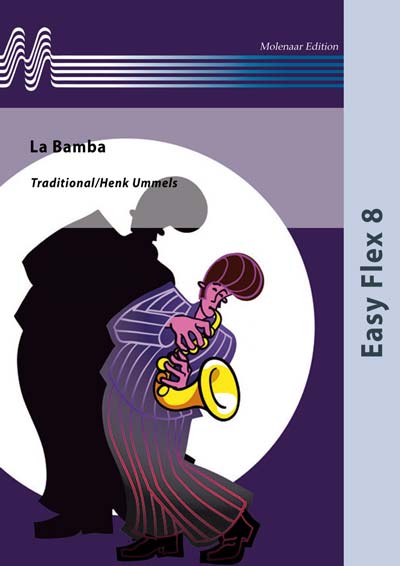
La Bamba - Traditional/Henk Ummels
This single from Ritchie Valens from 1958 is originally a Spanish song from Mexican folklore. Years later it was picked by Rolling Stone magazine as the only non-English song in their 500 Greatest Songs of All Time list at number 345. In 1987 it was covered by the American band Los Lobos, for the film La Bamba, about the life of Ritchie Valens. This arrangement has been made for flexible setting, and is suitable for a developed student band.
Estimated dispatch 10-14 working days
-
 £31.50
Edward Gregson: Postcard to Grimethorpe
DescriptionComposer's NoteI composed the original version of Postcard to Grimethorpe in 1993 at the request of Elgar Howarth, for a concert at the Queen Elizabeth Hall, London, given by the Grimethorpe Colliery Band. This was at a time when after the Grimethorpe Colliery pit closed the future of the band was in severe jeopardy. The concert was given in aid of the band, both through publicity and funding.Then in late 2022 Jack Stamp, the American composer, conductor and educator, and at that time international composer-in-association with Grimethorpe, contacted me to say that he had discovered my short piece in the band library, and asked if I might extend it for a recording he was sponsoring for the band - the repertoire to consist entirely of music specially composed for Grimethorpe.I agreed and decided to extend the piece by using the miner's hymn Gresford, as a symbolic gesture of protest at the many thousands of miners in the UK who were made redundant from their jobs. After an angular (atonal) first section, the hymn enters, softly at first, but with each phrase it becomes more powerful and insistent, ending with the final phrase triumphantly accompanied by melodic percussion (replacing the drums and cymbals of the earlier phrases, as if the band were then on the march). However, this short work ends softly and gently, as if anger has been replaced by quiet resolution and determination, looking to the future with confidence.For more information on Edward Gregson's music please visit the composer's website: www.edwardgregson.com
Estimated dispatch 7-14 working days
-
£73.00
Root Beer Rag - Billy Joel - Svein H. Giske
Root Beer Rag was written for the 1974 album release Streetlife Serenade by American pianist/vocalist/composer Billy Joel.After the success his own recording, several other pianists have performed it both on record and stage. There's also many arrangements of the song made, some of them featuring soloist(s).This arrangement for Brass Band by Svein H. Giske was written to Askoy Brass Band for their participation in the entertainment-competition Siddis Brass in 2016. It's very virtuosic and challenge almost all sections of the band.
Estimated dispatch 7-14 working days
-
£72.00
Walk on By - Bacharach-David - Haakon Esplo
"Walk on By" is an American song written by Burt Bacharach and Hal David. It was written for Dionne Warwick. Her recording was released in April 1964 to great success.It reached a sixth place on the American Billboard Hot 100 list and a first place at Cashbox 'R & B. The song was a short time on Top 10 on the Billboard Easy Listening List. Warwick also recorded a German version entitled "Geh vorbei".Like many of Warwicks Bacharach-composed songs from the 1960s, many cover versions were made. Some of them with great success all over the world.Solo Options:Vocal | Flute/Oboe | Bb Clarinet | Altosax | Tenorsax | Trumpet/Cornet | Eb-horn | F-horn | Euphonium/Trombone BC | Euphonium/Trombone TC
Estimated dispatch 7-14 working days
 View Music