
Results
-
 £40.00
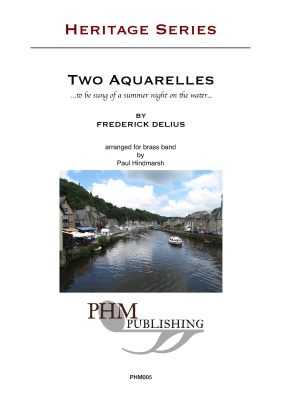
Two Aquarelles (Euphonium Feature with Brass Band - Score and Parts)
In the late spring of 1917, the Bradford born composer, Frederick Delius (1856 - 1934) composed two short part-songs at his home in Grez-sur-Loing. The river ran along the bottom of his garden and he called the two miniatures To be sung of a summer night on the water. The First World War was at its height, but one would never guess that from the languid and serene quality of these richly textured nocturnes. The songs were first heard in London on 28 June, sung by the Oriana Madrigal Society, conducted by Charles Kennedy Scott. In 1932 Delius's amanuensis, Eric Fenby, arranged them for string orchestra as Two Aquarelles. While I have taken Fenby's title, my arrangement is a note-for-note transcription of the choral original. It was prepared in early in 1993 for Besses o' th' Barn Band, of which I was Musical Director at the time. In the second song, the prominent tenor solo has been given to the solo euphonium, who should stand apart from the band in performance.- Paul HindmarshDuration: 5.00
Estimated dispatch 7-14 working days
-
 £39.95
Judd: A Pastoral Symphony
This symphony for brass band seeks to explore the thought that 'the greatest need of any congregation is its pastor's personal holiness'. The first movement challenges the pastor 'to serve the present age', the tunes 'Majesty' and 'Lathbury' are used. The second movement expresses a priority to 'Seek...first the Kingdom of God'. The short third movement presents the question 'Except I am moved with compassion, how dwellest they Spirit in me?' before the triumphant finale reflects the desire of every Christian that his life and work will always be for the glory of God with the presentation of 'In my life Lord, be glorified'.
Estimated dispatch 7-14 working days
-
 £29.95
Judd: Before The Cross
Written at the request of David Daws for his solo album The Sound of David Daws, this meditation for cornet and brass band uses the composer's own song Before the cross (The Musical Salvationist, April 1965), the first lines of which are "Before the cross I stand in fear and wonder, and see that all my sins on Thee are laid". The song was written at an early stage of the composer's career, just before commencing study at The Royal Academy of Music, London. After a brief introduction the melody is heard twice, first played by the soloist, then on euphonium and flugel horn with the soloist adding ornate counterpoint before taking up the melody once again, this time leading to a quiet and reflective conclusion.
Estimated dispatch 7-14 working days
-
 £34.95
Judd: Flourish
This solo was written for Philip Cobb and takes its inspiration from Virtuosity, a trumpet solo by Kenny Baker. The song Hand me down my silver trumpet is referred to in the two outer sections while the laid-back, jazzy central section features the song When the roll is called up yonder. The reason for including this song is the first line of the first verse which reads When the trumpet of the Lord shall sound.
Estimated dispatch 7-14 working days
-
 £29.95
Judd: Spirit of Joy
This march was awarded first prize in the 1930 American Golden Jubilee National Music Competition and was published the same year in the first edition of the American Festival Series. It was subsequently re-printed in the General Series of 1984. Soderstroms imaginative use of syncopation and chromatic harmony brought a new, American sound to the Salvation Army march. For example, he took the old Salvation Army fight song Hark, hark my soul written and changes its metre from 6/8 to 4/4 while also syncopating it!
Estimated dispatch 7-14 working days
-
 £44.95
Funk Engine (Brass Band - Score and Parts)
'Funk Engine' was commissioned by Brass Bands England for the 2016 National Youth Brass Band Championships of Great Britain. What Ryan says about the piece:"When I was commissioned to write a piece for the Championships I decided that I wanted to create something a bit different to standard brass band repertoire. I decided that the best way to do this was to go a bit out of my comfort zone and explore some styles of music that I have yet to experiment with. I have always been a great lover of jazz, funk and big band music and the sounds associated with them. In 'Funk Engine' I have tried to capture some of these sounds, however I am a brass-bander at heart and as such I've tried to create a fusion of styles that hopefully combines the best of brass band and jazz into one piece.'Funk Engine' runs continuously, but is divided into three broad sections - fast, slow, fast. The opening is in driving big band style, which segues into a smoother lyrical section; the pace then picks up into a jazz inspired scherzo. After a delicate transition from the basses and trombones the euphonium plays a soaring scale - bringing us into the central movement - which begins with a series of languid solos before descending into a darker interlude. A flugel solo lightens the mood and the music gains momentum leading into a brief cornet chorale before a euphonium solo leads into a percussive climactic passage for full band. As this section winds down to settle on an open fifth, the Hi-hat and Bass section punctuate the texture with the first notes of the final section."The final section of the piece is in similar big band style to the opening and develops material from the first two movements. The percussion feature heavily at this stage and the tension builds towards a final statement, with the piece concluding with a bang!"
Estimated dispatch 7-14 working days
-
 £14.95
Funk Engine (Score Only)
'Funk Engine' was commissioned by Brass Bands England for the 2016 National Youth Brass Band Championships of Great Britain. What Ryan says about the piece:"When I was commissioned to write a piece for the Championships I decided that I wanted to create something a bit different to standard brass band repertoire. I decided that the best way to do this was to go a bit out of my comfort zone and explore some styles of music that I have yet to experiment with. I have always been a great lover of jazz, funk and big band music and the sounds associated with them. In 'Funk Engine' I have tried to capture some of these sounds, however I am a brass-bander at heart and as such I've tried to create a fusion of styles that hopefully combines the best of brass band and jazz into one piece.'Funk Engine' runs continuously, but is divided into three broad sections - fast, slow, fast. The opening is in driving big band style, which segues into a smoother lyrical section; the pace then picks up into a jazz inspired scherzo. After a delicate transition from the basses and trombones the euphonium plays a soaring scale - bringing us into the central movement - which begins with a series of languid solos before descending into a darker interlude. A flugel solo lightens the mood and the music gains momentum leading into a brief cornet chorale before a euphonium solo leads into a percussive climactic passage for full band. As this section winds down to settle on an open fifth, the Hi-hat and Bass section punctuate the texture with the first notes of the final section."The final section of the piece is in similar big band style to the opening and develops material from the first two movements. The percussion feature heavily at this stage and the tension builds towards a final statement, with the piece concluding with a bang!"
Estimated dispatch 7-14 working days
-
 £67.78
Sinfonietta - Saints and Devils (Brass Band) Rob Wiffin
Saints and Devils is a challenging three movement work: Dance with the Devil (4.31), A Glimpse of Paradise (4.42) and Reyes Magos (3.40). I wrote it when I was living in Spain where the Catholic culture is still much more prevalent than in the UK.The first two movements are a transition from dark to light; Dance with the Devil is aggressive and occasionally macabre whereas A Glimpse of Paradise is serene. The first and final parts of the second movement were originally written for a sequence in the Royal Military Tattoo 2000, played under the John Magee poem High Flight - 'Oh I have slipped the surly bonds of Earth ............ Put out my hand, and touched the face of God' - with videos of eagle owls in flight dramatically projected onto the buildings of Horse Guards in Whitehall, London.The last movement, Reyes Magos, is the joyous fiesta of the Three Kings. I wrote it while living in Spain and there January 6th, rather than Christmas Day, is the main day of present-giving, marking the Epiphany, the arrival of the Kings from the Orient at the Nativity.Saints and Devils is technically and expressively demanding but is written within the realms of tonal language.Duration: Approx. 13.00 minutesDifficulty Level: AdvancedThis PDF download includes the full score and parts.Sheet music available at www.brassband.co.uk (UK) or https://satradecentral.org (USA)
In Stock: Estimated dispatch 1-3 working days
-
 £74.99
Cornet Concerto No.1 - Jonathan Bates
My 'Cornet Concerto No.1' was composed for Lode Violet and Brass Band Willebroek in 2018 and features 2 movements, entitled 'Dystopia' and 'Utopia'. . The nature of the music in the opening section, 'Dystopia', is very jagged, disjointed and unsettling, as the soloist almost battles against the constant churning of the mechanical accompaniment, trying to persevere with it's own ideas and styles without being dragged into conforming to it's surroundings. The movement is based largely on the 3 note interval heard right at the outset of the piece (C, D & G#, a series of notes that lends itself so well to different modes, scales, harmonies and intervals) and this forms much of the rhythmic and harmonic structure of the opening section.Whilst this movement acts as a virtuoso feature to demonstrate the extended capabilities of both the soloist and instrument, I feel the accompanying ensemble plays an equal role in the narrative of 'dystopia', and features a number of demanding and prominent episodes for soloists within the accompanying band. A short and heavy coda concludes the movement, with a sense of real pain and sorrowfulness as the music fades away into darkness. . 'Utopia' opens in an instantly more hopeful nature, with the soloist introducing the first real 'theme' of the movement, taken up shortly by the accompaniment. Throughout this movement, there are a number of timbral and melodic references back to the darkness of 'dystopia', but transformed into a much more positive outlook and soundworld. There is a moment of quiet reflect (using the initial 3 note cell as a basis) before flying head first into a frenzied wild 'tarantella' like section, full of joy and energy which tests the dexterity and light-natured approach to virtuosity (much unlike the heavier material in the 1st movement) of the soloist. Primarily, the concept of this finale is fun - joy, happiness, and freedom from restraint, so the addition of a quirky 'tongue-in-cheek' habanera section offers a brief moment of respite from the craziness of the tarantella. To conclude the work, there is an extended cadenza for the soloist which is built on several motifs heard throughout the concerto, which leads the band into a dramatic and energetic final few bars.. Jonathan Bates. (2018). .
In Stock: Estimated dispatch 1-3 working days
-
 £31.50
Edward Gregson: Postcard to Grimethorpe
DescriptionComposer's NoteI composed the original version of Postcard to Grimethorpe in 1993 at the request of Elgar Howarth, for a concert at the Queen Elizabeth Hall, London, given by the Grimethorpe Colliery Band. This was at a time when after the Grimethorpe Colliery pit closed the future of the band was in severe jeopardy. The concert was given in aid of the band, both through publicity and funding.Then in late 2022 Jack Stamp, the American composer, conductor and educator, and at that time international composer-in-association with Grimethorpe, contacted me to say that he had discovered my short piece in the band library, and asked if I might extend it for a recording he was sponsoring for the band - the repertoire to consist entirely of music specially composed for Grimethorpe.I agreed and decided to extend the piece by using the miner's hymn Gresford, as a symbolic gesture of protest at the many thousands of miners in the UK who were made redundant from their jobs. After an angular (atonal) first section, the hymn enters, softly at first, but with each phrase it becomes more powerful and insistent, ending with the final phrase triumphantly accompanied by melodic percussion (replacing the drums and cymbals of the earlier phrases, as if the band were then on the march). However, this short work ends softly and gently, as if anger has been replaced by quiet resolution and determination, looking to the future with confidence.For more information on Edward Gregson's music please visit the composer's website: www.edwardgregson.com
Estimated dispatch 7-14 working days