
Results
-
 £76.99
The Sound of Music - Richard Rodgers - Naohiro Iwai
The musical The Sound of Music represents the last collaborations between the successful duo Rodgers and Hammerstein. It is based on the story about the Austrian Von Trapp family that immigrated to the United States of America. Generations have fallen in love with the musical, made particularily famous through its subsequent cinematic release. Naohiro Iwai combines all the musical's highlights: Do-Re-Mi, The Lonely Goatherd, So Long, Farewell, Edelweiss, and Climb Ev'ry Mountain.
Estimated dispatch 5-14 working days
-
 £68.90
Elisabeth - Michael Kunze - Erik Jansen
The life of the Austrian empress Elisabeth (1837-1898) which started as a fairy tale but ended as a tragedy, inspired the librettist Michael Kunze and the composer Silvester Levay to write a musical based on the life of the popular 'Sissi'. The musical was premiered in Vienna on 3 September 1992 and was very successful for many years. The story is told by Luigi Lucheni, Elisabeth's murderer. So death, represented by a mysterious and seductive young man, is omnipresent throughout the musical. Several songs have become hits and, of course, you can hear them in this fine selection by Peter Kleine Schaars who gathered various music and dance styles such as the rock shuffle, the jazz waltz and the classical Viennese waltz.
Estimated dispatch 5-14 working days
-
 £79.99
Mamma Mia! - Björn Ulvaeus - Peter Kleine Schaars
On the 6th of April 1999, exactly 25 years after ABBA had won the Eurovision Song Contest with the song Waterloo, the musical Mamma Mia! opened in London. The funny and appealing love story, based on 22 ABBA classics, became an immediate success. Arranger Peter Kleine Schaars has selected five of the most famous titles from the musical, added the hit Waterloo and used his musical imagination. The result is a catchy ABBA medley that will appeal to young and old.
Estimated dispatch 5-14 working days
-
 £134.99
West Wind - Oliver Waespi
West Wind is structured in three parts, each bearing a subtitle drawn from poems of Emily Bronte (1818-1848). Poetry of the Romantic period, Bronte's in particular, often presents a gentle, almost innocent surface, beneath which lies the most elemental and volatile emotional forces capable of erupting at any moment.Accordingly, the opening movement, West-wind, in the glory and pride!, begins with a mellow, warm soundscape, underpinned by lightly pulsating patterns, almost like an aquarelle. Gradually however, the music transitions into far rougher, forward-driven gestures - turbulent, restless, and at times unpredictable, much like the west wind itself.The ensuing Adagio reflects on the poem Stars, in which a fundamental tension between exaltation and regret, another recurring feature of Bronte's poetry, is palpable throughout. Introspective solo and chamber music statements give way to a broad ecstatic sound field involving the full ensemble, before finally receding into a solitary euphonium soliloquy.The final movement, Wild words of an ancient song, takes the form of an extended rondo-scherzo, driven by virtuosic, perpetual motion. The sense of relentless pursuit bears a nod to The Boy on the Moor by the German poet Annette von Droste-Hulshoff, a contemporary of Bronte who explored similar narratives, albeit from a different perspective.Although certain core musical elements recur - pulsating patterns, a chorale, a tone row - the work is guided less by systematic symphonic development than by an intuitive stream of variants. These generate a sequence of metamorphoses that illuminate the material from shifting vantage points, projecting the emotional landscapes of Romantic poetry into the present day.West Wind was commissioned by the Flowers Band and was first performed under Musical Director Paul Holland, at the 2026 European Brass Band Championships in Linz (AT), where they also became European Champions.
Estimated dispatch 5-14 working days
-
 £129.99
Genetic Code - Thomas Doss
The source of inspiration for this composition was the so-called 'genetic code'. Something which is universal, as almost all organisms on our planet use the same code for their genetic information and therefore speak the same 'language', as it were. The fact that plants, animals, and humans are all subject to the universality of this code fascinates the composer time and time again. Thus, he has chosen a musical motif for this phenomenon, which has been woven through the various musical passages of this work like a genetic thread.Genetic Code was commissioned by the Swiss Brass Band Association to celebrate the 50th anniversary of the Swiss Brass Band Championships, in 2025, and to be the compulsory piece in the Excellence Division that same year.
Estimated dispatch 5-14 working days
-
 £137.99
Sunrise with Sea Monsters - Oliver Waespi
The title of this work is based on the painting of the same name by the English painter William Turner. The ambiguity and suggestive power of this seascape offers great musical possibilities. The first part of the work represents the sunrise, and depicts scenes from Greek mythology in which two sea monsters from Odyssey play their part. In Charybdis, rugged high and low sound fields contrast with a tuneful theme, veined with restlessly pulsing lines. The subsequent fragmentary movement, Sirens, is characterized by mysterious sounds and intertwined arabesques, that are increasingly overshadowed by menacing chords. Concluding the final movement is another famous musical monster: a Tarantella. Sunrise with Sea Monsters was commissioned by the Brassband Burgermusik Luzern and was premiered at the 2023 Swiss Brass Band Championships, conducted by Michael Bach.
Estimated dispatch 5-14 working days
-
 £105.20
Our Last Summer - Benny Andersson - Bjørn Morten Kjærnes
An exciting arrangement where almost all players have a bit of the melody line. There are many opportunities to give individual musicians soloistic challenges. Any bandmember should find something interesting in this piece. It will be possible to add vocals to the arrangement. A lovely melody with great expressions.Our Last Summer" is a song by the Swedish pop group ABBA from their seventh studio album, "Super Trouper," released in 1980. The song is indeed featured in the musical "Mamma Mia!", a little bit shortened and with small changes in the lyrics. The musical premiered in London's West End in 1999 and is a duet performed by the characters Harry Bright and Donna Sheridan, reflecting on their past romance during a summer spent in Paris.The song is primarily sung by Bjorn Ulvaeus, with backing vocals provided by Agnetha Faltskog and Anni-Frid Lyngstad, the female members of ABBA. Their harmonies contribute to the song's nostalgic and wistful atmosphere. The lyrics vividly describe the memories of the summer spent together, including scenes of walking along the Seine River in Paris and listening to French songs. The song also touches on the passage of time and the realization that the summer romance has ended.While not released as an official single in most countries, "Our Last Summer" still received considerable airplay and became a fan favorite. It charted in some European countries and has remained popular among ABBA fans over the years.
Estimated dispatch 5-14 working days
-
 £289.80
Catharsis - Kjetil Djønne
"Catharsis" explores purification through musical art - a process that provides spiritual renewal and release from moral ambiguities. Its etymology traces back to ancient Greece, but understanding and usage in modern language evolved in the late 18th century. The piece poses cathartic questions through diverse musical elements, from cadences to the ensemble, undergoing changes in tempo, style, texture, and meter. The music embarks on a journey from lyrical expressions to structuralism, from vibrant hues to pale tones, from unrest to tranquility, and from jazzy interludes to grand fulfillment.
Estimated dispatch 5-14 working days
-
 £145.50
3 Movements for Brass Band - Oskar Abel Valand Halvorsen
3 Movements for Brass Band is written with the intent to explore concise, but intention-lled musical forms. Even though each movement is a clearly dened part, there are still many similarities and unifying elements throughout. One of them can be characerized as a focus on musical initiatives that perpetually intensies the interplay between them. Furthermore, nearly all chords and melodic gestures in all the movements are based on the same three-note cell (e.g. Eb-F-Ab) in constant transposing versions. This structure of threes also nds expression in the rhythmical elements (e.g. in the lightly syncopated gures in the opening of the second movement). Lastly, there is also a signal in snare drum and whip, that ends each movement.
Estimated dispatch 5-14 working days
-
 £159.99
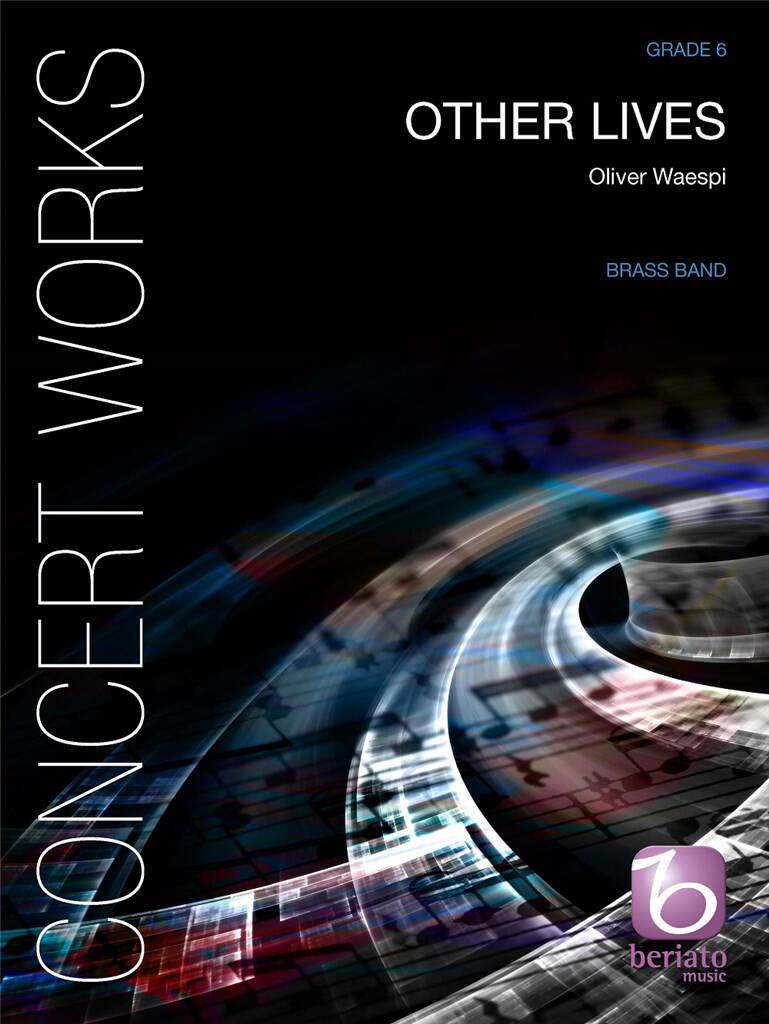
Other Lives - Oliver Waespi
Other Lives is works perfectly for a competition but can also be programmed as concert work. The dark chords at the beginning of the piece are derived from "Der Doppelganger", one of Franz Schubert's late songs. After a short development the music begins to accelerate and find its own shape, gradually moving away from the introduction. The entire first part, "Rage", has an intensely agitated character. The ensuing "Reflection" turns back to the initial chord progression, before a series of interspersing solos explore time and space at a slower pace. After another musical surge, the music is brought close to silence and then gives way to the third part, "Redemption".Here, a widely spaced sound field contains a remote allusion to another work by Schubert "Ruckblick". After this farewell, an abstract musical transformation triggers an emotional change, as the initial motifs are now presented in their inversed form in order to create a much brighter harmonic landscape. Moreover, in the last part of the piece, "Renewal", the grim, tense atmosphere of the first part is transformed into a great energy. Other Lives was commissioned by the Valaisia Brass Band.
Estimated dispatch 5-14 working days
 View Music