
Results
-
 £54.95
WORLD WITHIN, A (Brass Band Parts) - Scott, Andy
Brass Band parts only. 'A World Within' is a one-movement work that starts with a simple theme stated by the Soprano Cornet before an ostinato figure in 6/8 time emerges (Vibraphone, Horns and muted 2nd and 3rd Cornets) over which firstly Solo Cornet, and then both Solo Cornets (1 & 2), play a sustained melody. A shift between major and minor harmonies characterises the 'B' section, before making way for a virtuosic Flugel solo. When the Flugel leaves centre stage the front line Cornets take over, leading to a full bodied reprise of the 'B' section. The low brass bridge the gap between what is in effect the end of the first main section of the piece and the second section. The constant time shift between 3/4 and 6/8 that has been prevalent through-out 'A World Within', re-emerges towards the end of the 'slow, heavy blues' section, leading into an intricate almost fugue-like passage (Horn and Baritone leading the way). Out of this comes a short transitional bridge section that leads us back to the (transposed) original 6/8 time theme and feel, this time scored with a bold directness that leads to a powerful 2/4 time passage. The climax of 'A World Within' is heralded by one dark and dissonant chord that is repeated three times. A flashback moment occurs where the 'hymn' is stated (muted Cornets) in a bitonal harmonic world. A final statement emerges from the denseness of sound, a re-working of the initial theme (Solo Cornet), with the last work being left to Solo Eb Bass. Dur: 13:00
Estimated dispatch 7-14 working days
-
£20.00
WORLD WITHIN, A (Brass Band Score) - Scott, Andy
Brass Band score only. 'A World Within' is a one-movement work that starts with a simple theme stated by the Soprano Cornet before an ostinato figure in 6/8 time emerges (Vibraphone, Horns and muted 2nd and 3rd Cornets) over which firstly Solo Cornet, and then both Solo Cornets (1 & 2), play a sustained melody. A shift between major and minor harmonies characterises the 'B' section, before making way for a virtuosic Flugel solo. When the Flugel leaves centre stage the front line Cornets take over, leading to a full bodied reprise of the 'B' section. The low brass bridge the gap between what is in effect the end of the first main section of the piece and the second section. The constant time shift between 3/4 and 6/8 that has been prevalent through-out 'A World Within', re-emerges towards the end of the 'slow, heavy blues' section, leading into an intricate almost fugue-like passage (Horn and Baritone leading the way). Out of this comes a short transitional bridge section that leads us back to the (transposed) original 6/8 time theme and feel, this time scored with a bold directness that leads to a powerful 2/4 time passage. The climax of 'A World Within' is heralded by one dark and dissonant chord that is repeated three times. A flashback moment occurs where the 'hymn' is stated (muted Cornets) in a bitonal harmonic world. A final statement emerges from the denseness of sound, a re-working of the initial theme (Solo Cornet), with the last work being left to Solo Eb Bass. Dur: 13:00
Estimated dispatch 7-14 working days
-
 £33.62
Paseo (Cornet Solo with Brass Band) Rob Wiffin
A gentle solo for cornet with band accompaniment. Paseo is a Spanish word for a leisurely walk or stroll: the soloist takes the musical line for a walk with no great sense of hurry, and although there is one moment where the pleasantness of the stroll is threatened, it quickly passes and the good mood is resumed. Technically it needs a good sense of cantabile and control over the range from low D to D two octaves higher. To allow the soloist to sing through without fighting the accompaniment, the section cornets and percussion are omitted. Audio demo: https://soundcloud.com/user-565396545/paseo-cornet-solo-with-brass Duration: Approx. 4.10 minutes Difficulty Level: Medium This PDF download includes the full score and parts. Sheet music available at www.brassband.co.uk (UK) or https://satradecentral.org (USA)
In Stock: Estimated dispatch 1-3 working days
-
 £40.00
Losgaintir. For solo Baritone/Euphonium and brass band
Recommended - Championship to 2nd Section Written for Katrina Marzella and the Black Dyke band, Losgaintir (or Luskentyre in English) is one of my favourite places in Scotland. Losgaintir is on the west coast of the isle of Harris in the Outer Hebrides and has an outstanding beach widely regarded as one of the most beautiful in the world. Losgaintir is a wonderful place to be on warm sunny days with its long stretch of white sands, aqua marine seas, the incredible mountain backdrop of south Lewis and the uninhabited island of Taransaigh in view. The weather in Harris is notorious for changing very quickly and this piece tries to reflect this. Although idyllic on a calm, sunny days, on stormy days Losgaintir's character becomes dark and foreboding, with low dark clouds and sweeping winds from the Atlantic creating a dark, brooding atmosphere. The opening melody (written modally like a traditional Scottish Gaelic air) depicts the calm serenity of Losgaintir on a beautiful summer's day. The character of the fast section that follows portrays winter in Losgaintir during a tempestuous storm with bracing winds. Includes score & parts Also see: Losgaintir for Solo Baritone/Euphonium & Piano
-
 £19.50
Swing Low, With Grace
Estimated dispatch 7-14 working days
-
 £95.00
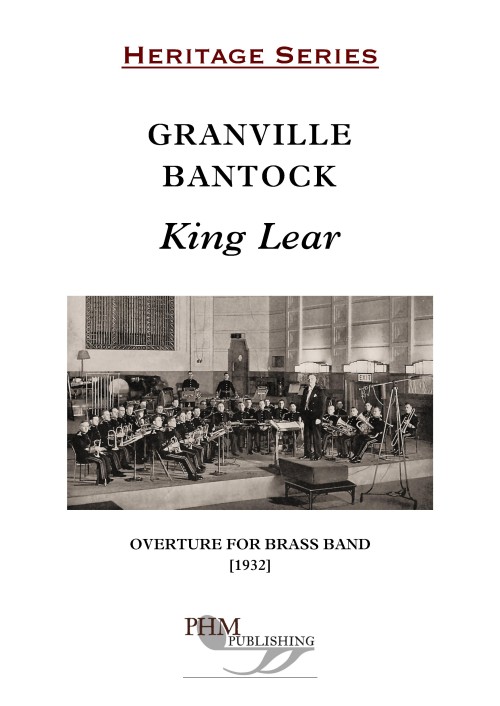
King Lear (Brass Band - Score and Parts) - Bantock, Granville - Hindmarsh, Paul
Sir Granville Bantock (1868 - 1946) composed the second of his five major brass band work for Callender's Cableworks Band, completing the commission on 30 November 1932. Based in the Thames-side district of Belvedere near Erith, the band was active between 1898 and 1961. The works band of the Callender Cable & Construction Co. Ltd, it was at the peak of its popularity during the 1930s and was a frequent broadcaster on the radio. The band employed an in-house arranger and played saxophones in its lighter material. King Lear was one of the band's major commissions and was not published in Bantock's lifetime. The manuscript score and parts were thought to be lost for decades, but were found in the library of the Haydock Band (Lancashire), which had inherited part of Callender's library of manuscripts material and bespoke arrangements after it has been transferred to nearby Prescott Cables Band after Callender's Cable Works closed.King Lear is a substantial work, in essence a dramatic tone poem in the romantic Tchaikovskian manner, presenting a series of character portraits of the foolish old king and his three daughters, Goneril, Regan and Cordelia. The music is dramatic and lyrical by turns, with the most generous lyrical episode revealing perhaps the warm-hearted Cordelia. An expansive melody that flows from this is brought back towards the end as the main climax of the work.In 2001, Bantock's score was recorded by the University of Salford Brass Band, conducted by Dr. Roy Newsome. The original is serviceable, but in comparison with the orchestral version he made in 1936 (part of which was recorded on a Paxton 78 rpm) and later brass band scores, performing editions of which were prepared by others, it lacks colour and range typical of Bantock's orchestral work. Above all it lacks percussion, which can be heard on the recorded extract. With the kind permission of the Bantock Estate, I have prepared a performing edition for publication that incorporates percussion, derived from the orchestral recording and added editorially in similar manner elsewhere. I have revoiced some of the low- lying instrumental parts to present the material in more comfortable ranges. Editorial interventions more elaborate than revoicing the original text have been identified as cue notes.- Paul HindmarshDuration: 15.00
Estimated dispatch 7-14 working days
-
£40.00
King Lear (Brass Band - Score only) - Bantock, Granville - Hindmarsh, Paul
Sir Granville Bantock (1868 - 1946) composed the second of his five major brass band work for Callender's Cableworks Band, completing the commission on 30 November 1932. Based in the Thames-side district of Belvedere near Erith, the band was active between 1898 and 1961. The works band of the Callender Cable & Construction Co. Ltd, it was at the peak of its popularity during the 1930s and was a frequent broadcaster on the radio. The band employed an in-house arranger and played saxophones in its lighter material. King Lear was one of the band's major commissions and was not published in Bantock's lifetime. The manuscript score and parts were thought to be lost for decades, but were found in the library of the Haydock Band (Lancashire), which had inherited part of Callender's library of manuscripts material and bespoke arrangements after it has been transferred to nearby Prescott Cables Band after Callender's Cable Works closed.King Lear is a substantial work, in essence a dramatic tone poem in the romantic Tchaikovskian manner, presenting a series of character portraits of the foolish old king and his three daughters, Goneril, Regan and Cordelia. The music is dramatic and lyrical by turns, with the most generous lyrical episode revealing perhaps the warm-hearted Cordelia. An expansive melody that flows from this is brought back towards the end as the main climax of the work.In 2001, Bantock's score was recorded by the University of Salford Brass Band, conducted by Dr. Roy Newsome. The original is serviceable, but in comparison with the orchestral version he made in 1936 (part of which was recorded on a Paxton 78 rpm) and later brass band scores, performing editions of which were prepared by others, it lacks colour and range typical of Bantock's orchestral work. Above all it lacks percussion, which can be heard on the recorded extract. With the kind permission of the Bantock Estate, I have prepared a performing edition for publication that incorporates percussion, derived from the orchestral recording and added editorially in similar manner elsewhere. I have revoiced some of the low- lying instrumental parts to present the material in more comfortable ranges. Editorial interventions more elaborate than revoicing the original text have been identified as cue notes.- Paul HindmarshDuration: 15.00
Estimated dispatch 7-14 working days
-
 £40.00
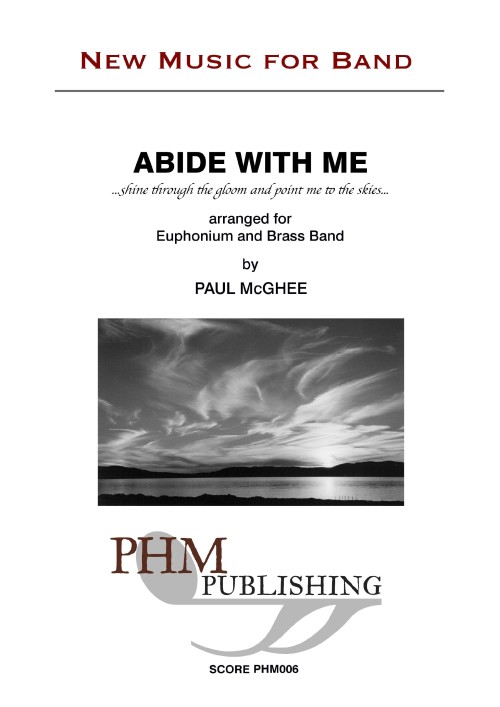
Abide With Me (Euphonium Solo with Brass Band - Score and Parts) - McGhee, Paul
My arrangement of William H. Monk's tune of 1861, uses the euphonium soloist as the central figure for the melodic line in the three verses. Surrounding the solo line is an irregular pulsed figure in the percussion to give the music an unsettled feel whilst the muted ensemble lightly colour the melodic contour of the soloist. From the low beginnings of the piece, where no high instrumentation is used, we are led through the darkened texture to a bright finale, although the sense of the forbidding is always present.Abide With Me has always been a favourite hymn of mine and it was when watching the film 28 Days Later that I believed it would make a rather striking arrangement for brass band. This was confirmed further when the hymn was used at the 2012 opening ceremony of the London Olympics. The juxtaposition between the static, slow moving melody and the rhythmic effects of the dancers was something that I thought could be captured in an arrangement.- Paul McGheeDuration: 5.00
Estimated dispatch 7-14 working days
-
 £89.95
The Trumpets of the Angels (Brass Band - Score and Parts) - Gregson, Edward
The Trumpets of the Angels was commissioned by the Fodens (Courtois) Band for their centenary concert at The Bridgewater Hall in 2000. It is based on a work written for the BBC Philharmonic and Huddersfield Choral Society in 1998, the starting point of which was a quotation from the Book of Revelation:and I saw the seven angels which stood before God; and to them were given seven trumpetsThus the idea behind the work is dramatic and I have tried to achieve this by the spatial deployment of seven solo trumpets around the band, four on-stage, the others off-stage. Six of the solo trumpets eventually join the band, but Trumpet 7 remains off-stage and, indeed, has the most dramatic and extended cadenza representing the words of the seventh angel ...and time shall be no more.The Trumpets of the Angels is a large-scale work, scored for seven solo trumpets, brass band, organ and percussion (deploying 'dark' instruments such as tam-tams, bass drum and two sets of timpani). The work opens with a four-note motif announced by off-stage horns and baritones and answered by fanfare figures on solo trumpets. In turn, each of the first four solo trumpets play cadenzas and then all four join together, independently playing their own music. The organ enters dramatically with its own cadenza, leading to the entry of solo trumpets 5 and 6 with music that is more urgent and rhythmic, describing the horsemen of the Apocalypse.The music reaches another climax, more intense this time, with the horns and baritones (now on-stage) again sounding the transformed motif, before subsiding into what might be described as a lament for humanity, slow music which builds from low to high, from soft to loud, with a melody that is both simple and poignant. At the climax, Trumpet 7 enters playing the opening four-note motif, dramatically extended to almost three octaves. This cadenza (to the partial accompaniment of tam-tams) introduces new material and foreshadows the ensuing scherzo which is fast and aggressive. Despite the somewhat desolate mood of this music, it slowly moves towards an optimistic conclusion, transforming the 'humanity' music into an affirmative and triumphant statement.- Edward Gregson
Estimated dispatch 7-14 working days
-
 £44.95
The Trumpets of the Angels (Brass Band - Score only) - Gregson, Edward
The Trumpets of the Angels was commissioned by the Fodens (Courtois) Band for their centenary concert at The Bridgewater Hall in 2000. It is based on a work written for the BBC Philharmonic and Huddersfield Choral Society in 1998, the starting point of which was a quotation from the Book of Revelation:and I saw the seven angels which stood before God; and to them were given seven trumpetsThus the idea behind the work is dramatic and I have tried to achieve this by the spatial deployment of seven solo trumpets around the band, four on-stage, the others off-stage. Six of the solo trumpets eventually join the band, but Trumpet 7 remains off-stage and, indeed, has the most dramatic and extended cadenza representing the words of the seventh angel ...and time shall be no more.The Trumpets of the Angels is a large-scale work, scored for seven solo trumpets, brass band, organ and percussion (deploying 'dark' instruments such as tam-tams, bass drum and two sets of timpani). The work opens with a four-note motif announced by off-stage horns and baritones and answered by fanfare figures on solo trumpets. In turn, each of the first four solo trumpets play cadenzas and then all four join together, independently playing their own music. The organ enters dramatically with its own cadenza, leading to the entry of solo trumpets 5 and 6 with music that is more urgent and rhythmic, describing the horsemen of the Apocalypse.The music reaches another climax, more intense this time, with the horns and baritones (now on-stage) again sounding the transformed motif, before subsiding into what might be described as a lament for humanity, slow music which builds from low to high, from soft to loud, with a melody that is both simple and poignant. At the climax, Trumpet 7 enters playing the opening four-note motif, dramatically extended to almost three octaves. This cadenza (to the partial accompaniment of tam-tams) introduces new material and foreshadows the ensuing scherzo which is fast and aggressive. Despite the somewhat desolate mood of this music, it slowly moves towards an optimistic conclusion, transforming the 'humanity' music into an affirmative and triumphant statement.- Edward Gregson
Estimated dispatch 7-14 working days
 View Music