
Results
-
£58.00
-
£40.00
Darkest Hour
A wonderfully dark and moody piece from the pen of Keiron Anderson. Low chords slowly spread out through the whole ensemble as the piece progresses and reaches it's climax before fading away to a resigned end. Minor keys predominate until the final section.
-
 £79.95
Amundsen - Jonathan Bates
DURATION: 14'00". DIFFICULTY: 1st+. 'Amundsen' was commissioned by rskog Brass, Norway for their winning performance at the 2020 Norwegian National Championships held at the Grieghallen in Bergen. In December 1911, Norwegian Roald Amundsen gained global fame by becoming the first explorer to lead a team to the geographic South Pole. Amundsen and 4 other members of his team arrived 5 weeks ahead of a rival team from the UK led by Robert Falcon Scott, all of which perished on their attempted return from the pole. Initially when Amundsen's team set out in 1910, they were under the impression that they would be making the far shorter journey to the arctic drift to attempt to reach the North Pole, but Amundsen had received news that American explorers Peary and Cook had beaten them to this goal, and so Amundsen's focus changed southward. 'Fram, Forward' - 'Fram' (translating to English as "forward") was the name of the ship Amundsen used for this particular polar expedition. Amundsen had only informed 2 people of his real intentions of conquering the South Pole when the ship first left port in Kristiansand before heading south to the Portuguese island of Madeira in the Atlantic Ocean. After weeks at sea - causing the uninformed members of the crew to raise a number of questions and produce a general feel of uncertainty and low spirits - it was here that Amundsen announced his true plans to the rest of his crew. They were asked whether they wished to continue with their expedition, to which all - some begrudgingly - agreed to sail on to the South Pole, through the great Ice Barrier before docking in the Bay of Whales on the Ross Ice Shelf. 'Ross Ice Shelf' - Upon Amundsen's arrival in the Bay of Whales, the team were greeted by the sight of the enormous ice plateau's and glaciers, towering into the Antarctic sky. In 1907, Ernest Shackleton had attempted - and failed - to reach the South Pole, but his route and mapping was by now well documented. Scott and the UK team were to follow this route, whereas Amundsen and his men forged their own way to the pole through unchartered territory and deadly terrain littered with deep crevasses and canyons. The music here though, is a picture of tranquility. The eerie silence of total emptiness with only the heavy snow falling around Amundsen as Fram and the Bay of Whales disappears into the distance, faced by the maginute of the expedition ahead. 'Advance to Polheim' - The first new challenge Amundsen discovered on this route was a rough, sharp and extremely steep glacier (which was later named the Axel heiberg Glacier after the Norwegian monarch who funded much of the expedition), which would take his team up from sea level to an altitude of over 9,000ft in just 20 miles, with most of this over just 7 miles. Once scaled, only the vast Antarctic Plateau stood between Amundsen and the pole. Here the race began, with only one aim - victory for himself, his team, and for the whole of Norway. .
In Stock: Estimated dispatch 1-3 working days
-
 £26.95
Paseo (Cornet Solo with Brass Band - Score and Parts) - Wiffin, Rob
A gentle solo for cornet with band accompaniment.Paseo is a Spanish word for a leisurely walk or stroll. The soloist takes the musical line for a walk with no great sense of hurry. There is one moment where the pleasantness of the stroll is threatened but it quickly passes and the good mood is resumed. Technically this needs a good sense of cantabile and control over the range from low D to D two octaves higher. In order to allow the soloist to sing through without fighting the accompaniment, cornets and percussion are omitted.Duration: 4.15
Estimated dispatch 7-14 working days
-
 £95.00
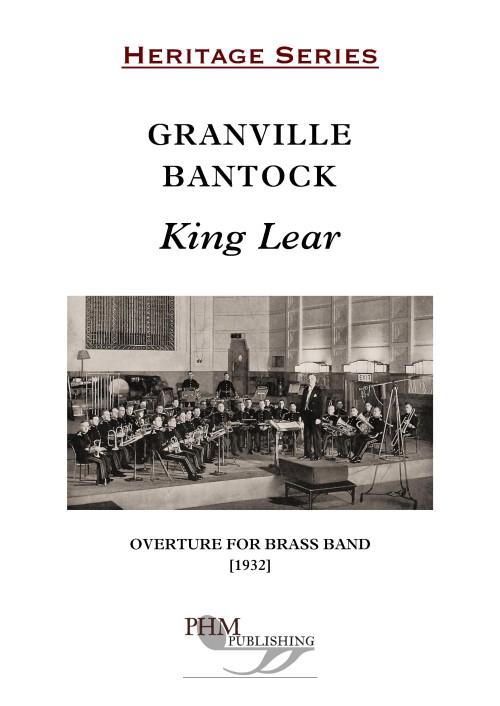
King Lear (Brass Band - Score and Parts) - Bantock, Granville - Hindmarsh, Paul
Sir Granville Bantock (1868 - 1946) composed the second of his five major brass band work for Callender's Cableworks Band, completing the commission on 30 November 1932. Based in the Thames-side district of Belvedere near Erith, the band was active between 1898 and 1961. The works band of the Callender Cable & Construction Co. Ltd, it was at the peak of its popularity during the 1930s and was a frequent broadcaster on the radio. The band employed an in-house arranger and played saxophones in its lighter material. King Lear was one of the band's major commissions and was not published in Bantock's lifetime. The manuscript score and parts were thought to be lost for decades, but were found in the library of the Haydock Band (Lancashire), which had inherited part of Callender's library of manuscripts material and bespoke arrangements after it has been transferred to nearby Prescott Cables Band after Callender's Cable Works closed.King Lear is a substantial work, in essence a dramatic tone poem in the romantic Tchaikovskian manner, presenting a series of character portraits of the foolish old king and his three daughters, Goneril, Regan and Cordelia. The music is dramatic and lyrical by turns, with the most generous lyrical episode revealing perhaps the warm-hearted Cordelia. An expansive melody that flows from this is brought back towards the end as the main climax of the work.In 2001, Bantock's score was recorded by the University of Salford Brass Band, conducted by Dr. Roy Newsome. The original is serviceable, but in comparison with the orchestral version he made in 1936 (part of which was recorded on a Paxton 78 rpm) and later brass band scores, performing editions of which were prepared by others, it lacks colour and range typical of Bantock's orchestral work. Above all it lacks percussion, which can be heard on the recorded extract. With the kind permission of the Bantock Estate, I have prepared a performing edition for publication that incorporates percussion, derived from the orchestral recording and added editorially in similar manner elsewhere. I have revoiced some of the low- lying instrumental parts to present the material in more comfortable ranges. Editorial interventions more elaborate than revoicing the original text have been identified as cue notes.- Paul HindmarshDuration: 15.00
Estimated dispatch 7-14 working days
-
£40.00
King Lear (Brass Band - Score only) - Bantock, Granville - Hindmarsh, Paul
Sir Granville Bantock (1868 - 1946) composed the second of his five major brass band work for Callender's Cableworks Band, completing the commission on 30 November 1932. Based in the Thames-side district of Belvedere near Erith, the band was active between 1898 and 1961. The works band of the Callender Cable & Construction Co. Ltd, it was at the peak of its popularity during the 1930s and was a frequent broadcaster on the radio. The band employed an in-house arranger and played saxophones in its lighter material. King Lear was one of the band's major commissions and was not published in Bantock's lifetime. The manuscript score and parts were thought to be lost for decades, but were found in the library of the Haydock Band (Lancashire), which had inherited part of Callender's library of manuscripts material and bespoke arrangements after it has been transferred to nearby Prescott Cables Band after Callender's Cable Works closed.King Lear is a substantial work, in essence a dramatic tone poem in the romantic Tchaikovskian manner, presenting a series of character portraits of the foolish old king and his three daughters, Goneril, Regan and Cordelia. The music is dramatic and lyrical by turns, with the most generous lyrical episode revealing perhaps the warm-hearted Cordelia. An expansive melody that flows from this is brought back towards the end as the main climax of the work.In 2001, Bantock's score was recorded by the University of Salford Brass Band, conducted by Dr. Roy Newsome. The original is serviceable, but in comparison with the orchestral version he made in 1936 (part of which was recorded on a Paxton 78 rpm) and later brass band scores, performing editions of which were prepared by others, it lacks colour and range typical of Bantock's orchestral work. Above all it lacks percussion, which can be heard on the recorded extract. With the kind permission of the Bantock Estate, I have prepared a performing edition for publication that incorporates percussion, derived from the orchestral recording and added editorially in similar manner elsewhere. I have revoiced some of the low- lying instrumental parts to present the material in more comfortable ranges. Editorial interventions more elaborate than revoicing the original text have been identified as cue notes.- Paul HindmarshDuration: 15.00
Estimated dispatch 7-14 working days
-
 £40.00
Abide With Me (Euphonium Solo with Brass Band - Score and Parts) - McGhee, Paul
My arrangement of William H. Monk's tune of 1861, uses the euphonium soloist as the central figure for the melodic line in the three verses. Surrounding the solo line is an irregular pulsed figure in the percussion to give the music an unsettled feel whilst the muted ensemble lightly colour the melodic contour of the soloist. From the low beginnings of the piece, where no high instrumentation is used, we are led through the darkened texture to a bright finale, although the sense of the forbidding is always present.Abide With Me has always been a favourite hymn of mine and it was when watching the film 28 Days Later that I believed it would make a rather striking arrangement for brass band. This was confirmed further when the hymn was used at the 2012 opening ceremony of the London Olympics. The juxtaposition between the static, slow moving melody and the rhythmic effects of the dancers was something that I thought could be captured in an arrangement.- Paul McGheeDuration: 5.00
Estimated dispatch 7-14 working days
-
 £87.99
Centennial Salute (Brass Band - Score and Parts) - Sparke, Philip
Just based on its title, this piece has to be celebratory and up-beat, which it is! It opens with a stately fanfare, first played on the low brass before the entire band joins in. This gives way to a contrasting lyrical theme which develops until it joins up with the fanfare to complete the opening section. A lively and heavily syncopated vivo follows, cast as a traditional march, complete with a 'bass strain' and trio. After the original march theme returns, a climax leads back to a reprise of the majestic opening, which brings the piece to an appropriately triumphant close.Duration: 7:30
Estimated dispatch 7-14 working days
-
 £89.95
The Trumpets of the Angels (Brass Band - Score and Parts) - Gregson, Edward
The Trumpets of the Angels was commissioned by the Fodens (Courtois) Band for their centenary concert at The Bridgewater Hall in 2000. It is based on a work written for the BBC Philharmonic and Huddersfield Choral Society in 1998, the starting point of which was a quotation from the Book of Revelation:and I saw the seven angels which stood before God; and to them were given seven trumpetsThus the idea behind the work is dramatic and I have tried to achieve this by the spatial deployment of seven solo trumpets around the band, four on-stage, the others off-stage. Six of the solo trumpets eventually join the band, but Trumpet 7 remains off-stage and, indeed, has the most dramatic and extended cadenza representing the words of the seventh angel ...and time shall be no more.The Trumpets of the Angels is a large-scale work, scored for seven solo trumpets, brass band, organ and percussion (deploying 'dark' instruments such as tam-tams, bass drum and two sets of timpani). The work opens with a four-note motif announced by off-stage horns and baritones and answered by fanfare figures on solo trumpets. In turn, each of the first four solo trumpets play cadenzas and then all four join together, independently playing their own music. The organ enters dramatically with its own cadenza, leading to the entry of solo trumpets 5 and 6 with music that is more urgent and rhythmic, describing the horsemen of the Apocalypse.The music reaches another climax, more intense this time, with the horns and baritones (now on-stage) again sounding the transformed motif, before subsiding into what might be described as a lament for humanity, slow music which builds from low to high, from soft to loud, with a melody that is both simple and poignant. At the climax, Trumpet 7 enters playing the opening four-note motif, dramatically extended to almost three octaves. This cadenza (to the partial accompaniment of tam-tams) introduces new material and foreshadows the ensuing scherzo which is fast and aggressive. Despite the somewhat desolate mood of this music, it slowly moves towards an optimistic conclusion, transforming the 'humanity' music into an affirmative and triumphant statement.- Edward Gregson
Estimated dispatch 7-14 working days
-
 £44.95
The Trumpets of the Angels (Brass Band - Score only) - Gregson, Edward
The Trumpets of the Angels was commissioned by the Fodens (Courtois) Band for their centenary concert at The Bridgewater Hall in 2000. It is based on a work written for the BBC Philharmonic and Huddersfield Choral Society in 1998, the starting point of which was a quotation from the Book of Revelation:and I saw the seven angels which stood before God; and to them were given seven trumpetsThus the idea behind the work is dramatic and I have tried to achieve this by the spatial deployment of seven solo trumpets around the band, four on-stage, the others off-stage. Six of the solo trumpets eventually join the band, but Trumpet 7 remains off-stage and, indeed, has the most dramatic and extended cadenza representing the words of the seventh angel ...and time shall be no more.The Trumpets of the Angels is a large-scale work, scored for seven solo trumpets, brass band, organ and percussion (deploying 'dark' instruments such as tam-tams, bass drum and two sets of timpani). The work opens with a four-note motif announced by off-stage horns and baritones and answered by fanfare figures on solo trumpets. In turn, each of the first four solo trumpets play cadenzas and then all four join together, independently playing their own music. The organ enters dramatically with its own cadenza, leading to the entry of solo trumpets 5 and 6 with music that is more urgent and rhythmic, describing the horsemen of the Apocalypse.The music reaches another climax, more intense this time, with the horns and baritones (now on-stage) again sounding the transformed motif, before subsiding into what might be described as a lament for humanity, slow music which builds from low to high, from soft to loud, with a melody that is both simple and poignant. At the climax, Trumpet 7 enters playing the opening four-note motif, dramatically extended to almost three octaves. This cadenza (to the partial accompaniment of tam-tams) introduces new material and foreshadows the ensuing scherzo which is fast and aggressive. Despite the somewhat desolate mood of this music, it slowly moves towards an optimistic conclusion, transforming the 'humanity' music into an affirmative and triumphant statement.- Edward Gregson
Estimated dispatch 7-14 working days
 View Music