Results
-
 £115.60
Dream of the Return - Pat Metheny - Ray Farr
Dream of the Return is one of the tracks on Pat Metheny's album of 1989 "Letter from Home".The CD recording is remarkable for its variety, imagination and musical artistry, and the combining of Latin American rhythms with jazz harmonyproduces magical results especially with Pat Metheny's guitar playing.While most tracks on the CD are instrumental, this song stands out because of its beautiful lyrics (by Pedro Aznar) which, roughly translated, are:I tossed a poemto the sea that took my questions and my voice.Like a sinking ship it was lost in the waves.I begged it not to return without having seen the open seaAnd in my dreams, show me what it had seen.Even if it did notcomeback I would know that it had journeyed.Floating all the time on calm or stormy seasEven though some safe haven waits.I waited long for its answer and almost gave up hope,And with a yearning voice I cried desperatelyto the heavens.Much later, somehow, it was washed ashore like an answered prayer.Now the rolling sea beats in my veins and sets my heart free
Estimated dispatch 5-14 working days
-
£76.99
Durkle Bandrydge Suite - Bruce Fraser
Durkle Bandrydge is the name of the composers imaginary world, but it could very well be anyones invisible dream world with a different name. In this very versatile suite by Bruce Fraser, 8 characters are featured, each with its ownpeculiarities, making Durkle Bandrydge such a colourful place. Do these characters differ that much from us? That is for you to find out! In the last part, all characters come together in a special way.Durkle Bandrydge exists at the end ofyour street. It is invisible to humans, but Durkle Bandrygators can watch us with great interest. The music will introduce you to some of the characters who live in this unusual place. The parts: Somnanbulyss, who is a giant trollguarding the entrance to Durkle Bandryde. At least, he is supposed to, but he tends to sleep most of the time. His music is therefore very slow moving and sleepy. Long Gwysteen is a tall, mysterious, and somehow sophisticated character,who walls around with a shell on his back. His music glides along rather gracefully. Squelfitch is a rather unpleasant and smelly character who lives in a bog, which is why his music sounds rather slimy and a bit like trying to walkthrough quicksand. Perfydlia is a meddling old woman, who gossips about everybody and squeals with sudden delight at the small exciting bits of tittletattle about others in the village. In the music you can hear her sudden little squealsof delight. Maryann Lovely is a beautiful young lady, graceful, gorgeous, absolutely devine, and her music is obviously just the same. Thistledoo Nicely is a lively character who spends and spends and spends with her credit card,buying the latest fashion and never worries about having to pay the bills. Her music reflects her excitement when shopping and het 'happy go lucky' approach to life. Marsyn Edginton is the Lord of the manor, the richest man in town, the'big cheese', the man with all the power and, of course, the biggest house. He is very grand and his music like he could be a king. Jimmy McScotsmyn is a red haired scotsman wearing tartan cap. He misses his home country terribly and eatslots of shortbread, oatcakes, scotch eggs, porridge and drinks an enormous amount of Scotch Wisky, which helps him to have fond memories of the kind of music he would like to dance to when he was a younger man. His favourite dance is a Jig andthis is the music he remembers. Grand March of the Durkle Bandrydgators. We hope that you have enjoyed meeting these characters from Drukle Bandrydge and would invite you to listen to all the villagers now march along in a grand parade -it is a pity that you can not see them, what is a wonderful sight. If you listen carefully, you will hear the melodies which belong to the characters as they march past. Oh what a grand spectacle!
Estimated dispatch 5-14 working days
-
 £271.60
Aubade - Dawn Songs of the Fabulous Birds - Torstein Aagaard-Nilsen
Commissioned by The Norwegian Band Federation for The European Brass Band Championship 2003, in Bergen, Norway (Third edition) I remember as a kid the very early morning wake-up ceremonies caused by Seagulls having a "party" outside our home. Very few would describe it as beautiful, particularly not at 4:30 in the morning... But by listening carefully to birds I was fascinated by their diversity and musical language: they dont sing tunes or long phrases, they rather make sounds and signals, based on short motives. Aubade is based on musical pictures of the imaginary birds: the creatures with wings that exists only in myths and legends. The whole story starts with aBaritone-cadenza that evoke all the sleeping creatures. Very soon they all start to sing their songs in one way or another. The composition has a burlesque scherzo-character including slow espressive intersections. Traditional elements like melody and harmony is combined with extensive sounds and textural effects created by use of multiple muting, singing and playing at the same time. I am not too concerned about having a program for the piece. I just know that by thinking of the unheard dragon-songs, griffin-songs, the sound of the dodo, my creativity was stimultated. As a piece of music, Aubade follows its own rules based on well-known elements like melodies, arpeggio-figures, harmonies, rhythms, variations and recapitulation of ideas. - Torstein Aagaard-Nilsen
Estimated dispatch 5-14 working days
-
 £54.99
Ding-a-Dong - Thijs Oud
The group Teach-In, from the Netherlands, won the Eurovision Song Contest in 1975 with the song Ding-a-Dong. It was the fourth time that a Dutch entry had won the prestigious festival but since then no Dutch artist has even come near first place again. The original Ding-a-Dong was performed, in keeping with tradition, with the accompaniment of a large orchestra. This sparkling arrangement of the catchy song provides a cheerful note in every concert. The melody will certainly stay in the audience's memory long after the performance.
Estimated dispatch 5-14 working days
-
 £60.99
Horns Enjoying Themselves - Bertrand Moren
This composition highlights the tenor horns. Long understated and unfairly relegated to the accompaniment, the tenor horn has gained prominence in the brass band during recent years.Horns Enjoying Themselves is an entertaining piece that will delight performers and audience alike. The first part is inspired by circus, with playful themes featuring humorous dissonances. The second part is a slow and calm journey through the mellow and luminous sound colours of the tenor horn. The third and last movement opens with a cadenza played by the soloists (alone). Written in triple time, it showcases the technical skills of the soloists.
Estimated dispatch 5-14 working days
-
 £29.95
The Strong Tower (Brass Band - Score and Parts)
Following the popularity of Turris Fortissima, I decided, albeit many years later, to revisit some of the material it contains and create a shorter piece, expanding on some of the ideas and motifs, allowing myself to follow those in different directions altogether. The result is this piece which I hope will also excite players and listeners alike.The music is marked at a quick tempo from the start, but despite several changes in meter, the tempo doesn't change until the small accelerando leads us into the presto section. In order to maintain the excitement and drama, it's important to set the pace and keep it consistent throughout.Section A introduces a few of the motifs that will be developed during the piece, including the main Turris Fortissima theme from bar 13 to 18.At section B, ensure the quavers are tight across the whole band with a strong attack, making an obvious difference in dynamic when fff is marked, in bars 23, 25 and 27. A more lyrical approach will be effective from the Horns in section C, with vigorous interruptions from the rest of the band breaking up their melody.Section D features long notes from muted 1st and 2nd Cornets and Trombones, with crescendos each time. These should be significant and sound as though they emerge from nowhere, completely cutting through the overall texture.Section D features long notes from muted 1st and 2nd Cornets and Trombones, with crescendos each time. These should be significant and sound as though they emerge from nowhere, completely cutting through the overall texture.Sections E and F are both passages of building intensity. Various contrasting motifs are layered, including a subtle reference to the hymn tune Ein' feste Burg (A mighty fortress is our God) from the Euphonium. The music becomes more busy and muddled, before reaching its climax at section G where the lyrical melody is heard again, this time from the Solo Cornets and Euphonium.In bars 141 to 145, there is a reference to Dean Goffin's My strength, my tower in the Basses, as used in Turris Fortissima. Allow this motif to dominate, keeping the notes full and grand-sounding. In bars 149 to 151 there is further use of the line from Ein' feste Burg in the Baritones, Trombones, Euphoniums and Basses leading into the final section.- Steven Ponsford
Estimated dispatch 7-14 working days
-
 £79.95
Neverland - Christopher Bond
"All children, except one, grow up" wrote J.M. Barrie about Peter Pan in 1911; the first line and an expression of beautiful melancholy and fantasy, coming to represent one of the best-loved children's stories of the twentieth century. 'Peter & Wendy', as the book was first released, has subsequently been transformed into adaptations for film and stage, with subsequent books based on this iconic tale. In writing this new work for brass band, the composer has taken three of the main themes from J. M. Barrie's book, and used these themes to create new musical material, forming a work in three contrasting sections. I. Journey to Neverland The opening of the work, mysterious in its style, reflects the opening chapters of the story - a leafy London street, still in the dead of night - with the music transforming quickly as it builds in texture and momentum - a Journey to Neverland through the night sky; Second Star to the Right and straight on 'til morning. "Then Peter knew that there was not a moment to lose. 'Come,' he cried imperiously, and soared out at once into the night, followed by John and Michael and Wendy. Mr & Mrs Darling and Nana rushed into the nursery too late. The birds were flown." II. The Windows that Closed The central section of the work takes its inspiration from the sense of longing throughout the book, mainly by Peter Pan, the Darling Children & The Lost Boys. Distant memories of life before Neverland, memories of the Lost Boys' mothers, and regret at what the children have missed. Peter says "Long ago, I thought like you that my mother would always keep the window open for me; so I stayed away for moons and moons and moons, and then flew back; but the window was barred, for mother had forgotten all about me, and there was another little boy sleeping in my bed." III. Aboard the Pirate Ship The final section of the work takes its inspiration from the Pirate Ship, and Peter Pan's ultimate battle with its infamous Captain Hook. "In person, he was cadaverous and blackavized, and his hair was dressed in long curls, which at a distance looked like black candles, and gave a singularly threatening expression to his handsome countenance. His eyes were the blue of the forget-me-not, and of a profound melancholy, save when he was plunging his hook into you, at which time two red spots appeared in them and lit them up horribly."
Estimated dispatch 10-14 working days
-
£70.00
Milestone - Peter Meechan
Milestone is a concerto commissioned by Mark Wilkinson (with funds provided by the Arts Council England) to celebrate 21 years as Principal Cornet with Fodens Band. In three movements, the work is intended to not only demonstrate the soloistas virtuosic skills, but also his ability to communicate to the audience.The first movement, titled Milestone, combines sections of driving rhythms (intended to represent Markas years of continuing hard work), in the accompaniment with long legato phrases from the soloist interspersed with dexterous, virtuosic, passages.The second movement, Song, features a simple chord sequence, over which the soloist asingsa a melody, each time varying and each time becoming more expressive, leading to an emotional climax.The final movement, Twenty One, is a quasi-celebratory dance. Opening with the band clapping, the soloist weaves their way through the various textures in the band. Occasionally making both a musical and metaphorical nod to the industrious nature of the first movement, the chord sequence of the second movement also re-appears, before a brief coda takes us to the conclusion of the work.
Estimated dispatch 12-14 working days
-
£100.00
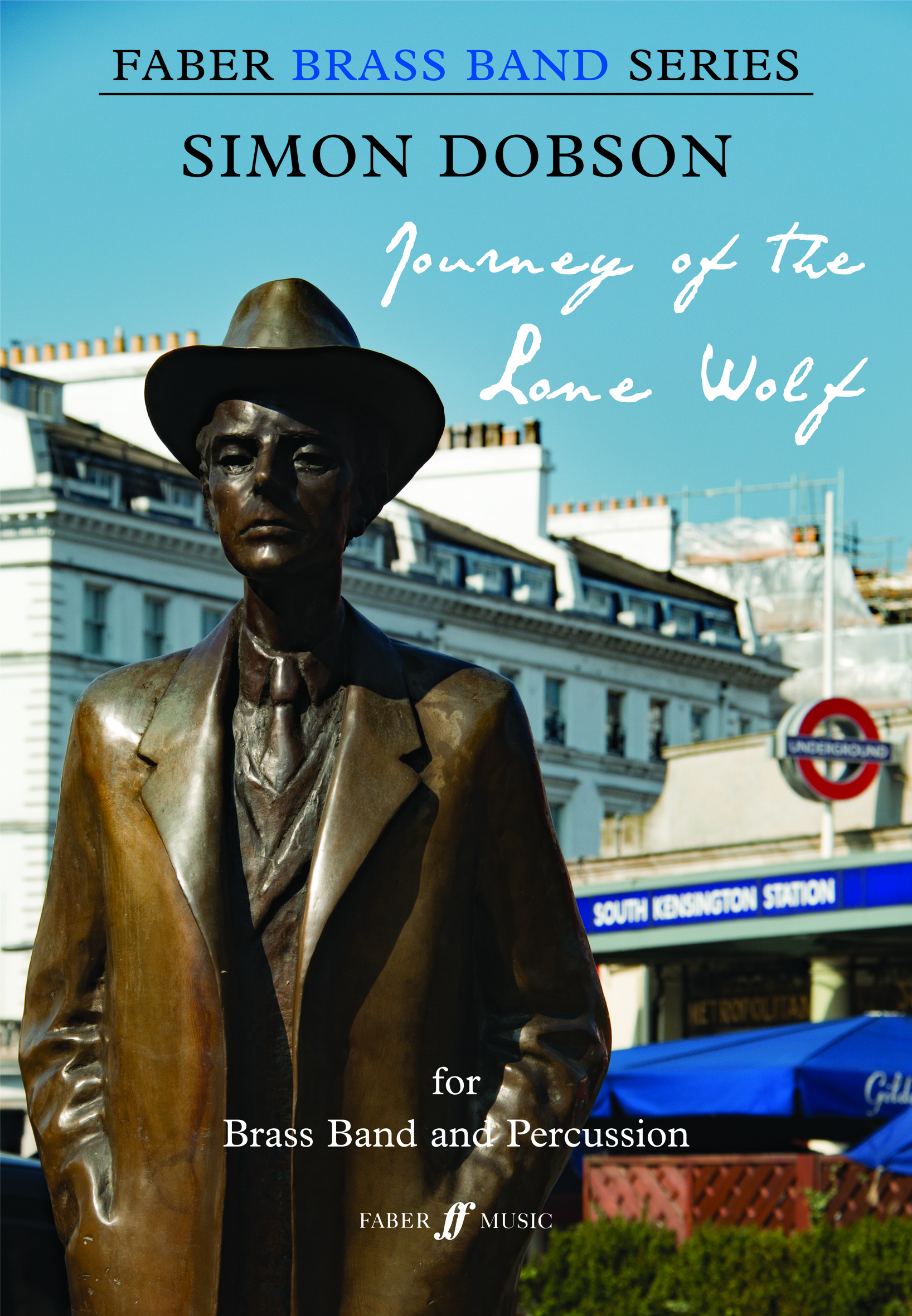
Journey of the Lone Wolf (score & parts) - Simon Dobson
Journey of the Lone Wolf tells the story of the hungarian composer Bla Bartk. It was commissioned by Dr. Nicholas Childs for Black Dyke Band, who gave the first performance on Sunday 26 January 2014 at the Bridgewater Hall, Manchester as part of the Royal Northern College of Music Festival of Brass.The composer's programme notes for each movement: 1. Capturing the Peasants' SongAfter the upheaval of moving to Budapest the young Bla Bartk meets Zoltn Kodly and the pair embark on summertime adventures throughout the Hungarian countryside to collect and catalogue the astonishing variety (both harmonically and rhythmically) of gypsy and folk music heard in the Balkans. The arrival of WW1 plunges Bartk's beloved Hungary into chaos.2. Night MusicBartk was at times a cold man, aloof and lonely. The odd moments of tenderness he showed are portrayed here in a series of evocative solos. His brief but intense affairs speak of a love he could only long for. Jazz is my night music and here there are hints of what Bartk may have heard in the USA later in his life.3. Flight and FightHaving been forced by the world's evils to leave his homeland of Hungary for America, Bartk, the anti-fascist, felt isolated and angry. In this movement we hear his longing for a simpler time of gypsy folk dances as well as his maturity and depth as a composer finally exploring deeper colours and darker themes. Duration: 15 minutes.Level: Championship
In Stock: Estimated dispatch 1-3 working days
-
£70.00
Apophenia - Peter Meechan
aApophenia is the experience of seeing patterns or connections in random or meaningless data.aApophenia is a trumpet concerto in three movements written for American trumpet virtuoso Rex Richardson. Each of the three movements features a different instrument; Movement 1 is for the Bb trumpet, the second is for flugel horn and trumpet, and the third is for trumpet and piccolo trumpet.Each of the three movements of Apophenia relate to the phenomenon of viewing Dark Side of the Rainbow - a name used to refer to the act of listening to the 1973 Pink Floyd album The Dark Side of the Moon whilst watching the 1939 film The Wizard of Oz, where moments where the film and the album appear to correspond with each other.Movement 1 is a fast a furious movement. Solo and ensemble interact at high tempo, swapping and creating new ideas, leading each other in new directions. Aside from the trumpet soloist, the kit player also acts as a quasi soloist.The second movement takes its musical inspiration from the Pink Floyd song Us and Them. It is during this segment of the film that some of the most amazing moments of connection happen.The final movement is a dance - and a tour de force for the soloist who begins on the Bb trumpet, before switching to the piccolo trumpet (or Eb trumpet) for the fast and furious finale. Many of the coincidences from Dark Side of the Rainbow relate to dancing, however, as long as a piece of music is the same tempo as the original, and the time signature is a regular one, this could be the case across most films. So the composer chose to write a dance that wouldn't synchronise to too many existing dance scenes!The soloist is free to improvise their own cadenza.Apophenia is dedicated to Rex Richardson.
Estimated dispatch 12-14 working days
 View Music