
Results
-
£24.50
Sailor's Hymn - Amber Hooton
Sailor's Hymn depicts a scene of sailors preparing to depart from the port of Liverpool, looking out over the docks as the Blue Peter flag flies,beckoning the sailors aboard to begin their long journey. It is a piece about saying goodbye to what was once familiar, moving on and pushing towards new horizons.This piece was written for a cultural exchange between brass and wind bands from St Helens (Valley Brass Band) and Normandy (Harmonie Courselles Sur Mer), culminating in a massed bands concert in Normandy during April 2024. The piece was one of several arrangements and original compositions written especially for the exchange, supported by grants from the Victoria Wood Foundation and Johnson Foundation. The concert celebrated the local cultures of Merseyside and Normandy, as well as the wider national cultures of the United Kingdom and France.
In Stock: Estimated dispatch 1-3 working days
-
 £40.00
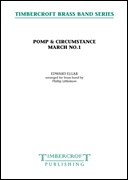
Pomp and Circumstance March No.1 (Brass Band - Score and Parts) - Elgar, Edward - Littlemore, Phillip
Elgar's Pomp & Circumstance March No. 1?was completed in July 1901 although the 'big tune' actually dates from earlier in that same year. It was premiered in Liverpool by its dedicatees, the Liverpool Orchestral Society, on the 19th October. It was repeated in London a few days later by Henry Wood at the Promenade concerts and the result was sensational, the audience roared its applause, and refused to allow the concert to continue. In order to restore order, Wood conducted the march three times - the only time in the history of the Promenade concerts that an orchestral item was accorded a double encore in Wood's lifetime. Duration: 6:40
Estimated dispatch 7-14 working days
-
 £54.99
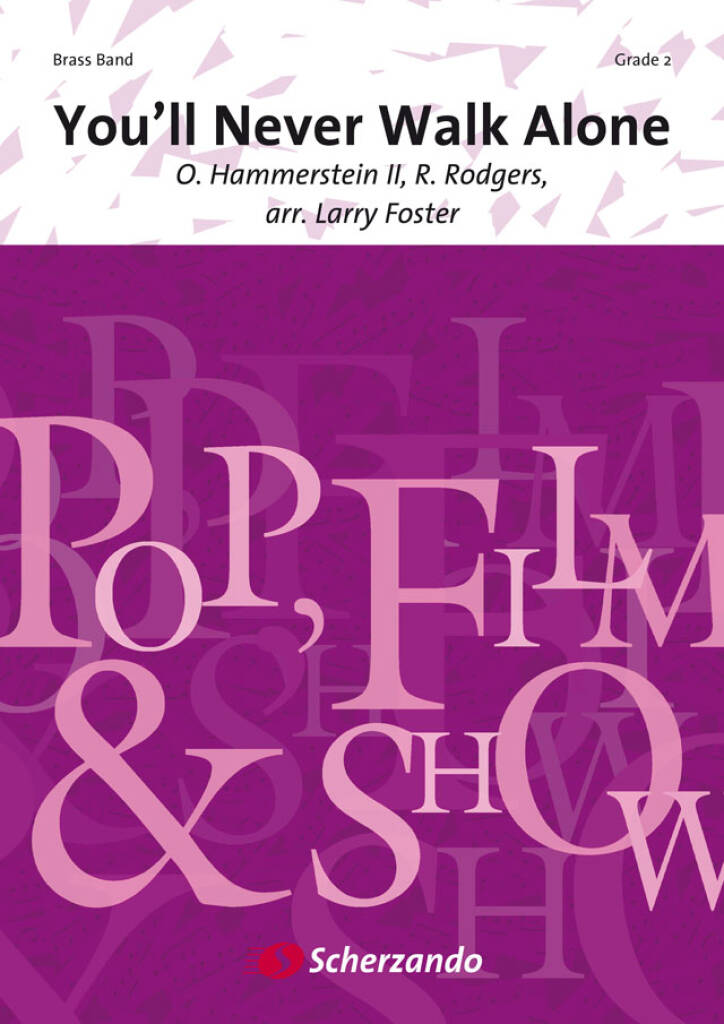
You'll Never Walk Alone - Oscar Hammerstein II - Larry Foster
This great football anthem (don't be put off if you are not a Liverpool supporter!) was originally featured in the Rogers and Hammerstein musical Carousel, however it was made famous worldwide when it was sung against the background of the Eiffel Tower to close the 1998 World Cup. It can now be performed by your band, with or without football scarves, to end your concert on a winning note.
Estimated dispatch 5-14 working days
-
 £24.95
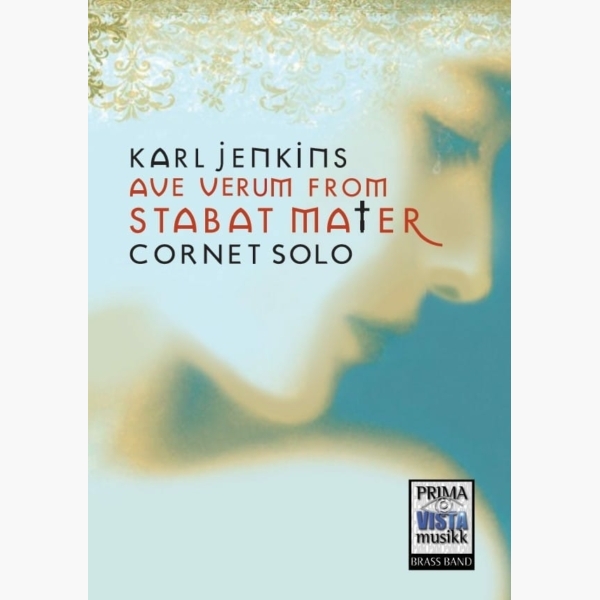
Ave Verum from Stabat Mater - Karl Jenkins - Andrew Wainwright / Robert Childs
The World premiere performance of Karl Jenkins' Stabat Mater took place on March 15th 2008 in Liverpool's Anglican Cathedral performed by the Royal Liverpool Philharmonic Orchestra and Choir conducted by the composer. Stabat Mater is a 13th-century Roman Catholic poem...
Estimated dispatch 5-7 working days
-
 £64.95
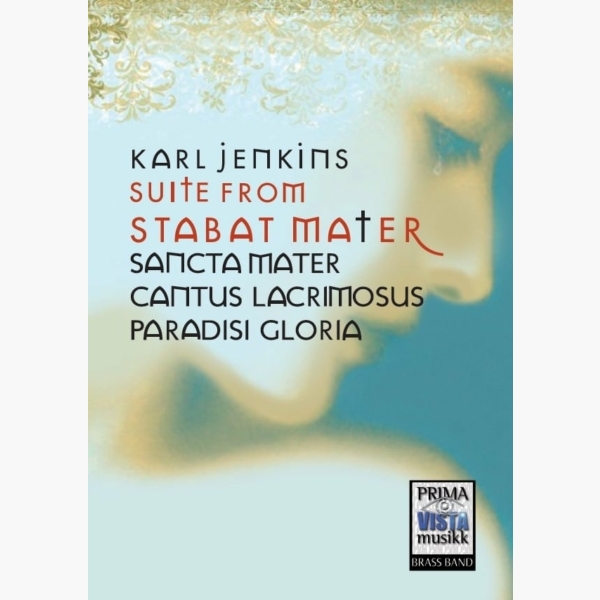
Suite from Stabat Mater - Karl Jenkins - Andrew Wainwright / Robert Childs
The world premiere performance of Karl Jenkins' Stabat Mater took place on March 15th 2008 in Liverpool's Anglican Cathedral, performed by the Royal Liverpool Philharmonic Orchestra and Choir conducted by the composer. Stabat Mater is a 13th-century Roman Catholic poem...
Estimated dispatch 5-7 working days
-
£35.00
Epitaph (for Hillsborough) - Peter Meechan
Epitaph (for Hillsborough) was written on the 20th anniversary of the Hillsborough stadium disaster, April 15 1989, in memory of the 96 victims. All of the victims were fans of Liverpool Football Club, the club I have supported since I was a young child.The disaster unfolded in front of the BBC television cameras, and due to the importance of the match (FA Cup semi final), millions, including myself, witnessed it first hand, leaving a lasting impression in the public psyche.Several features of the piece were determined by the tragedy. The length of the piece, 6 and a half minutes, represents the minutes of the game that were played that day (The match was abandoned after 6 minutes), and the final thirty seconds of the work, where the band gently applaud, is a reference to the first match played after the tragedy, a European Cup semi final between AC Milan and Real Madrid.After 6 minutes, the referee blew his whistle and all the players stood still where they were, both sets of fans applauded in memory of the perished, and the fans of AC Milan began singing Youall Never Walk Alone, the anthem of Liverpool Football Club.The work also features 96 strikes of the tubular bells, in memory of each person who lost their life.Epitaph is dedicated to the 96 people who died that day, and to their families whose fight for justice is an inspiration to all.
Estimated dispatch 12-14 working days
-
 £45.00
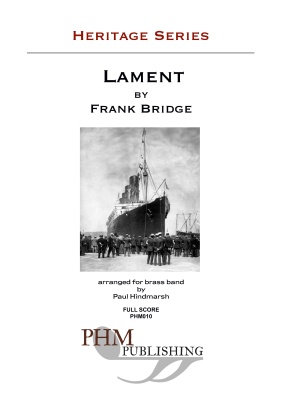
Lament (Brass Band - Score and Parts)
The English composer Frank Bridge (1879 - 1941) did not take an active part in the First World War. However, he was devastated by the slaughter on the western and the eastern fronts, especially the loss of so many of his musicians friends and colleagues. Writing in 1963, his former pupil Benjamin Britten confessed that 'a lot of my feelings about the First World War which people seemed to see in the War Requiem came from Bridge. He had written a piano sonata in memory of a friend killed in France and though he didn't encourage me to take a stand for the sake of a stand, he did make me argue and argue and argue. His own pacifism was not aggressive, but typically gentle'.Bridge composed this Lament for string orchestra on 14 June 1915, in memory of Catherine Crompton, who drowned when the Cunard liner Lusitania was torpedoed by a German submarine on 7 May, 1915. According to figures researched by Liverpool historian Kevin Roach (www.lusitania.net), 1201 men, women and children lost their lives out of the 1962 people aboard. Ninety-four children died, including Catherine, her twin brother Paul and four other siblings. Paul Crompton, Snr. (44), a British businessman working in Philadelphia, his wife Gladys (40) and the family nanny were also drowned. How Bridge's dedication came about is uncertain. The music critic Edwin Evans, who knew Bridge well, has written that the Catherine was a young friend. It is also possible that he came across the family photograph which was published in many newspapers in the wake of the tragedy. By that time, Bridge was greatly distressed by the war as a whole. It seems perfectly in keeping with his pacifist leanings and the strength of his reaction, that this poignant and deeply touching 'war memorial' should mourn a child who he did not know, rather than one of the thousands of young men who fell in battle.Through the musical tears of this melancholy lullaby, Bridge may have regarded the death of young Catherine Crompton as symbolic of the loss of so many innocent lives in wartime. His response to this personal tragedy was characteristically spontaneous and utterly sincere. It is one of his most effective miniatures, poignant yet restrained in its lyrical beauty, with a compelling directness and simplicity of construction.This brass band transcription is pitched one tone lower than the original for string orchestra.- Paul HindmarshDuration: 5.00
Estimated dispatch 7-14 working days
-
 £29.51
How Shall I Woo Thee (Cornet Solo with Brass Band) Coleridge-Taylor arr.Bushnell
The 7 African Romances, Op. 17 for voice and piano has words by Paul Laurence Dunbar and music by Samuel Coleridge-Taylor. Published in 1897, it comprises of 7 songs, "An African Love Song", "A Prayer", "A Starry Night", "Dawn", "Ballad", "Over the Hills" and "How Shall I Woo Thee?", of which the last is arranged here.This arrangement was requested by Besses o' th' Barn Band for the The Samuel Coleridge-Taylor Festival held in Liverpool on 11 October 2025. The song is wonderfully lilting with moments to indulge in the music.This arrangement is for the UK-style brass band and either solo B-flat cornet, solo E-flat soprano cornet or soprano singer. It also has alternative parts for horns in F and bass-clef lower brass. A recording of the original song can be found here: https://www.youtube.com/watch?v=tglGpaBsWOo Duration: Approx. 3.10 minutes Difficulty Level: 4th Section + This PDF download includes the full score and parts. Includes alternative parts for soloist in Eb, horns in F and lower brass in bass clef. Sheet music available at www.brassband.co.uk (UK) or https://satradecentral.org (USA) Instrumentation: Cornet Soloist Bb Soprano Cornet Eb Solo Cornet Bb Repiano Cornet Bb 2nd Cornet Bb 3rd Cornet Bb Flugel Horn Bb Solo Horn Eb 1st Horn Eb 2nd Horn Eb 1st Baritone Bb 2nd Baritone Bb 1st Trombone Bb 2nd Trombone Bb Bass Trombone Euphonium Bb Bass Eb Bass Bb Timpani Percussion 1-2
In Stock: Estimated dispatch 1-3 working days
-
£35.00
Match Day - Peter Meechan
Match Day takes itas inspiration from a night in May 2005, when the team I have supported from my childhood, Liverpool FC, won the European Cup in what was considered by many to be one of the greatest football matches of all time.The piece is not only inspired by a football match, but also takes its musical material from chants and songs that you will hear at 3PM on a Saturday afternoon at any football ground in the country.Match Day was written as a result of a commission from the National Youth Brass Band of Great Britain, and their Musical Director, Bramwell Tovey, to whom the piece is dedicated.First performance:National Youth Brass Band of Great BritainBramwell Tovey - Conductor
Estimated dispatch 12-14 working days
-
£70.00
Shine - Peter Meechan
Shine is my second large scale work for solo tuba, following on from my concerto Episodes and Echoes. Like the concerto, Shine was commissioned and premiered (with the Grimethorpe Brass Band, conducted by Howard Evans) by Les Neish - the title being an anagram of the soloist surname.Although in one movement, Shine has 3 broad sections, each requiring virtuosic skill and dexterity from the soloist. The opening section features lots of bright, metallic sounds - especially in the percussion section - providing the accompaniment to soloist as they demonstrate the range and flexibility of the tuba.The second section gives the soloist the opportunity to demonstrate the considerable lyricism that the tuba is capable of. The solo line weaves in and out of textures in the accompaniment, exchanging snippets of melody with other players in the ensemble.After a short unaccompanied passage, the final section emerges juxtaposing new solo lines and material from the opening section. This builds in momentum - and difficulty for the soloist - as the piece reaches its climatic ending.Shine is dedicated to my good friend, fellow Liverpool supporter, and amazing musician, Les Neish.Peter Meechan, 2011
Estimated dispatch 12-14 working days
 Listen to MP3
 View Music