
Results
-
 £80.00
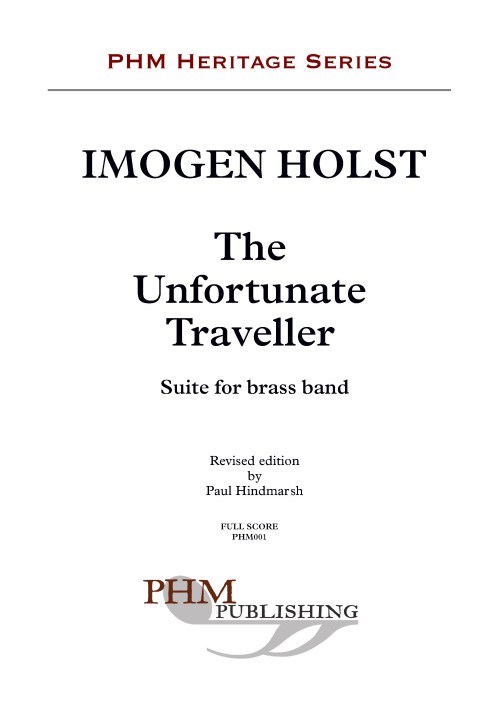
The Unfortunate Traveller (Brass Band - Score and Parts) - Holst, Imogen - Hindmarsh, Paul
Imogen Holst (1907-1984) submitted The Unfortunate Traveller (1929) as her final work as a student portfolio at the Royal College of Music, where her composition teacher was Gordon Jacob. The title was taken from Thomas Nashe's famous 1594 picaresque novel of the same title. The Suite was first performed on 12 February 1933 at her Majesty's Theatre, Carlisle, by the St. Stephen's Band, with the composer conducting. Te concert was given in memory of Holst's uncle, Dr. H.A. Lediard. Holst had been impressed with the band's performance of his A Moorside Suite at the 1928 National Brass Band Championships (The Crystal Palace, South London) and was keen to work with them. Writing in Imogen Holst, a life in music, Christopher Grogan indicates that it was Gustav Holst's suggestion to include his daughter's work in the programme, quoting Imogen Holst's remarks made in interview to The Daily Mail as follows: "....it is the first time, so far as I know, that a woman has conducted a brass band at a public concert....It has been a delight to rehearse the St. Stephen's Band. It was their performance at the Crystal Palace Festival that inspired me to write this Suite, which I have dedicated to them."Imogen Holst accompanied her father to the Crystal Palace in 1928 to hear the performances of A Moorside Suite, and was so excited by the played and, audibly, by her father's music that she decided to write a brass band piece for her final examination. Te result was The Unfortunate Traveller (1929). However, it was not possible for her to present a brass band work for examination. She arranged it for string orchestra so that it could be played before she left the RCM in July 1930. Following the premiere of the original in 1933, the manuscripts did not resurface until 1969 Imogen found them among her late mother's effects. Although she requested score and parts be destroyed, they ended up in the possession of Manchester composer John Golland, who marked up the score presumably with the intention of creating a new performing edition. The original scoring reveals a lack of experience with what can be a tricky medium.With the agreement of the Holst Foundation, a revised edition, with additional percussion, was prepared in 2011 since when the work has been fortunate to travel round the world as a concert and contest piece. The original includes drums in the March only. The title was taken from Tomas Nashe's famous 1594 picaresque novel of the same title. Several Morris Dance tunes are introduced during the course of the four short movements, including Bonnie Green Garters, Shepherd's Hey, The Rose and The Wind Blaws Cauld. Quirky twists and turns of harmony and spirited rhythms that remind us how much Imogen Holst loved tradition English dance music.In September 2025, I made a performing edition of the composer's arrangement for string orchestra. The manuscript lacks the final movement, which I arranged in a similar style, ie. without extending the upper ranges. Making this edition raised some issues regarding the accuracy of my band version and some of the solutions I used to smooth out the voicing. I have used the composer's second thoughts to refine my performing edition and to correct a textual errors.- Paul HindmarshDuration: 10.00
Estimated dispatch 7-14 working days
-
£40.00
The Unfortunate Traveller (Brass Band - Score only) - Holst, Imogen - Hindmarsh, Paul
Imogen Holst (1907-1984) submitted The Unfortunate Traveller (1929) as her final work as a student portfolio at the Royal College of Music, where her composition teacher was Gordon Jacob. The title was taken from Thomas Nashe's famous 1594 picaresque novel of the same title. The Suite was first performed on 12 February 1933 at her Majesty's Theatre, Carlisle, by the St. Stephen's Band, with the composer conducting. Te concert was given in memory of Holst's uncle, Dr. H.A. Lediard. Holst had been impressed with the band's performance of his A Moorside Suite at the 1928 National Brass Band Championships (The Crystal Palace, South London) and was keen to work with them. Writing in Imogen Holst, a life in music, Christopher Grogan indicates that it was Gustav Holst's suggestion to include his daughter's work in the programme, quoting Imogen Holst's remarks made in interview to The Daily Mail as follows: "....it is the first time, so far as I know, that a woman has conducted a brass band at a public concert....It has been a delight to rehearse the St. Stephen's Band. It was their performance at the Crystal Palace Festival that inspired me to write this Suite, which I have dedicated to them."Imogen Holst accompanied her father to the Crystal Palace in 1928 to hear the performances of A Moorside Suite, and was so excited by the played and, audibly, by her father's music that she decided to write a brass band piece for her final examination. Te result was The Unfortunate Traveller (1929). However, it was not possible for her to present a brass band work for examination. She arranged it for string orchestra so that it could be played before she left the RCM in July 1930. Following the premiere of the original in 1933, the manuscripts did not resurface until 1969 Imogen found them among her late mother's effects. Although she requested score and parts be destroyed, they ended up in the possession of Manchester composer John Golland, who marked up the score presumably with the intention of creating a new performing edition. The original scoring reveals a lack of experience with what can be a tricky medium.With the agreement of the Holst Foundation, a revised edition, with additional percussion, was prepared in 2011 since when the work has been fortunate to travel round the world as a concert and contest piece. The original includes drums in the March only. The title was taken from Tomas Nashe's famous 1594 picaresque novel of the same title. Several Morris Dance tunes are introduced during the course of the four short movements, including Bonnie Green Garters, Shepherd's Hey, The Rose and The Wind Blaws Cauld. Quirky twists and turns of harmony and spirited rhythms that remind us how much Imogen Holst loved tradition English dance music.In September 2025, I made a performing edition of the composer's arrangement for string orchestra. The manuscript lacks the final movement, which I arranged in a similar style, ie. without extending the upper ranges. Making this edition raised some issues regarding the accuracy of my band version and some of the solutions I used to smooth out the voicing. I have used the composer's second thoughts to refine my performing edition and to correct a textual errors.- Paul HindmarshDuration: 10.00
Estimated dispatch 7-14 working days
-
 £65.00
RISE OF THE PHOENIX (Brass Band - Score and Parts) - Barry, Darrol
As the title suggests, the phoenix was a fabulous mythical bird, who every morning at dawn, sang a song so enchanting that even the sun God, Apollo, would stop and listen. The bird would live for a hundred years, and at the end of its life, would build a pyre, set it on fire and be consumed by the flames. After three days, the phoenix would be reborn from the ashes, to sing once more.This work was commissioned by Clifton and Lightcliffe Band and reflects the difficulties and rebirth of the band to make music once more.Suitable for second section bands and above.
Estimated dispatch 7-14 working days
-
£27.50
RISE OF THE PHOENIX (Brass Band - Score only) - Barry, Darrol
As the title suggests, the phoenix was a fabulous mythical bird, who every morning at dawn, sang a song so enchanting that even the sun God, Apollo, would stop and listen. The bird would live for a hundred years, and at the end of its life, would build a pyre, set it on fire and be consumed by the flames. After three days, the phoenix would be reborn from the ashes, to sing once more.This work was commissioned by Clifton and Lightcliffe Band and reflects the difficulties and rebirth of the band to make music once more.Suitable for second section bands and above.
Estimated dispatch 7-14 working days
-
 £61.99
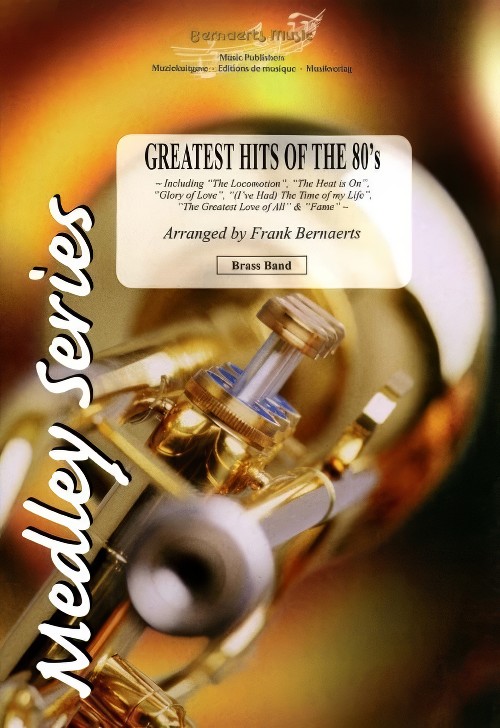
Greatest Hits of the 80's (Brass Band - Score and Parts) - Bernaerts, Frank
Including the titles: The Locomotion, The Heat Is On, Glory Of Love, (I've Had) The Time Of My Life, The Greatest Love Of All & Fame. Duration: 07:50
Estimated dispatch 7-14 working days
-
 £42.95
You Are the Sunshine of My Life (Flugel/Trombone Sextet with Brass Band - Score and Parts) - Wonder, Stevie - Richards, Goff
A brilliant feature for 3 flugel horns and/or cornets and 3 trombones.Although originally conceived to feature a sextet consisting of three Flugel Horns and three Trombones, with Brass Band, it may, of course, use cornets instead of Flugel Horns or, indeed, a mixture of the two.As it is envisaged that Solo Cornet players may be involved in the sextet, a Repiano Cornet part has been omitted so that the remaining cornet players can be dispersed among the parts to achieve the best balance.Recorded on Polyphonic QPRL229D Ovation!
Estimated dispatch 7-14 working days
-
 £21.99
Pirates of the Caribbean: Dead Man's Chest (Brass Band - Score only)
The atmosphere of the brilliant and successful Walt Disney film Pirates of the Caribbean - Dead Man's Chest was partly defined by the exciting, dramatic and powerful soundtrack by Hans Zimmer. With this excellent arrangement of his memorable themes, the adventure comes to life all over again! Take your band on a high seas adventure with this swashbuckling medley. 06:59
Estimated dispatch 7-14 working days
-
 £68.90
Elisabeth - Michael Kunze - Erik Jansen
The life of the Austrian empress Elisabeth (1837-1898) which started as a fairy tale but ended as a tragedy, inspired the librettist Michael Kunze and the composer Silvester Levay to write a musical based on the life of the popular 'Sissi'. The musical was premiered in Vienna on 3 September 1992 and was very successful for many years. The story is told by Luigi Lucheni, Elisabeth's murderer. So death, represented by a mysterious and seductive young man, is omnipresent throughout the musical. Several songs have become hits and, of course, you can hear them in this fine selection by Peter Kleine Schaars who gathered various music and dance styles such as the rock shuffle, the jazz waltz and the classical Viennese waltz.
Estimated dispatch 5-14 working days
-
 £183.20
Folklore - Kjetil Djønne
"Folklore" is a work for brass band and percussion loosely based on the story of the Norwegian woman accused of witchcraft, Anne Pedersdotter. She was sentenced to be burned at the stake in Bergen in the spring of 1590 and has since been frequently highlighted as Norway's most famous and talked-about witch.The work begins with the movement "Lyderhorn," depicting the mountain outside Bergen where witches gathered to plan magical actions against the city. Here, we hear the quietness of nature and the wind blowing through the trees before a new theme appears, which will come to life in the next movement. In the distance, the witches have started their ceremony.In the next movement, "Walpurgis Night," the witches perform their rituals to afflict the city with fire, disease, and natural disasters. The ceremony becomes more and more chaotic, violent, and compelling until the darkness of the night envelops us, concluding the section.The third movement describes the women's inner struggle against the harassment they faced when the people of Bergen suspected them of being witches. Rumors often turned into formal accusations from the legal system, and many were sentenced to death after undergoing trial. "From life to death through the fire."The fourth and final movement, "The Pyre," depicts the actual death sentence. You can hear the pyre being ignited and the flames growing and intensifying. It all culminates in a chorale as a memorial to the lives that were taken.
Estimated dispatch 5-14 working days
-
 £76.99
Bread and Games - William Vean
'Panem et Circenses', Bread and Games were essential for keeping the citizens of ancient Rome in check. While the bread was meant for the poorest among the Romans, the Games were Popular Pastime Number One for everybody.There were different kinds of games, such as chariot races (especially popular with female spectators), or wild-beast fights, where lions, tigers, bulls or bears were set on one another or even on human beings. Most popular, however, were the Gladiator fights. In 'Bread and Games' William Vean depicts one of the many fights in the antique Colosseum. 1. Entrance of the Gladiators: By powerful bugle-calls the attention of the peoplewas asked for, after which the Gladiators entered the Arena at the sound of heroic marching-music.2.Swordfight: We can hear that the fights were not mere child's play in this part.On the contrary, they were a matter of life and death and were fought accordingly.3.Mercy of the Emperor: Sometimes a wounded gladiator could be fortunate, depending on the mercy of the audience. Waving one's handkerchief meant mercy, a turned-down thumb meant no pardon. The Emperor had the right to take the final decision, but he usually complied with the wish of the majority of the public. 4.Lap of Honour: Gladiators were mainly selected among slaves, convicted criminals, or prisoners of war. Consequently, winning was very important, as it would mean fame, honour and sometimes even wealth. A lap of honour, therefore, was the winner's due reward.
Estimated dispatch 5-14 working days
 View Music