
Results
-
 £45.00
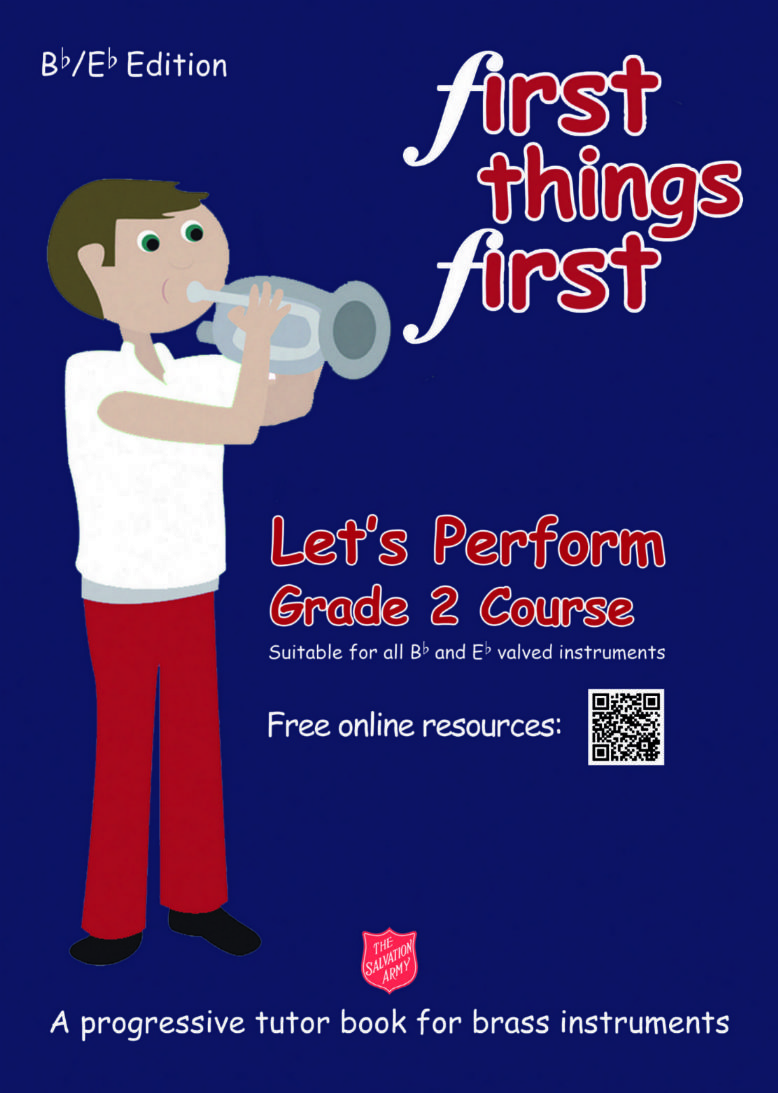
First Things First - Let's Perform (Grade 2 Course) Bb/Eb Edition (Pack of 10)
Let's Play (Elementary Course) provides an exciting and challenging early introduction to brass playing. Intentionally, using just the first 5 noes (C-G), the course allows and encourages the important early development of a brass player's most vital commodity, the lips!Includes link to downloadable resources including backing and demonstration tracks, online course assessment sheets and personalised course certificates.In this book you will be introduced to:new notes, extending your range both higher and lowernew rhythmic patters, including semiquaversnew time signatures, including 6/8 timekey signatures, meeting more sharps and flats
Estimated dispatch 7-14 working days
-
 £24.95
David of the White Rock (Cornet Solo with Brass Band - Score and Parts)
This melody is reputed to have originated in Caernarvonshire, North Wales. Tradition holds that a bard called David, lying on his deathbed, called for his harp and performed this plaintive tune, expressing a desire that it should be played at his funeral. Ever since the tune has been called by his name and that of his house 'Garagwen' ('Druid Stone' or 'White Rock'). The solo is not just a slow melody with brass band accompaniment but is a composite whole, the band needing as much sensitivity as the soloist in the presentation.
Estimated dispatch 7-14 working days
-
 £29.95
Judd: Deep Harmony
Stuart Pullin passed away in September 2007, aged just 32, but leaves a wonderful legacy of compositions. It was his wish that this moving arrangement of 'Deep Harmony' be donated to The Salvation Army for publication.
Estimated dispatch 7-14 working days
-
£50.00
Vectis Isle - Broadbent, D
VECTIS ISLE is the Roman name for the Isle of WrightSTATELY OSBORNEOsborne House was the summer residence of Queen Victoria. Music of fanfares and pageantry in 3/4 time, with a central delicate minuet section, before returning to the original fanfares and stately themes.PICTURESQUE CALBOURNECalbourne is a pretty, tiny country village with its feature of an old water mill. The music is pastorale in style. 6/8 rhythms with a free and easy waltz section.THE OLD CHURCH AT GODSHILLThis movement links directly from the second, but may be played on its own if desired. Godshill is a quaint but beautiful village of thatched cottages by an old church.SANDOWN HOLIDAYSThis final movement is intended to portray the happy atmosphere of this pleasant seaside resort, with just a moment or two to laze on the fine beaches under an afternoon sun before the final allegro concludes this suite.Duration 14 and a half mins
In Stock: Estimated dispatch 1-3 working days
-
 £44.95
Princethorpe Variations (Brass Band - Score and Parts) - Downie, Kenneth
Colourful harmony, rhythmic flair and melodic invention are the hallmarks of this excellent set of variations by Kenneth Downie, based on the well known church tune, Princethorpe.This major work demonstrates the well-known characteristics of the composer: colourful harmony, rhythmic flair and melodic invention, all encapsulated in scoring which is engulfing both to players and listeners alike. Following a presentation of the theme there are five variations culminating in what can be described as either a finale or coda.Theme. The composer shows his originality in the harmonic sense of this introduction. Perhaps it could be suggested that over-indulgence of rubato may be a temptation to be avoided.Sections A to F. Relentless rhythmic drive is of paramount importance in this first variation. Conscientious observance of dynamics is of course an essential requirement in conveying the exciting quality of the music; there are moments of sudden contrast of which all will need to be aware. Moving between the time-signatures of 5/4 and 6/4 these sections are built from strong easily-identifiable fragments of the theme. These is a significant increase in temp at letter F which will further the exciting impact of the music.Sections G & H. In a pastorale style this short, gentle variation affords a contrast in style between the previous and succeeding ones. The gentle undulating character of the melodic lines is governed by the Allegretto grazioso directive.Sections I to M. Commencing two bars before letter I the music is now exuberant and the tempo and style is that of a march in compound time. In this exhilarating movement there are moments of contrast and indeed of delicacy which are a foil to the more energetic moments. Rhythmic control will be essential to maintain a consistent tempo. As elsewhere in the work, the percussion section will contribute much to the success of the performance there are bars where this section alone is heard and there are important entries for glockenspiel.Sections N & O. With emotional content this Adagio variation has the first two notes of the melody as its melodic impetus. Apart from just over two bars at O (where there is an interpolatory phrase from Cornets and Trombones), the melodic line is entrusted to the plaintive sounds of the horn section. Cornets and Trombones provide a change of tone colour at the beginning of section O. Under a poco rall, this very expressive variation is concluded; there is an important link supplied by Eb Bass.Sections P & Q. A lively march-tempo is launched immediately and these sections are in the nature of an introduction to the final variations. There is a quickening of pace at Q which assists the generation of excitement which should be an essential part of the performance. Solo Cornets introduce a melodic line at Q which anticipates the compound time of the following section.Sections R & S. The Solo Cornet theme of the previous section is now a contrapuntal line accompanying the theme tune. With an elongation of the notes in the melody, the conductor will need to call on the sustaining powers of the band and at no time should the interesting accompanying lines be allowed to detract from the sonorous presentation of the basic theme.Sections T, U & V. Following a poco rit, the finale begins at letter T with the directive, molto vivace. There is much detail to be rehearsed, not least being the dynamic contrasts which are encountered. As throughout the work, the listener should have no difficulty in identifying the thematic sources of the composer's music.
Estimated dispatch 7-14 working days
-
£22.50
Princethorpe Variations (Brass Band - Score only) - Downie, Kenneth
Colourful harmony, rhythmic flair and melodic invention are the hallmarks of this excellent set of variations by Kenneth Downie, based on the well known church tune, Princethorpe.This major work demonstrates the well-known characteristics of the composer: colourful harmony, rhythmic flair and melodic invention, all encapsulated in scoring which is engulfing both to players and listeners alike. Following a presentation of the theme there are five variations culminating in what can be described as either a finale or coda.Theme. The composer shows his originality in the harmonic sense of this introduction. Perhaps it could be suggested that over-indulgence of rubato may be a temptation to be avoided.Sections A to F. Relentless rhythmic drive is of paramount importance in this first variation. Conscientious observance of dynamics is of course an essential requirement in conveying the exciting quality of the music; there are moments of sudden contrast of which all will need to be aware. Moving between the time-signatures of 5/4 and 6/4 these sections are built from strong easily-identifiable fragments of the theme. These is a significant increase in temp at letter F which will further the exciting impact of the music.Sections G & H. In a pastorale style this short, gentle variation affords a contrast in style between the previous and succeeding ones. The gentle undulating character of the melodic lines is governed by the Allegretto grazioso directive.Sections I to M. Commencing two bars before letter I the music is now exuberant and the tempo and style is that of a march in compound time. In this exhilarating movement there are moments of contrast and indeed of delicacy which are a foil to the more energetic moments. Rhythmic control will be essential to maintain a consistent tempo. As elsewhere in the work, the percussion section will contribute much to the success of the performance there are bars where this section alone is heard and there are important entries for glockenspiel.Sections N & O. With emotional content this Adagio variation has the first two notes of the melody as its melodic impetus. Apart from just over two bars at O (where there is an interpolatory phrase from Cornets and Trombones), the melodic line is entrusted to the plaintive sounds of the horn section. Cornets and Trombones provide a change of tone colour at the beginning of section O. Under a poco rall, this very expressive variation is concluded; there is an important link supplied by Eb Bass.Sections P & Q. A lively march-tempo is launched immediately and these sections are in the nature of an introduction to the final variations. There is a quickening of pace at Q which assists the generation of excitement which should be an essential part of the performance. Solo Cornets introduce a melodic line at Q which anticipates the compound time of the following section.Sections R & S. The Solo Cornet theme of the previous section is now a contrapuntal line accompanying the theme tune. With an elongation of the notes in the melody, the conductor will need to call on the sustaining powers of the band and at no time should the interesting accompanying lines be allowed to detract from the sonorous presentation of the basic theme.Sections T, U & V. Following a poco rit, the finale begins at letter T with the directive, molto vivace. There is much detail to be rehearsed, not least being the dynamic contrasts which are encountered. As throughout the work, the listener should have no difficulty in identifying the thematic sources of the composer's music.
Estimated dispatch 7-14 working days
-
 £24.95
The Pilgrim's Prayer (Brass Band - Score and Parts) - Rouse, Sydney - Ball, Eric
Introduction - This could hardly be more simple. Inexperienced players may have some little difficulty in intonation, especially as they are starting 'cold', but a useful lesson can be learned in this connection when rehearsing these two bars. Section A - The music is hymn tune-like in character, but it should not become stilted. Close intonation is still a point to study, especially in view of the chromatic nature of some of the harmony. Section B - Aim to secure just balance in the accompanying parts, especially in the second phrase, where the 1st comets may be inclined to treat their moving part as an independent melody rather than part of the 'colour' background. Section C -This is a reprise of the first theme, with a different arrangement. The same comments apply, however. Section D - Here the music becomes more song-like in style, and provides an interesting contrast. The scoring, too, is more varied, and there are a number of points that call for attention. Note that the 1st and 2nd comets and 2nd trombone work as a team throughout; see that the pulsating, syncopated background adds to the movement of the music without giving a jerky effect; the new entries in the fourth and twelfth bars are to be made quite smoothly; and do not allow the texture of the music, especially in the last eight bars of the section, to overshadow the simplicity of the main tune. Section E - Here the first subject appears again. In the arrangement the colour contrasts are quite clear-cut. In order to secure true balance in the fifth and sixth bars, it may be necessary to adjust the amount of tone given by the bass trombone, as this part is not doubled as are the other parts. Section F -This section forms a simple but expressive coda.
Estimated dispatch 7-14 working days
-
£12.50
The Pilgrim's Prayer (Brass Band - Score only) - Rouse, Sydney - Ball, Eric
Introduction - This could hardly be more simple. Inexperienced players may have some little difficulty in intonation, especially as they are starting 'cold', but a useful lesson can be learned in this connection when rehearsing these two bars. Section A - The music is hymn tune-like in character, but it should not become stilted. Close intonation is still a point to study, especially in view of the chromatic nature of some of the harmony. Section B - Aim to secure just balance in the accompanying parts, especially in the second phrase, where the 1st comets may be inclined to treat their moving part as an independent melody rather than part of the 'colour' background. Section C -This is a reprise of the first theme, with a different arrangement. The same comments apply, however. Section D - Here the music becomes more song-like in style, and provides an interesting contrast. The scoring, too, is more varied, and there are a number of points that call for attention. Note that the 1st and 2nd comets and 2nd trombone work as a team throughout; see that the pulsating, syncopated background adds to the movement of the music without giving a jerky effect; the new entries in the fourth and twelfth bars are to be made quite smoothly; and do not allow the texture of the music, especially in the last eight bars of the section, to overshadow the simplicity of the main tune. Section E - Here the first subject appears again. In the arrangement the colour contrasts are quite clear-cut. In order to secure true balance in the fifth and sixth bars, it may be necessary to adjust the amount of tone given by the bass trombone, as this part is not doubled as are the other parts. Section F -This section forms a simple but expressive coda.
Estimated dispatch 7-14 working days
-
 £34.95
The Mansions of Glory (Brass Band - Score and Parts) - Bates, Jonathan
"A young, talented and tender-hearted actress was passing along the street of a large city. Seeing a pale, sick girl lying upon a couch just within the half-open door of a beautiful dwelling, she entered, with the thought that by her vivacity and pleasant conversation she might cheer the young invalid. The sick girl was a devoted Christian, and her words, her patience, her submission and heaven-lit countenance so demonstrated the spirit of her religion that the actress was led to give some earnest thought to the claims of Christianity, and was thoroughly converted and became a true follower of Christ. She told her father, the leader of a theatre troupe, of her conversion and of her desire to abandon the stage, stating that she could not live a consistent Christian life and follow the life of an actress. Her father was astonished beyond measure and told his daughter that their living would be lost to them and their business ruined if she persisted in her resolution. Loving her father dearly, she was shaken somewhat in her purpose and partially consented to fill the published engagement to be met in a few days. She was the star of the troupe, and a general favourite. Every preparation was made for the play in which she was to appear. The evening came and the father rejoiced that he had won back his daughter and that their living was not to be lost. The hour arrived; a large audience had assembled. The curtain rose and the young actress stepped forward firmly, amid the applause of the multitude. But an unwonted light beamed from her beautiful face. Through Christ she had conquered and, leaving the audience in tears, she retired from the stage, never to appear upon it again. Through her influence her father was converted, and through their united evangelistic labours many were led to God."
Estimated dispatch 7-14 working days
-
£17.50
The Mansions of Glory (Brass Band - Score only) - Bates, Jonathan
"A young, talented and tender-hearted actress was passing along the street of a large city. Seeing a pale, sick girl lying upon a couch just within the half-open door of a beautiful dwelling, she entered, with the thought that by her vivacity and pleasant conversation she might cheer the young invalid. The sick girl was a devoted Christian, and her words, her patience, her submission and heaven-lit countenance so demonstrated the spirit of her religion that the actress was led to give some earnest thought to the claims of Christianity, and was thoroughly converted and became a true follower of Christ. She told her father, the leader of a theatre troupe, of her conversion and of her desire to abandon the stage, stating that she could not live a consistent Christian life and follow the life of an actress. Her father was astonished beyond measure and told his daughter that their living would be lost to them and their business ruined if she persisted in her resolution. Loving her father dearly, she was shaken somewhat in her purpose and partially consented to fill the published engagement to be met in a few days. She was the star of the troupe, and a general favourite. Every preparation was made for the play in which she was to appear. The evening came and the father rejoiced that he had won back his daughter and that their living was not to be lost. The hour arrived; a large audience had assembled. The curtain rose and the young actress stepped forward firmly, amid the applause of the multitude. But an unwonted light beamed from her beautiful face. Through Christ she had conquered and, leaving the audience in tears, she retired from the stage, never to appear upon it again. Through her influence her father was converted, and through their united evangelistic labours many were led to God."
Estimated dispatch 7-14 working days
 View Music