
Results
-
 £25.95
Dignity - Alan Fernie
Alan Fernie created this beautiful work in support of a charitable project, known in 2005 as Brass Band Aid. The organisation called for original compositions to be included in a follow-up CD release - Into Africa to help raise funds for projects in Adet, Ethiopia, Africa, and to build awareness of the Make Poverty Historycampaign.This work offers a quiet, peaceful interlude. No technical fireworks, just a simplicity which reflects the dignity of the people in Ethiopia, despite the hardships they endured.'Dignity' was in fact the second donation of music made by Alan Fernie in support of the project (his first being African Funk which has featured in many a band's programme). It was recorded by the Scottish Co-Op Band and featured on the Brass Band Aid CD - Into Africa.
In Stock: Estimated dispatch 3-5 working days
-
 £36.30
Here and There - Martyn Brabbins
An original composition for brass band by Martyn Brabbins.This work was created by Brabbins early in his career and combines his creativity and passion for the sounds of brass bands . It is one of two compositions from that era (the other being There and Back) which have now been given a new lease of life and made available to the general public through The Music Company (UK) Ltd.With great chords, sounds and unexpected bursts of energy, the work lasts just 1 48, making it ideal to be positioned as an attention grabbing opener or a contrasting interlude to greatly enhance the interest of a concert.The brass band version was originally premiered by The Dalmellington Band at The Cumnock Tryst 2017, and the Symphonic Wind Orchestra adaptation was performed by The BBC Scottish Symphony Orchestra in 2019.Available here for brass band. Also available for Symphonic Wind Orchestra.**Brass Band version for purchase/Symphonic Wind Orchestra version for hire only.Listen InFind out more about Martyn Brabbins, listen in to the fascinating podcast presented as part of the British Bandsman's On The Record series:Apple podcasts:apple.co/3ufSsfXSpotify:spoti.fi/3duqoj5Podbean:bit.ly/3k3B75h
In Stock: Estimated dispatch 3-5 working days
-
 £30.00
The Bare Necessities - Terry Gilkyson
A superb arrangement by Jon Bennett of this Disney favourite from The Jungle Book. It's been arranged here as a duet for two Eb Basses (or Eb/Bb Bass as an alternative) with brass band.Even just the concept of the scoring lends itself to being a piece with excellent entertainment value! When coupled with the expertise of the arranger's musicality, this is a feature which will definitely be well received by your band and audiences alike.
In Stock: Estimated dispatch 3-5 working days
-
 £40.00
Legends of Cyfarthfa - Matthew Hall
Legends of CyfarthfaCombining the music of Joseph Parry and the legendary Cyfarthfa Band, Legends of Cyfarthfa is a technically challenging but musically rewarding concert work. Robert Crawshay owned the Cyfarthfa Ironworks in South Wales creating a business empire second to none.Cyfarthfa Castle was built by Crawshay as the family home from the income made via the ironworks. He wanted his own private band to play under the name of the ironworks with the best players in the world, playing on the highest quality instruments at the time. Employing the band members under the guise of iron workers, the Cyfarthfa Band was made up of virtuoso players, performing for the pleasure of the Crawshay dynasty.This virtuosity can be heard in some of the more technically challenging sections of Legends of Cyfarthfa. Joseph Parry was born in Cyfarthfa.He composed the first piece of music specifically written for brass band called Tydfil Overture for the Cyfarthfa Band, alongside many other memorable works for other instrumentation.Legends of Cyfarthfa incorporates many of Parry's works including his opera Blodwen, hymn tune Aberystwyth, folk melody Myfanwy and the Tydfil Overture, alongside many other melodies from Wales. Sospanfach, Men of Harlech, Lisa Lan and Calon Lan are just a number of the melodies that are used in this composition.The premiere performance was given by Tredegar Town Band under the direction of Ian Porthouse at the 2010 Brass in Concert Championships where it was awarded the Cyril Beere Memorial Trophy for Best New Composition or Arrangement.https://matthew-hall.co.uk/wp-content/uploads/2014/08/05-Legends-Of-Cyfarthfa.mp3Legends of Cyfarthfa
Estimated dispatch 5-7 working days
-
£40.00
Situation Flammable - Matthew Hall
Situation Flammable is the second installment in the Jonny Midnight / Jim Hayes solo cornet series of pieces. Situation Flammable can be found on 'A Second from Midnight' and is a Latin-themed firecracker full of flair, style and just a hint of laid-back sophistication.
Estimated dispatch 5-7 working days
-
Saviour's Day - Chris Eaton - Len Jenkins
Chris Eaton wrote "Saviour's Day" in October 1989 and took the original version of the song to a Christmas party to show Cliff Richard, despite having been told that his songs had already been selected for the following year. Nevertheless, they listened to the tape in Cliff's Rolls Royce. He liked it and predicted it could be a 'number one'. The following year it became just that; the second Christmas solo 'number one' for Cliff, following the success of "Mistletoe and Wine" in 1988. Since then it has variously been voted into lists of both the best and the most annoying Christmas songs. A music video of the song was filmed at Durdle Door near Swanage in Dorset, in warm, sunny September weather but with extras wearing winter clothes as if at Christmas. Enjoy!
-
Scotch Missed - Len Jenkins - Len Jenkins
Back in the late 1980's a crowd of us went to Scotland to see in the New Year. We were dismayed to find that the pubs were shut early on New Year's Eve, and the only drink and merriment would be in an hotel (if resident or invited), or by 'first footing'. This involved taking a bottle of Scotch and presenting oneself at the door of a complete stranger, whereupon we were relieved of the bottle and welcomed into the general hubbub. The bottle was passed around those gathered there, so that by the time it got back to us it was empty. Just like its homonym, when it got around to us, it simply did not exist.
-
 £94.95
Rhapsody on a Theme by Purcell (Brass Band - Score and Parts)
Contest VersionIn his relatively short lifetime, Henry Purcell (1659 -1695) achieved stellar musical success and was known and admired internationally by his contemporaries. He is justifiably considered one of England's greatest composers.I thought long and hard before using this magnificent theme as the basis for a band piece because I think that Benjamin Britten has said just about everything possible regarding it in his The Young Person's Guide to the Orchestra. Bearing this in mind, I tentatively set about working on this composition. Once started though, the job became fun because the theme still yielded possibilities - even after Britten!The piece is basically a set of linked variations, much like Rachmaninov's great Rhapsody on theme by Paginini. The music starts slowly and makes much use of crisply dotted rhythms - a Purcellian characteristic. The theme is heard twice before the music changes into a jaunty duple time variation based on the opening motif of Purcell's theme. After this, the mood changes to a waltz-like variation in which clear references to the original theme can be heard. The slow movement follows, and is based on rising and descending scalic figures. This variation is an 'A-B-A' movement with two similar passages framing a more vigorous middle section which features antiphonal fanfare-like figures. Without any preamble, the last variation launches itself - a rumbustious dance which has a distinctive feel to it.The theme eventually reappears as a counter-melody to this dance music before a final triumphant treatment of the melody featuring a somewhat athletic bass line. The music accelerates at the Coda and disappears in a 'puff of smoke'.- Kevin Norbury
Estimated dispatch 7-14 working days
-
£39.95
Rhapsody on a Theme by Purcell (Brass Band - Score only)
Contest VersionIn his relatively short lifetime, Henry Purcell (1659 -1695) achieved stellar musical success and was known and admired internationally by his contemporaries. He is justifiably considered one of England's greatest composers.I thought long and hard before using this magnificent theme as the basis for a band piece because I think that Benjamin Britten has said just about everything possible regarding it in his The Young Person's Guide to the Orchestra. Bearing this in mind, I tentatively set about working on this composition. Once started though, the job became fun because the theme still yielded possibilities - even after Britten!The piece is basically a set of linked variations, much like Rachmaninov's great Rhapsody on theme by Paginini. The music starts slowly and makes much use of crisply dotted rhythms - a Purcellian characteristic. The theme is heard twice before the music changes into a jaunty duple time variation based on the opening motif of Purcell's theme. After this, the mood changes to a waltz-like variation in which clear references to the original theme can be heard. The slow movement follows, and is based on rising and descending scalic figures. This variation is an 'A-B-A' movement with two similar passages framing a more vigorous middle section which features antiphonal fanfare-like figures. Without any preamble, the last variation launches itself - a rumbustious dance which has a distinctive feel to it.The theme eventually reappears as a counter-melody to this dance music before a final triumphant treatment of the melody featuring a somewhat athletic bass line. The music accelerates at the Coda and disappears in a 'puff of smoke'.- Kevin Norbury
Estimated dispatch 7-14 working days
-
 £4.99
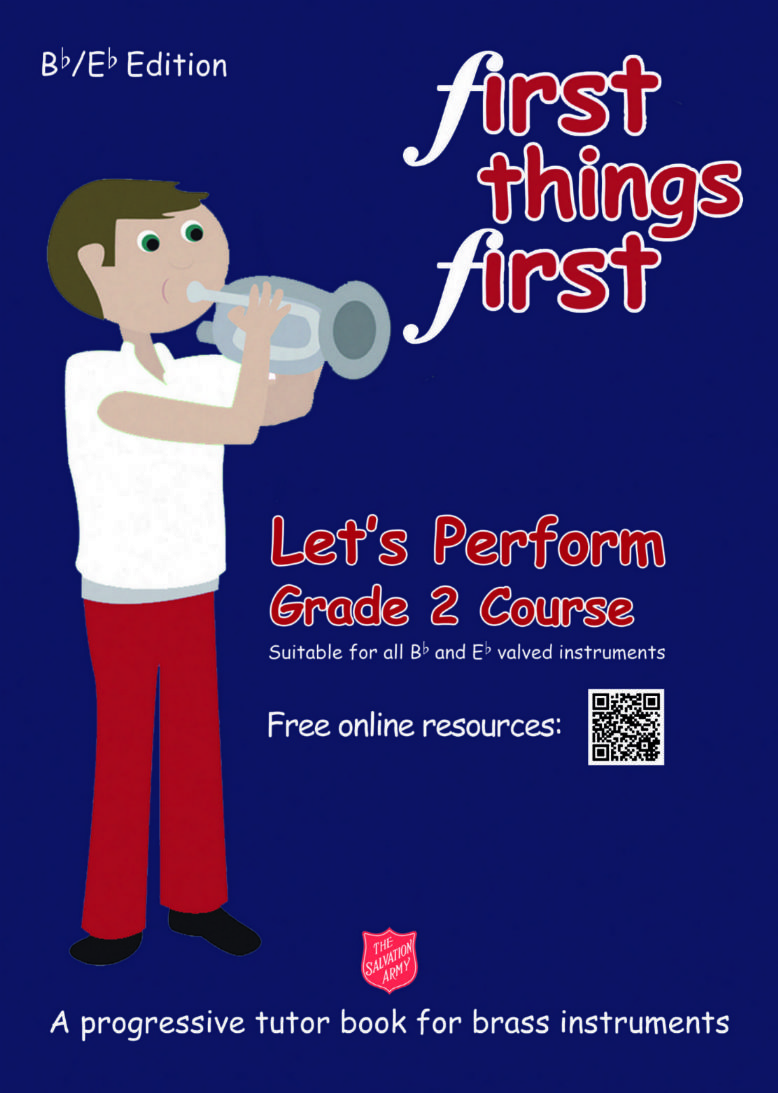
£4.99First Things First - Let's Perform (Grade 2 Course) Bb/Eb Edition
Let's Play (Elementary Course) provides an exciting and challenging early introduction to brass playing. Intentionally, using just the first 5 noes (C-G), the course allows and encourages the important early development of a brass player's most vital commodity, the lips!Includes link to downloadable resources including backing and demonstration tracks, online course assessment sheets and personalised course certificates.In this book you will be introduced to:new notes, extending your range both higher and lowernew rhythmic patters, including semiquaversnew time signatures, including 6/8 timekey signatures, meeting more sharps and flats
Estimated dispatch 7-14 working days