
Results
-
 £33.62
Libera Me from 'Requiem' (Brass Band) Faure arr. Rob Bushnell
Composed between 1887 and 1890, Gabriel Faure's Requiem is not only one of his best-known works but one of the most popular piece of choral music in the Classical repertoire, coming 23rd in the Classic FM's Hall of Fame 2024. Believed to be a tribute to his father (who died in 1885), Faure himself said "My Requiem wasn't written for anything - for pleasure, if I may call it that!" It started life as a five-movement work but was later expanded to be the final seven-movement work we know today. The first version (which Faure called "un petit Requiem") was first performed on 16 January 1888, with Faure conducting, a second version premiered on 21 January 1893 before the final version (reworked for full orchestra) was played on 12 July 1900; the Requiem was performed at the composer's own funeral in 1924.The Libera Me, or Deliver Me, was actually written in 1877 and is the sixth part of the Requiem.Faure once said of the work, "Everything I managed to entertain by way of religious illusion I put into my Requiem, which moreover is dominated from beginning to end by a very human feeling of faith in eternal rest." Upon interview, he also said, "It has been said that my Requiem does not express the fear of death and someone has called it a lullaby of death. But it is thus that I see death: as a happy deliverance, an aspiration towards happiness above, rather than as a painful experience. The music of Gounod has been criticised for its inclination towards human tenderness. But his nature predisposed him to feel this way: religious emotion took this form inside him. Is it not necessary to accept the artist's nature? As to my Requiem, perhaps I have also instinctively sought to escape from what is thought right and proper, after all the years of accompanying burial services on the organ! I know it all by heart. I wanted to write something different."This arrangement is for the British-style brass band, with alternative parts for horns in F and bass-clef lower brass. The tenor solo is featured on the euphonium. A recording of the original composition can be found here: www.youtube.com/watch?v=fXwFNoBHCf0 Duration: 4.20 minutes approx. Difficulty Level: 4th Section + PDF download includes parts and score. Sheet music available from www.brassband.co.uk Instrumentation: Soprano Cornet Eb Solo Cornet Bb Repiano Cornet Bb 2nd Cornet Bb 3rd Cornet Bb Flugel Horn Bb Solo Horn Eb 1st Horn Eb 2nd Horn Eb 1st Baritone Bb 2nd Baritone Bb 1st Trombone Bb 2nd Trombone Bb Bass Trombone Euphonium Bb Bass Eb Bass BbTimpani
In Stock: Estimated dispatch 1-3 working days
-
 £30.00
Amazing Grace (W. Walker arr. by Paul Pennicotte-Henrie) - Brass Band Sheet Music Full Score and Parts - LM642
COMPOSER: W. WalkerARRANGER: Paul Pennicotte-Henrie"Amazing Grace" is a Christian hymn published in 1779 by English Anglican clergyman, abolitionist, and poet John Newton. It is possibly the most sung and most recorded hymn in the world and is especially popular in the United States, where it is used for both religious and secular purposes. Newton wrote the words from personal experience; he grew up without any particular religious conviction, but his life's path was formed by a variety of twists and coincidences that were often put into motion by others' reactions to what they took as his recalcitrant insubordination. He was pressed into service with the Royal Navy, and after leaving the service, he became involved in the Atlantic slave trade.In 1748, a violent storm battered his vessel off the coast of County Donegal, Ireland, so severely that he called out to God for mercy. While this moment marked his spiritual conversion, he continued slave trading until 1754 or 1755, when he ended his seafaring altogether. Newton began studying Christian theology and later became an abolitionist.Ordained in the Church of England in 1764, Newton became the curate of Olney, Buckinghamshire, where he began to write hymns with poet William Cowper. "Amazing Grace" was written to illustrate a sermon on New Year's Day of 1773. It is unknown if there was any music accompanying the verses; it may have been chanted by the congregation. It debuted in print in 1779 in Newton's and Cowper's Olney Hymns, but settled into relative obscurity in England. In the United States, "Amazing Grace" became a popular song used by Baptist and Methodist preachers as part of their evangelizing, especially in the American South, during the Second Great Awakening of the early 19th century. It has been associated with more than 20 melodies. In 1835, American composer William Walker set it to the tune known as "New Britain" in a shape note format; this is the version most frequently sung today.
In Stock: Estimated dispatch 3-5 working days
-
 £45.00
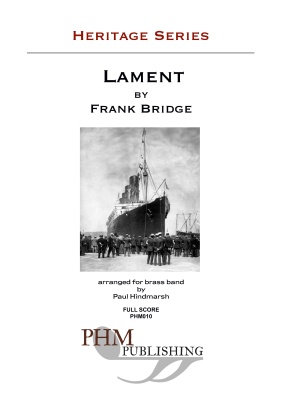
Lament (Brass Band - Score and Parts)
The English composer Frank Bridge (1879 - 1941) did not take an active part in the First World War. However, he was devastated by the slaughter on the western and the eastern fronts, especially the loss of so many of his musicians friends and colleagues. Writing in 1963, his former pupil Benjamin Britten confessed that 'a lot of my feelings about the First World War which people seemed to see in the War Requiem came from Bridge. He had written a piano sonata in memory of a friend killed in France and though he didn't encourage me to take a stand for the sake of a stand, he did make me argue and argue and argue. His own pacifism was not aggressive, but typically gentle'.Bridge composed this Lament for string orchestra on 14 June 1915, in memory of Catherine Crompton, who drowned when the Cunard liner Lusitania was torpedoed by a German submarine on 7 May, 1915. According to figures researched by Liverpool historian Kevin Roach (www.lusitania.net), 1201 men, women and children lost their lives out of the 1962 people aboard. Ninety-four children died, including Catherine, her twin brother Paul and four other siblings. Paul Crompton, Snr. (44), a British businessman working in Philadelphia, his wife Gladys (40) and the family nanny were also drowned. How Bridge's dedication came about is uncertain. The music critic Edwin Evans, who knew Bridge well, has written that the Catherine was a young friend. It is also possible that he came across the family photograph which was published in many newspapers in the wake of the tragedy. By that time, Bridge was greatly distressed by the war as a whole. It seems perfectly in keeping with his pacifist leanings and the strength of his reaction, that this poignant and deeply touching 'war memorial' should mourn a child who he did not know, rather than one of the thousands of young men who fell in battle.Through the musical tears of this melancholy lullaby, Bridge may have regarded the death of young Catherine Crompton as symbolic of the loss of so many innocent lives in wartime. His response to this personal tragedy was characteristically spontaneous and utterly sincere. It is one of his most effective miniatures, poignant yet restrained in its lyrical beauty, with a compelling directness and simplicity of construction.This brass band transcription is pitched one tone lower than the original for string orchestra.- Paul HindmarshDuration: 5.00
Estimated dispatch 7-14 working days
-
 £15.00
Symphony in Two Movements (Study Score Only)
Selected as the Championship Section test piece for the National Brass Band Championships of Great Britain 2025This work was jointly commissioned by the National Youth Brass Band of Great Britain (NYBBGB) and the National Youth Brass Band of Wales (NYBBW), the latter with funding from T Cerdd (Music Centre Wales), to celebrate their 60th and 30th anniversaries respectively. The first performances were given at Cadogan Hall, London, in April 2012, by the NYBBGB, conducted by Bramwell Tovey; and at the Great Hall, Aberystwyth University, in July 2012, by the NYBBW, conducted by Nicholas Childs.When I was approached about a joint commission to write a new work to celebrate the anniversaries of these two outstanding youth bands I was delighted to accept, and decided to respond by writing a work apposite for the magnitude of these special occasions, namely a 'symphony for brass'.Through a long journey of writing music for brass band, which commenced with Connotations (1977), and continued with Dances and Arias (1984), Of Men and Mountains (1991), The Trumpets of the Angels (2000) and Rococo Variations (2008), I arrived at what I regard as the most important work of the cycle to date, combining as it does serious musical intent with considerable technical demands. It is perhaps my most abstract work for brass band, avoiding any programmatic content.The symphony lasts for some 19 minutes and is structured in two linked movements. The form is based on that used by Beethoven in his final piano sonata (Op.111), which is in two movements only: a compact sonata-form allegro, followed by a more expansive theme and four variations. Prokofiev also adopted this model in his 2nd Symphony of 1925.The opening Toccata of this Symphony is highly dramatic but compact, whilst still retaining the 'traditional' structural elements of exposition, development and recapitulation; indeed, it also has the 'traditional' element of a contrasting second subject - a gentle, lyrical modal melody first heard on solo cornets.In contrast, the longer and more substantial second movement Variations is built around a theme and four variations. The slowly unfolding chorale-like theme accumulates both added note harmony and increasing instrumentation, whilst the four variations which follow are by turn mercurial (fast, starting with all the instruments muted), march-like (menacing, with short rhythmic articulations underpinning an extended atonal melody), serene (a series of 'romances' for solo instruments alongside echoes of the chorale) with an emerging theme eventually bursting into a climax of passionate intent; whilst the final variation is a dynamic scherzo (concertante-like in its series of rapid-fire solos, duets, trios and quartets) with the music gradually incorporating elements of the main ideas from the first movement, thus acting as a recapitulation for the whole work. It reaches its peroration with a return to the very opening of the symphony, now in the 'home' tonality of F, and thus creating a truly symphonic dimension to the music.Most of the melodic material of the symphony is derived from the opening eleven-note 'row', which contains various intervallic sets, and although the work is not serially conceived it does use some typical quasi-serial procedures, such as canons, inversions, and retrogrades. The symphony uses somewhat limited percussion, in line with a 'classical' approach to the sound world of the brass band, alongside a use of multi-divisi instrumentation, whereby each player has an individual part rather than the traditional doubling within certain sections of the band.- Edward GregsonDuration: 19.00
Estimated dispatch 7-14 working days
-
 £10.00
The Once and Future King
DescriptionThe Once and Future King is a suite of three movements; each movement was inspired by an Arthurian legend. The first movement, 'Tintagel', concerns the famous Cornish promontory said to be the birthplace of King Arthur. In Arthur's time, Tintagel was part of the court of King Mark of Cornwall and the music imagines a visit by the King of the Britons to his Cornish neighbour and the place of his birth, reflecting the ceremony and drama of such an occasion; the music is strongly antiphonal, contrasting the more strident fanfares of the cornets and trombones with the warmth of the saxhorns and tubas.The second movement, 'Lyonesse', takes its inspiration from the mythical land which once joined Cornwall to the Isles of Scilly. One legend claims that after the disastrous battle of Camlan where Arthur and Mordred were both killed, the remnants of Arthur's army were pursued across Lyonesse to Scilly, whereupon Merlin cast a spell to sink Lyonesse behind them and drown the pursuers. Some say the bells of the 140 churches inundated that day can still be heard ringing. All the material in this movement derives from two short motifs heard in counterpoint at the very beginning, which are intentionally dissonant and bitonal in character.The final movement, 'Badon Hill', takes its title from the legendary site of Arthur's last battle with the Saxons and is a lively toccata based on the medieval secular song L'Homme Armee ('The Armed Man'). The music uses a number of medieval devices including "hocketing" (passing melody from one voice to another). The actual site of Badon Hill is unknown but it has been associated with Badbury Rings in Dorset and a lot of evidence now points towards the town of Bath. Arthur's victory at Badon Hill was the last great victory for Celtic Britain over the Saxon invaders, but in the end only set the conquest back by a few decades. Arthur himself was dead by then, betrayed and defeated by his nephew Mordred, but it is said that Arthur only sleeps and will return in a time of dire need - hence the legend that Arthur's dying words were: Bury me in Britain, for I am the Once and Future King.Performance NotesWhere space and practicality permits the opening movement should be played with cornets and trombones standing behind the band facing the audience; they should retake their seats for the second and third movements.PercussionConcert Bass Drum (ideally NOT Kit/Pedal Bass Drum), Suspended Cymbal, pair of Clash Cymbals, Glockenspiel, Snare Drum, Tambourine, 2 x Timpani (Eb-G, Bb-D), 2 x Tom-toms, Triangle, Tam-Tam* (only if available), Tubular Bells *(only if available).MutesBaritones, all cornets and trombones will require metal straight mutes; all trombones and cornets will require cup mutes.*The Once and Future King was set as the test-piece for the 3rd section of the Swiss National Championships in 2007. The score was then slightly revised in July 2008, the main alteration being the exclusion of the tubular bells part for the Regional Championships of Great Britain in 2009. Some parts which were optional (or cued on other instruments) at the request of the Swiss Brass Band Association were restored to their original octaves and instruments. In 2015 the tubular bells part was restored in the optional Percussion 3 part; all parts in Percussion 3 are optional, although some are cued in the percussion 1 & 2 parts (and the cues should be played if only two players are available).Listen to a preview and follow along with the score below!
Estimated dispatch 7-14 working days
-
£90.00
Fragile Oasis - Peter Meechan
Fragile Oasis is the name of a collective who describe themselves as aaa grass-roots participatory initiative that connects the shared perspective of astronauts from different countries and cultures with people on Earth, encouraging all to work together so that our planet is not only visibly beautiful, but beautiful for alla.Many involved in the project are astronauts on the International Space Station (I.S.S.), who post, on their website (http://www.fragileoasis.org) many different details of their experiments, photos from space, and some incredible video footage of our Earth.One such time lapse video (a video made up many still images) was posted on their website by astronaut Ron Garan (http://www.fragileoasis.org/blog/2011/11/coming-back-down-to-our-fragile-oasis-2/) in 2011. It is made up of images taken from the I.S.S. of what Garan described as aaa couple of laps around our Fragile Oasis before coming back down [to Earth]a and features all kinds of amazing views from space.Each of the five sections of this work relate to an aspect of the video - either something literal or something more metaphorical. The opening section, i: The lights from Above, is a musical description of the view of the Aurora Australis from above the lights. The second section, ii: The Storm from Above (part i), is also a musical portrayal of portions of the video clip - in this case the many lightning storms we see from above. The storms that are so powerful on Earth appear as small bolts of electricity dancing through the clouds.The third section, iii: Freya, has its roots in personal family tragedy. The name Freya derives from a Norse goddess who was associated with both beauty and love, and in this central section I wanted to write music that not only acknowledged how fragile life itself is, but that every day of it counts and should be celebrated.iv: The Storm from Above (part ii) is a again a reference to the lightning storms, but also to the huge hurricanes we see in the video. It leads us to the final section, v: The Oasis from Above - a description of the size and grandeur of Earth, our Fragile Oasis.Fragile Oasis was commissioned by Leyland Brass Band and Michael Bach, and partly funded by The John Golland Trust, for their appearance at the 2013 European Brass Band Championships in Oslo, Norway. It is dedicated to Natalie Youson, in friendship
Estimated dispatch 12-14 working days
-
 £95.00
A Wartime Sketchbook (Brass Band - Score and Parts)
Early in 1941 William Walton, 39, received his call-up papers. He was by then one of the most eminent of British composers and was exempted from military service on condition that he provided music for films deemed to be of 'national importance'. Scoring Lawrence Olivier's Shakespeare epic Henry V in 1943 was the most substantial of these wartime projects. His role in patriotic films from 1941 and 42 like The Foreman went to France, Next of Kin, Went the day Well and The First of the Few was to provide appropriate title music and some underscoring at key moments. Walton extracted the most substantial portions of the latter as the popular Spitfire Prelude and Fugue for orchestra. The remaining music remained unpublished until 1990, when Christopher Palmer assembled the highlights into A Wartime Sketchbook. I was intrigued to hear these examples of Walton's wartime music and having discovered that they would fit naturally and idiomatically onto the brass band, I arranged six of the numbers into a suite for Besses o' th' Barn Band, which I was conducting at the time.In 1995 the brass band suite was recorded by the famous Black Dyke Mills Band as part of an all Walton album which I produced for the ASV label (ASV CD WHL 2093). This award- winning CD also included Walton's First Shoot, in the edition by Elgar Howarth, my transcription of movements from Music for Children and two substantial brass versions by Edward Watson of the suite from Henry V (with narrator) and the March and Siegfried Music from The Battle of Britain music.Prologue: This is the stirring title music from Went the day Well, a screen play by Graham Greene about a German airborne invasion of an English village. The main theme leads toBicycle Chase: Characteristic musical high-jinks for J.B.Priestley's The Foreman went to France.Refugees: From the same film, this is a poignant accompaniment to the long march of refugees. As Ernest Irving, the film's musical director, put it, "this really makes your feet sore and your knees sag."Young Siegfrieds: This lively movement comes from the music that Walton composed for The Battle of Britain in 1968, with the assistance of Malcolm Arnold, but which the film's producer rejected. It portrays first the Berliners, cheerfully ignoring the black-out and then, in the trio, the Young Siegfrieds of the Luftwaffe, courtesy of a parody of Siegfried's horn call from Wagner's opera.Romance: A soldier and a Dutch refugee snatch a few tender moments together in Next of Kin.Epilogue: At the end of The Foreman went to France, the French look forward with hope and optimism to eventual liberation.- Paul HindmarshDuration: 14.00
Estimated dispatch 7-14 working days
-
£40.00
A Wartime Sketchbook (Brass Band - Score only)
Early in 1941 William Walton, 39, received his call-up papers. He was by then one of the most eminent of British composers and was exempted from military service on condition that he provided music for films deemed to be of 'national importance'. Scoring Lawrence Olivier's Shakespeare epic Henry V in 1943 was the most substantial of these wartime projects. His role in patriotic films from 1941 and 42 like The Foreman went to France, Next of Kin, Went the day Well and The First of the Few was to provide appropriate title music and some underscoring at key moments. Walton extracted the most substantial portions of the latter as the popular Spitfire Prelude and Fugue for orchestra. The remaining music remained unpublished until 1990, when Christopher Palmer assembled the highlights into A Wartime Sketchbook. I was intrigued to hear these examples of Walton's wartime music and having discovered that they would fit naturally and idiomatically onto the brass band, I arranged six of the numbers into a suite for Besses o' th' Barn Band, which I was conducting at the time.In 1995 the brass band suite was recorded by the famous Black Dyke Mills Band as part of an all Walton album which I produced for the ASV label (ASV CD WHL 2093). This award- winning CD also included Walton's First Shoot, in the edition by Elgar Howarth, my transcription of movements from Music for Children and two substantial brass versions by Edward Watson of the suite from Henry V (with narrator) and the March and Siegfried Music from The Battle of Britain music.Prologue: This is the stirring title music from Went the day Well, a screen play by Graham Greene about a German airborne invasion of an English village. The main theme leads toBicycle Chase: Characteristic musical high-jinks for J.B.Priestley's The Foreman went to France.Refugees: From the same film, this is a poignant accompaniment to the long march of refugees. As Ernest Irving, the film's musical director, put it, "this really makes your feet sore and your knees sag."Young Siegfrieds: This lively movement comes from the music that Walton composed for The Battle of Britain in 1968, with the assistance of Malcolm Arnold, but which the film's producer rejected. It portrays first the Berliners, cheerfully ignoring the black-out and then, in the trio, the Young Siegfrieds of the Luftwaffe, courtesy of a parody of Siegfried's horn call from Wagner's opera.Romance: A soldier and a Dutch refugee snatch a few tender moments together in Next of Kin.Epilogue: At the end of The Foreman went to France, the French look forward with hope and optimism to eventual liberation.- Paul HindmarshDuration: 14.00
Estimated dispatch 7-14 working days
-
 £67.24
Pyrenean Carol Suite (Brass Band) David Taylor
This attractive suite for brass band by David Taylor features five traditional carols from the Pyrenees region of Spain, as follows: i. Nadal Tindaire (Jingling Christmas) - Occitan traditional This Occitan Christmas song tells of musical instruments used to celebrate the Nativity - 'fifes and trumpets, timpani and pipes, or you, clear little bells, along with the angels' choir.' ii. Gabriel's Message (Birjina Gaztetto Bat Zegoen) - Basque traditional The most widely-known of the chosen carols, honouring Jesus's mother Mary, this is often sung in its English version, but the melody came from the Basque country. The Basque words were adapted from the Mediaeval song Angelus ad Virginem. Here, we feature the flugel horn. This movement was originally written on its own, with organ accompaniment, for the composer's wife, Diane Scott. iii. El Noi de la Mare (The Child of the Mother) - Catalan traditional A beautiful Catalan carol celebrating the birth of Jesus, telling of the tasty gifts that the singer would bring - 'Raisins and figs and nuts and olives; Raisins and figs and honey and mato [a Catalan dessert cheese traditionally served with honey.]' Here we feature the euphonium. The tune was made famous by guitarist Andres Segovia, who used it as a favourite encore, and by John Rutter, who made a widely-used setting for choir. iv. Paure Satan (Poor Satan) - Occitan traditional This rather unusual carol tells of the pain that Satan is put to by the arrival of the infant Jesus. Its mocking and sarcastic tone is reflected here, where the tuba soloist (as Satan) is given musical trouble throughout by the other parts. At first they conflict with the soloist, then the soloist makes overtures of friendship, which are treated with suspicion followed by contempt. The soloist finally gives in to their accompaniment (or do they?). There are plenty of opportunities for little theatrical touches here, if the tuba player is so inclined! The tuba part in this movement is notably more difficult than the rest of the music, and a number of optional changes have been marked to make the part easier to play, if so desired. The player is also welcome to add suitable extra embellishments to taste if they wish, within the character of the music. v. Fum, Fum, Fum! - Catalan traditional A favourite Catalan Christmas song for centuries, this rousing melody provides a fitting way to round off the suite, with its repeated rhythmic refrain of the nonsense title phrase. It tells of the Nativity, and then it tells of the celebratory feasting and good times that the singers look forward to to honour it. Although the suite is intended to be performed whole, it is also intended for usage with a selection of movements on occasions where a shorter piece is wanted. Suggested formats include a single movement alone (2, 3, and 5 are likely most appropriate), a pair of movements (any of the first four, plus 5), and a suite of three or four movements (1 and 5, plus one or two of 2, 3, or 4 in the middle). It is suggested that a good way to design a 'pick-your-own-suite' from the movements is to think of the earlier movements as introductory to the final movement. To view a rolling score video featuring Kidlington Concert Brass please visit www.youtube.com/watch?v=QIGdul-yxxg PDF download includes score and parts. Sheet music available from: UK - www.brassband.co.uk USA - https://satradecentral.org Difficulty Level: 3rd Section + Length: 9.45 minutes Instrumentation: Soprano Cornet Eb Solo Cornet Bb Repiano Cornet Bb 2nd Cornet Bb 3rd Cornet Bb Flugel Horn Bb Solo Horn Eb 1st Horn Eb 2nd Horn Eb 1st Baritone Bb 2nd Baritone Bb 1st Trombone Bb 2nd Trombone Bb Bass Trombone Euphonium Bb Bass Eb Bass Bb Timpani Percussion 1-2
In Stock: Estimated dispatch 1-3 working days
-
 £34.95
Song for the Skies (Eb Bass Solo with Brass Band - Score and Parts)
Song for the Skies was commissioned by Tuba virtuoso Les Neish and was given its world premier on the December 9th 2010 with the James Madison University Brass Band in Harrisonburg, Virginia, USA.Les asked me to compose a slow melody that highlights the wonderful sonorous sound of the Tuba. I am a big fan of Les and of the instrument and knowing the capabilities of Les as a soloist I wanted to experiment with the range and colour of the instrument in this solo.After a warm introduction from the ensemble the soloist enters almost timeless over the muted cornets. The melody when it is first heard has a somewhat haunting Celtic feel to it. It is intentionally marked as con rubato so that the soloist can really put their own musical stamp on the music. As the haunting melody repeats again this time in a change of key the accompaniment takes more of a role within the piece of music performing counter melodies within this second section.The middle of the piece introduces a new secondary melodic device that serves as an introduction to the original melody played in all its glory by the ensemble. This dies away to leave the second half of the melody in the euphoniums and baritones as the soloist plays a soaring counter melody in the highest register of the instrument.The piece starts to return home with a recapitulation of the introduction followed by the second part of the original melody by the soloist. After a momentary reflective solo from the soloist the introduction is used for a final time before the tuba guides us home to conclude.For the soloist, there are a number of occasions where the opportunity to play in the upper register of the instrument arises. However, I have also given the opportunity for the soloist to play various passages down the octave so it suits the performers playing style and range.Song for the Skies is very simple yet beautiful and I feel it suits the playing of the Eb Tuba perfectly. I hope you enjoy performing it.Paul Lovatt-Cooper
Estimated dispatch 7-14 working days

 View Music