
Results
-
 £115.60
Dream a Little Dream of Me - Gus Kahn - Reid Gilje
This song was written in 1931 by Fabian Andre and Wilbur Schwandt with lyrics by Gus Kahn. It's now one of the most popular songs from the Great American Songbook and it's also recorded in many versions. Ella Fitzgerald, Louis Armstrong and Nat King Cole are among the most famous ones that have recorded it. In later years singers like Michael Buble, Diana Krall land Robin Williams have all recorded "Dream a Little Dream of Me". This arrangement is inspired by the version by American band Chicago from their 1995 album release "Night & Day".
Estimated dispatch 5-14 working days
-
 £67.50
Columbus - Thierry Deleruyelle
Columbus is a brilliant and dynamic overture for brass band, with a soft and melodious central passage. In addition to the many American towns that hold the name, Columbus is a European space laboratory that is part of the International Space Station. Launched in 2008 by the American space shuttle Atlantis, it makes it possible to carry out continuous scientific experiments in fundamental physics, life sciences, fluid physics, etc. Several hundred experiments take place within Columbus every year. Commissioned by the Brass Band Bourgueillois, this piece celebrates the 10th anniversary of the launch of the band at the instigation of its conductor, Michael Auclert. The ensemble brings together musicians from the various wind bands of the Bourgueillois region and beyond. Thus, just like the space laboratory that inspired this work, the Brass Band Bourgueillois also serves as a laboratory, albeit a musical one, within a territory that is discovering this ensemble and its original repertoire.
Estimated dispatch 5-14 working days
-
 £115.60
Grevling i taket - Øystein Dolmen og Gustav Lorentzen - Reid Gilje
This is an arrangement which has to be performed a bit humorous in the spirit of the original.It starts with a kazoo-like opening, played on the mouthpieces. At C, baritones and euphoniums should stand up. Maybe the musicians can play it by heart?Two bars before D, the tempo increase. On E, the cornet players should stand (and play by heart)?New, even higher tempo two bars before F. The trombonists should stand up in bar 103 to prepare for a terrific tempo. But G will be played like a laidback reggae-version. Flugelhorn and horns can stand up simultaneous with the glissando in bar 120.The tempo at H should be high and fresh and with several sections standing. In bar 158 should almost all players sit. At bar 160 everyone should stand up.In bar 162, all players should turn to the audience during the crescendo.
Estimated dispatch 5-14 working days
-
 £115.60
Klabb - Øyvind Moe
Klabb was written in 2010 for the brass band at Manger Folkehogskule and conductor Bjorn Sagstad. The piece consists of a series of short related episodes based on the whole-tone scale, but intermittently tending towards traditional "major" tonality. "Klabb" can refer to punching someone - and the piece is certainly meant to pack a punch - but the common meaning of the word comes from snow clumping to the undersides of skis, or more generally, something that makes for laborious progress. The whole-tone scale is directionless in that it has no implicit pull towards a tonal center, complicating the creation of meaningful and believable harmonic development. In thisrespect, the title can be seen as the composer's expression of frustration with his own choice of basic material (it seemed like a good idea at the time ...). For the performers, the unusual fingering combinations are what constitute the "klabb". Good luck, and don't forget to wax!
Estimated dispatch 5-14 working days
-
 £54.99
Onward! - Gawan Roberts
A brief history: Pentecost Monday was a special day for schools in Yorkshire (England). There were a variety of activities. The pupils of Sabine Baring-Gould would meet with the children of a nearby village. It seemed like a good idea that during the walk would be sung. But she could not find a suitable song and decided to write one by herself. "Onward Christian Soldiers" was the result. It soon became very popular, though she herself was not entirely satisfied with the rhyme scheme. The melody used (St. Gertrude) was by the famous English composer Sir Arthur S. Sullivan. Back to now: Gawan Roberts, has given the hymn a proper update. He gave the still popularsong a solid rock beat and added daring harmonies. So it's popular, for current generations, again for years. Onward!
Estimated dispatch 5-14 working days
-
 £76.99
Animal Kingdom - William Vean
In this composition William Vean takes you on a journey through the fascinating and exciting world of animals. Apart from it being a composition filled with "special effects", Animal Kingdom contains many educational elements, such as playing inswing (triplets feeling), chromatics, flutter tonguing, gypsy tuning, varying keys, and, of course, dynamics and articulation. The melodic lines occur in all four voices, as well as in all percussion parts, providing each musician with theopportunity to play a solo or to accompany. Highly recommended for your youth band! William Vean is an educational composer. He knows how to musically shape the special elements from our daily lives. His music is therefore veryexpressive, containing creative solutions to possible problems. Special ways of playing make his music particularly interesting for the winds, but the percussion section is also featured in his special effects. The world of the animalsalways plays on ones imagination. In Animal Kingdom, William Vean has portrayed a number of animals in a special manner: Kevin Kangaroo - The jumping character of this animal can be heard in different voices. The swing style alsoemphasizes the characteristic movements of the kangaroo. Playing in swing style can be practised by using scales. Eddy Elephant - For some of his smaller fellow fauna friends this can be quite an ordeal, but for Eduard (Eddy for friendsand intimates) it is his daily walk. Baldrick Bat - Baldrick the Bat is a mysterious character. This can be heard in the fast moving valves and keys, accompanied by special effects in the percussion section. Curtis Camel - Curtisthe Camel trudges across the desert, feeling bored. The idea that the horizon will never change does not affect him anymore. He has accepted his fate. The distinctive tones from the gypsy scale provide the suitable oriental sounds. BettyButterfly - Butterfly Betty elegantly, and without worries, flutters from flower to flower in the garden. Her motto: Carpe Diem (Seize the Day). Betty is a one-day butterfly. Marvin Monkey - A "swing" monkey stirs up the feelings. Evenmembers of the orchestra will look like real monkeys. How about your audience? Each part has its own difficulties and challenges. Important in the first part is playing "in swing" (triplets feeling). This can be practised usingscales. In the second part ensemble playing and balance are important. In Baldrick additional information on the effects that have to be played might be useful. "New" sounds are, of course, welcome. Curtis the Camel introduces thegypsy scale. Additional explanation of the use of the scale might be useful. Key changes are interesting in this part. A slight accent on the first beat of the bar will add to the charm of this part. Marvin the Monkey brings back the swingrhythm that was introduced in the first part, alternated by a "straight" part with attention to chromatics and articulation. A story teller will definitely be an asset when performing this composition.
Estimated dispatch 5-14 working days
-
£76.99
Jubilant Prelude - Toon Hagen - Dirk Annema
'Jubilant Prelude' is an orchestration of the 'Preludium over Psalm 150' originally composed for organ by Toon Hagen. Since 1998 Toon Hagen has been organ-player of the 'Grote or Sint Michaelskerk' in Zwolle (the Netherlands). He has written several 'contemporary' compositions for organ.'Jubilant Prelude' has a capricious character by the use of irregular measures and its many measure changes. The structure of the Prelude is that of a fugue and is based on motives from the psalm.After the first climax, which is both dynamic and harmonic, the theme in the Andante Jubiloso is clearly audible and it is alternated with erratic motifs. Tension increases until at last the psalm itself isheard in all its glory. The melody of the psalm sounds as a cantus firmus in tenor register, with motifs in ornamentation for saxophones, bugles and trumpets. The finale, like the prelude is capricious and vehement.The instrumentation for brassband was made by Dirk Annema. It is particularly colourful and has a surprising role for the percussion section.
Estimated dispatch 5-14 working days
-
 £137.70
Why Not? - Michel A. Camilo - Lars Erik Gudim
"Why Not?" is the most well-known piece by Dominican Republic pianist/composer Michel Camilo. It appeared for the fist time on his 1984 album record "French Toast". He re-recorded it in 1985 for the "Why Not?"-album whoich is among his best-selling to date. The song has also been recorded by other artist like the vocal group The Manhattan Transfer. "Why Not?" ia a modern latin-jazz classic and this demaning arrangement for Brass Band captures the featureless and musical challenges of the original piece.
Estimated dispatch 5-14 working days
-
 £54.95
Sonata - Derek Bourgeois
This work, composed in 1998, was commissioned by the American trombonist Don Lucas as a work for trombone and piano and first performed by him in Birmingham on 19th May 2000. Subsequently, I arranged the music for both solo trombone and brass band and solo trombone and wind band so that it now exists in three formats. The first movement, in B flat major, is brisk and energetic, and is cast in sonata form. The second subject is gentler and more lyrical. The second movement, a scherzo in C major, is the most complex of the four. Basically the structure is a rond. For a long time the music remains in the opening 5/8 time until a new theme introduces more broken rhythms in a more jazzy idiom. After a return of the opening theme the following episode is more tonally ambiguous. Finally, the main theme returns to round off the movement. The third movement, a lyrical adagio, is really one long extended melodic flow. The harmonies are lush and the textures simple and direct. The tonal center is A minor, but the music meanders through so many keys, that this key centre is heavily disguised. The finale is a fiery affair. G minor is really its home key, but throughout the movement the music moves about a lot and the second subject is first heard in A flat minor. The movement's underlying sonata structure is masked not only by its loose tonality but also by its frequently changing time signatures. Like the first movement the second subject is more lyrical in nature and for a while it seems that the music will end peacefully, but a final flurry heralds a triple forte unison on the home note of the first movement - B flat. Derek Bourgeois
Estimated dispatch 5-14 working days
-
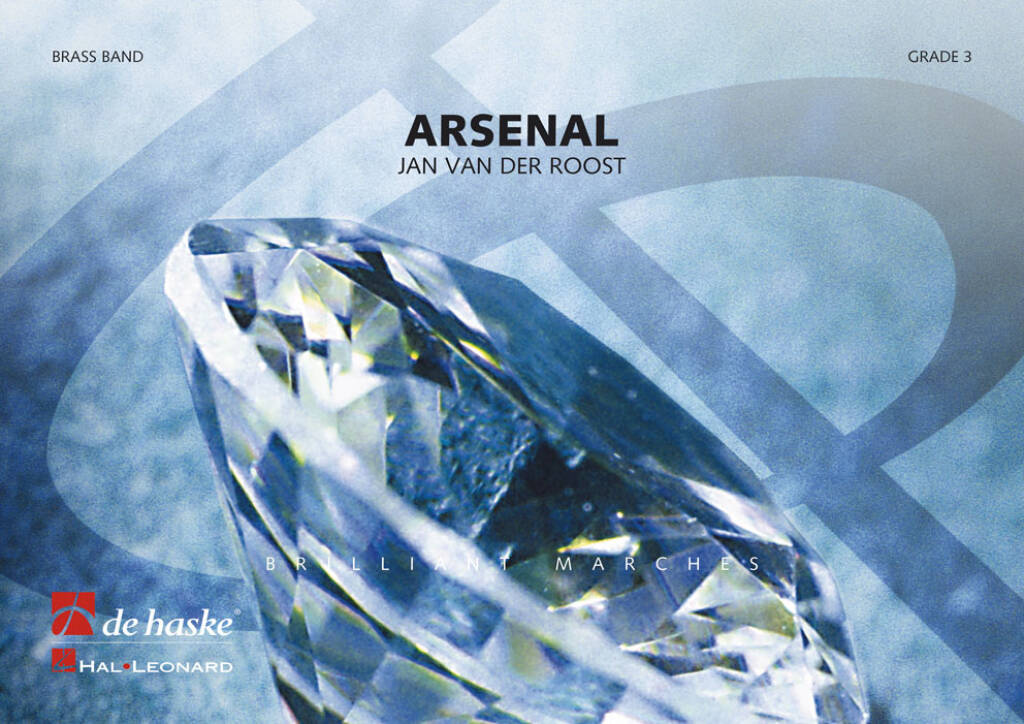 £60.99
Arsenal - Jan Van der Roost
Arsenal was composed for the 50th anniversary of the 'Harmonie van het Spoorwegarsenaal'[railroad arsenal], based in Mechelen (Belgium). Rather a stately concert march, it has beautiful themes and a broad melody in the trio. It was premiered in the Mechelen Cultural Center on the 11th of May 1996 during the solemn ceremony, opening the anniversary year and conducted by the composer. In the mean time, Arsenal has been recorded several times by such renowed performers like the Tokyo Kosei Wind Orchestra, the Black Dyke BB etc.
Estimated dispatch 5-14 working days
 View Music