
Results
-
 £45.00
Diversions After Benjamin Britten (Brass Band - Score only)
Suite by Lucy Pankhurst, Simon Dobson, Paul McGhee and Gavin HigginsHaving devised a collective centenary tribute for Michael Tippett at the 2006 RNCM Festival of Brass (Variations on a Theme of Michael Tippett by five eminent composers of brass band music, PHM002), I commissioned this companion piece as a Benjamin Britten tribute for the 2013 festival. In the late 1970s, while researching a book about the English composer, and Britten's first teacher, Frank Bridge (1879 - 1941), I came across a copy of the printed score of Benjamin Britten's Variations on a Theme of Frank Bridge (Op.10) for string orchestra, in which Britten had written descriptive titles for each of the variations suggesting appropriate character traits of his much loved mentor and guide. The character variations are cast in march, song and dance forms.Taking inspiration from Britten's youthful tribute, I invited four award-winning composers, who have all made significant contributions to the brass band medium, to create their own personal reflections on four aspects of Britten's character and music, designed to form a suite of Diversions after Benjamin Britten, but which can also be played separately.Lucy Pankhurst's hauntingly lyrical Prelude: His Depth refers to the emotional and symbolic subtexts that underpin Britten's operas, taking its musical cue from Britten's many arrangements of folk songs. The flugel horn takes a prominent role throughout.Simon Dobson's breathless Scherzo: His Vitality reminds us with its rapid passage work and leaping bass 'groove' that Britten loved tennis and fast cars in his younger days.Paul McGhee's evocative interpretation of the March: His Sympathy represents Benjamin Britten's pacifism, as the composer writes: 'We view the music through the eyes of a pacifist. Whilst war and violence surround us, we do not engage in it and though it continues to happen around us. With the use of muted effects in most of the band throughout the piece, the flugel horn is the lone voice of reason, standing firm against the mechanical and destructive society in which it is forced to live. As the machine of war continues around the lone voice, the voice is gradually dismissed and mocked as the war machine rumbles on into the distance.'In an extended finale, entitled Toccata: His Skill, Gavin Higgins celebrates Benjamin Britten's consummate creativity. For the RNCM Festival of Brass premiere, the four contrasting movements were framed and connected by Britten's Fanfare for St. Edmundsbury for three trumpets, with the trumpet soloists spaced round the hall. I am grateful to the Britten Estate and publishers Boosey & Hawkes for giving permission for the elements of Britten's fanfare to be incorporated in the collective work.- Paul HindmarshDuration: 19.30
Estimated dispatch 7-14 working days
-
 £38.95
Unity Series Band Journal - Numbers 530 - 533, June 2024
530: Carol Arrangement - God rest you merry, gentlemen (Noel Jones)This swing arrangement of the traditional English carol also features references to O come, all ye faithful (C.C. 61) and Jingle Bells (C.C. 121). Play with imagination and a sense of style!531: Go, tell it on the mountain! (Nathanael Watchorn)Historically, the passion of enslaved people in America for singing about the Gospel of Jesus is well documented, but it was men of three generations, each named John Wesley Work, who enabled spirituals to become more widely known. John Wesley Work Sr, a church choir director in Nashville, Tennessee, wrote and arranged music for the pioneering Fisk Jubilee Singers whose early repertoire consisted largely of spirituals. This passion and knowledge of spirituals was passed down through the generations. John Work III travelled hundreds of miles to collect songs by attending church services in remote areas. In 1940, he published a collection of 230 songs which included a setting of Go, tell it on the mountain! that is still performed today.Nathanael Watchorn, a Bandsman at Regent Hall Corps in London, is a new contributor to the journals. He originally wrote this as a vocal arrangement for the group FourHymn, subsequently transcribing it for the corps' Young People's Band, while he was Band Leader.532: Carol Arrangement - They all were looking for a king (Stephen Hull)At the North American Composers Forum, Major Len Ballantine challenged participants to find an unfamiliar song in the Salvation Army Song Book and try to write an arrangement of the listed tune. Stephen Hull happened across They all were looking for a king (S.A.S.B. 128) and the tune Childhood (T.B. 421) which lead to this arrangement.533: March - Washed and healed (Eiliv Herikstad)The Christian experience of many people will have been positively impacted by the life of the late Bandmaster Eiliv Herikstad, either personally or through his musical leadership and compositions. This march is the second publication from this well-known Salvation Army composer since his Promotion to Glory last year. This march is more traditional in style that many of his compositions but contains a strong Christian message and demonstrates his compositional expertise.
Estimated dispatch 7-14 working days
-
 £29.95
St. Andrew's Variations (Score Only)
This piece, written for the East Anglian Brass Band Festival in 1998, takes the form of eight variations and a finale, loosely based on the descending third motif heard in the initial theme. It was initially composed for junior band, and expanded and rescored for full band in 2006. There is no significance in the title, other than the fact it was written by a Scotsman to be played in the St Andrew's Hall, in Norwich!Alan Fernie was born and brought up in the Scots mining village of Newtongrange. From the age of 13 he learned to play the trombone both at school and with the local brass band, going on to study music in Glasgow and London. After a short period working as an orchestral musician, Alan moved into instrumental education, spending over 20 years teaching brass in schools all over the East of Scotland. It was during this time that he began to conduct and he has since directed bands at all levels, winning many awards. He first wrote for brass whilst still a student, and his music is now played, recorded and published throughout the world.In 2009, Alan was honoured with the "President's Award" from the Scottish Brass Band Association for services to banding. He is also proud to be associated as composer in residence with the acclaimed charity "Brass for Africa", with whom he spent two months recently teaching in Kampala, Uganda. Living in the Scottish Borders, Alan now works as a freelance musician, finding time to write, teach, conduct, judge, perform and act as compere throughout the UK and beyond.
Estimated dispatch 7-14 working days
-
 £34.95
Judd: My Hope - Roger Trigg
'My Hope' was written for, and premiered by Enfield Citadel Band (Bandmaster Jonathan Corry) on 11th October, 2013. The work formed part of the band's annual pre-contest festival on the eve of the National Brass Band Championships which are held in the august surroundings of the Royal Albert Hall, London each year. The words 'my hope' appear in both hymns that are referenced in the music. The notes 'E', 'C', 'B' also feature throughout the work as homage to Enfield Citadel Band. The verse of 'My hope is built on nothing less' (S.A.S.B. 662), to the tune 'Solid Rock' (T.B. 446), is then introduced and forms the basis of the end of the first section - set in the minor, unlike the usual setting of the melody. The more sedate middle section that follows features an original theme, again using the notes 'E', 'C', 'B' as a melodic stimulus.The tune 'Michael' (Herbert Howells), to which the text 'All my hope on God is founded' (S.A.S.B. 530) is sung, provided the original impetus for this work. The song features as a new addition to The Salvation Army's 2015 iteration of its song book. It is a noble tune and there are big majestic, organ-like sounds utilised in its final treatment which brings the work to a climactic end.
Estimated dispatch 7-14 working days
-
 £94.95
Dances and Arias (Brass Band - Score and Parts)
This work was commissioned by Boosey & Hawkes Band Festivals (with funds provided by the Arts Council of Great Britain) for the National Brass Band Championships of Great Britain, held at the Royal Albert Hall, London, on 7th October 1984.Dances and Arias is in one continuous movement, but as the title suggests is a series of alternating fast and slow sections as follows: Dance - Aria I - Dance (scherzo) - Aria II - Dance. The opening dance is energetic and introduces a four-note motif (on trombones) which is the basis for much of the melodic material in the work. Throughout, there is a continuous process of thematic cross-reference and transformation.The first aria unfolds a long melody on solo cornet, eventually continued by all the solo cornets, and dissolving into a shimmering harmonic background (muted cornets, horns and baritones) over which is heard a brief self-quotation on solo tuba. This leads into the second dance, a frenetic scherzo, followed by the second aria, in the style of a lament (solo euphonium, followed by two flugel horns). This builds to a powerful climax which subsides, leaving the percussion to introduce the final toccata-like dance. It transforms material from the opening before a coda brings the music to a triumphant close. The large percussion section is an integral part in the work and uses a wide variety of instruments including timpani, glockenspiel, vibraphone, xylophone, tubular bells, tom-toms, snare drum, bongos and tam-tam.
Estimated dispatch 7-14 working days
-
 £32.95
Variations for Brass Band (Score Only)
The great British brass band tradition has been fostered since 1860 by an annual competition for bands. Held in the Crystal Palace until that edifice burned in the 1930s, it is a major event at the Royal Albert Hall in London. Each year there is a new test piece, required of all bands and in 1957, Ralph Vaughan Williams (by then a revered, grandfatherly figure in British music) was finally persuaded to write a composition for that purpose.The 12-minute composition comprises a theme and 11 variations. The brief variations are in a variety of moods and styles, including a waltz, a polonaise, a chorale, a canon, an arabesque, and a fugue. It tests ensemble coordination, command of and flexibility concerning styles, and richness of sound.
Estimated dispatch 7-14 working days
-
 £34.95
By Trevone Bay (Flugel Horn Solo with Brass Band - Score and Parts))
By Trevone Bay was composed for Flugel Soloist Zoe Hancock and the Black Dyke Band to celebrate both their Double Champion Victory at the British Open and National Championships 2014 and Zoe's unique achievement in winning the Best Soloist Award in both contests - an accomplishment never done before. The world premier was performed by Zoe and the band at Birmingham's Symphony Hall on February 8th 2015.By Trevone Bay is a lovely lyrical slow melody that utilises the full range and colour of the flugel horn. Starting with an atmospheric opening the soloist performs the main theme, which repeats with more colour in the accompanying parts and solo line. After introducing a second theme from the ensemble, the solo cornets perform the main melody with the soloist enjoying a lyrical counter melody. The piece develops with a tranquil middle section from the soloist that builds for the second theme to return, performed by the ensemble while the soloist soars over the top. Ending as it starts, the piece dies away to leave the soloist performing the opening melodic phrase to a tranquil close.As for the title: Trevone Bay is a beautiful tiny bay in Cornwall, close to Zoe's home town of Roche. Its tranquil waters lead out to the Celtic Sea and provide a picturesque landscape. The views there can be enjoyed all year round but they are particularly beautiful at sunset.
Estimated dispatch 7-14 working days
-
 £65.00
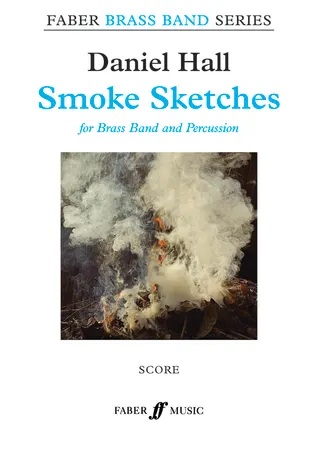
Smoke Sketches (Brass Band - Score and Parts)
Smoke Sketches is Daniel Hall's first original work to be published in the Faber Music Brass Band Series. Daniel is one of the most gifted of the rising generation of composers writing for brass bands. Smoke Sketches was composed at the invitation of Brass Bands England for the Intermediate Section of the 2017 National Youth Brass Band Championships of Great Britain.This colourful, jazzy suite draws inspiration from the ancient art of gazing into smoke from fire to find stories through the act of divination. Into the Blaze suggests someone briskly fire-walking, barefoot, with unexpected sparks fizzling from the ground. A Lonesome Ember captures the fleeting life of a small ember, beginning insignificantly and gradually evolving into a larger being before disappearing into ash, while Spark of Light bristles with life and energy.Band Grade 3/4, duration 8 minutes.
Estimated dispatch 7-14 working days
-
£11.99
Smoke Sketches (Brass Band - Score only)
Smoke Sketches is Daniel Hall's first original work to be published in the Faber Music Brass Band Series. Daniel is one of the most gifted of the rising generation of composers writing for brass bands. Smoke Sketches was composed at the invitation of Brass Bands England for the Intermediate Section of the 2017 National Youth Brass Band Championships of Great Britain.This colourful, jazzy suite draws inspiration from the ancient art of gazing into smoke from fire to find stories through the act of divination. Into the Blaze suggests someone briskly fire-walking, barefoot, with unexpected sparks fizzling from the ground. A Lonesome Ember captures the fleeting life of a small ember, beginning insignificantly and gradually evolving into a larger being before disappearing into ash, while Spark of Light bristles with life and energy.Band Grade 3/4, duration 8 minutes.
Estimated dispatch 7-14 working days
-
 £95.00
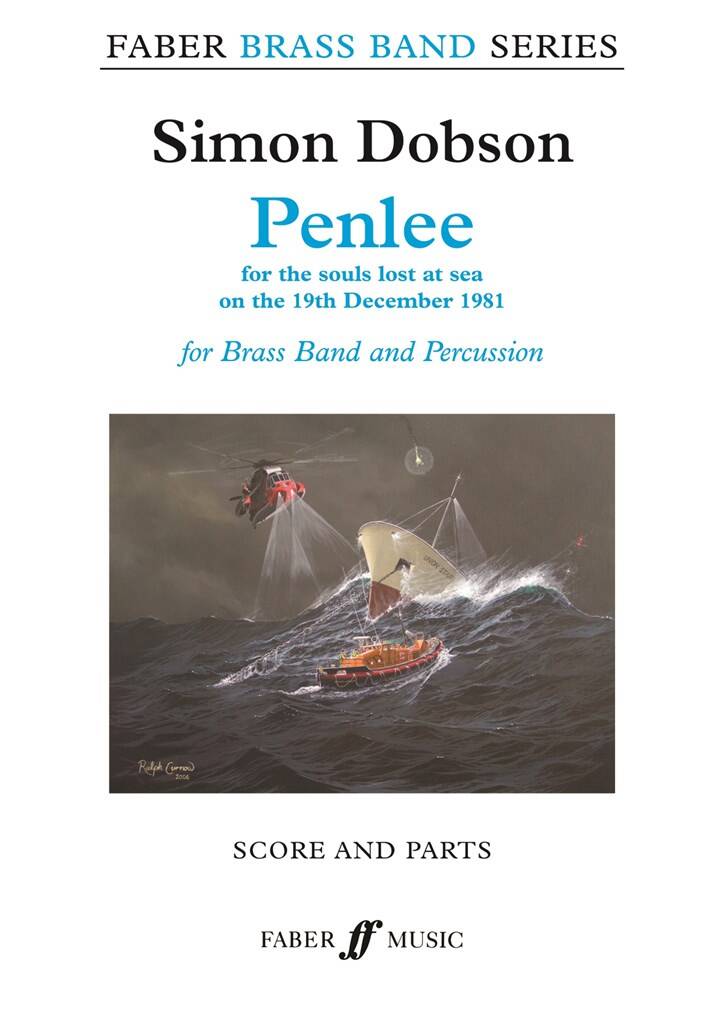
Penlee - Simon Dobson
To some, the tragic story of the Penlee lifeboat, Solomon Browne, would need no introduction, and to some the pain felt is still very much a reality. The composer, born just a few weeks before that fateful night on the19th December 1981, has created this work as a musical homage to the bravery of the souls who lost their lives and has dedicated it to their memory. Penlee was commissioned by the Cornwall Youth BrassBand using funds bequeathed by Michael Pickett. The first performance was given by the Cornish Youth Brass Band, conducted by Ian Porthouse, at St. Michael's Church, Newquay, on 30th December 2008.Penleehas been voted into the Classic FM Hall of Fame 2011 at No.106. Not only is it the first time a brass work has been featured in the Hall of Fame, but it was also thehighest new entry. The work has subsequently been recorded by the Leyland Band, conducted by Jason Katsikaris, on the CD entitled Penlee.Brass Band Grade 4: Advanced Youth and 3rd Section Duration: 13 minutes
Estimated dispatch 5-14 working days