
Results
-
 £33.09
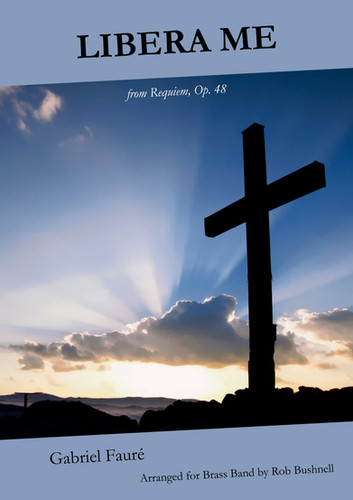
Libera Me from 'Requiem' (Brass Band) Faure arr. Rob Bushnell
Composed between 1887 and 1890, Gabriel Faure's Requiem is not only one of his best-known works but one of the most popular piece of choral music in the Classical repertoire, coming 23rd in the Classic FM's Hall of Fame 2024. Believed to be a tribute to his father (who died in 1885), Faure himself said "My Requiem wasn't written for anything - for pleasure, if I may call it that!" It started life as a five-movement work but was later expanded to be the final seven-movement work we know today. The first version (which Faure called "un petit Requiem") was first performed on 16 January 1888, with Faure conducting, a second version premiered on 21 January 1893 before the final version (reworked for full orchestra) was played on 12 July 1900; the Requiem was performed at the composer's own funeral in 1924.The Libera Me, or Deliver Me, was actually written in 1877 and is the sixth part of the Requiem.Faure once said of the work, "Everything I managed to entertain by way of religious illusion I put into my Requiem, which moreover is dominated from beginning to end by a very human feeling of faith in eternal rest." Upon interview, he also said, "It has been said that my Requiem does not express the fear of death and someone has called it a lullaby of death. But it is thus that I see death: as a happy deliverance, an aspiration towards happiness above, rather than as a painful experience. The music of Gounod has been criticised for its inclination towards human tenderness. But his nature predisposed him to feel this way: religious emotion took this form inside him. Is it not necessary to accept the artist's nature? As to my Requiem, perhaps I have also instinctively sought to escape from what is thought right and proper, after all the years of accompanying burial services on the organ! I know it all by heart. I wanted to write something different."This arrangement is for the British-style brass band, with alternative parts for horns in F and bass-clef lower brass. The tenor solo is featured on the euphonium. A recording of the original composition can be found here: www.youtube.com/watch?v=fXwFNoBHCf0 Duration: 4.20 minutes approx. Difficulty Level: 4th Section + PDF download includes parts and score. Sheet music available from www.brassband.co.uk Instrumentation: Soprano Cornet Eb Solo Cornet Bb Repiano Cornet Bb 2nd Cornet Bb 3rd Cornet Bb Flugel Horn Bb Solo Horn Eb 1st Horn Eb 2nd Horn Eb 1st Baritone Bb 2nd Baritone Bb 1st Trombone Bb 2nd Trombone Bb Bass Trombone Euphonium Bb Bass Eb Bass BbTimpani
In Stock: Estimated dispatch 1-3 working days
-
 £14.71
Finale from Symphony No.3 (Organ Symphony) (Brass Band) Additional Parts
Saint-Saens' magnificent Finale from Symphony No.3 (widely known as the 'Organ Symphony') has here been arranged for brass band with optional organ by Kevin Norbury. It was recorded by The International Staff Band on its CD Manuscripts, although this version has been revised in places. Saint-Saens decided to add the organ and piano to his 3rd symphony as a pragmatic orchestration innovation. The composition of this symphony was probably started in 1885 and a first draft was completed in Prague in 1886. Saint-Saens later recalled its eventful genesis: 'The Symphony in C was three-quarters sketched out when I found it impossible to write the finale. I did not know how to resolve this situation, until one night I suddenly woke up and, in a sort of hallucination, I heard the whole finale, which I hastily wrote down in outline, knowing that if I went back to sleep without having put anything on paper, I would have forgotten it all the next day.' The symphony was first performed under the composer's direction at Saint James's Hall in London on May 19, 1886. This arrangement by Kevin Norbury can both function as a stand-alone brass band piece, and be performed with an organ by omitting the notes found in square brackets in the parts and score. To view a rolling score video please visit www.youtube.com/watch?v=OlUd_FppBY8 PDF download includes additional parts as listed below. Full set including score available here. Sheet music available from: UK - www.brassband.co.uk USA - https://satradecentral.org Difficulty Level: 1st Section + Length: 8.30 mins. Alternative Parts included in this download: Solo Horn F 1st Horn F 2nd Horn F 1st Baritone B.C. 2nd Baritone B.C. 1st Trombone B.C. 2nd Trombone B.C. Euphonium B.C. Tuba 1 B.C. (Bass Eb equivalent) Tuba 2 B.C. (Bass Bb equivalent)
In Stock: Estimated dispatch 1-3 working days
-
£47.80
Finale from Symphony No.3 (Organ Symphony) (Brass Band) Saint-Saens arr. Norbury
Saint-Saens' magnificent Finale from Symphony No.3 (widely known as the 'Organ Symphony') has here been arranged for brass band with optional organ by Kevin Norbury. It was recorded by The International Staff Band on its CD Manuscripts, although this version has been revised in places. Saint-Saens decided to add the organ and piano to his 3rd symphony as a pragmatic orchestration innovation. The composition of this symphony was probably started in 1885 and a first draft was completed in Prague in 1886. Saint-Saens later recalled its eventful genesis: 'The Symphony in C was three-quarters sketched out when I found it impossible to write the finale. I did not know how to resolve this situation, until one night I suddenly woke up and, in a sort of hallucination, I heard the whole finale, which I hastily wrote down in outline, knowing that if I went back to sleep without having put anything on paper, I would have forgotten it all the next day.' The symphony was first performed under the composer's direction at Saint James's Hall in London on May 19, 1886. This arrangement by Kevin Norbury can both function as a stand-alone brass band piece, and be performed with an organ by omitting the notes found in square brackets in the parts and score. To view a rolling score video please visit www.youtube.com/watch?v=OlUd_FppBY8 PDF download includes score and parts. Additional parts (Horn in F and Baritone, Trombone, Euphonium & Tuba in Bass Clef) available here. Sheet music available from: UK - www.brassband.co.uk USA - https://satradecentral.org Difficulty Level: 1st Section + Length: 8.30 minutes Instrumentation: Soprano Cornet Eb Solo Cornet Bb Repiano Cornet Bb 2nd Cornet Bb 3rd Cornet Bb Flugel Horn Bb Solo Horn Eb 1st Horn Eb 2nd Horn Eb 1st Baritone Bb 2nd Baritone Bb 1st Trombone Bb 2nd Trombone Bb Bass Trombone Euphonium Bb Bass Eb Bass Bb Timpani Glockenspiel Percussion Organ (optional)
In Stock: Estimated dispatch 1-3 working days
-
£35.00
Devil's Duel - Peter Meechan
Devilas Duel takes its inspiration from the story of the infamous Niccolo Paganini whose virtuosity was astounding. He began playing the violin at age seven, and by the age of 13 had the reputation of being the leading Italian violinist of his time. People began to speculate about Paganinias great talent, and began to wonder about his gift. He became known as a aHexensohna or witchas brat.Paganinias demonic reputation became so widespread that his talent was often attributed to the belief that he had help from the devil. Later in life, Paganini would tour Europe, though rumours of supernatural guidance never ceased. He would give concerts, and often aduela with other virtuosi - awinninga by improvising during the contest (or concert!) by adding octaves, thirds, and sixths, and often playing more notes in a second than thought humanly possible.Devils Duel uses the famous music of Paganinias Caprice no.24 as its musical material, and sees the euphonium soloist duelling with various instruments in the band with displays of virtuosity in the fast music, and cunning in the slow.Devilas Duel was commissioned by David Thornton, to whom this is dedicated. The premiere was given by David Thornton, Nicholas Childs, and the Black Dyke Band at Leeds Town Hall, 26 May 2006.
Estimated dispatch 12-14 working days
-
 £40.00
Activate - Matthew Hall
ActivateTop to bottom in less than 2 minutes! Originally composed for Tredegar Town Band under the direction of Ian Porthouse, Activate is a fantastic way to start any programme in a concert or on the contest stage.The original conception of Activate occurred when Tredegar had 18 minutes of a 20 minute contest programme and couldn't find a piece to start the performance to fit in the time slot.With funky bass lines, percussion and melody lines as well as some devilish rhythmical elements in the inner parts, Activate is a sure fire way of getting the audience's feet tapping.The trombone solo in the middle section of the piece can be substituted on to any other Bb instrument should the need occur, and the piece can also be started with a drum kit rhythm rather than straight into the first bar.Activate
Estimated dispatch 5-7 working days
-
£40.00
Blaenwern - Matthew Hall
BlaenwernThe hymn tune Blaenwern (Love Divine) arranged for Brass Band by Matthew Hall for the Cymanfa Ganu (Singing Festival) at the National Eisteddfod of Wales in Ebbw Vale, 2010.Score and Parts.Blaenwern
Estimated dispatch 5-7 working days
-
 £40.44
Allegro Spirito from Symphony No.2 (Brass Band) Borodin arr. Harold Burgmayer
Alexander Borodin's Second Symphony in B minor dates from the years 1869-76, a time when he was also working on his enduring opera Prince Igor. Flavors of the exotic and outdoor celebration seemed to have spilled over from the opera in this brilliant sonata movement. Borodin seldom quotes Russian folk tunes, but his graceful melodic lines are permeated with the spirit of his native song, supported by iridescent harmonies and bright colors. This arrangement for brass band was premiered by The Salvation Army's New York Staff Band, with Ronald Waiksnoris conducting, at Alice Tully Hall in New York City on 11 April 2001. This complete transcription of the Finale movement of Borodin's Second Symphony has an approximate duration of 6.40 minutes. To alternatively utilize the piece as an opener, a cut from bar 173 to 272 is indicated with Coda signs, reducing the piece to 4.30 seconds. To view a rolling score video of the work please visit www.youtube.com/watch?v=x4SqSXLopRo Difficulty Level: 2nd Section + PDF download includes parts and score. Sheet music available at www.brassband.co.uk (UK) or https://satradecentral.org (USA) Instrumentation: Soprano Cornet Eb Solo Cornet Bb Repiano Cornet Bb 2nd Cornet Bb 3rd Cornet Bb Flugel Horn Bb Solo Horn Eb 1st Horn Eb 2nd Horn Eb 1st Baritone Bb 2nd Baritone Bb 1st Trombone Bb 2nd Trombone Bb Bass Trombone Euphonium Bb Bass Eb Bass Bb Timpani Percussion 1-3
In Stock: Estimated dispatch 1-3 working days
-
£40.00
Kiwi Dragon - Matthew Hall
'Kiwi Dragon' was commissioned by Byron 'Buzz' Newton for his Master's final performance recital at The Royal Welsh College of Music & Drama in 2012, a recital in which he was awarded an unprecedented 100%. Buzz travelled to Cardiff, Wales for his Master's degree course and became a member of Tredegar Town Band during his studies. 'Kiwi Dragon's' inception came from an initial conversation with the soloist where the thought of combining traditional Welsh folk music with that of Buzz's native New Zealand folk songs to create a virtuosic finishing piece for the recital was conceived. Originally scored for solo euphonium, 10-piece brass and percussion, 'Kiwi Dragon' includes the traditional New Zealand folk melodies Pokare Ana and Tarakihi and the Welsh folk melody Myfanwy, combined with the national anthems of both New Zealand and Wales in the pieces' culmination.
Estimated dispatch 5-7 working days
-
£40.00
Dial M for Midnight - Matthew Hall
Dial M for Midnight is a jazz-based solo for aspiring and accomplished cornet players alike. Technically not particularly demanding yet quite complicated rhythmically, Dial M allows players young and old to stand up and show off their skills in a work which has it's roots in Latin America but travels through the late night smoke-filled jazz clubs along the way. Commissioned by Jim Hayes for his debut CD recording, Dial M is the title track. Nicknamed Jimmy Midnight, Jim Hayes has established himself as one of the leading cornet players in the world playing within the Scottish Co-Op Band. Dial M is a take on Jim's persona and his love of jazz, the culmination of which ends up as a witty pastiche signature track of all things James Bond to Perry Mason.
Estimated dispatch 5-7 working days
-
£48.00
Spanning Revolutions - Matthew Hall
Spanning RevolutionsSpanning Revolutions was commissioned by The Ironbridge Gorge Brass Band Festival in celebration of the 25th Anniversary of the Ironbridge Gorge being made a UNESCO World Heritage Site.The premiere performance was given at the Festival in 2011, based at the Museum of Iron, Coalbrookdale, Shropshire, performed by the combined bands of Tongwynlais Temperance and Wellington (Telford) under the direction of the composer.The Ironbridge Gorge is seen as the birthplace of the Industrial Revolution; the section between G and I is a representation of a steam engine starting up.Spanning Revolutions
Estimated dispatch 5-7 working days
 View Music